There’s a word in the Dano-Norwegian language used by 19th century Norwegian priests that sounds just as ugly as it does in English: uægte. It means “illegitimate”. And if you scroll through as many old Norwegian church records as I do, you’ll notice how often it comes up. In the old record books, whether a child was born to a married couple (ægte) or an unmarried couple (uægte) was deemed important enough to warrant a separate column on the page.
Today in the United States, almost no one cares whether a child’s parents are married or not. Every day in the U.S., roughly 10,000 children are born, 40% of whom are born to unmarried couples. In the minute it has taken you to read these last two paragraphs, roughly three American children were born “out of wedlock”.
There may still be some legitimate reasons to care about “legitimacy” (e.g., it can sometimes signify things about the stability of a child’s home life), but the moral stigma of being an unwed parent – particularly harmful for unwed mothers – is largely absent today. This was not the case a century ago in Wisconsin when my paternal grandpa, Bob Rude (1925-2009), was born. The story of who fathered him and the circumstances surrounding that – these things were simply not spoken of.
But in the late 1980s, as my great-grandpa John Rude was approaching 90 and starting to get his affairs in order, it came to light that my Grandpa Bob had never been formally adopted in 1930 when his parents married. They rectified this at the courthouse and officially changed my grandpa’s last name from Helgestad (his mother’s maiden name) to Rude (the name he had used for almost all of his life).
For a brief moment, this taboo subject was spoken of by members of the family, albeit in hushed tones. We knew that Grandpa Bob’s biological father’s name was J. Oscar Veum. We knew that this J. Oscar Veum had worked at the Highway Trailer Company for a number of years. We knew that he’d died of a heart attack at age 49. But we knew nothing else. What was the nature of his relationship to my great-grandmother? Was she taken advantage of? Did he deny paternity? Anyone who could have answered those questions was long gone.
Over the past decade or so, I’ve done research into the questions that could be answered: Who was J. Oscar Veum? Who was his family? And where were they from? Through newspaper articles, church and Census records in Norway and Wisconsin, and limited exchanges with biological relatives, I’ve managed to piece together some rough biographical notes on J. Oscar Veum and his family.
Johan “Oscar” Veum was born on April 5, 1893 in Edgerton, Wisconsin – the fourth of seven children born to Bertha Thorpe (1864-1937) and Erik Ingebretsen Veum (1864-1942). The Veums worked in tobacco on a farm in Christiana township not far from where my great-grandma Borghild Helgestad’s family lived in Busseyville (north of Lake Koshkonong in Wisconsin). The Veums attended the same church as the Helgestads – the East Koshkonong Lutheran Church – and the families would have been familiar with one another.
Oscar’s parents, Erik and Bertha, married in Norway in 1885 and immigrated to Wisconsin the next year. In the photo below, Erik (at right) is overseeing work in one of his tobacco fields. The East Koshkonong Lutheran Church is in the background.

The March 7, 1919 issue of the Wisconsin Tobacco Reporter (precursor to the Edgerton Reporter) referred to the Veums as “prosperous farmers”, and one indicator of that properity is that their son, Oscar, was sent to the private Albion Academy for his schooling (articles from Dec 11, 1908 and March 5, 1909). Erik also travelled to Norway with two of his daughters in June of 1921 and sent dispatches back to the paper about their trip.
According to a Veum family member I’ve been in touch with, Oscar served in the Navy during the First World War. That family member sent me the two photos below.
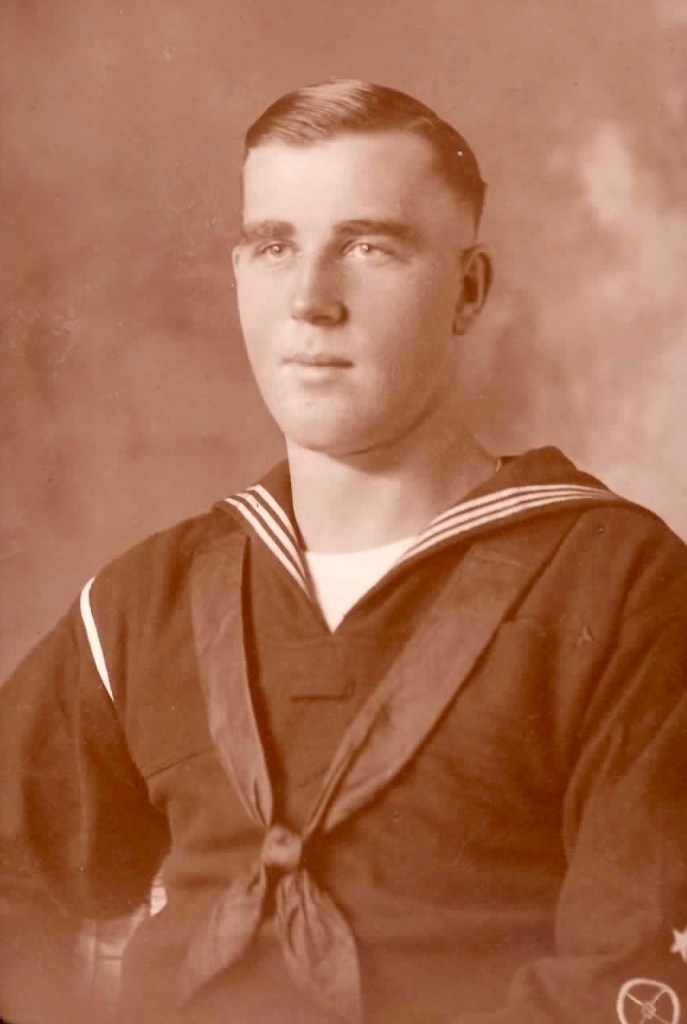
Two years after my Grandpa Bob was born, Oscar married Edna Wolf.

I have yet to make contact with any of Oscar and Edna’s direct descendants.
I have sometimes wondered what Ole and Klara Rude thought about their son John marrying a woman with a five-year old son born out of wedlock. A little research into the Rude family has helped me realize that they were probably more understanding than most. It turns out that Klara had herself been an unwed mother. She gave birth to Anna in 1896, three years before she married Ole. In the church records from Ringsaker Parish, Anna is labeled “Uægte” and the father’s name is listed as Johan Andreasen (i.e., not Ole).
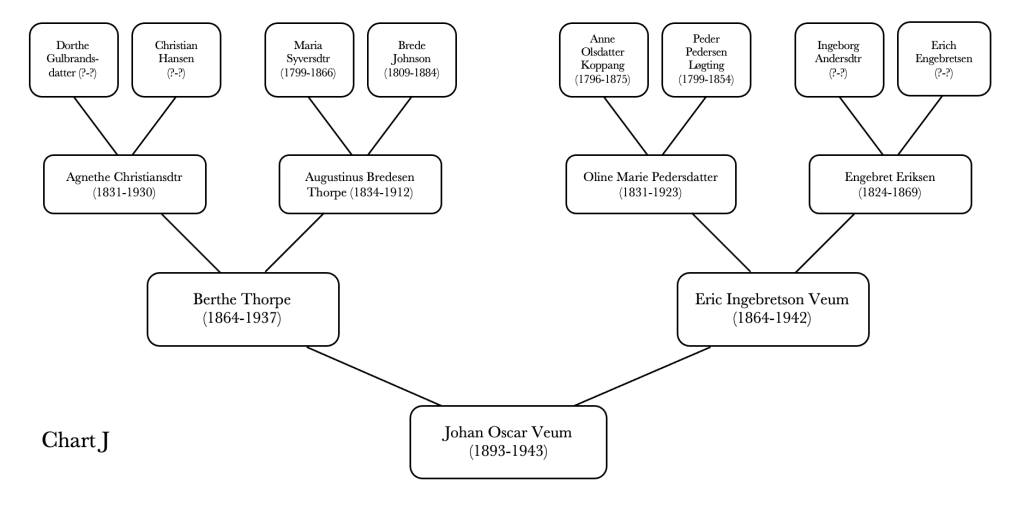
Coincidentally, the Veum family came from parishes that border Ringsaker and Veldre where the Rudes are from. Oscar’s father Erik Ingebretsen and his two brothers were born in Hamar in 1860s. The family moved to Nes Parish in the 1870s and Erik’s mother Oline Maria ran two farms there: Aarlien and Veum. She did so after the death of Erik’s father Engebret and with the help of a farmhand named Peder Hågensen, whom she married in 1881. During these years in Nes Parish, Erik must have met Berthe Thorpe, whose family lived on Helgøya, the large island in the middle of Lake Mjøsa. The couple married and left for Wisconsin in the mid-1880s.
I took a quick drive through Nes and found the Veum farm. I actually spoke to the current owner, and once I explained the connection she invited me into her home. Together we flipped through the local bygdebok (farm history) and found the relevant names. She also very kindly gave me directions to the other family farm, Aarlien.

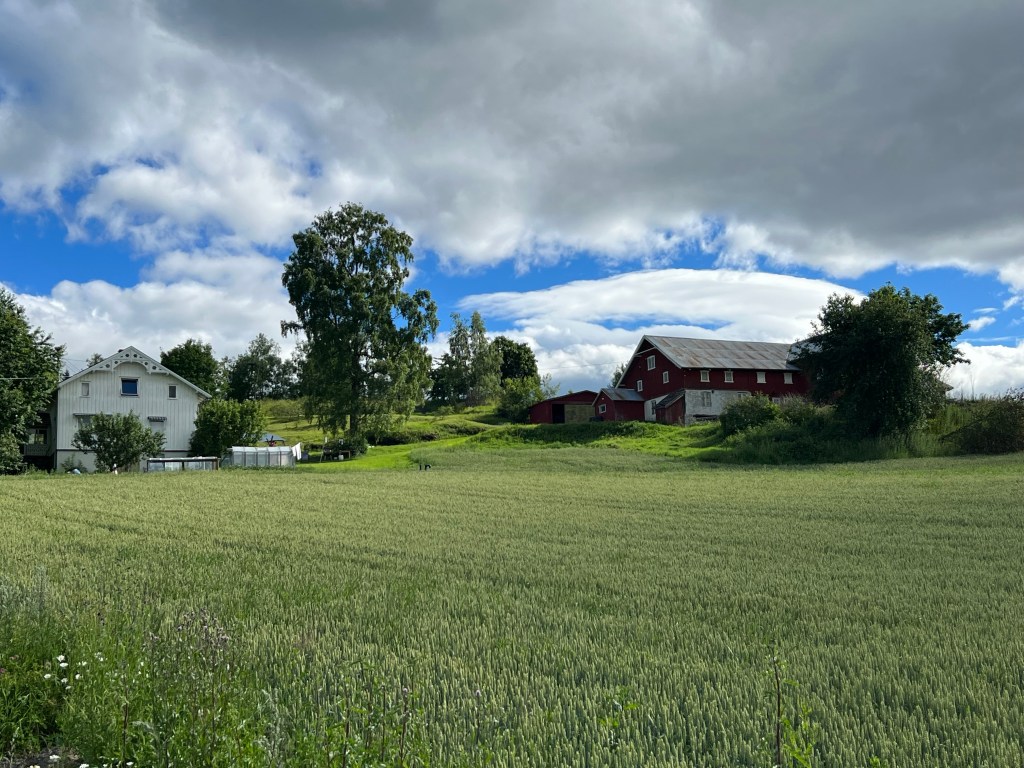
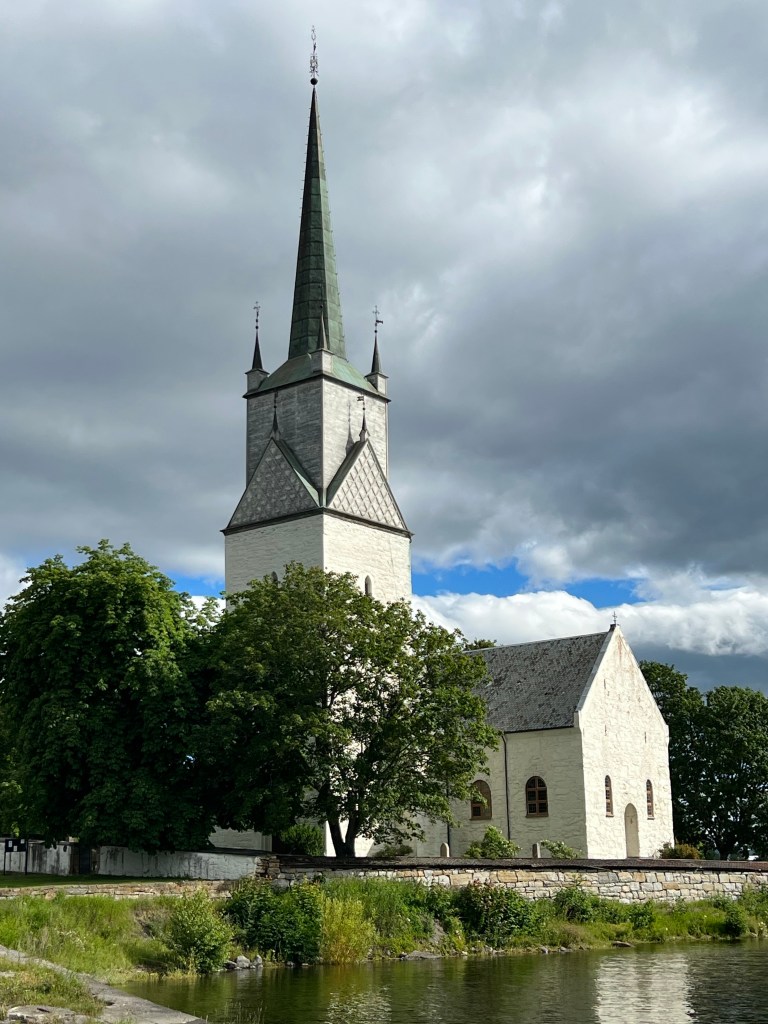
Erik Veum’s wife Bertha Thorp was from a farm on Helgøya. I didn’t visit Helgøya, but I did drive down to the tip of Nes and take a look across the channel. It’s a beautiful, peaceful spot with barely any sounds but seagulls. Nes Church, consecrated in 1250, is located there in Tingnes, and that’s where Erik and Bertha married multiple family members married. [Correction made Apr 18, 2025]
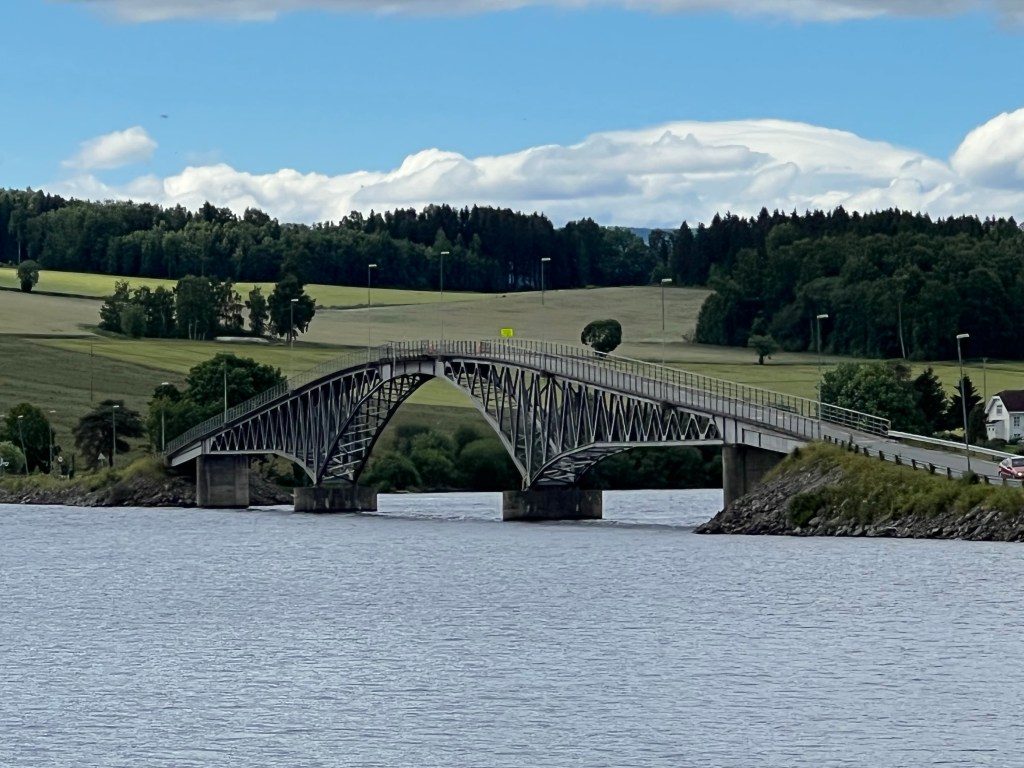
I provide these details for any of the descendants of my Grandpa Bob who may be curious — as I was curious. But I want to be clear about my view on these matters: this may be “family history” but it isn’t my family history. Family isn’t biology; family is who you love and who loves you in return. Sometimes you hear people say “blood is thicker than water”. I disagree. For me, family is who I choose to have as part of my life, and DNA doesn’t have anything to do with that.
But I don’t shy away from discussing my grandpa’s paternity because (a) there’s nothing to be ashamed of, and (b) the generation that worked hard to keep this information locked away is now gone. A wise man once told me, “we’re only as sick as our secrets” and my life has shown me the truth of these words time and time again.
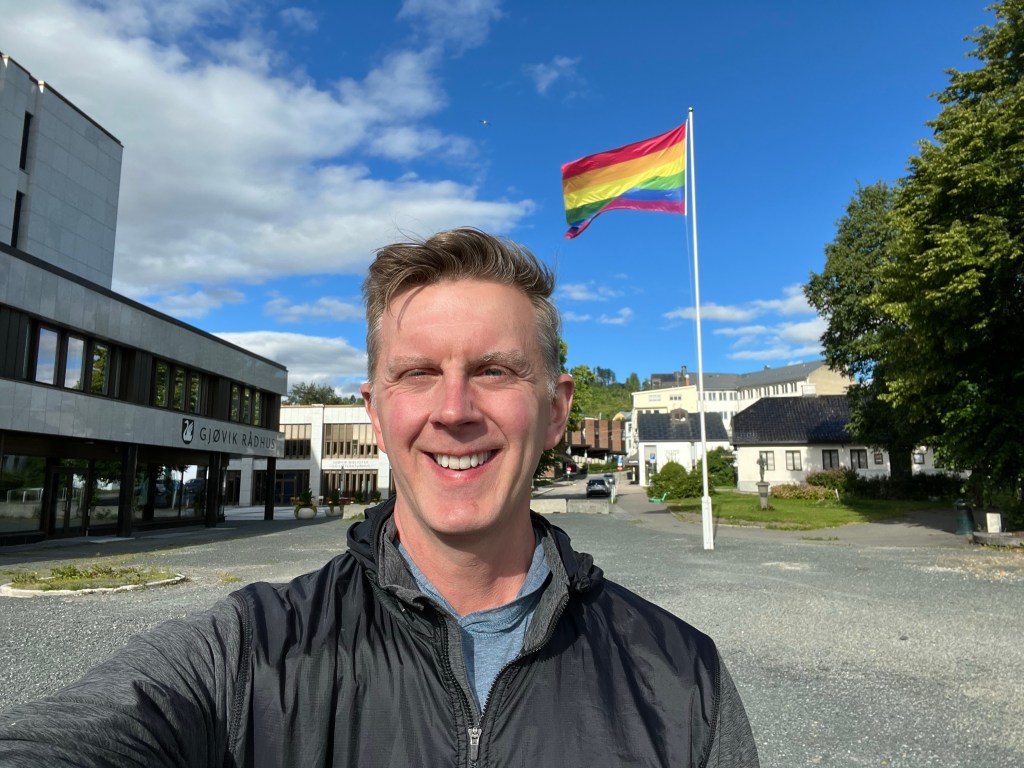
One of the most encouraging sights I saw during my time in Gjøvik was the symbol of one of my chosen families, the flag of the LGBT community, flying proudly in the plaza next to the town hall. It flew directly across from my hotel window and reminded me that we all belong to multiple families. The common denominator of all of our families is love.


Leave a comment