
I’ve spent the day visiting the villages where my great-grandpa Frank Smith’s family originated in northeastern Germany.
I have fond early memories of my maternal grandpa’s mother, Elvina Anderson Smith (1899-1983) but I never knew my grandpa’s father, Frank Smith (1895-1954). My mom has only a couple fuzzy memories of him. But I love that one of the few things she does remember is Grandpa Frank taking her and her brother Glenn fishing on the Rock River in Fort Atkinson, Wisconsin. Frank loved to fish.

Frank was born as Franz Johannes Karl Schmidt on March 17, 1895 in Aztalan – a very small town east of Lake Mills in Jefferson County, Wisconsin. Frank’s parents were Augusta Hahn and William Schmidt, who had met, married and had their first child in Prussia before immigrating to Wisconsin.
Frank was William and Augusta’s sixth child, after Emilge or “Amelia” (1882), Anna (1884), Arthur (1885), Ida (1889) and William (1893). And following Frank there was one more child, John (1897). So, like his wife Elvina, Frank was born in the United States but his childhood was heavily influenced by his parents’ recent immigration experience.
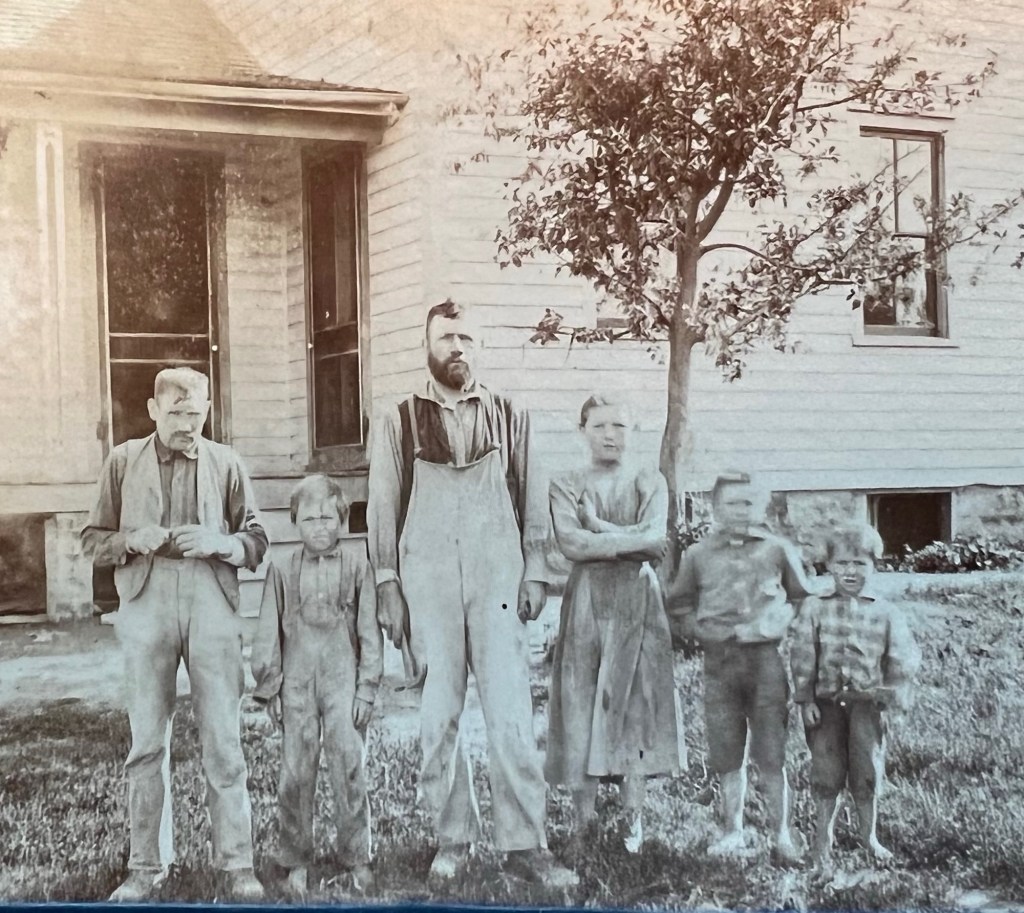
(Photo courtesy of Dianne Hrobsky, granddaughter of William Schmidt Jr.)
Frank’s parents both originated from villages near the city of Stettin in the Prussian province of Pommern (Pomerania). Pomerania has a complicated history, and it is likely that our family’s ancestry reflects this complexity. Prior to Treaty of Westphalia in 1648, the area where Frank’s family came from was part of the Duchy of Pomerania, a vassal state of the Holy Roman Empire. For 150 years, the region was bitterly contested by Prussia-Brandenburg and Sweden, it became a site of intensive German colonization efforts (Ostsiedlung), and like many parts of Europe it experienced the horrors of the Nazis’ “ethnic cleansing” campaigns. With the conclusion of World War II, Pomerania was divided between Allied-occupied Germany and Poland, and Stettin became the Polish city of Szczecin. After 1949 the villages where our ancestors came from were part of the German Democratic Republic (i.e., East Germany, the “DDR”) until the fall of the Berlin Wall in 1989.
Given the region’s tumultuous history and fragmentary records, it’s tough to trace the family’s origins much further back than Frank’s grandparents.
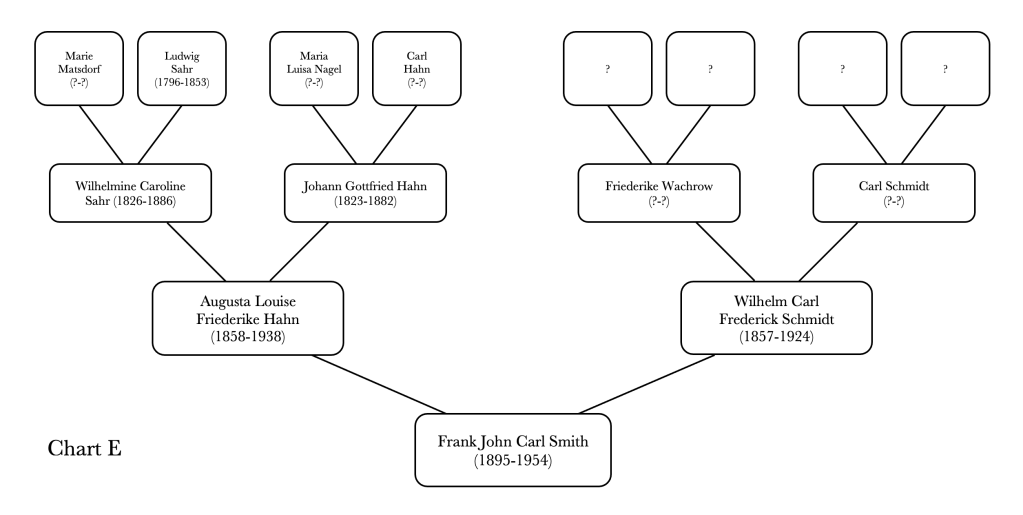
Frank’s father William was born as Wilhelm Carl Friedrich Schmidt on April 12, 1857 in a small village called Müggenburg (near Torgelow, northwest of Stettin) in what is now the district of Vorpommern-Greifswald in the state of Mecklenburg-Vorpommern, Germany. At the time of Wilhelm’s birth, Müggenburg was located in Pomerania’s Kreis Ueckermünde. Wilhelm’s parents were Friederike Wackrow and Carl Schmidt. When Wilhelm was born, his father Carl worked as an Arbeitsmann (laborer), and it is possible that he was employed by one of the many industries in the area. The region was especially known for brickmaking.

In his youth, Wilhelm received a religious education from the state church in Pomerania (Evangelische Landeskirche), he apprenticed as a mason, and he served in the Prussian army. We also know that he had at least one older brother, Carl (1854), who immigrated to Jefferson County, Wisconsin a couple of years after Wilhelm. How Wilhelm Schmidt and Augusta Hahn met is unknown. Both Wilhelm and his brother Carl were stonemasons by trade, and it seems possible that Wilhelm’s work could have taken him south to where the Hahns lived.
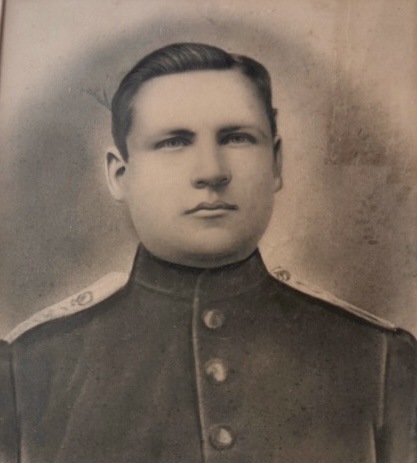
Augusta and Wilhelm married on March 19, 1882, just before their first child, Emilge, was born. The following spring the new family of three boarded the SS Strassburg out of Bremen and traveled to Baltimore, arriving on May 26, 1883. From there, they took the train to Wisconsin and joined Augusta’s siblings who had settled on farms near Lake Mills and Watertown. Augusta’s older brother Carl L.W. Hahn, his wife Gustine and their three oldest children Carl, Herman and Albertine had taken the Strassburg to Baltimore the prior October, so they probably gave Augusta and Wilhelm some instructions on how to do it.
* * *
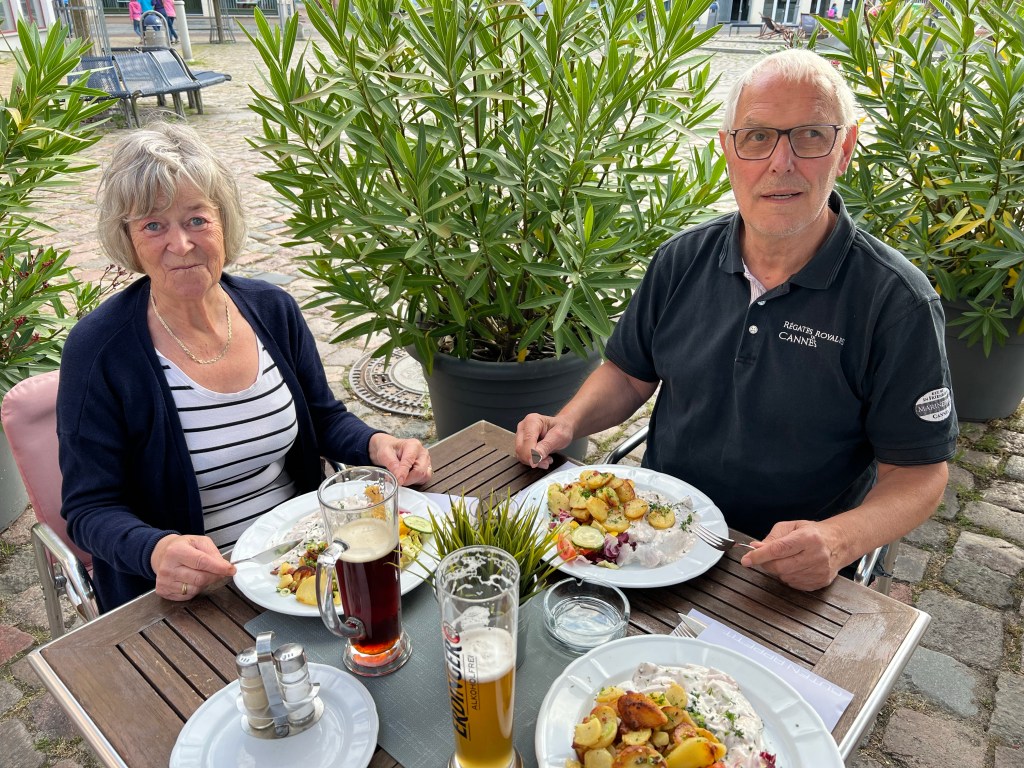
Before I share some of the photos of the Schmidts’ hometown in Germany, I’d like to give you some insight into how the genealogical sausage was made. Much of the documentary evidence that I have for Frank’s parents’ origins in Germany comes from one person — a kindly local historian named Hartmut Wegner, who lives in Mönkebude with his wife Helga.
I first contacted Hartmut in May of 2021 after a volunteer genealogy group in Germany referred me to him. I had the names, birthdates and approximate birth locations of both of my great-great grandparents — William and Augusta (Hahn) Schmidt — but I had no documents from Germany that confirmed this information. There was nothing available online; I had tried everything.
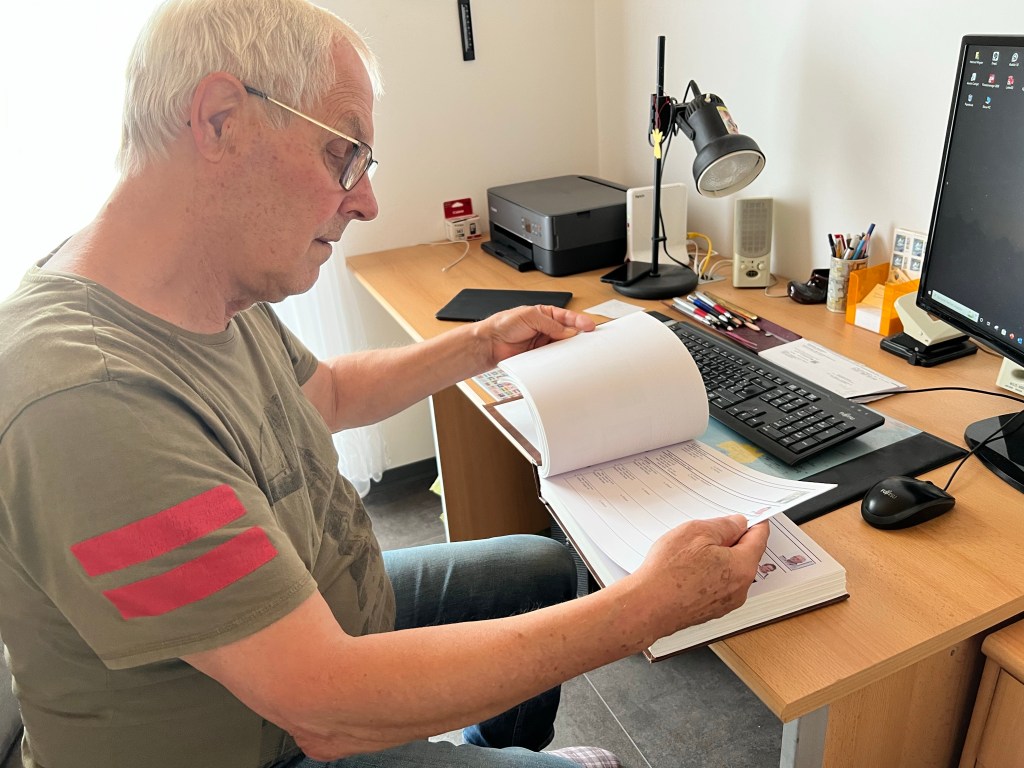
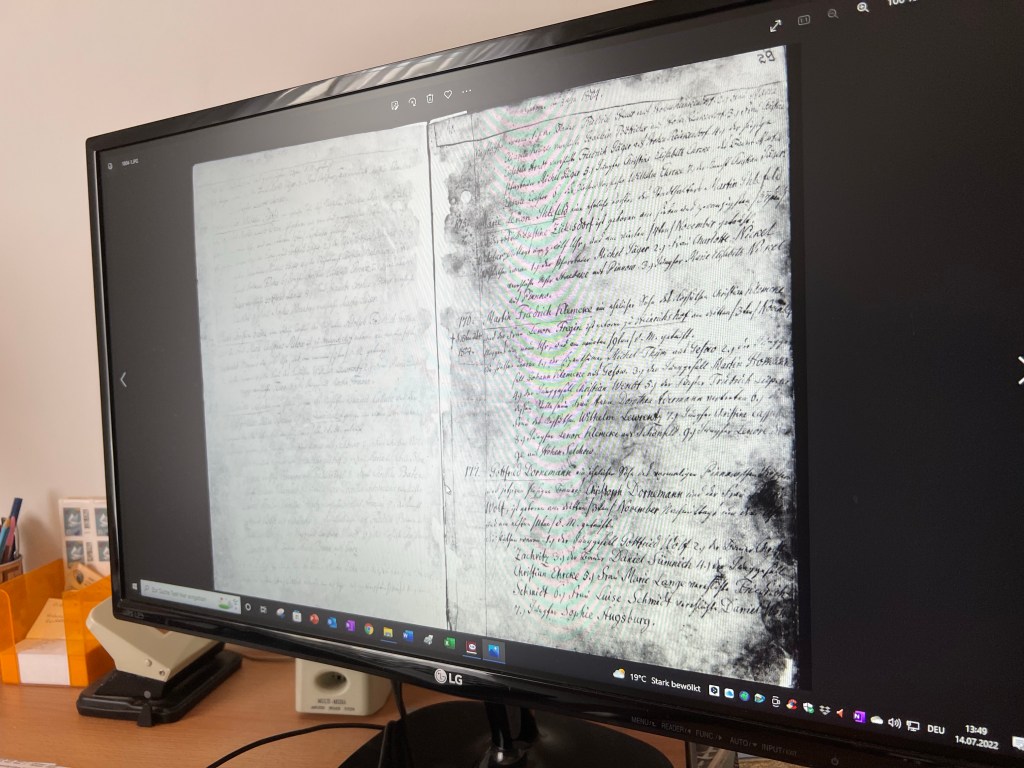
Hartmut took on my case. To my great surprise, he tracked down both the Schmidts and the Hahns in the church record books. He did so by using a digital archives of his own creation. Over the past few years, Hartmut has been traveling to local archives in Vorpommern and northwest Poland to personally digitize thousands of records — records that do not exist anywhere online.
Who is this guy? I wondered. What kind of person does this? I had to come to Germany to find out.

It turns out that Hartmut’s local history work goes far beyond what I’d realized. Since retiring from teaching, he has written several books on the history of the area, its schools, churches, and military dead. He has built family trees for friends, colleagues and even perfect strangers like me. His own family history is a massive tome.
* * *
I knew from an obituary that my great-grandpa Frank Smith’s father Wilhelm Schmidt came from Müggenburg. And thanks to help from Hartmut, I knew which Müggenburg to visit — there are several in Germany and two of them in this part of Pomerania.
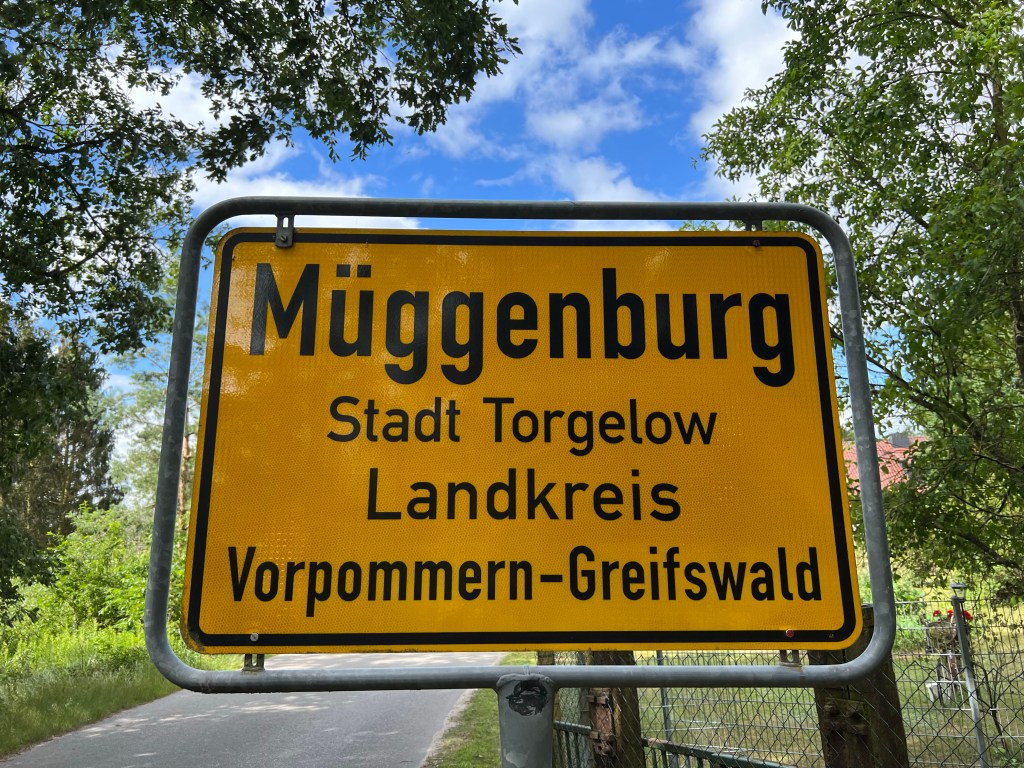

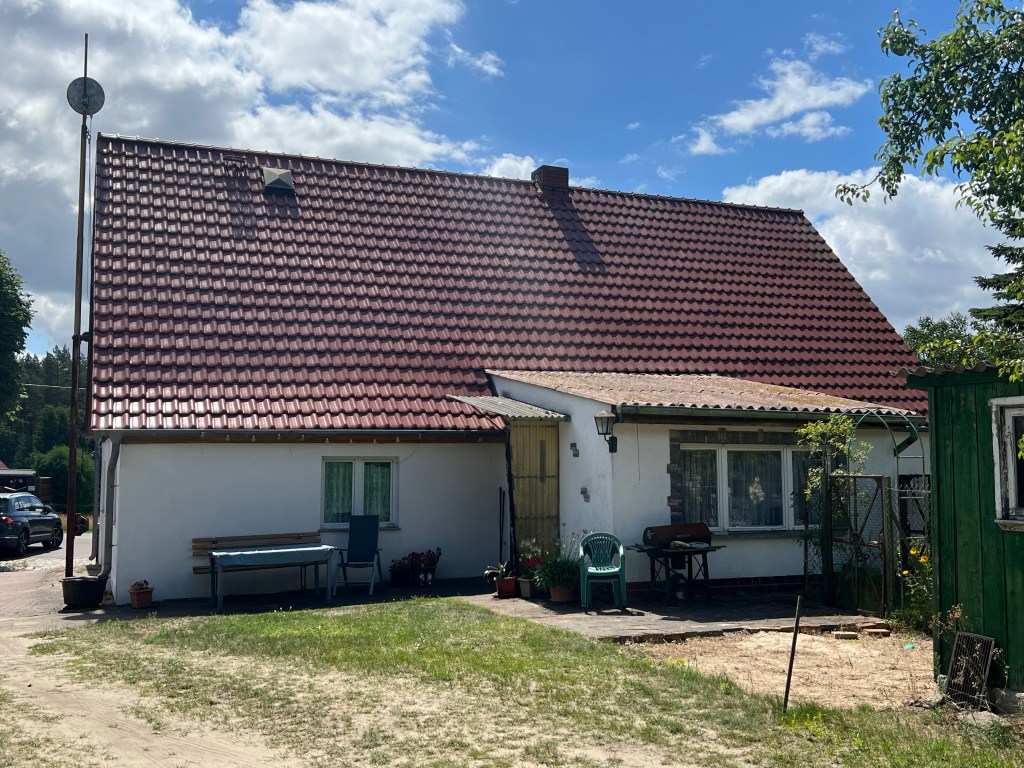
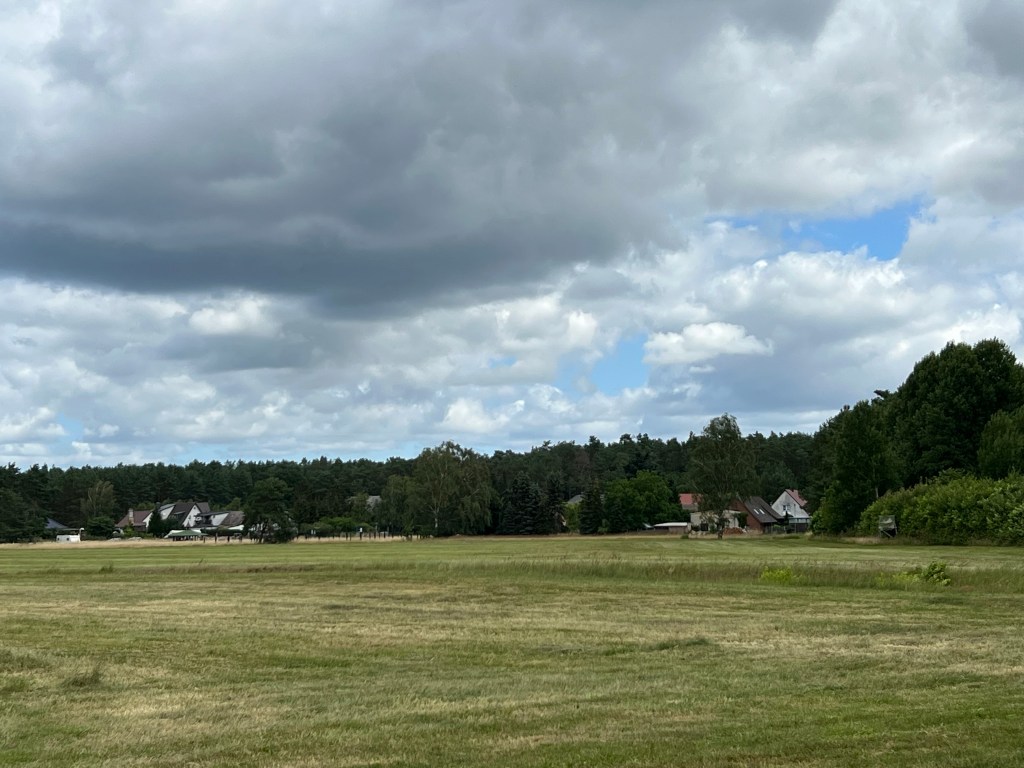
The village lies where a tiny road dead-ends in a forest clearing. There are no more than 10 houses. A couple of guys were chatting outside one of the houses, and I explained in a laughable mixture of German and English what I was up to and who my family was. They recognized one of the names I mentioned — Wackrow — and one of them said, “Follow me in your car. I’ll take you there.” Or at least, I imagine that’s what he said in German. And so off we went. We drove through the woods about a half a mile, and then he pointed toward a house next to a huge yard full of scrapped cars. With that, the guy waved and drove back to his own house.
There are no Schmidts in Müggenburg these days, but the local auto scrapyard is owned by Bernd Wackrow. Wackrow was the maiden name of my 3x great-grandmother Friederike Schmidt (Wilhelm’s mother). So naturally I knocked on the door and said “Guten tag”!
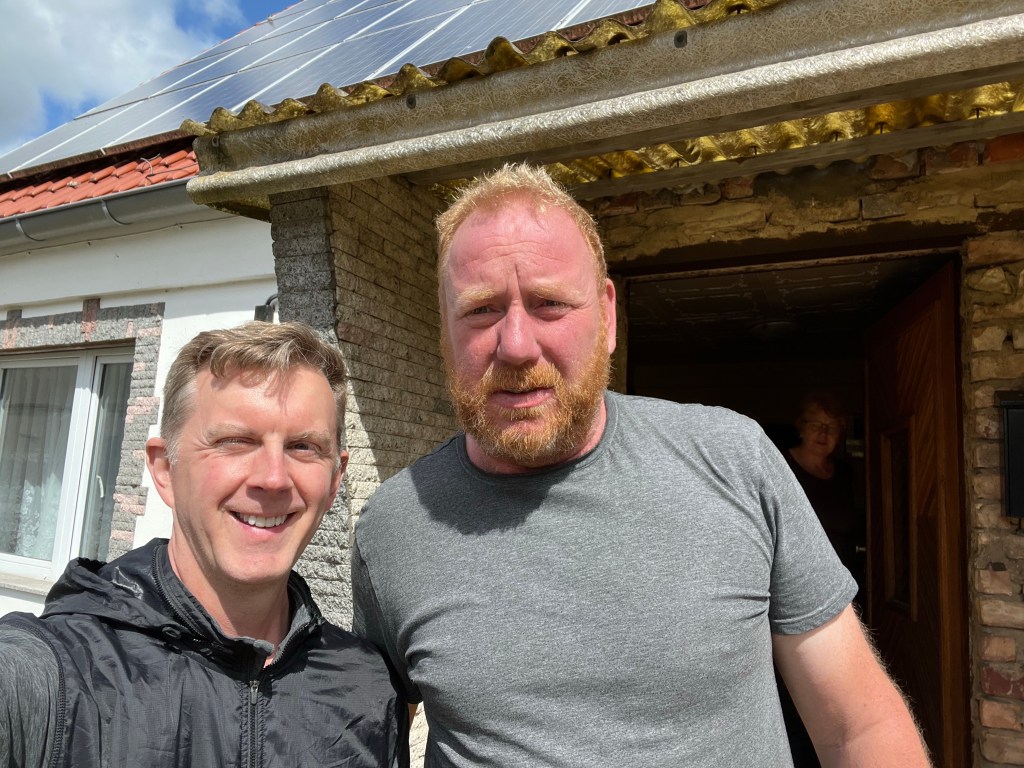
It’s uncertain if Bernd and I are actually distant cousins, but I’d say the chances are good considering how small the village is. He even reminded me a little of an uncle of mine on my mom’s side.
Regardless of whether there is a real connection or not, Bernd thought there was — and so did I. He invited me in for a coffee, and we attempted to communicate using Google Translate. As I was heading out, I showed him a translated message on my phone that said, “It’s been so good to meet a family member from Germany.” To my surprise, his eyes welled up and he pulled me in for a giant bear hug.
Germany felt much “homier” from that moment on.


 Deep Roots
Leave a comment