

A few years before my grandma Barbara Jean (Kaufman) Rude died, I started asking her questions about her childhood, her parents, and what she could remember of her grandparents. Although my grandma’s mind was sharp, the details were murky when she spoke about her mother’s parents, John and Margaret Clark.
There are a few good reasons for the murkiness. First, Grandma’s mother Ruth left home and when she was only 17 or 18 and moved a hundred miles away – from the town of Adell in Sheboygan County, Wisconsin, south to Edgerton in Rock County, Wisconsin. This was a considerable distance in the 1910s. Ruth’s father John died just a few years later, in 1924. This was two years before my grandma was born, so she never got to meet him. Finally, I got the impression that Ruth didn’t get along well with her mother Margaret. In point of fact, even though my grandma was nine years old when Grandma Margaret died, she couldn’t remember meeting her. She could only remember her mother Ruth saying that Grandma Margaret was “nuttier than a fruitcake”.

It was little surprise then that when I asked my grandma about her great-grandparents – particularly her grandpa John Clark’s parents – she was at a complete loss.
I knew that John and Margaret Clark had moved to Adell from Highland, Wisconsin (in Iowa County), and that’s also where Margaret’s parents – the Muldowneys – had lived. But what about John’s family? Other than a few facts I could glean from John’s obituary, I had precious little to go on. Out of the blue, a distant relative on this side of the family sent me some details about John’s parents, information that had supposedly been provided to her by a genealogist. But the facts didn’t line up, and those red herrings threw me off the trail for quite some time.
Eventually, I reached out to the Wisconsin Historical Society in Madison, and a kind soul there helped me track down records that verified my great-great grandpa’s parentage: John Clark had been born to William and Mary Clark of Highland, Wisconsin.
But who were William and Mary Clark, and where did they come from?
Over the years I’ve had little luck in solving the mystery of William Clark (sometimes spelled Clarke). Every source document I’ve found lists his origins simply as “England.” There were dozens of William Clarks born in England around the year of his birth (1827) and several who immigrated to the U.S. in the year he was believed to have come over (1852). But the story of his wife Mary has become clearer with time and additional research. The notes below are a summary of what we know about the family of my great-great-great grandma, Mary Clark (maiden name Cock, later Cox).
* * *
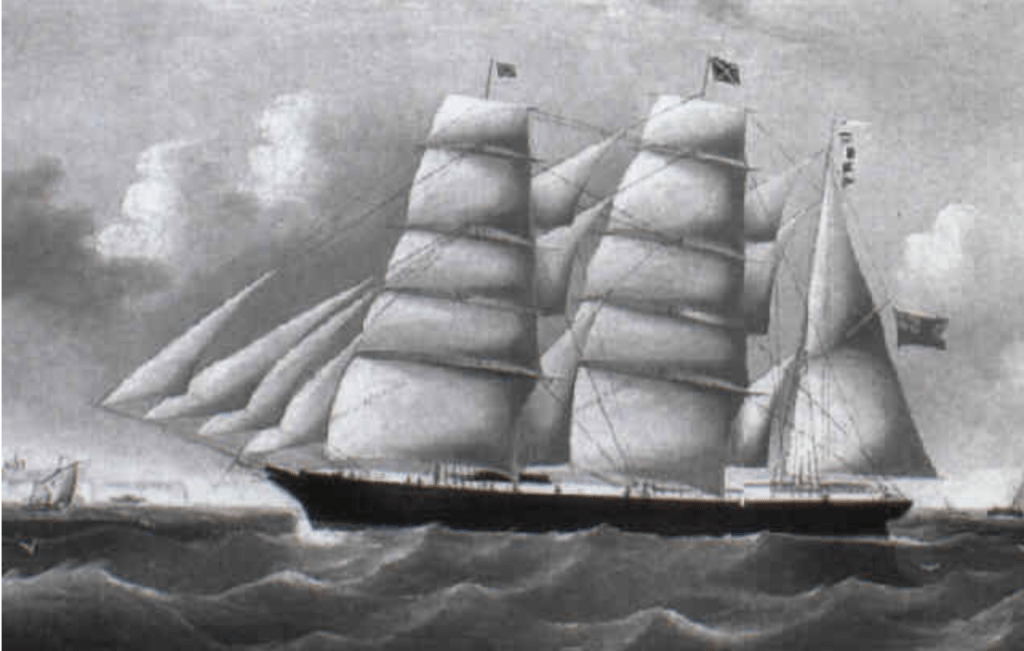
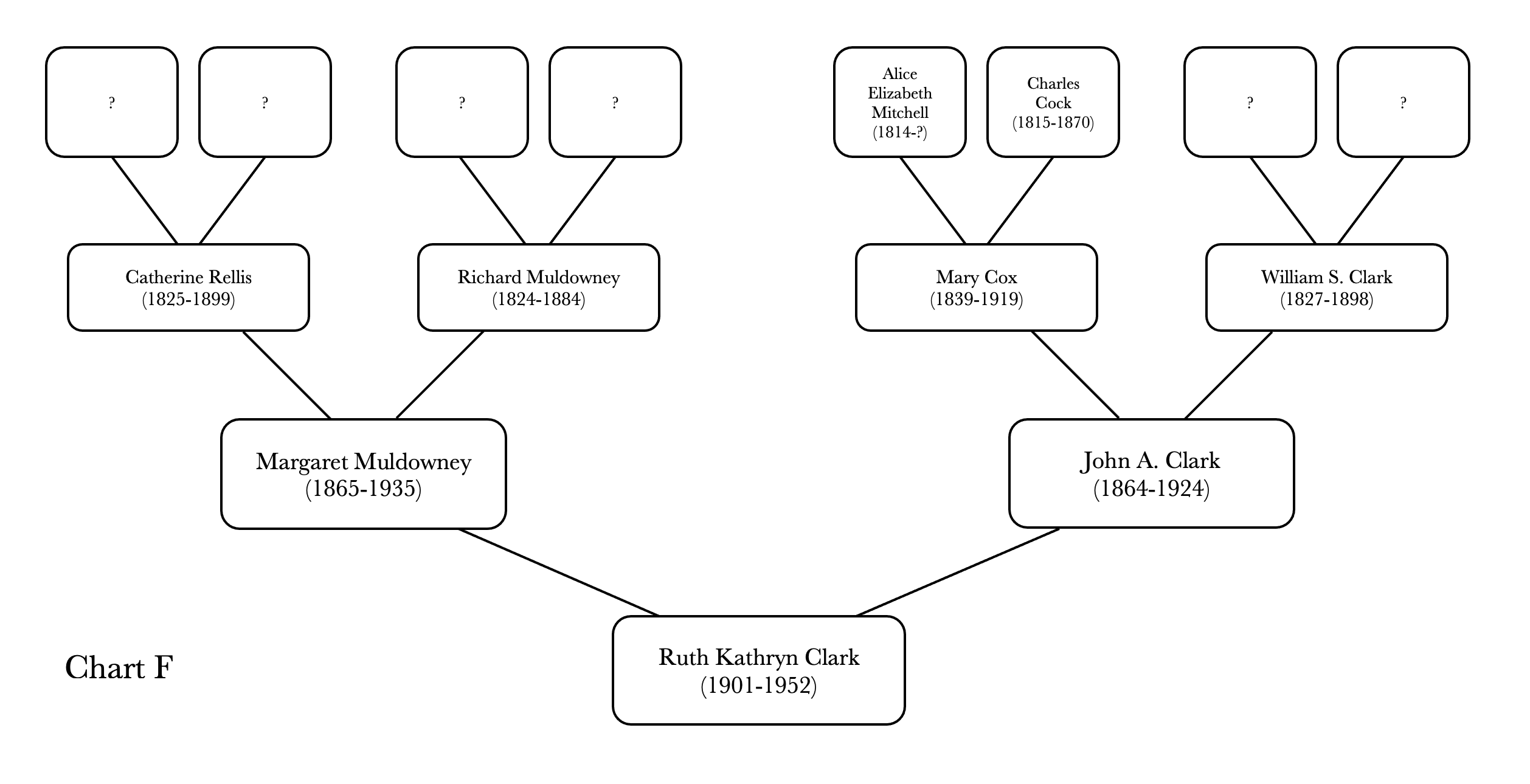
Mary Cock was still a young girl when she and her siblings, accompanied by female relatives, arrived from Penzance on the Barque Cornwall into New York Harbor. The day was August 23rd, 1849. Mary’s father, Charles Cock (born 1815), had been a copper miner in Cornwall, England. Like many of his Cornish compatriots, Charles was no doubt enticed by the prospects of mining in southwestern Wisconsin. Indeed, there had been a steady flow of Cornish miners into the area since the 1830s. Charles, his brother Francis, and his brother-in-law Oliver Honeychurch appear in Wisconsin’s 1850 Census but they are not listed on the 1849 ship manifest of the Barque Cornwall, so my best guess is that these three men arrived earlier to establish themselves in Wisconsin.
Eight years earlier, the 1841 Census in England lists the family as living in Lanyon within the parish of Gwinear – just to the southeast of St. Ives. Charles (age 25) and wife Alice (27) had three children at this time: William (3), Alice (2), and my great-great-great grandma, Mary (1). Also listed is Elizabeth Mitchell (67), Alice’s mother. Other family historians have researched branches of the Cock and Mitchell families back several generations. I cannot verify their research, but it would appear that these families have deep Cornish roots. (In this post, I write a little about what their life in Cornwall may have been like.)

Mary’s post-immigration life is somewhat easier to trace. We know she wed William Clark in Ridgeway, Wisconsin in 1854, when she would have been only 14 or 15. In the 1850s and at least through the early 1860s, the Clarks lived in the vicinity of Ridgeway, and William worked in a mill. But by 1870 the family was living in the town of Highland, Wisconsin, and they ran a small farm. They raised six children in those years (approximate birth years in parentheses): Mary Ann (1857), Charles W. (1860), Alice (1861), my great-great grandpa John (1864), Nellie (1868), and Emma (1870). In her later years, after William had passed away, Mary lived with one and then another of her younger daughters until her death in 1919. Her grave can be found just off Highway 14 in Mazomanie Cemetery.

What became of Mary’s parents, Charles and Alice Cock, has yet to be revealed. They seem to vanish from the historical record. For starters, it’s unclear whether Mary’s mother is listed on the Barque Cornwall manifest of 1849. There are two young women with the last name Cock who accompanied the children over – a Jane and a Betsey Cock. The ages and names don’t match, but perhaps one of these women is the same as “Alice” who appears in England’s 1841 Census? Adding to the confusion, the children’s mother is also absent from the 1850 Census in Wisconsin. That record shows the children living with their father Charles and a large number of family members on their father’s side: their father’s brother Francis, his sister Hannah Maria, Hannah Maria’s husband Oliver Honeychurch, and their Honeychurch cousins. (Hannah Maria and her daughters also appear on the Barque Cornwall manifest.)
Mary’s father Charles shows up on both the 1850 and 1860 censuses, although his surname changes from Cock to Cox. By 1870, however, he too disappears from the historical record; I have yet to locate a death certificate or a grave.
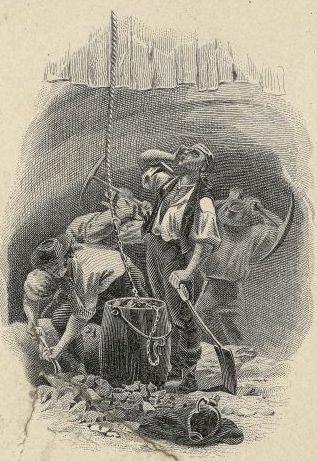
Of course, this is the nature of mining for genealogical ore. You can spend a lot of time digging in one direction and come up with nothing. Then suddenly a new nugget of knowledge is unearthed – often in the unlikeliest of places – which provides clues to further discoveries. The Clarks’ story remains buried, but I hold out hope that one day I’ll find the mother lode.


 Deep Roots
Leave a reply to Brea Sanders Cancel reply