

My family left the Midwest and moved to Virginia when I was 13. At the time, I remember feeling like Virginia was another country. Its mountains, its speech patterns, its ties to a Confederate past – we were strangers in a strange land. But as we drove into the state after a stop in Washington D.C., my maternal grandma – wedged between my brother and me in the back of the car – reminded us that her side of the family had longstanding connections to the state. Her father’s maternal grandfather, William Wells, had died in Virginia serving the Union in the Civil War and was buried here.
In her sweet but persistent way, Grandma Phyllis suggested a field trip to find his grave. Maps were consulted (as this was in the days before GPS) and we made our way to Poplar Grove National Cemetery outside of Petersburg.
Five years later, I would be an undergraduate at the College of William and Mary, and I would pass this cemetery and its surrounding battlefields many times going back and forth between home and school. But I never stopped there again. The Civil War seemed so long ago, and as a young man I was more interested in a shiny future than a dusty past. My college, located beside the open-air museum of Colonial Williamsburg, felt all too rooted in yesteryear. I often rolled my eyes at Colonial Williamsburg’s employees, the “reenactors” who wandered Duke of Gloucester Street in their 18th century costumes, trying to engage passersby about the high price of candlesticks or whatnot.
But time and age have a way of changing us. As I approach my own half-century mark, I’ve begun to realize that “objects in mirror are closer than they appear”.

The distance between the end of the Civil War and the end of the Second World War is just 80 short years. Likewise, there’s a little less than 80 years between the end of WWII and today. In the span of a few generations, the United States has transformed from a backwards and largely agrarian post-colonial experiment – one at the brink of tearing itself apart over slavery – to a mighty postindustrial superpower (albeit still in danger of tearing itself apart). We can only imagine what the next 160 years will bring.
All of this is just to say that, as I’ve aged, I’ve gotten more curious about how Grandpa Wells ended up in that Civil War cemetery.
Fortunately, as I’ve mentioned in a prior post, I stand on the shoulders of others. In the 1980s, my grandma’s sister Helen conducted careful research into William Wells’s origins in England and his enlistment in the Union Army. The summary below is based on her work as well as some digging of my own:
In the early 1840s, William Wells and his bride Maria Butler were leatherworkers from Worcester in the West Midlands of England. They married in March of 1845 and, as far as I can tell, they almost immediately hopped a ship from Liverpool to New York. At the time of the 1850 U.S. Census, we find the couple – still without property or children – living with a farming family by the name of Stephenson in Dane County, Wisconsin. Had they headed straight for Wisconsin or did they live elsewhere for a while? Why Wisconsin? Did the Stephensons sponsor them? We have almost no information on the young Wellses, but it would appear that at this point, as Aunt Helen summarized in her genealogy, they “were not yet established in America”.1
The next decennial census and the 1860 county agricultural report paint a dramatically different picture: William and Maria now have four young children, 120 acres of land (12 of which is being actively farmed), and a good amount of wheat, corn, oats, potatoes and livestock. Their seven milk cows are producing $500 worth of butter per year. It would appear they were living the American Dream.
Aunt Helen again poses the pertinent commentary:
“We can only guess why on the 23rd of May 1864, 43 year old William Wells enlisted as a private in the 37th regiment of Wisconsin Volunteers leaving behind a farm, wife and five young children, the youngest only three and five years old. It is probable it was patriotism towards his new country or either the possibility of a draft of men under the age of 45 years or the enticement of the city of Madison offering an extra bounty over and above that of the federal government to men who enlisted in the Civil War.22
Whatever reasons William may have had for joining the Union Army, we can be sure of one thing: he could not have fully grasped what horrors awaited him.
Before I describe William’s brief and hellish military career, I need to set the scene. Throughout the 1850s, northern and southern states argued over the power of federal authority (especially the authority to regulate slavery) and the terms under which new states in the West would be admitted to the Union (e.g., as slave-holding or free states). Abraham Lincoln’s election in 1860 – with exactly zero Electoral College votes from the southern states – signaled to the South that they could no longer win this contest politically. Thus, seven states seceded and formed a new government in early 1861. Four other states later joined them. Neither side wanted war and neither could foresee the scale of the destruction to come. But what ensued was a series of the bloodiest battles that the world had experienced up to that point – battles whose names many of us know, even if we’ve forgotten the details from our high school history classes: Gettysburg, Chickamauga, Antietam, Shiloh…
One reason the Civil War was so deadly – and why it is sometimes called the first modern war – is the development of military technology in the form of long-range and quick loading rifles. Weaponry and tactics that we often associate with the First World War (e.g., repeater rifles, hand grenades, trench warfare) had their debut in the Civil War.4
By early 1864, as William Wells was undoubtedly debating whether to enlist, Lincoln was getting desperate. The war had dragged on for three excruciating years, resulting in the deaths of hundreds of thousands of Americans. And while the North outnumbered the South and had more resources at its disposal, the Confederates had outmaneuvered the Union Army on multiple occasions and continued to maintain their supply lines. Adding to these pressures was the fact that Lincoln was up for re-election. If he didn’t stitch the Union back together soon, one of his rivals would be in power and might opt for a completely different path. He called for fresh recruits.

The 37th Wisconsin Infantry regiment was part of this final, desperate push to end the war and reunite the states. Under the command of Colonel Sam Harriman, the 37th Wisconsin Infantry was mustered into service in March of 1864 at Madison’s Camp Randall.5 It was determined that, after a brief training period, the men of the 37th would join Ulysses S. Grant’s Army of the Potomac as they swept down into Virginia towards Richmond, the capital of the Confederacy. More specifically, they were assigned to the First Brigade of the Third Division of the Ninth Army Corps, under the command of General Burnside.
The first six companies – A through F – arrived by rail into Washington on May 1st. Companies H and I joined them soon after. Later that month, the regiment took boats down the Potomac, through the Chesapeake Bay, and up to the Union base east of Richmond at White House (via the York-Pamunkey river system). When William Wells appeared at Camp Randall in May of 1864, he was enlisted into Company G.
Company G didn’t catch up with the rest of the regiment until June 22nd. What shock William and his Company must have felt when they arrived and saw their fellow Wisconsinites. The regiment had been engaged in heavy fighting during the battle of Cold Harbor just a few days before. Sixty-five of their number were dead and 93 were wounded. But there was no time to absorb this shock. The day Company G arrived, the regiment was sent to a position at the front rifle pits near the Norfolk and Petersburg Railroad.6
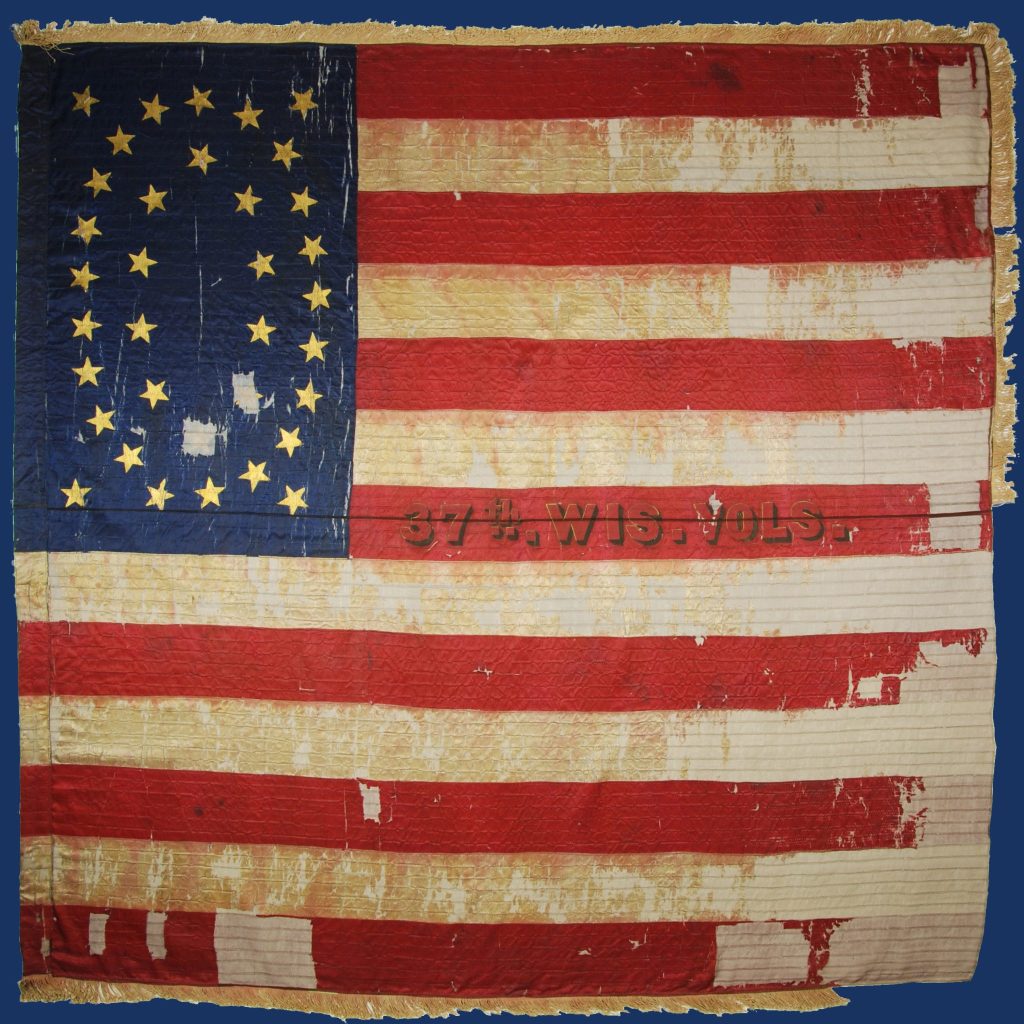
Grant’s strategy had shifted: rather than take Richmond directly, he would cut off their supply routes in an operation that has been called the Siege of Petersburg. The men of the 37th experienced heavy artillery fire while patrolling the earthworks southeast of Petersburg. Rebel sharpshooters picked off several of them, but they held this position until the end of July. The final company, Company K, joined them during this time, making the regiment complete.

Meanwhile, a former mining engineer, Lieutenant Colonel Henry Pleasants of Pennsylvania’s 48th Infantry, had the idea to dig below the Rebel defenses and blow them up. The plan was approved and digging began on June 25th. On the morning of July 30th, after the tunnels had been stuffed with four tons of gun powder, the fuse was lit. The explosion was heard for miles and a giant crater opened up where the Rebel lines once stood. Almost 300 Confederate soldiers died in the blast. Those not killed or mortally wounded staggered away in panic and confusion. This could have been a turning point for the north. Instead, Union commanders waited a full hour before ordering their troops forward, and when they finally did advance, they were sent directly into the crater itself rather than around it. The area became densely packed with Union troops. Confederates who had since regained their bearings stood at the crater’s edge and picked these men off like flies. An eyewitness from the 37th Wisconsin wrote that “they were left almost entirely without protection, and the whole place soon become a perfect slaughterhouse.” Grant called the Battle of the Crater “the saddest affair I have witnessed in this war.”7

William and his regiment would have been among the last of the Union soldiers to retreat when commanders called an end to the fighting. (It later came to light in a military tribunal that two of the key Union commanders had been holed up and drinking rum in a bombproof shelter during the day’s fighting.) The 37th did not fare well. Of the 250 men who marched out that morning, only 95 were at roll call that night. Among the many wounded was Company G’s captain Lieutenant Atwell, whose leg had to be amputated. Company K, comprised of men from the Menomonie tribe, was particularly hard hit, and their captain received a fatal wound to the head. All told, almost 6,000 Americans died in nine hours of fighting – some 4,000 Union troops and nearly 2,000 Confederates.8
The 37th was relieved from the front line and put on fatigue duty until August 19th. Among other things, the men helped build a fort on the Jerusalem Plank Road. They had spent the night of the 19th working on the fort, but upon arriving back at camp in the morning they were instructed to strike their tents and march. They caught up with the rest of the brigade at Yellow Tavern and here engaged in fighting with the Confederates over the next two days; the goal was to take possession of the Weldon Railroad. On the 21st, the regiment was ordered to support the 19th New York Battery at the extreme left flank, which they did at the price of several more men. But they held this ground, cutting off a vital supply line to the Rebels. The men of the 37th served picket and guard duty here until August 25th. At this point, William and the rest of the regiment were ordered to Ream’s Station to support the Second Corps. As they marched in that direction, they came across many stragglers wearing the cloverleaf badge of the beleaguered Second Corps. Part of the brigade stayed behind to prevent deserters, but the 37th marched on and engaged the Confederates, holding the line there.

From August 27th to September 24th, the soldiers of the 37th constructed a new line of works at Blick’s Station and successfully guarded it. At the end of the month, Colonel Harriman of the 37th assumed command of the entire First Brigade and his men were ordered to the area around Poplar Grove Church, where they served as a reserve to the Second Brigade. Throughout late September and early October, the regiment engaged in a series of battles around Pegram Farm, resulting in the deaths of 25 of their men and the wounding of 75 others. But another kind of death lurked in this place, a death that the men feared even more than falling in battle. Contaminated drinking water and poor hygiene gave rise to a number of “camp diseases” that took out otherwise healthy soldiers. William Wells was one of them.9
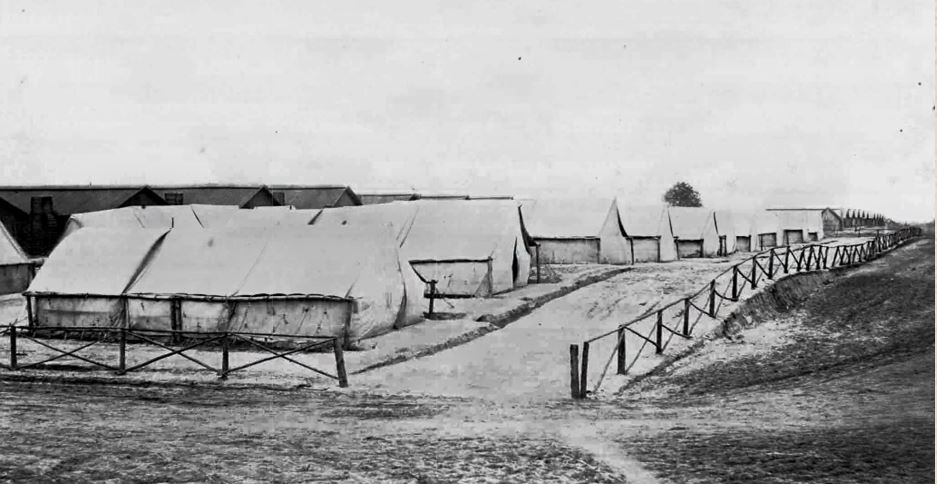
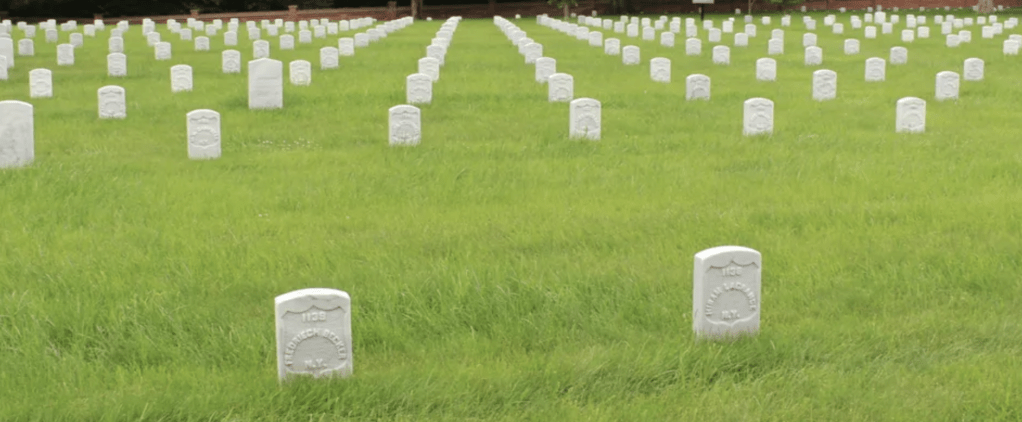
On October 14th, William Wells was pronounced dead at one of the area field hospitals set up to accommodate the many wounded and ailing. The cause of death – dysentery. Sadly, due to unsanitary conditions and little understanding of germ theory, over 400,000 men succumbed to disease during the Civil War, about two-thirds of all war deaths. William would have been buried in a simple grave near the field hospital. Later, in 1866, a cemetery was surveyed at Poplar Grove and became the final resting place of 6,718 Union soldiers who died in the area10 – William Wells’s grave marker just one in a sea of small white headstones.
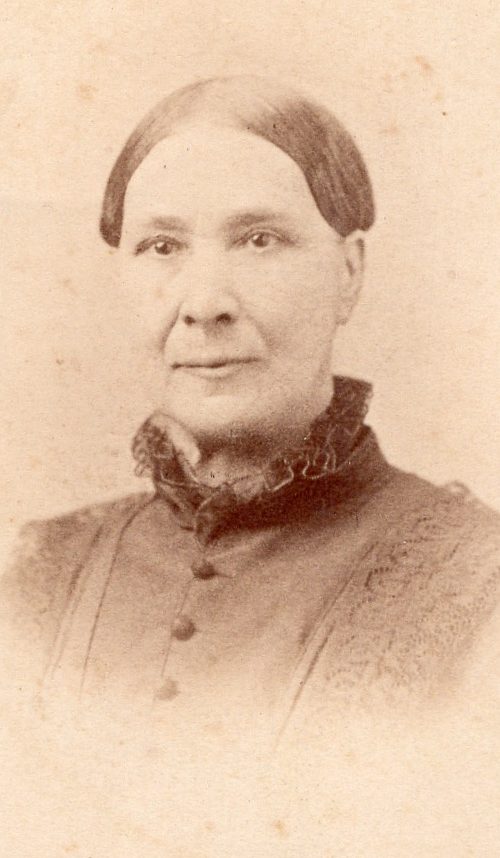
Nineteenth-century Americans were on more intimate terms with death than we are today, even before the start of the Civil War. But no amount of familiarity could have prepared Maria for the shock and horror on receiving news of her husband’s death. And then there were the practical matters of providing for herself and her five children. She applied for a widow’s pension, and within a year she married a man named Thomas Hastie.
We have to wonder what someone in Maria’s position thought about the ultimate sacrifice made by men like her late husband William. Was she proud? Bitter? The Wellses had lived in the U.S. for less than 20 years. Did they feel compelled to prove their loyalty to their new homeland? In their minds, was the Union cause worthy enough or were the monthly wages large enough to risk capture, injury, disease and death? Perhaps serving the war effort, either by volunteering or by the draft, was simply seen as inevitable. We’ll never know how our ancestors approached these decisions, nor how they grappled with their consequences.
But the high price paid by countless American families like the Wellses did, in fact, preserve the Union. Slowly and steadily, the Siege of Petersburg worked and General Lee surrendered to General Grant at Appomattox, Virginia on April 9th, 1865. Of the roughly 1,100 men who served in the 37th Wisconsin Infantry, only about 680 mustered out of service on July 26th, 1865. One in five of the men had been previously discharged or transferred. Another one in five men, like Grandpa Wells, lay buried in Virginia’s bloody soil.11
Excerpt from the folk ballad Virginia’s Bloody Soil
Come all you loyal unionists, wherever you may be
I hope you’ll pay attention and listen unto me
For well you know the blood and woe, the misery, the toil
It took to down secession on Virginia’s bloody soil
When our good flag, the Stars and Stripes, from Sumter’s walls was hurled
And high overhead on the forwardest walls the Rebel’s flag unfurled
It aroused each loyal Northern man and caused his blood to boil
For to see that flag, Secession’s rag, float o’er Virginia’s soil
Then from the hills and mountain tops there came that wild alarm
Rise up ye gallant sons of North
Our country calls to arms
Come from the plains o’er hill and dale, ye hardy sons of toil
For our flag is trampled in the dust on Virginia’s bloody soil
And thousands left their native homes, some never to return
And many’s the wife and family dear were left behind to mourn
There was one who went among them who from danger would ne’er recoil
His bones lie bleaching on the fields of Virginia’s bloody soil
- See p. 88 in Reed, Helen A. Reiner. 1984. Ancestors and Descendants of Johann Jacob Reiner and Elsbeth Hitz and Allied Lines. Decorah, IA: The Anundsen Publishing Co. ↩︎
- Ibid, pp. 88-89. ↩︎
- Ibid, pp. 88-89. ↩︎
- For an excellent account of how Americans dealt with the scale of death and destruction during the Civil War, see Drew Gilpin Faust’s (2008) This Republic of Suffering: Death and the American Civil War. You can also read more about how the Siege of Petersburg set the stage for future wars here: https://www.nps.gov/articles/training-for-trench-warfare.htm ↩︎
- Camp Randall had sprung up on what had previously been the state fairgrounds and was specifically created to recruit, house and train soldiers for the Civil War. It is now the site of the University of Wisconsin stadium. ↩︎
- Three main sources were consulted in this summary of the 37th’s service. Where not otherwise cited, these sources provide most of the details:
(1) R.C. Eden’s (1865) The Sword and Gun: A History of the 37th Wis. Volunteer Infantry from Its First Organization to Its Final Muster Out (https://archive.org/details/01666961.3303.emory.edu/page/17/mode/2up),
(2) “37th Infantry, chapter 45” from E.B. Quiner’s Military History of Wisconsin (https://content.wisconsinhistory.org/digital/collection/quiner/id/17121), and
(3) William Love’s Wisconsin in the War of the Rebellion, Vol. 2 (https://content.wisconsinhistory.org/digital/collection/quiner/id/24053/rec/6) ↩︎ - See p. 538 in Foote, Shelby. 1974. The Civil War, A Narrative; Vol. 3. Red River to Appomattox. New York: Random House. ↩︎
- Ken Burns’s documentary, The Civil War, includes a segment describing the Battle of the Crater. The segment starts at about 23:36 within Episode 7 “Most Hallowed Ground – 1864”:
https://archive.org/details/The_Civil_War_Episode_7_Most_Hallowed_Ground_1864_PBS_1990_Tape ↩︎ - Burns’s documentary also includes a segment entitled, “Now, Fix Me”, which provides a vivid account of the suffering endured by those in Civil War field hospitals. This segment is found at approximately 51:51 in Episode 6 “Valley of the Shadow of Death – 1864”:
https://archive.org/details/The_Civil_War_Episode_6_Valley_of_the_Shadow_of_Death_1864_PBS_1990_Tape ↩︎ - Of this number, only 2,139 are positively identified. See https://www.nps.gov/pete/learn/historyculture/poplar-grove-national-cemetery.htm ↩︎
- Statistics about the 37th can be found in Charles Estabrook’s 1915 volume, “Wisconsin Losses in the Civil War”, available online here: https://content.wisconsinhistory.org/digital/collection/tp/id/41031 ↩︎

 Deep Roots
Leave a reply to Notes from the heartland (Part 2: Kansas and Missouri) – Deep Roots Cancel reply