-
Twisted symbols
Pick any aspect of ancient Scandinavian culture – from Norse religion to runic writing – and do an online search. It won’t take you long to find groups and individuals who are co-opting this culture to serve white supremacist ideologies. The Nazis were of course fascinated with Norse culture, believing that it harkened back to a “pure” form of Germanic culture. They incorporated it into their national mythmaking and iconography. Likewise, they placed the so-called “Nordic race” at the top of a racial hierarchy supported by the scientific racism that was popular in European and American academia at that time. Those pseudo-scientific theories about a master race were not simply misguided; they led to the slaughter of millions of innocent people.
The misappropriation of Norse history, culture and symbolism didn’t die out with the Nazis’ defeat in 1945. White supremacism lives on and, if anything, has been emboldened by the regressive political movements taking place in the United States and across parts of Europe today. Thus, the misappropriation of Norse culture for racist ends is unfortunately still common.
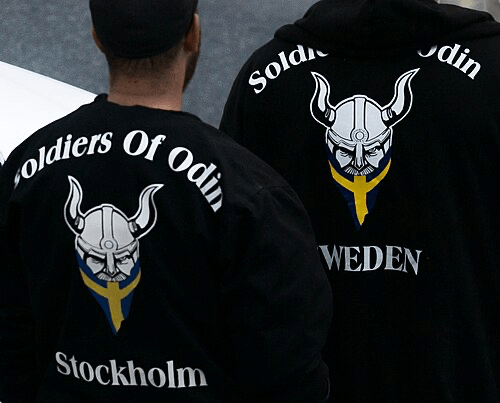
Anti-immigrant group “Soldiers of Odin” (Source: Wikipedia) 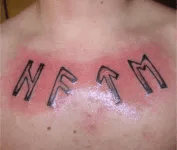
“Hate” tattoo in runic writing (Source: ADL) I am always a bit wary of an author’s motives when I come across a discussion of Scandinavia’s historical cultures online. Is this author trying to assert the superiority (historical or current) of a particular ethnic or cultural group? Is there an implied hierarchy in the discussion of such peoples?
Given this history, people of Northern European descent who are captivated by their own ancestry can be a little suspect to me. Do they have an axe to grind? What’s their angle? And yes, if I came across my own blog online, I’d be asking those same questions. So, I sadly feel it necessary to offer some explanations here.
Norse culture – whether broadly or narrowly defined – has some quirky features worth exploring. The Viking Age, for example, presents us with contradictions. Was Scandinavia an isolated cultural backwater or a land of intrepid seafarers and explorers? Were the people easy converts to Christianity or pagan holdouts? Egalitarian or class conscious? Peace-loving farmers or violent marauders? Perhaps they were all these things. Our lack of knowledge allows the Viking Age to be a screen onto which our imaginations (and Hollywood) can project whatever suits.

Logo of the Minnesota Vikings football team 
Today’s Hollywood Vikings: less horned helmets, more abs 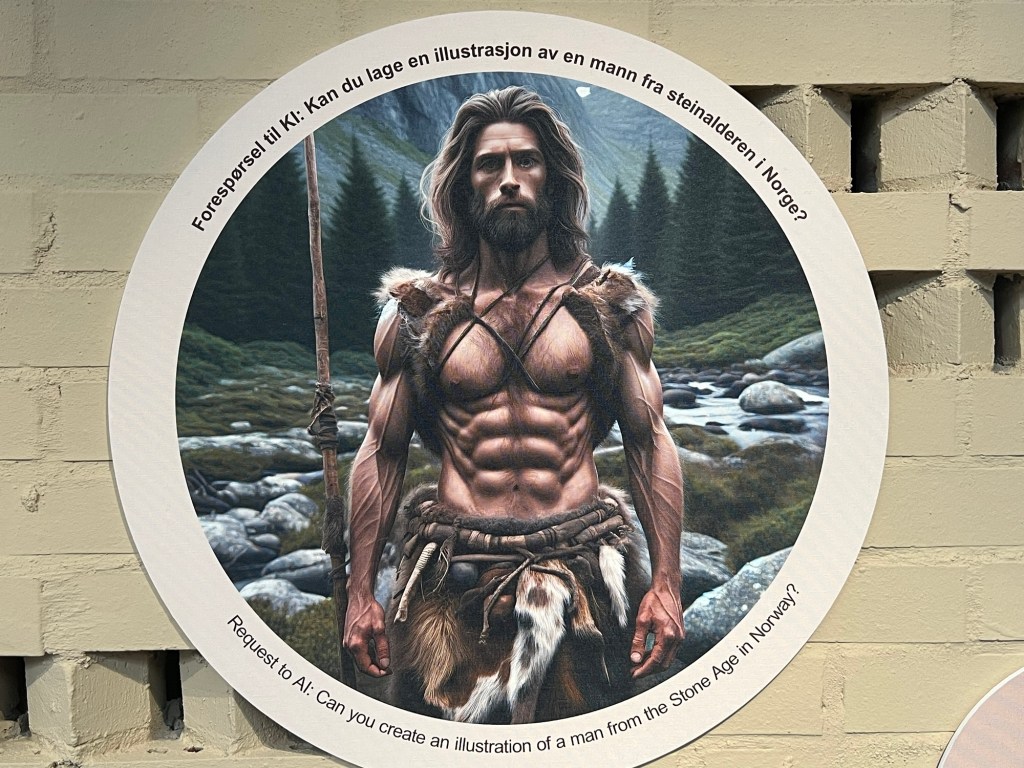
A display at the Museum of Archaeology in Stavanger asks visitors to consider how AI — which bases its “intelligence” on existing images in popular culture as well as research — can reproduce stereotypes of people from the past (photo from my visit on May 20th) As a culture that made its mark across the North Atlantic, Russia, and even parts of the Mediterranean and Near East, the Norse are worth a look for anyone inquisitive about world history. Personally, I am interested in how the Norse encountered other peoples of the world and how these cultures mutually influenced one another. And as a family historian, I am curious to find out what aspects of ancient Scandinavian culture might have been preserved in modern practices and ideas – practices and ideas which my ancestors may have even brought with them across the water.
But I strive to approach all my inquiries with a healthy dose of cultural relativism and social constructionism. Both viewpoints are currently under attack in America today as being “woke” and neither are typically mentioned in genealogical writing. They deserve some amplification here.
Cultural relativism refers to anthropologist Franz Boas’ idea that no culture can be understood according to the standards of another culture; it must be understood within its own cultural context. Were the Vikings violent by 21st century standards? Certainly. Is this an appropriate context to judge them by? Certainly not. Cultural relativism is the natural cure for ethnocentric and present-centric views.
Social constructionism refers to Peter Berger and Thomas Luckmann’s idea that the social phenomena we observe are not simply “out there” – objective realities to be discovered. Instead, they are in large part the product of what we have been conditioned to observe through our interactions with others. Do “white people” exist? Biologically speaking, no. But the social category can exist within a particular social context and such a categorization can have real world effects on life outcomes. This may sound like splitting hairs, but the implication is that if a social phenomenon (like a race, ethnicity, nationality or culture) is a construction, it can be re- or de-constructed. Its boundaries can shift, become porous or solid, or be erased entirely. New meanings can get attached to old categories. Social constructionism is therefore the natural cure for essentialism – the circular, ‘common sense’ logic that things just “are the way they are.” The social constructionist says, “No – things come to be the way they are through a history of interactions, and subsequent interactions can change them.”
These postmodern approaches to culture have their drawbacks. If taken to the extreme, they beg the question: can we say anything about anything? I would argue that any inquiry – academic or personal – requires definitions and categories, and therefore some of the postmodern navel-gazing must be bracketed off, at least temporarily, for us to summarize knowledge and make sense of our world. I would also argue that no amount of postmodernism saves us from the reality that inquiry itself is value laden. We can make good faith attempts to conduct our inquiries free from cultural bias, ethnocentrism and essentialism, but the act of inquiry itself – our choice of subject and methods – makes a statement about our values and positionality. The real question is whether we are aware of these or not.
To bring this essay back to the uncomfortable truth I laid out at the beginning – that Norse culture has been co-opted by racist ideologues over the past century – is it possible to study Norse culture without reinforcing such ideology? I certainly hope so. But I am also aware that one person’s anti-racist inquiry can become fodder for another’s racist inquiry. Once knowledge is put out into the public sphere, it can become perverted by another person’s agenda. I am keenly aware, for example, that I’m writing these words in an era in which artificial intelligence technology can scrape up my thoughts and repackage them for different purposes, different audiences. I can’t possibly know how my words will be used going forward. But I can state my intent and clarify my own views: that Norse culture is worthy of study – not because it encapsulates the lifeways of a supposedly superior people – but because it has been one of countless cultures engaged in a historical dialogue with the rest of world, and some of its internal contradictions are – in my opinion – interesting in and of themselves. And I can also admit my own bias, my own “angle”: that part of my curiosity about this culture relates to how aspects of it may have filtered down to modern practices and folk customs, and perhaps even to those of my own ancestors.

-
Bridges across the pond
To travel abroad as an American in 2025, particularly to Western Europe, is to open yourself up to questions about what it means to be an American. For 80 years, Europe knew it could rely on the U.S. as a bulwark against the forces of despotism and tyranny. That faith has been shattered.

Norway was one of 12 founding members of the North Atlantic Treaty Organization (NATO) when the alliance formed in 1949. But, given the actions and rhetoric of the Trump administration, Norway and other NATO members can’t assume that the U.S. would come to their aid if attacked. Trump has even gone so far as to threaten the sovereignty of the people of Greenland, an autonomous territory of Denmark.
Moreover, the Trump administration is imposing tariffs on many goods coming in from overseas, even goods from longstanding allies like Norway. The president seems determined to destroy the international goodwill that our nation has painstakingly built over decades.
As an individual American confronted with these realities, I’ve felt pretty powerless. I can’t right the wrongs my government is committing abroad. Nor can I explain its actions. Nor can I articulate why millions of my fellow Americans seem to support these actions.
I do, however, believe in the power of citizen diplomacy, and I’m hopeful that the various personal, professional, cultural and economic ties between the U.S. and Norway will serve as the foundation for a renewed friendship once the Trump administration is out of power.
So, in the conversations I’ve had during my travels these past two weeks, I’ve done my best to listen and understand, and I’ve tried to remember I may be one of the few Americans folks here have the chance speak to personally during these tumultuous years. These personal connections were the highlight of my trip.
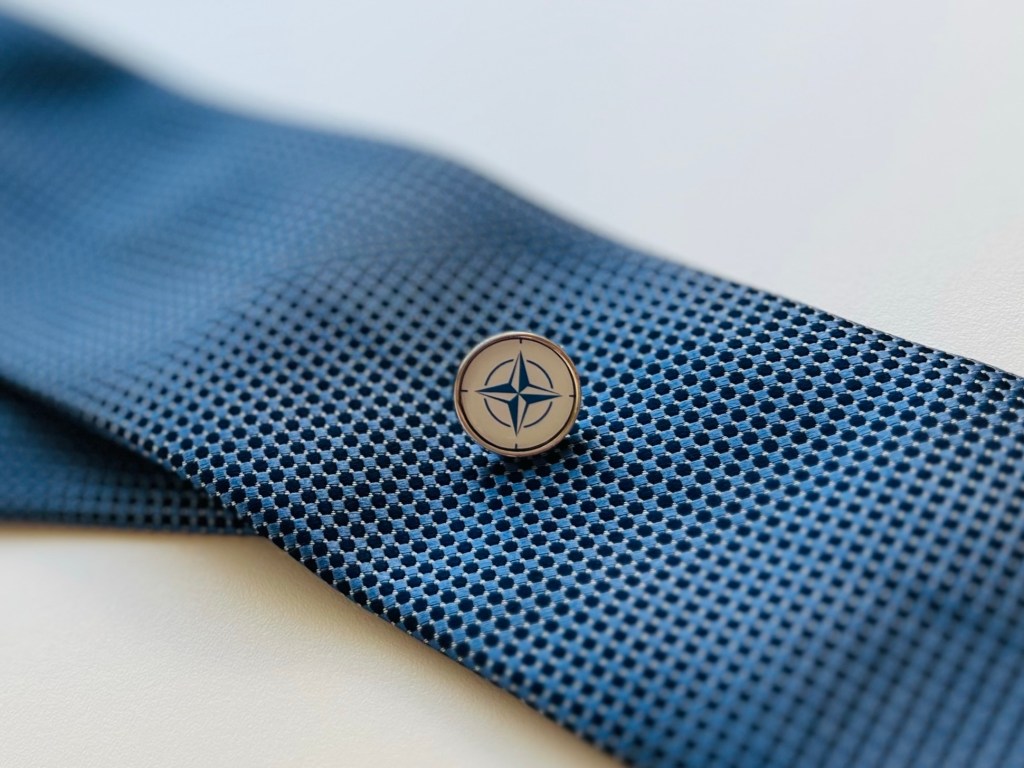
I gave NATO tie tacks to a couple of the folks I met on this trip Here are a few glimpses of those conversations.
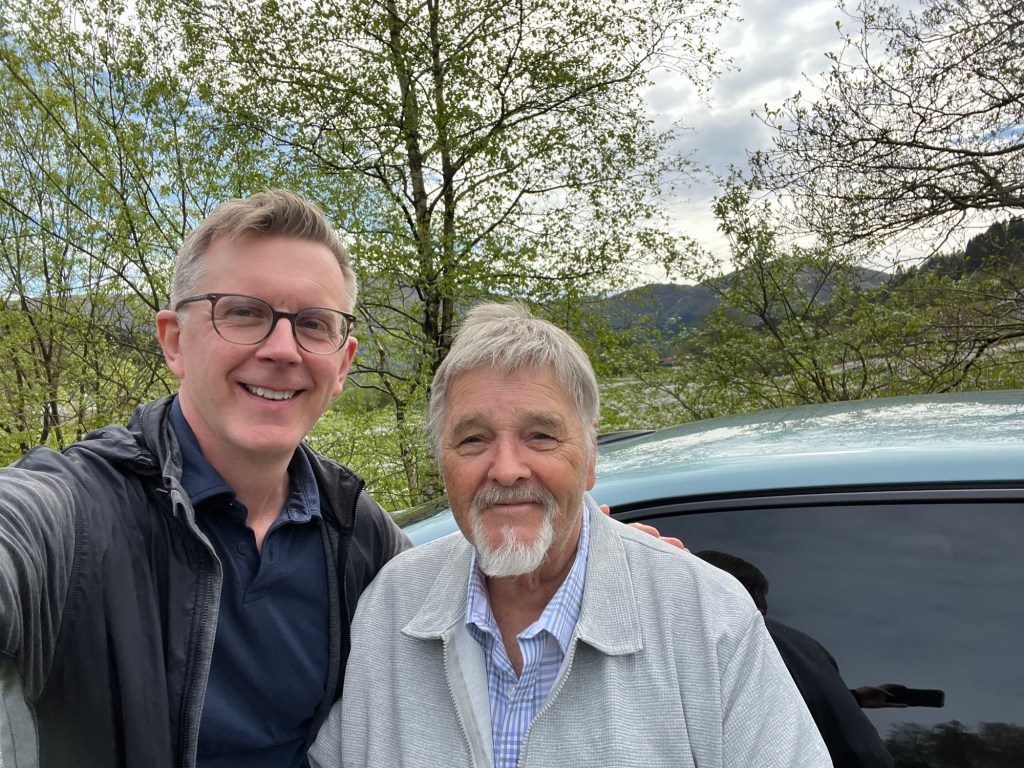
Ole Johan Hauge, local historian in Arna (near Bergen) 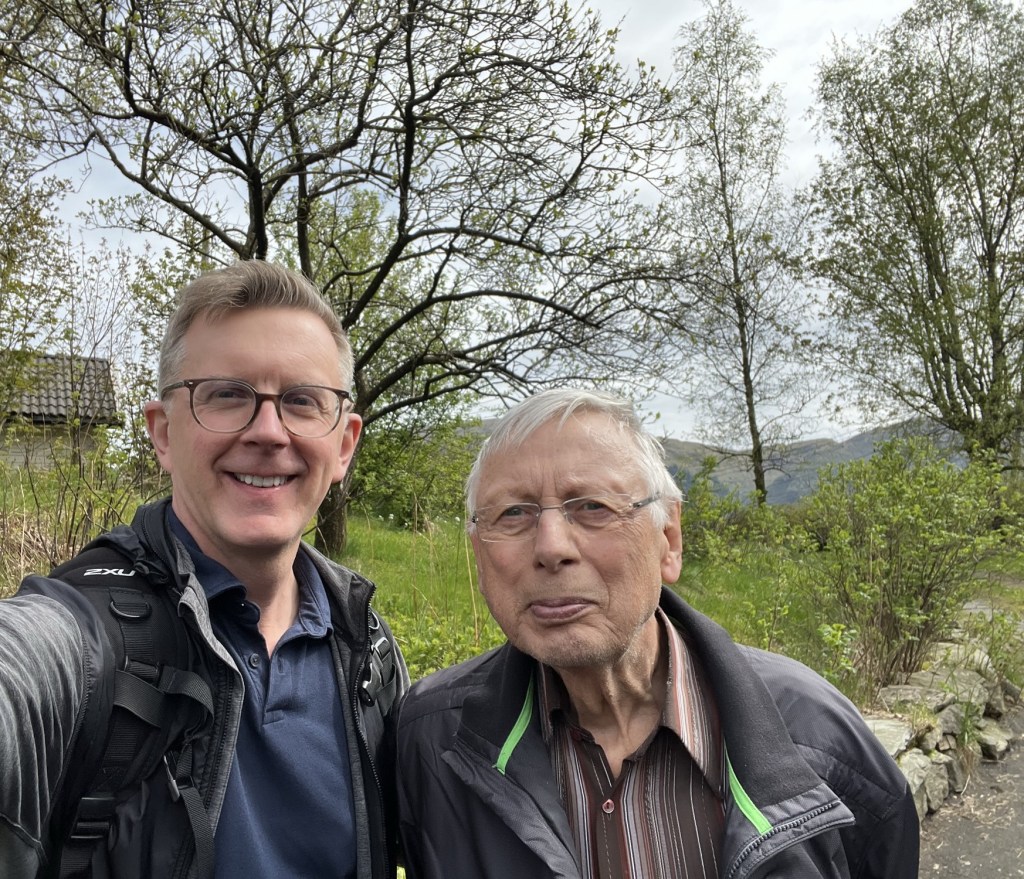
Arne Storlid, distant cousin on my mother’s mother’s mother’s side. Photo taken on the Hauge farm in Arna. 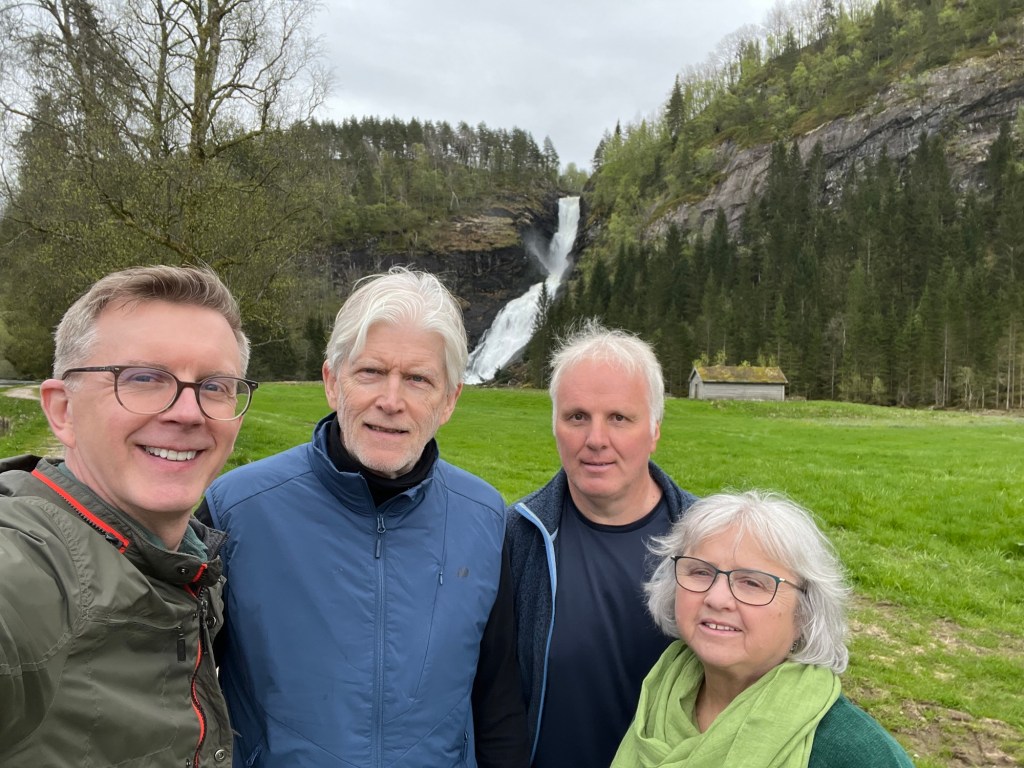
Ove Farsund, Erik Ole Haugen, and Judith Hegrenes of Førde (Sunnfjord); photo taken at Huldafossen 
My relative Hilde Iversbakken and her children (living in Kapp) engaged me in several conversations about the current state of affairs in the U.S. In this photo, Hilde is serving up kjøttkaker (meatballs) while daughter Josefine takes a break from her studies. (These relatives are on my father’s father’s mother’s side.) 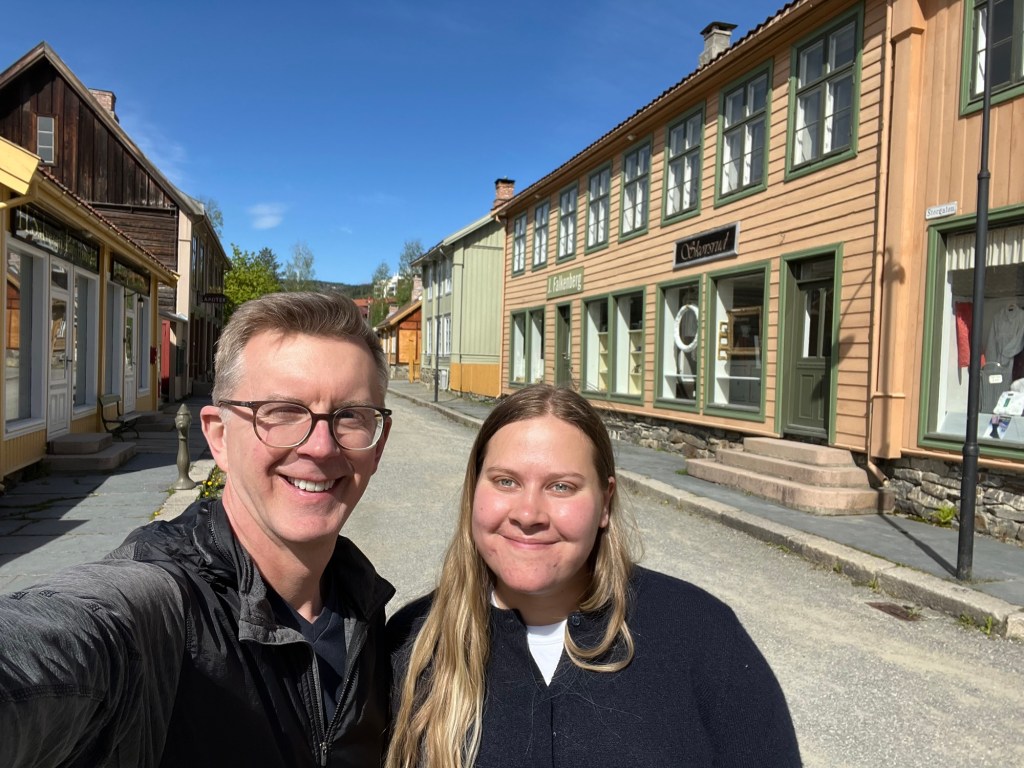
One of Hilde’s daughters, Mathilde Hansson, was an international studies major and now is focused on business. She’s a voracious consumer of news media and knows far more about U.S. politics than most Americans. Photo taken at Maihaugen in Lillehammer. 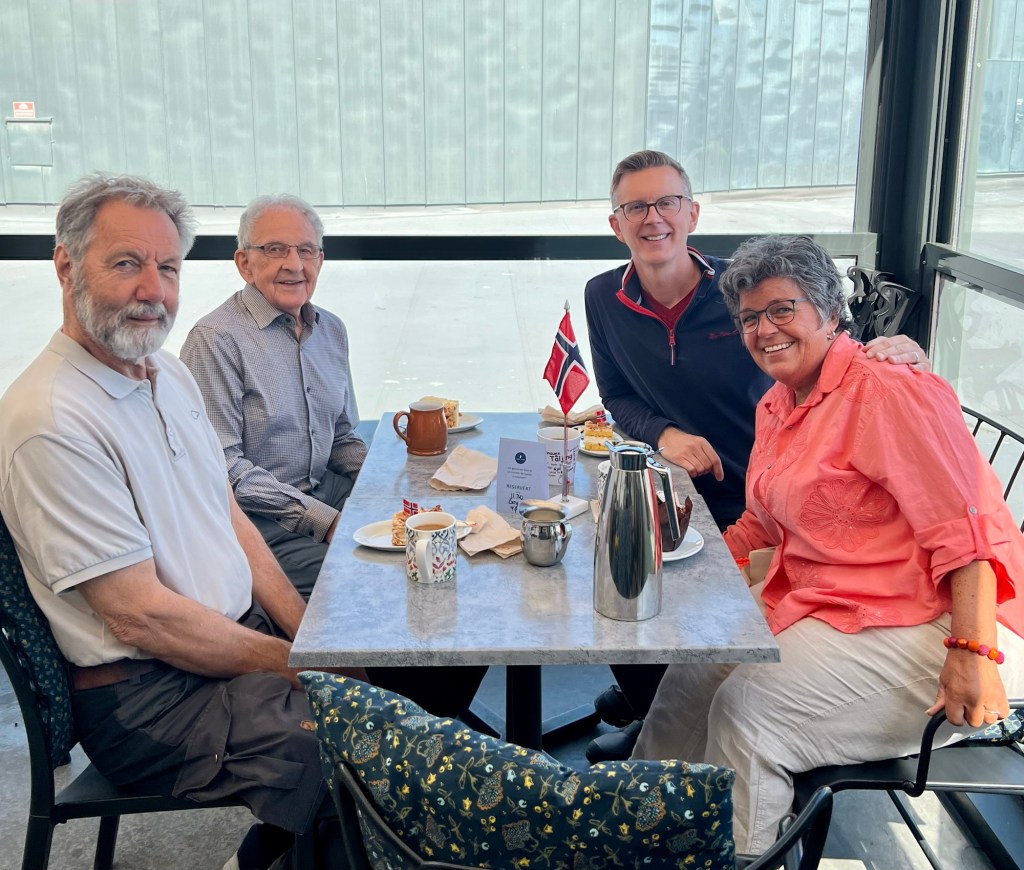
Cake, coffee and a heartfelt conversation in Gjøvik with the Lindalen family: Ole and Willy on the left, Gry on the right. (The Lindalens are relatives on my mother’s father’s mother’s side) 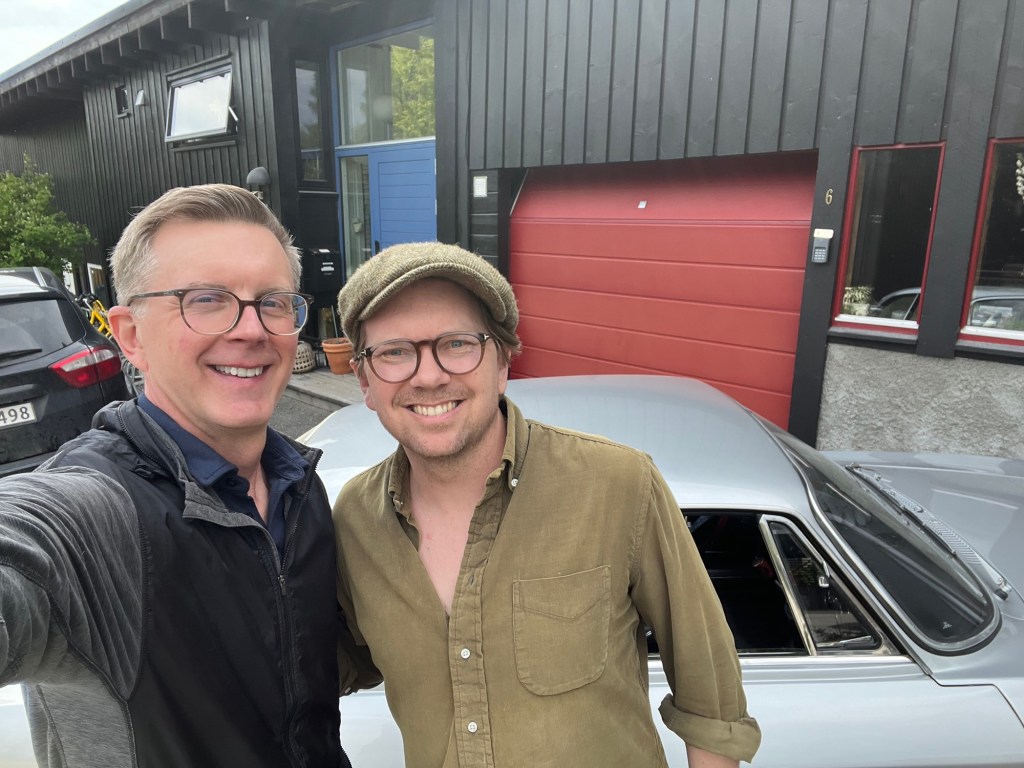
Stimulating conversations about business, international travel and politics with Kristian Harby, while we rode around Hamar in his 1967 Alfa Romeo. (Kristian is a relative on my father’s father’s father’s side.) 
In Oslo, I got to meet Torstein Torblå, whom I had connected with via AncestryDNA. Our conversation ranged from WWII to the future of data consulting. (Torstein is a relative on my mother’s mother’s mother’s side.) 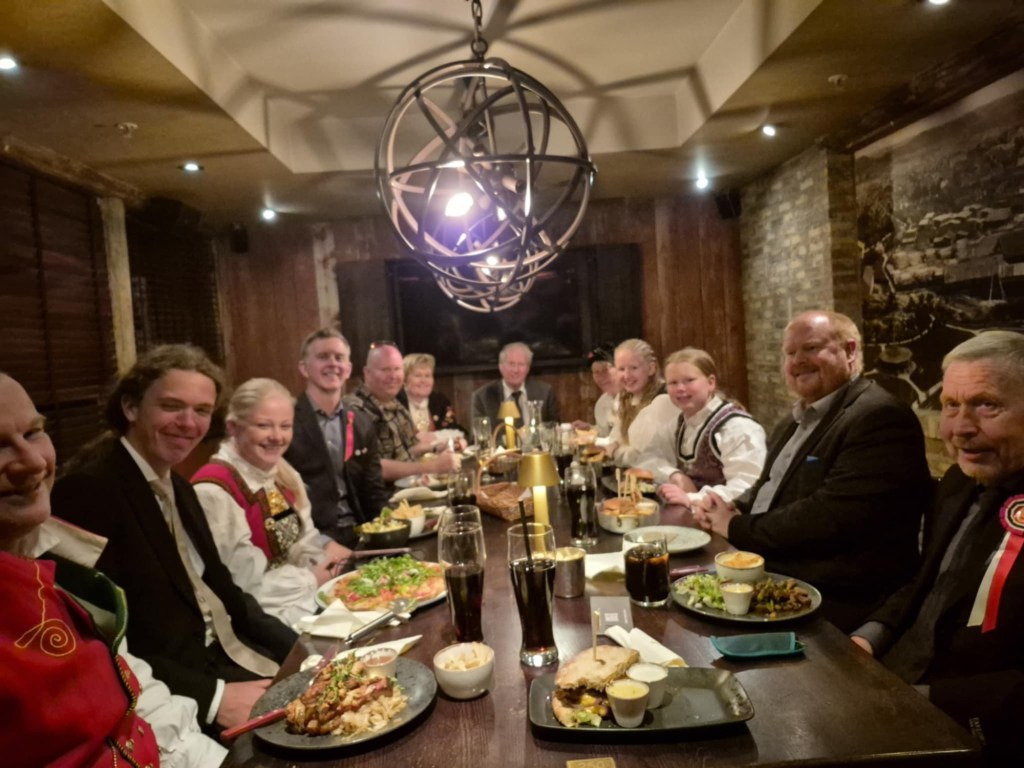
I was treated to a syttende mai dinner by the Kittelsen-Larsen-Greibesland families in Kristiansand (from left: Morten, Mats, Sina, Jesse, Kjell Inge, Linda, Reidar, Lilian, Henriette, Frida, Roger, and Alf). They are relatives on my mother’s father’s mother’s side. 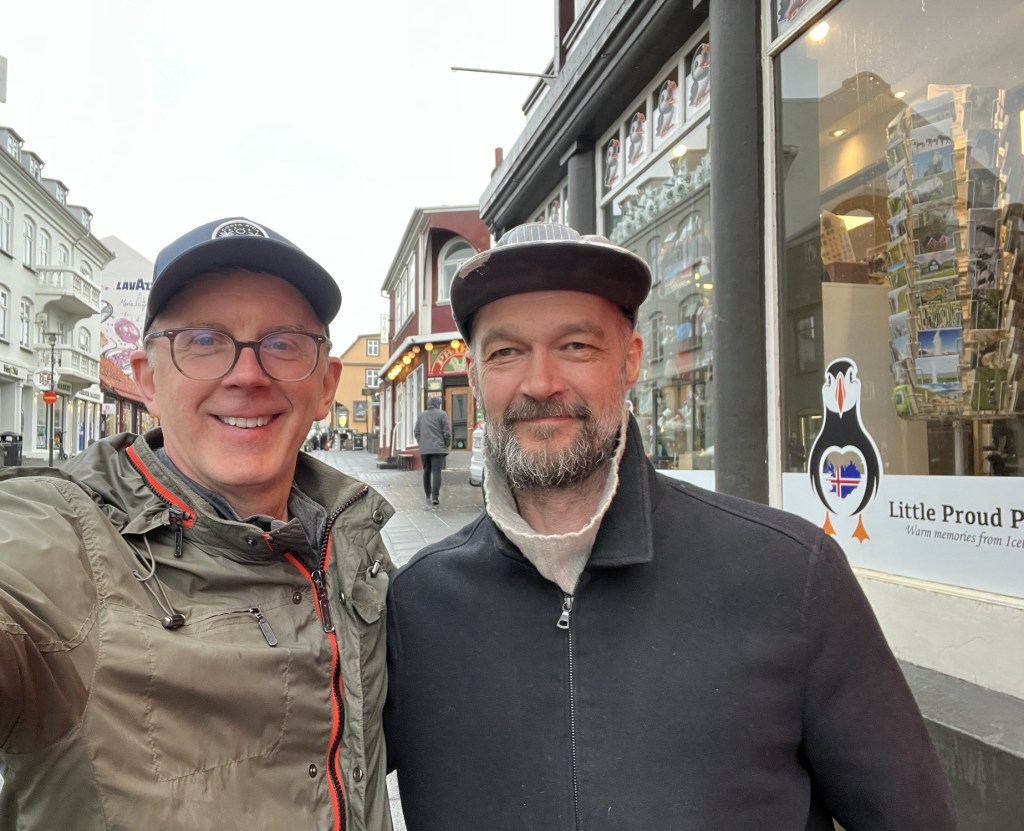
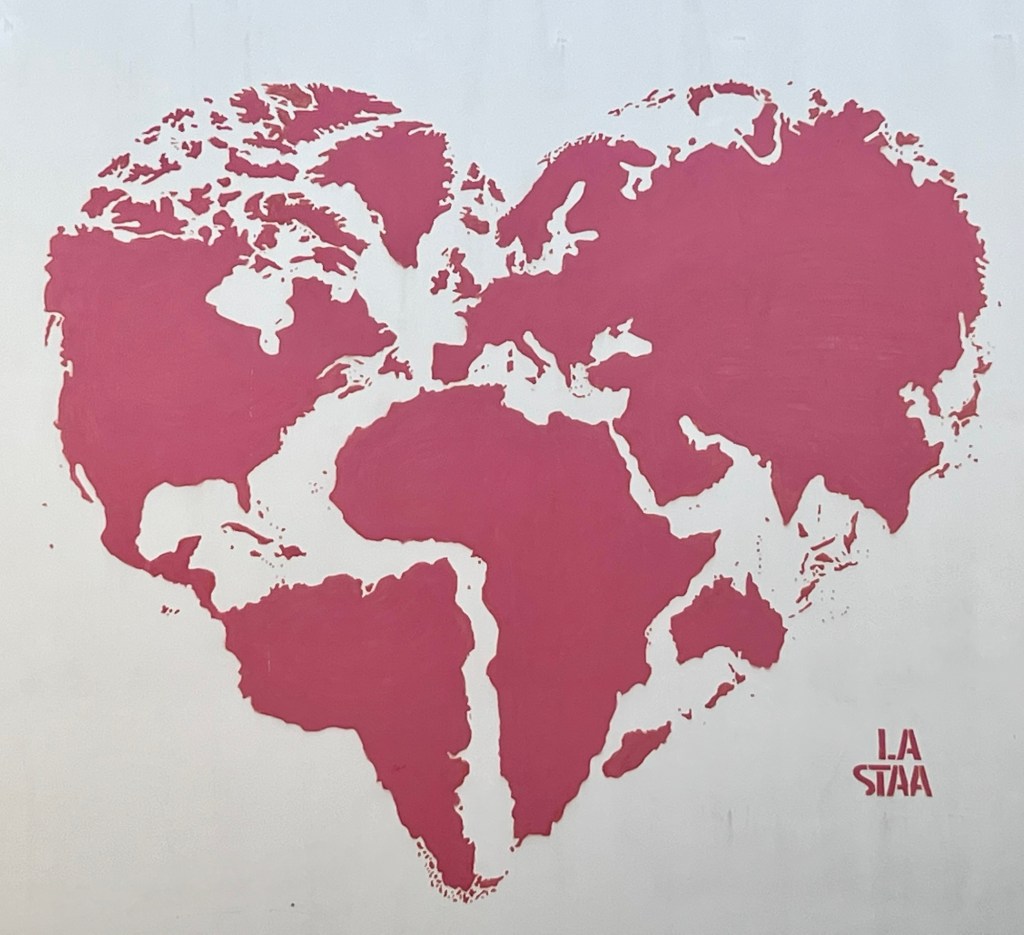
My final meet-up on this journey: I caught up with an old friend from my NYC days, Snorri Sturluson, this evening in Reykjavik. Street art in Stavanger
-
Norway’s scattered children (part 2)
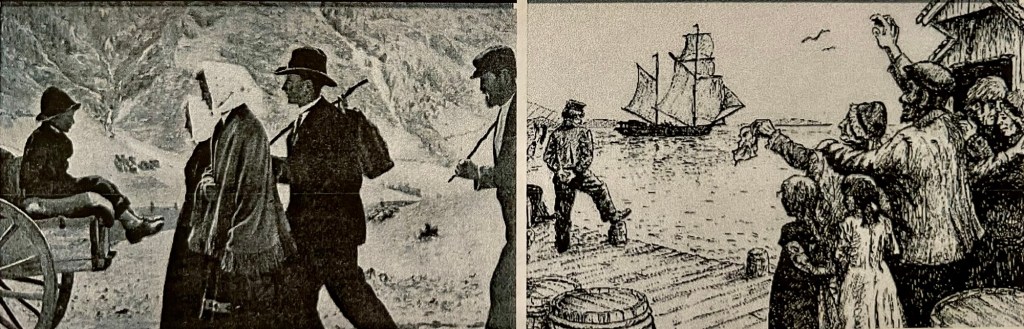
One-third of Norway’s population left the country between 1825 and 1925 — nearly a million people. As a citizen of a country that has more often been the recipient of migrants, I can scarcely imagine the impact those departures would have had, both for individual families and for the nation as a whole. In a previous post I considered the Norwegian diaspora in the United States and those settlers’ assimilation into the American mainstream. In this post, I grapple with what that exodus has meant for those left behind and how modern Norwegians view their “cousins” across the pond.


Model of the first emigrant ship from Norway, the “Restauration”; on display at the Maritime Museum in Stavanger Images courtesy of Ole Johan Hauge, a local historian I met in Arna on May 7th Traveling around Norway in the last couple of weeks, I am struck by how often I’ve come across exhibits and events marking the 200th anniversary of the first emigrant ship to America. Individual communities around the country have planned a variety of lectures, activities and displays to commemorate this bicentennial. These programs are organized by local committees that roll up to a national initiative — Crossings.

Here is their website: https://utvandrermuseet.no/2025. In the States, we have a few such events as well, including a conference to be held in June at St. Olaf College in Minnesota. But the sheer scale of these activities in Norway highlights a key takeaway from my explorations: the emigration period had a massive impact on Norway and its view of the U.S. It looms large in Norway’s collective imagination.
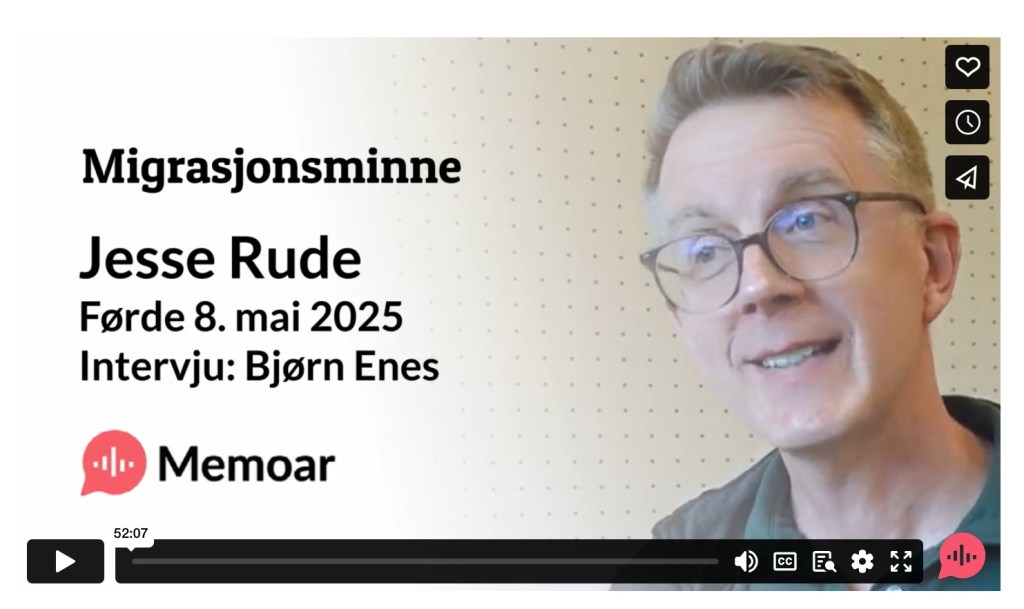
When I was in Førde on May 8th, I had the privilege of participating in one of the projects associated with Crossings — an oral history project organized by a volunteer organization called Memoar. One of Memoar’s founders, the freelance journalist Bjørn Enes, interviewed me about the Norwegian diaspora and my family’s emigration experiences. Here’s a link to the website and a summary of the interview: https://www.memoar.no/mig/jesse-rude (The interview is a bit long, but if you are interested in watching it, send me a direct message and I’ll provide the password.)
And on May 15th, driving out of the Hamar area, I stopped by the museum that’s helping coordinate these events — Norsk utvandrermuseum (The Norwegian Emigrant Museum), located in Ottestad. The indoor exhibits are closed until next month, but you can walk around the grounds and see a collection of historical buildings relocated from Norwegian-American farms and communities — a little town on the prairie!
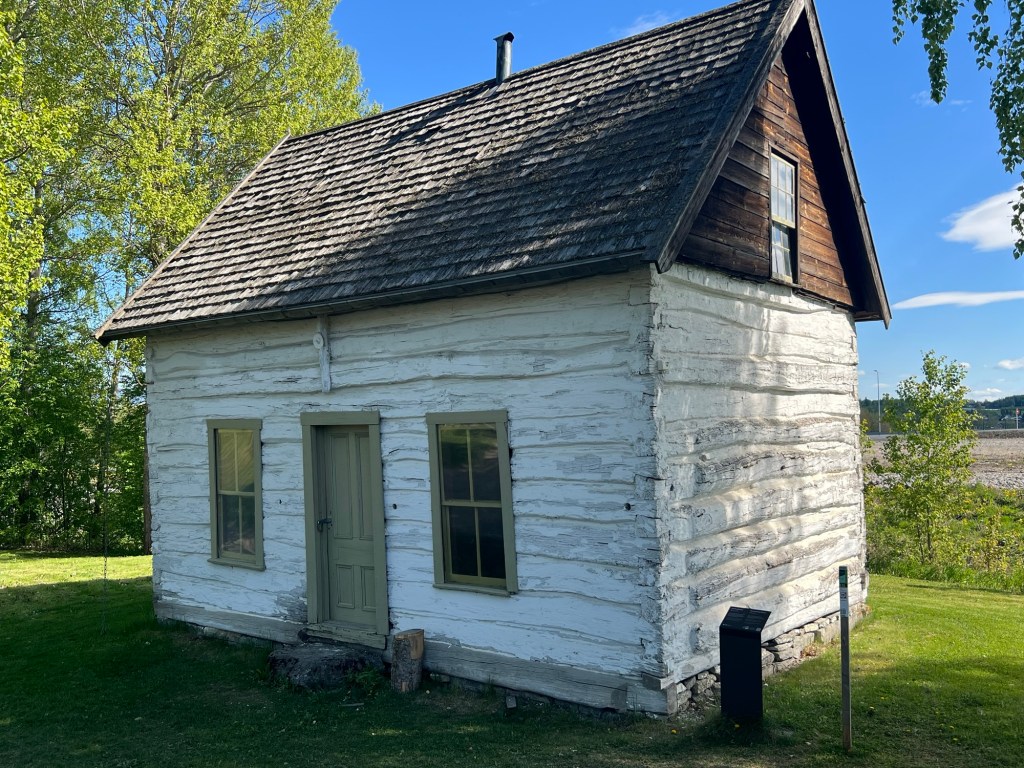
Multi-use building, built c. 1873, Kindred, ND 
Barn, c. 1860, Highlandville, IA 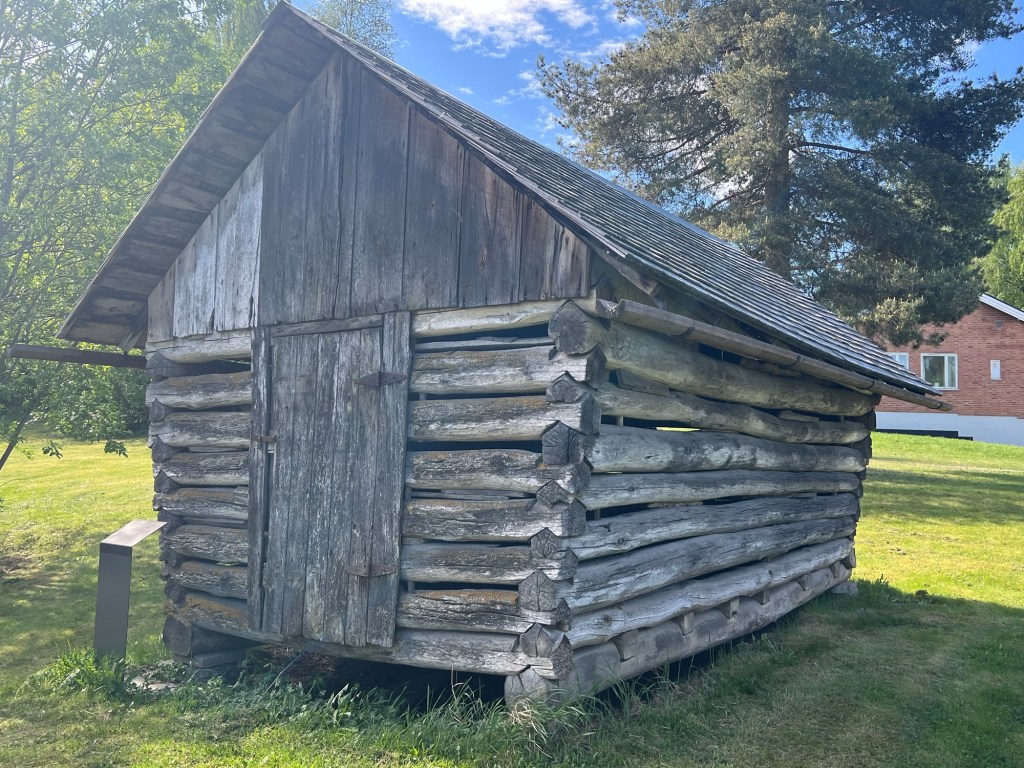
Corn crib, c. 1858, Coon Valley, WI 
Granary, 1870s, Highlandville, IA 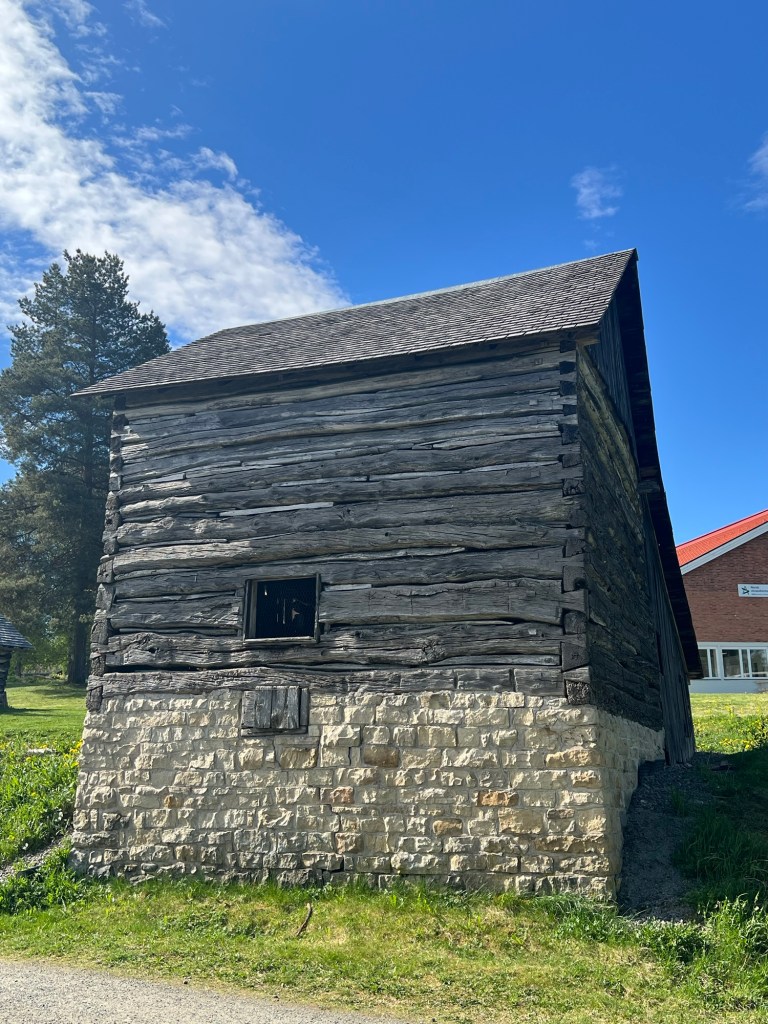
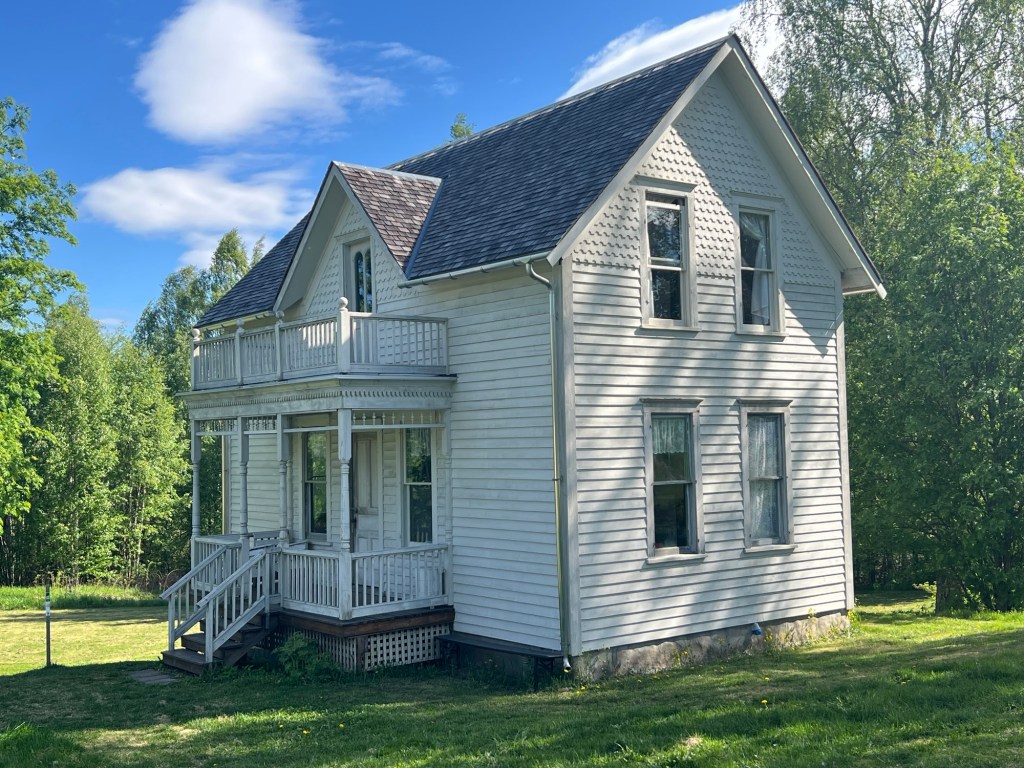

Oak Ridge Lutheran Church, 1895, Houston, MN 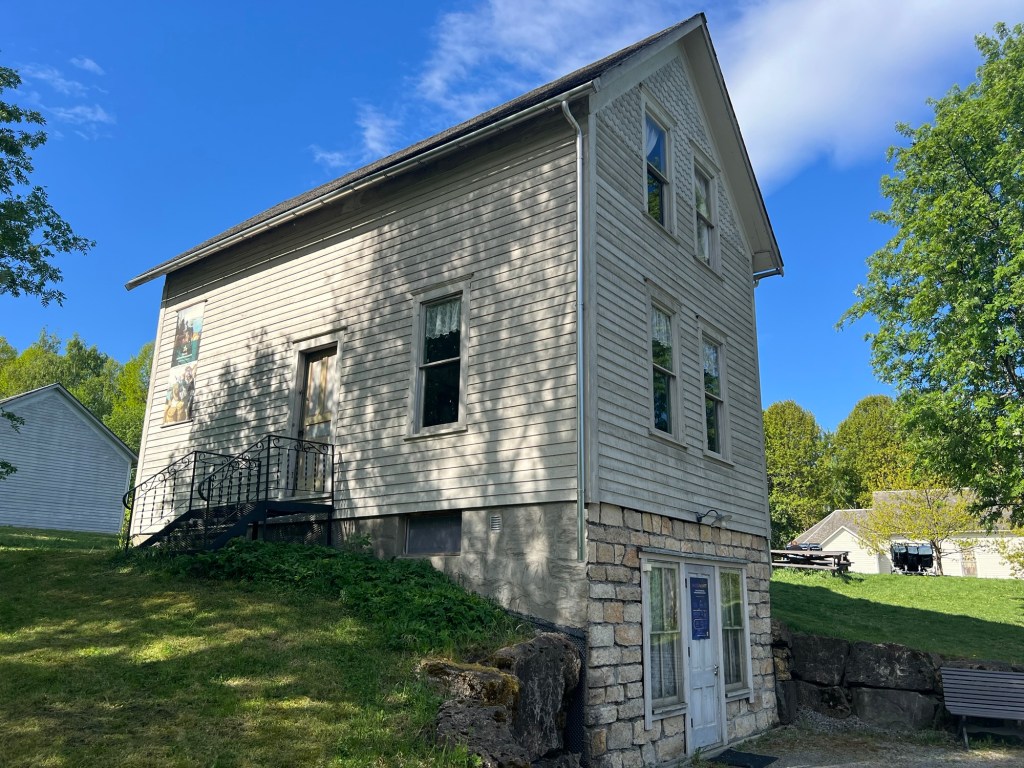
Home, 1902, Highlandville, IA For anyone who grew up in the American Midwest, buildings like these look very familiar. I was interested to learn that new words — like kornkrybbe (corn crib) — entered the Norwegian lexicon through Norwegian Americans. Later that day, I took in an exhibit at the National Library in Oslo called “Rett vest. Drømmer om et bedre liv i Amerika” (Due west: Dreams of a better life in America). The exhibit stitches together the letters, stories, and even “tall tales” sent from emigrants back to their relatives and friends in Norway… dreams of what might be possible in a new land.
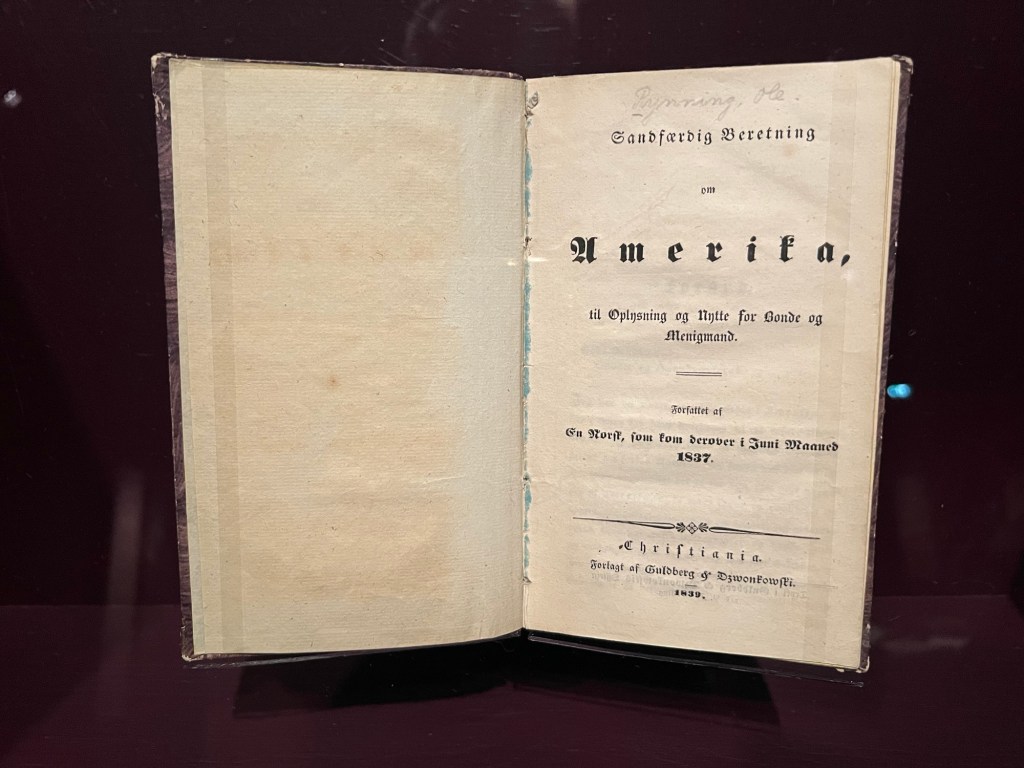
“America for Dummies” — In 1837 a Norwegian emigrant named Ole Rynning wrote a manual for folks back home interested in a life in the States. His manual inspired two ship-loads of migrants to set off for America, but by the time they got there Rynning was dead. The community where he lived was a malaria-infested swamp. One such dream, which I hadn’t been aware of, was the violinist Ole Bull’s aspiration of founding a Norwegian colony in Pennsylvania. In 1852, he purchased over 11,000 acres (45 square km) and attempted to establish four Norwegian communities in his “New Norway”. It was an epic failure. According to the exhibit, the failure of Bull’s grandiose vision may have inspired some satirical aspects of Henrik Ibsen’s play Peer Gynt.
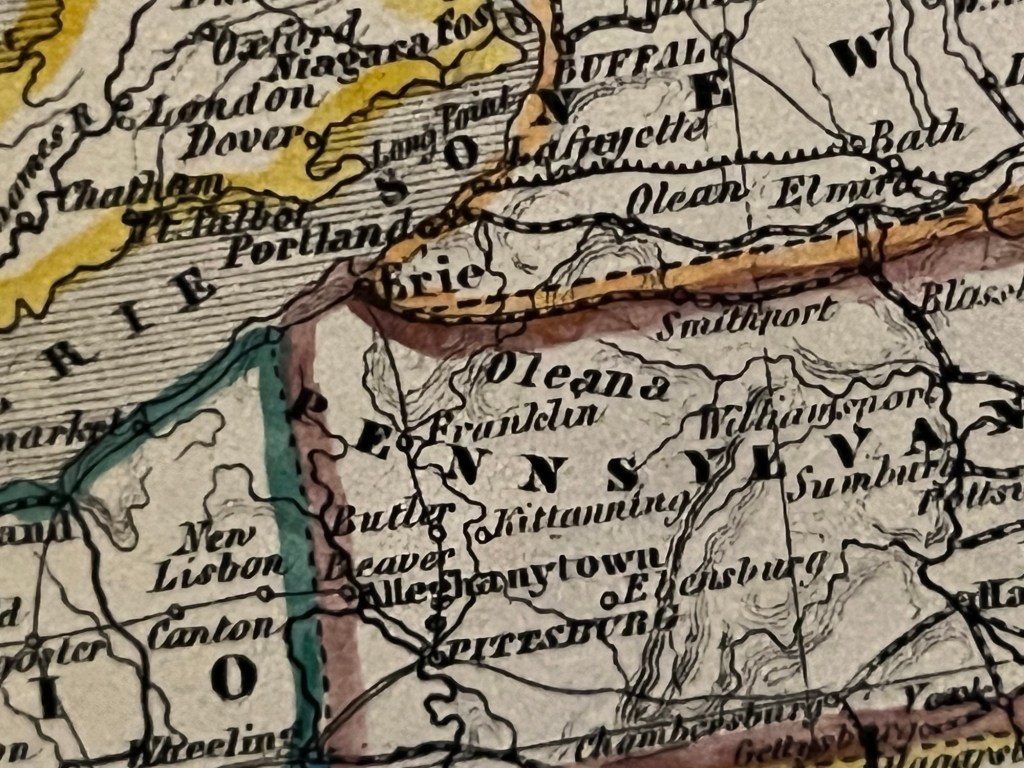
The only map that has “Oleana” marked — one of the communities in Ole Bull’s “New Norway” which he named after himself The materials from the exhibit point to a central theme I’ve picked up on here in Norway when discussing the diaspora — a fascination with America, tempered by a healthy skepticism of its endless bounty and so-called freedoms.
Let’s address the “endless bounty” first. One of the branches of my Norwegian family left in 1904, just a year before Norway’s independence from Sweden. According to my great aunt Carol, this branch lost touch with relatives in Norway after my great-great grandmother Sophia’s brother Hans Hanson died in Milwaukee in 1927. The siblings back in Norway believed that they should have inherited more from his estate since “Americans are so wealthy”. The reality, however, was that Hans and the rest of the family in the States weren’t wealthy; they were scraping by as best they could.
I am happy to report that, 98 years later, these relations are well and truly mended.
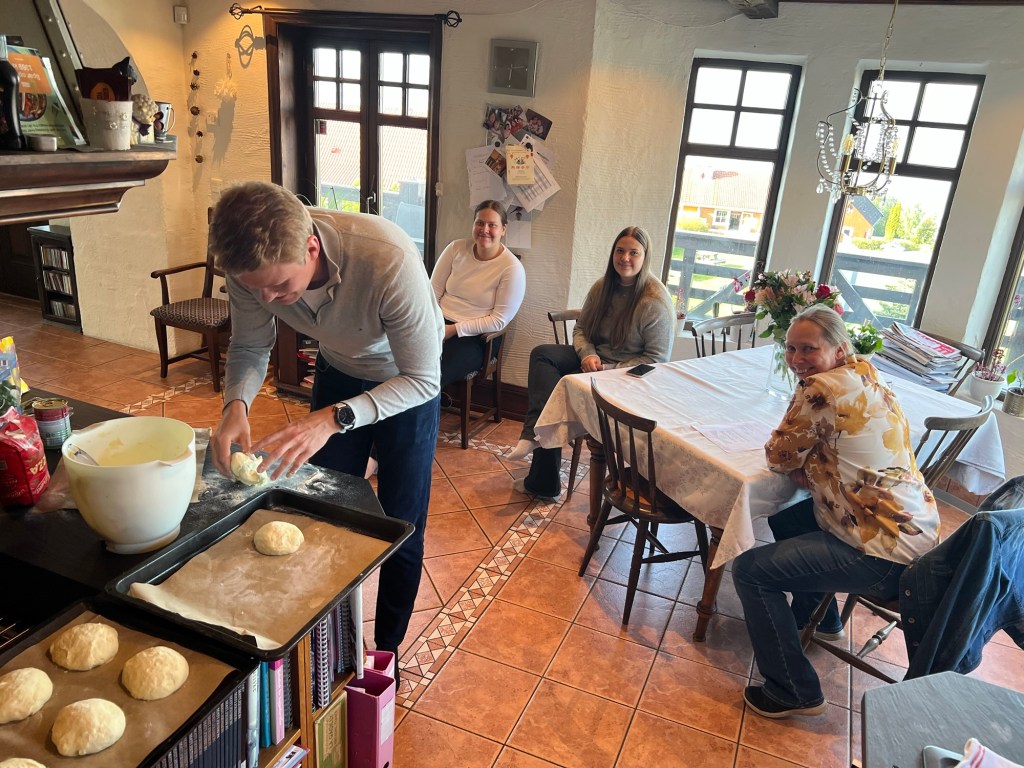
Making pizza with Iversbakken-Hanssen family in Kapp, Innlandet (from left: Raimond, Mathilde, Josefine, and Hilde) Last week, I stayed with Hilde Iversbakken and her family — the descendants of my great-great grandma Sophia’s sister Johanne. This family took such great care of me. In addition to wonderful meals and outings together, I had the privilege of hearing about their impressions of the States and the American people. Norwegian media is fairly saturated with American TV and movies, but a driving trip Hilde and her family took in 2023 changed the way they saw America. They drove from New York to Wisconsin and back again, traversing southern Canada, Detroit, Chicago, Washington D.C., Philadelphia and all points in between. They took the time to get to know the “real America”, and they’re glad they did.
Engaging in these conversations, I felt that my Norwegian relatives could see my country more clearly, more objectively than I could myself. While they were extremely complimentary of all those they met — particularly their relatives in Wisconsin — their perspective as Norwegians helped them see some of the contradictions inherent in American society, contradictions that are hard for us Americans to look at head on. I feel greatly enriched by these exchanges.
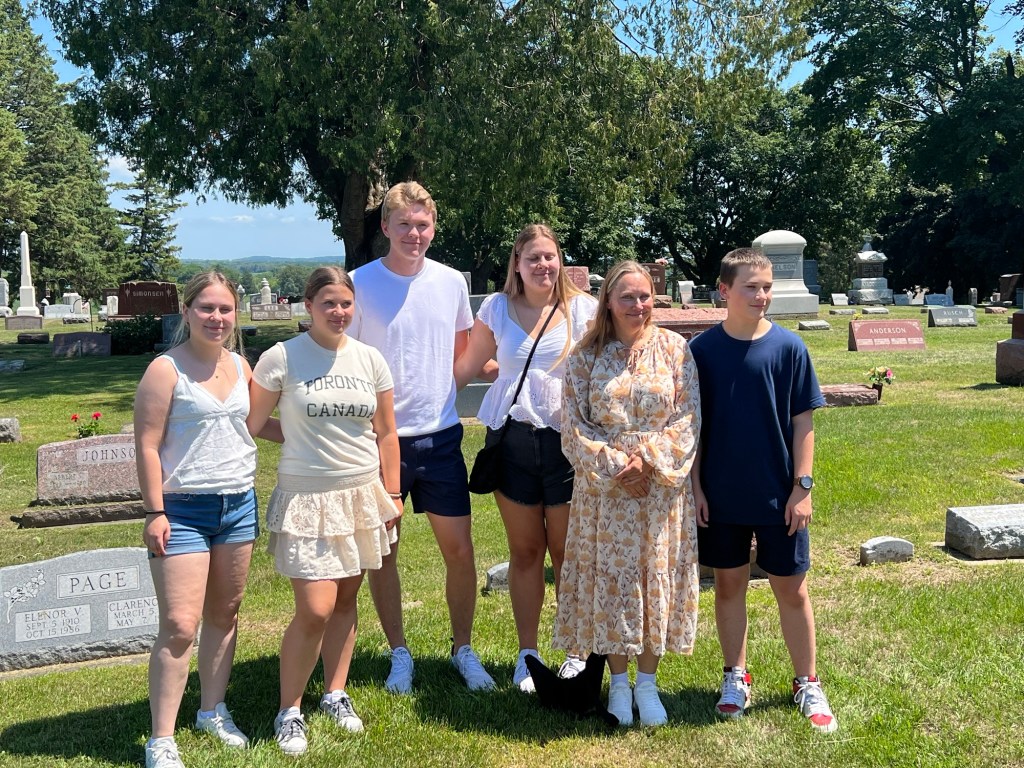
A photo from Hilde’s family’s visit to Wisconsin in 2023; cemetery at East Koshkonong Lutheran Church (from left: Kathinka, Josefine, Raimond, Mathilde, Hilde, and Kristian) A topic that came up several times in one form or another was the concept of freedom and the role of the state. In Norway, it is the government that offers individuals freedom: freedom from worry about healthcare, education and other basic needs, freedom to pursue a life not constantly concerned with making ends meet. Whereas in the U.S., the government is often viewed as the enemy of freedom. Freedom to many Americans means freedom from the government.
Similarly, my family in southern Norway who generously hosted me during the 17th of May celebrations, expressed bafflement over America’s relatively loose laws on the possession of alcohol, fireworks, and most of all, guns. Likewise to the unfettered use of large trucks, recreational vehicles, and fossil fuels. Such “freedoms”, where do they lead? To the loss of the life… the loss of freedom. Why don’t Americans see this?
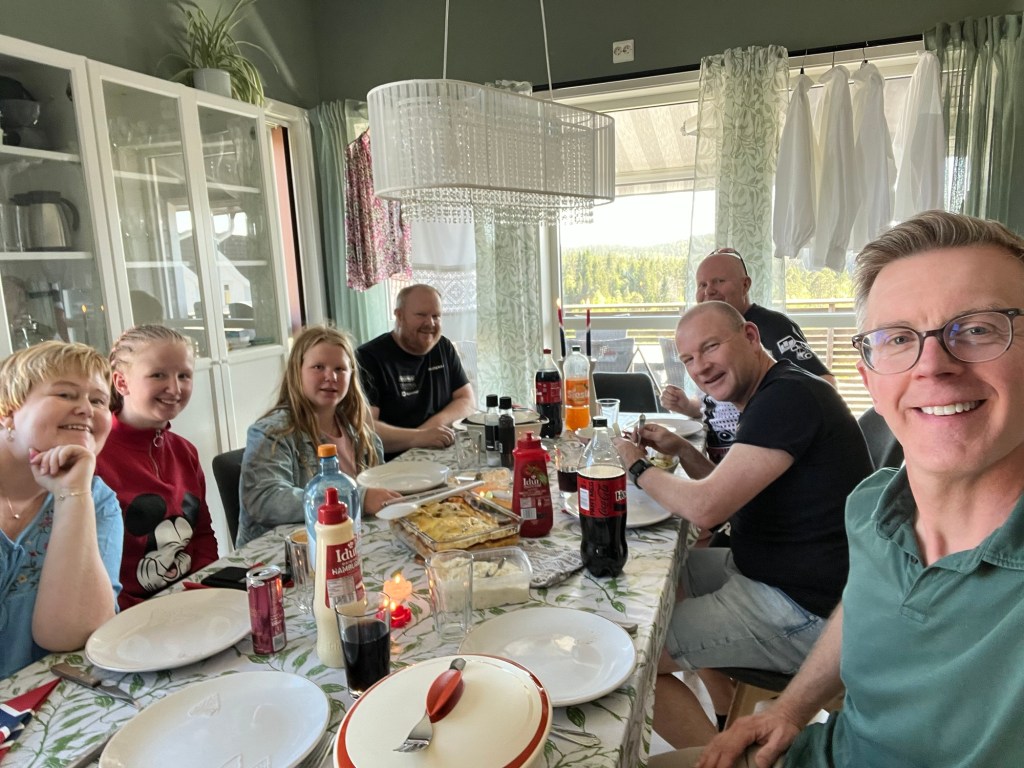
A pre-17th of May grill with the Kittelsen and Larsen families of Øvrebø, Agder (from left: Linda, Henriette, Frida, Roger, Kjell Inge, Morten and I) 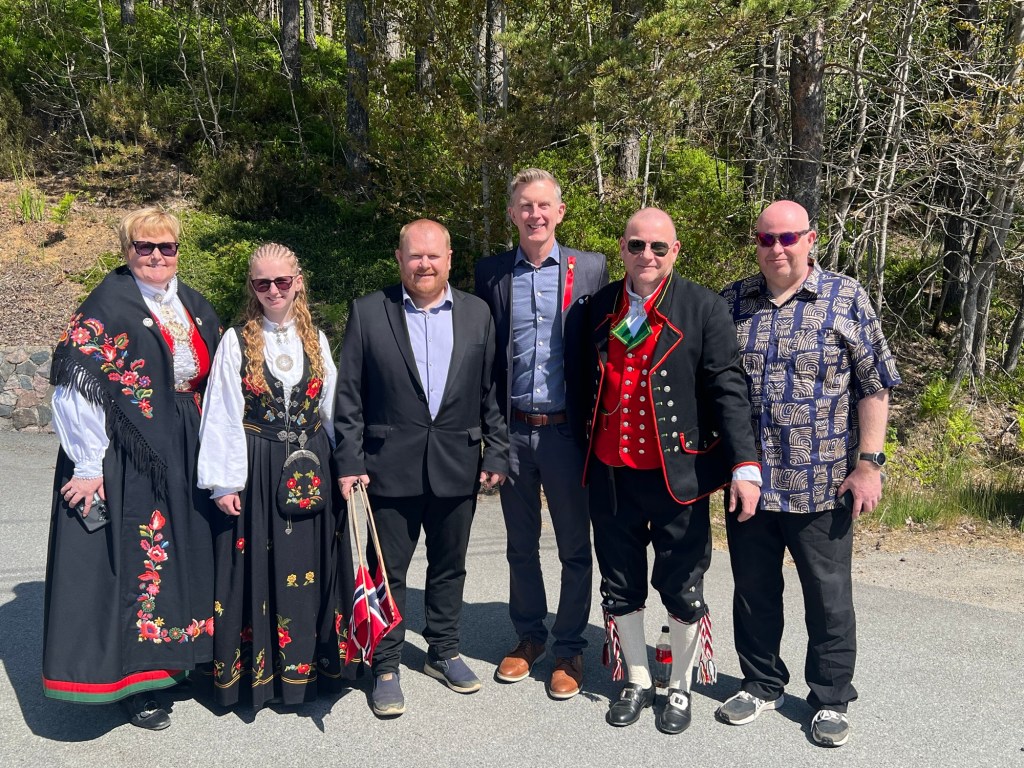
17th of May festivities with the Kittelsen and Larsen families (from left: Linda, Henriette, Roger, Jesse, Morten, and Kjell Inge) 
Experiencing “friluftsliv” (outdoor life) with my relatives in Agder on May 18th — just a little 30 km bike ride to work off the cake we ate on syttende mai (from left: Kjell Inge, Roger, and Alf) One of my relatives paraphrased a Norwegian commentator: “Great freedom requires great responsibility. Without responsibility, freedom is egoism.” I thought this was insightful and underscored the difference in each society’s approach to the concept. Norwegians generally trust their government to provide reasonable boundaries within which they can enjoy their freedoms. For many Americans, however, that trust is greatly eroded, and for those who lack trust in the government any such responsibilities get labeled as roadblocks to their freedom.
The gulf between Norwegian Americans’ and Norwegians’ political views is larger than is typically admitted. Many of us in Minnesota, for instance, like to think we’re running our state in a more Scandinavian style. But while our state taxes may be a little higher and our welfare a little more generous than our neighbors’, I just don’t see the kind of collectivist ethos that exists in Norway.
Somewhere along the way — perhaps especially during the Second World War — Norwegians learned that if they don’t stick together and trust one another, they won’t survive. But I wonder if Norwegian Americans, like Americans more generally, took away the opposite lesson — perhaps from decades of living in the low-trust environment of the western frontier. The American ethos is more along the lines of: if we don’t look out for ourselves, no one will. Despite Norway and America’s many cultural and historical links, this difference is as wide as the Atlantic itself.
***
Am I overgeneralizing? Have a different perspective? I would love to hear it. Please add your thoughts to the comment section!
Øvrebø, Bjørn Enes, Crossings, emigration, Førde, freedom, Greibesland, Hansen, immigration, Memoar, Minnesota, musing, nasjonalbiblioteket, Norsk utvandrermuseum, Norway, Norwegian history, Norwegian National Library, politics, Restauration, St. Olaf College, Stavanger Maritime Museum, U.S. history, utvandring -
Norway’s scattered children (part 1)
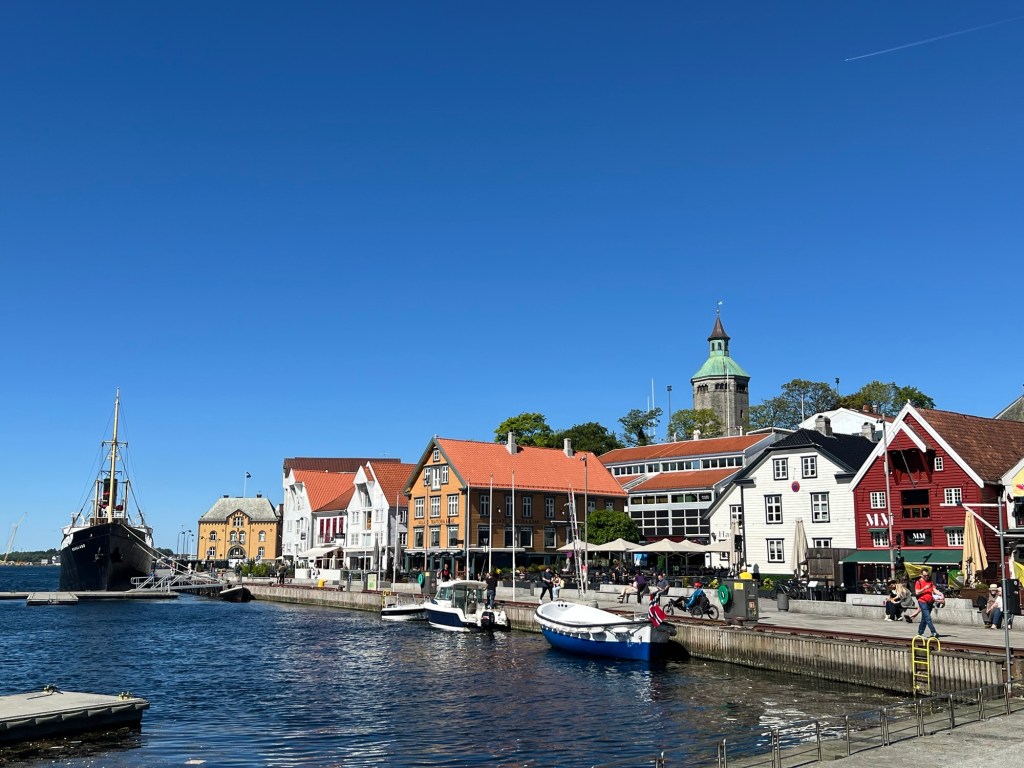
Two hundred years ago this year, a small ship set sail from Stavanger, Norway bound for New York City with 52 passengers and crew. This was Norway’s “Mayflower moment”.* Who could have guessed that over the coming century the number of migrants from Norway to the United States would reach nearly a million?
The wharf in Stavanger from which the sloop Restauration set sail for the U.S. in 1825 The Norwegian diaspora stretches far beyond the U.S., as Norwegian migrants have settled on every continent (see this link). But the American Midwest – particularly states like Wisconsin, Iowa, Minnesota and the Dakotas – became a kind of second homeland for hundreds of thousands of Norwegians. Those personal ties to Norway are increasingly distant today, as the immigrant generations fade from memory. But a handful of institutions in the Midwest are working hard to preserve this history and revive those ties (see especially Norway House and Sons of Norway in Minneapolis, MN, the Norwegian American Historical Association in St. Olaf, MN, Vesterheim in Decorah, IA, and the Norwegian-American Genealogical Center & Naeseth Library in Madison, WI).
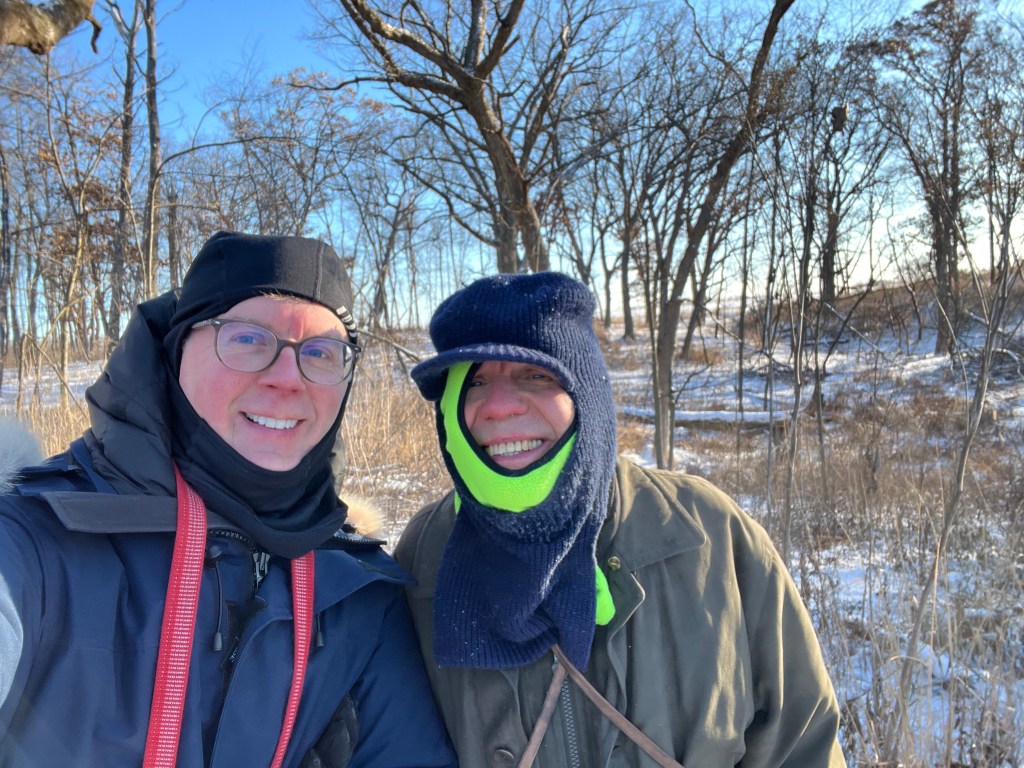
Uncle Phil and I at Silverwood County Park, just north of Lake Koshkonong in southeastern Dane County, Wisconsin My Uncle Phil and I visited one such institution, Livsreise, on January 23rd of this year. After walking our dogs through a park near Lake Koshkonong — on quite possibly the coldest morning of the year! — we drove to Stoughton, Wisconsin to take in the museum. Livsreise (Norwegian for “life’s journey”) focuses on the physical and cultural journey undertaken by Norwegian immigrants, as well as on the impact those settlers had on their adopted home. Uncle Phil and I were reminded in exhibit after exhibit of the resourcefulness of these hardy settlers, and the immigrant stories featured in the displays recalled similar stories passed down in our family.
But the museum made me wonder: Is there anything particularly “Norwegian” about today’s Norwegian Americans? As a rule, we don’t speak the language and have little contact with the culture, aside from an occasional nod to our roots at holiday meals. (For a hilarious take on Norwegian Americans by a Norwegian television program, check out “Alt for Norge”: https://youtu.be/EjY4AirrdLw?si=inNTUKuxZvx77reS). You might have an auntie who still knows how to make krumkake or paint in the rosemål style, but that’s increasingly rare.
Last month I went in search of this culture in what had been America’s largest Norwegian community — Bay Ridge in Brooklyn. In 1940, this part of NYC was home to the third-largest concentration of Norwegians in the world, after Oslo and Bergen. I had read online that the neighborhood’s beloved Norwegian bakery, Leske’s, had changed ownership and was now an Italian bakery called Il Fornaretto which still sold Norwegian favorites. Sadly, this is not the case. I did find a lovely bakery, but there’s nothing Scandinavian about its offerings. Similarly, there’s almost no trace of Norwegian culture in the surrounding community. Walking the length of 8th Avenue — once nicknamed Lapskaus Boulevard after the stew favored by Norwegian residents — I found few hints of a Norwegian-American past. Today 8th Avenue is a vibrant Chinatown.
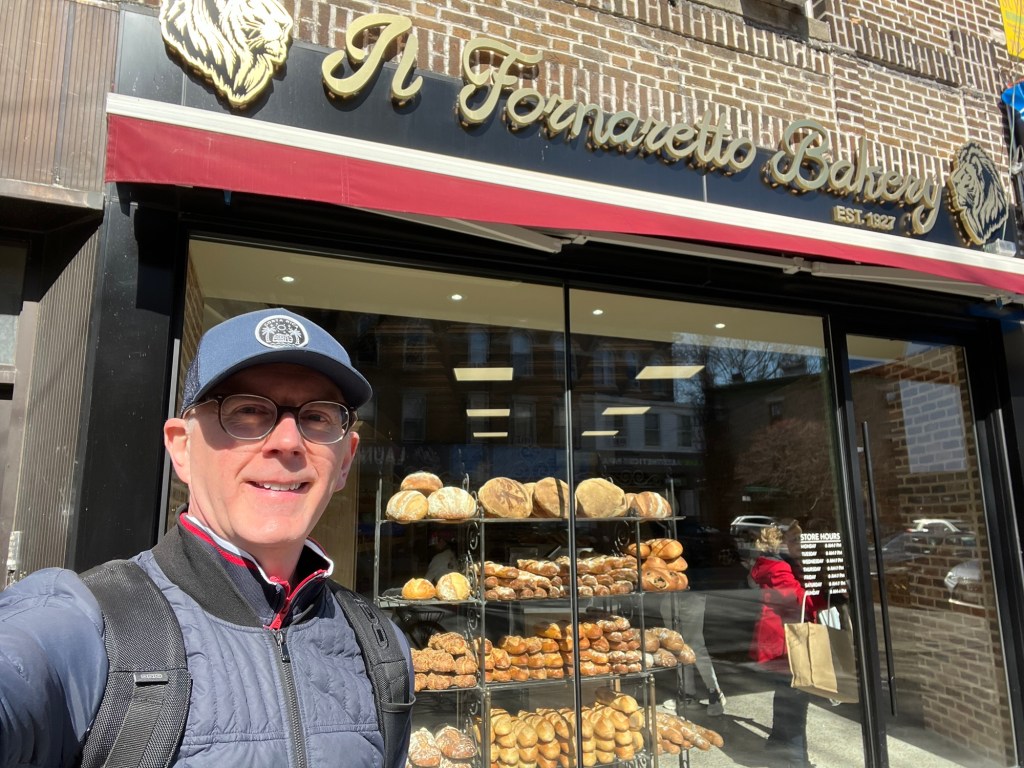
The former Leske’s 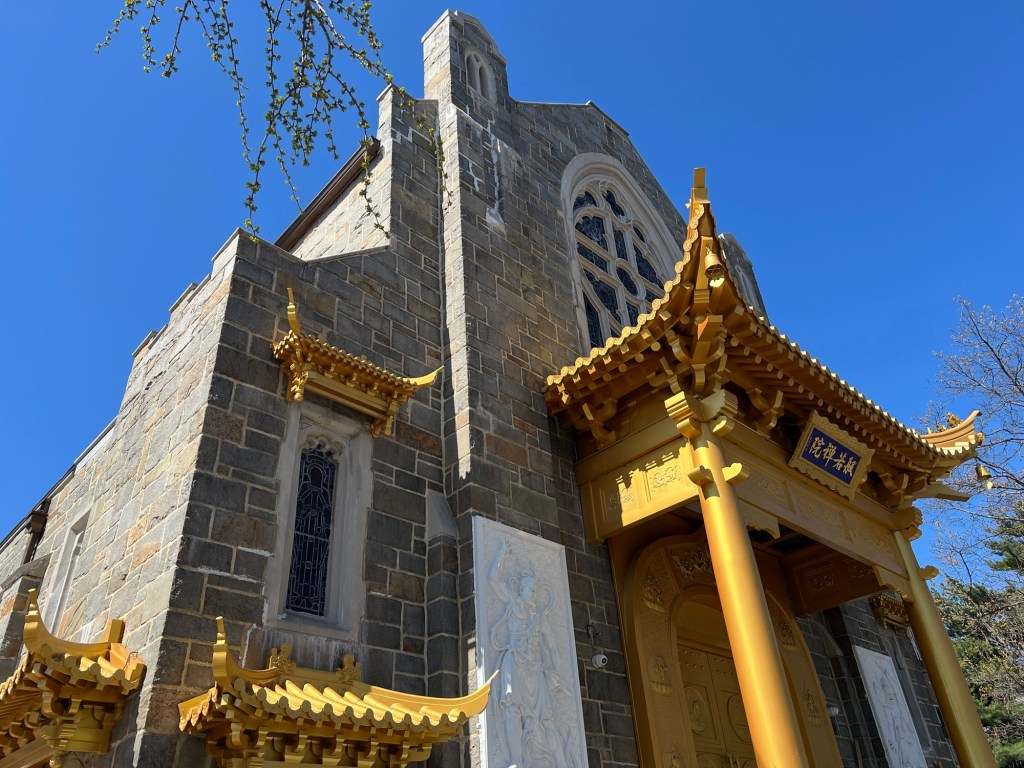
A church converted to a temple 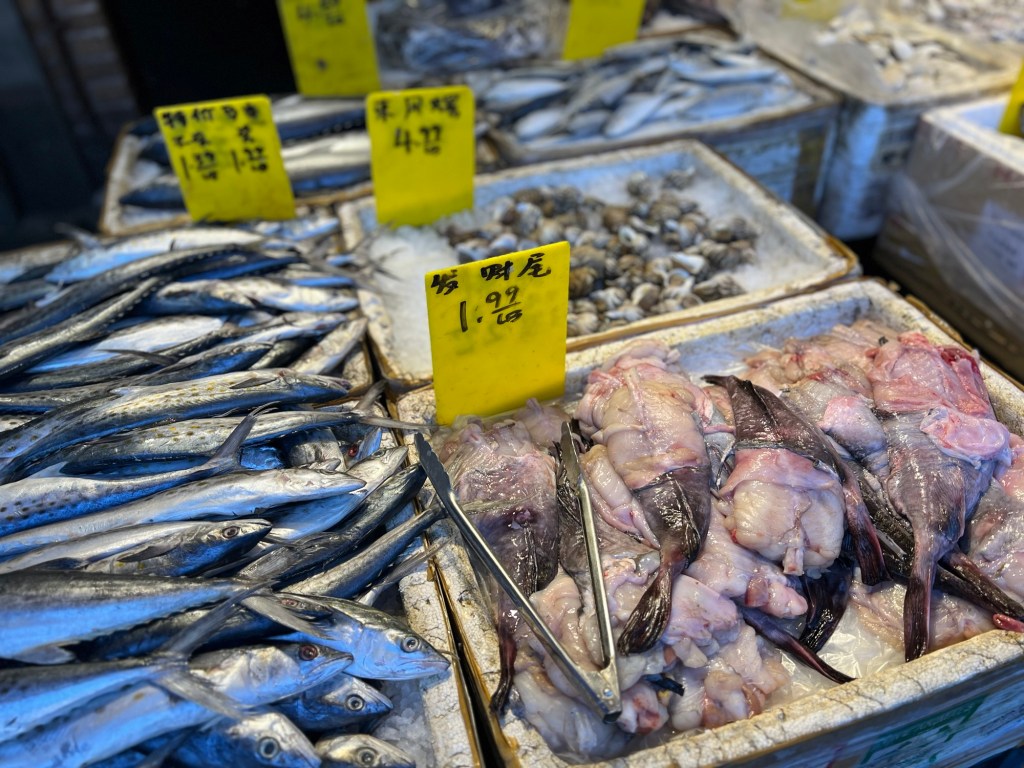
A Chinese fish market 
8th Avenue in Brooklyn Faint echoes of Brooklyn’s once thriving Norwegian community are all that remain.

An Irish tavern flies a Norwegian flag 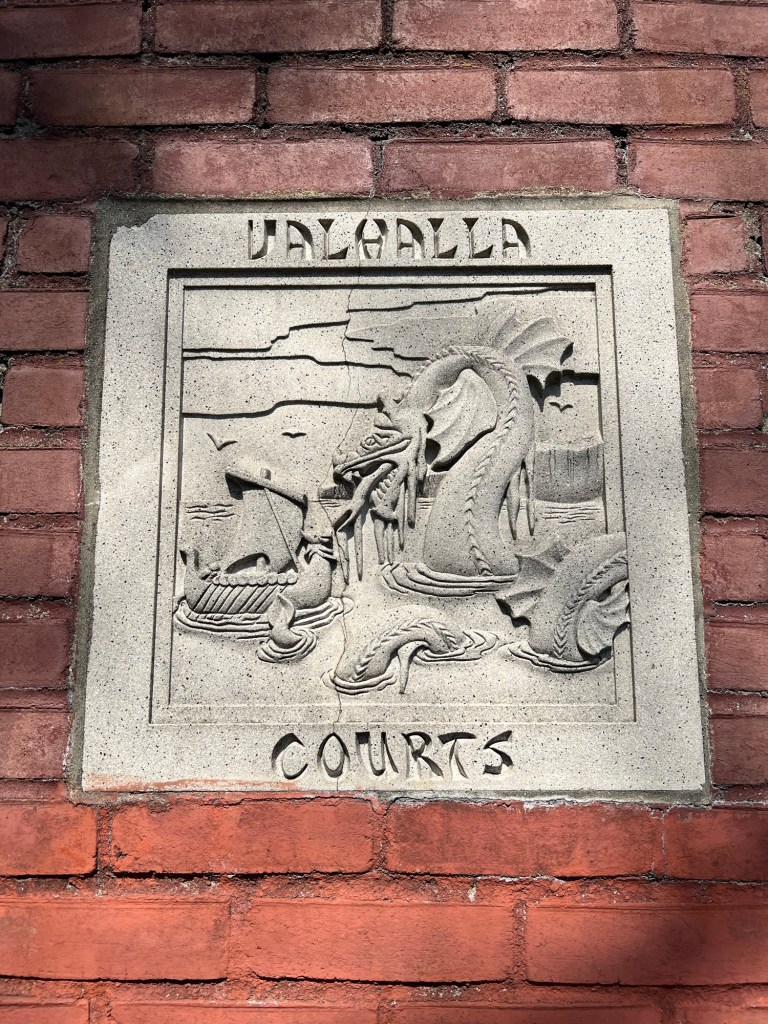
Valhalla Courts at Leif Ericson Park 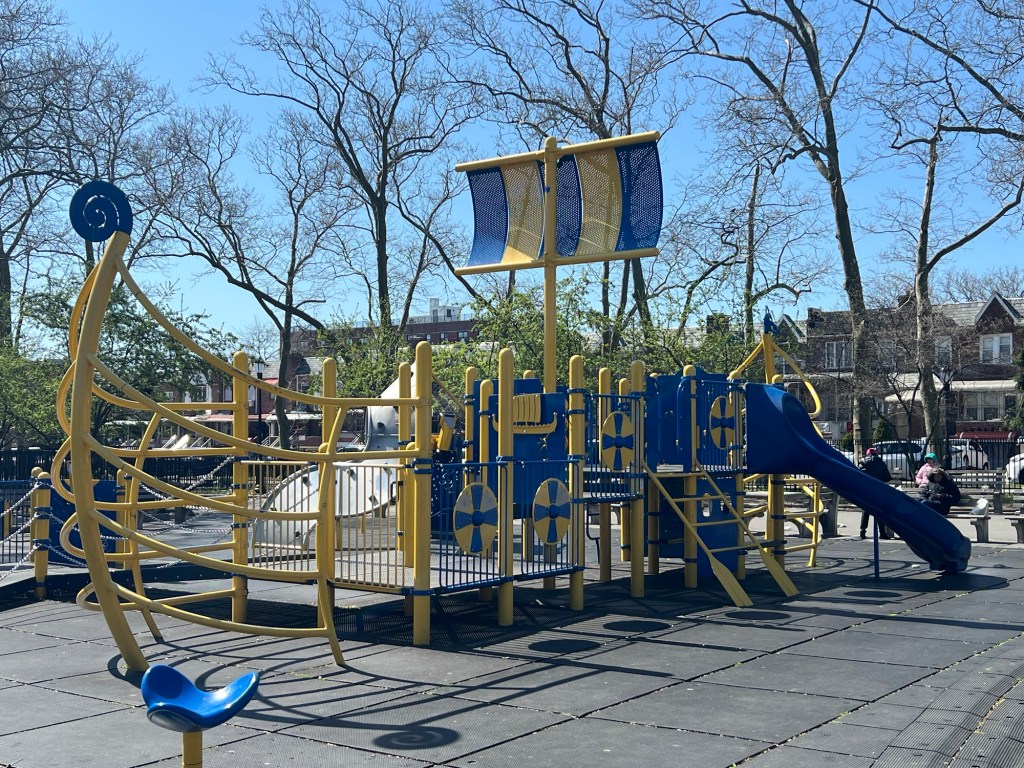
A play structure in the shape of a Viking longboat 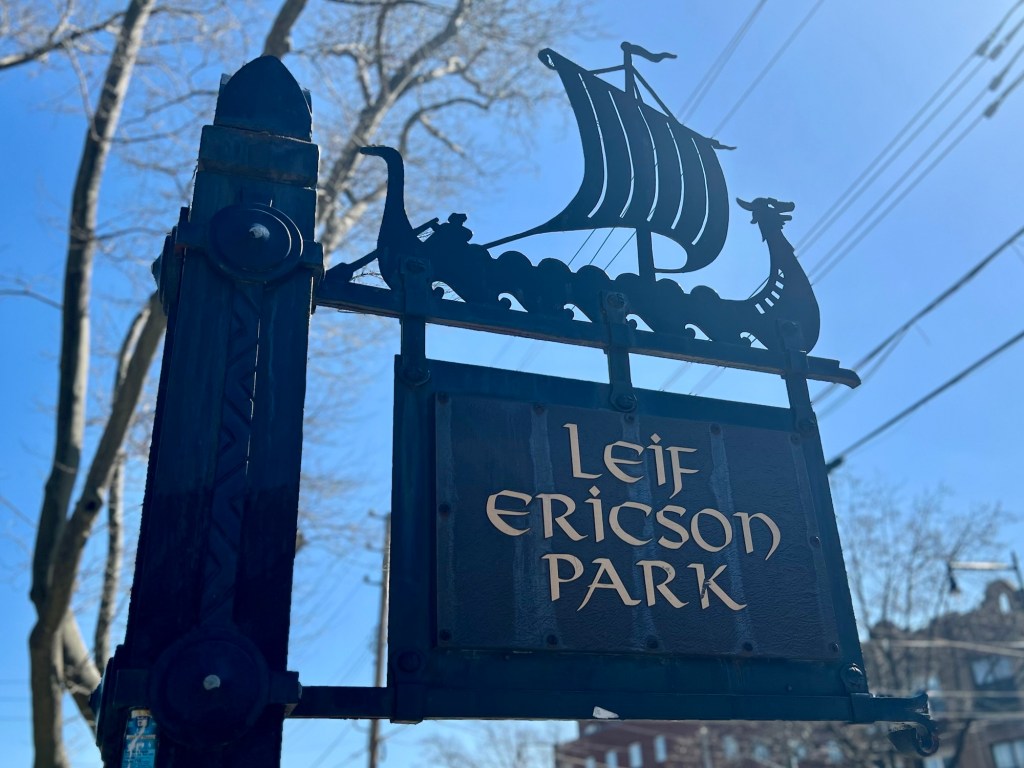
Leif Ericson park sign 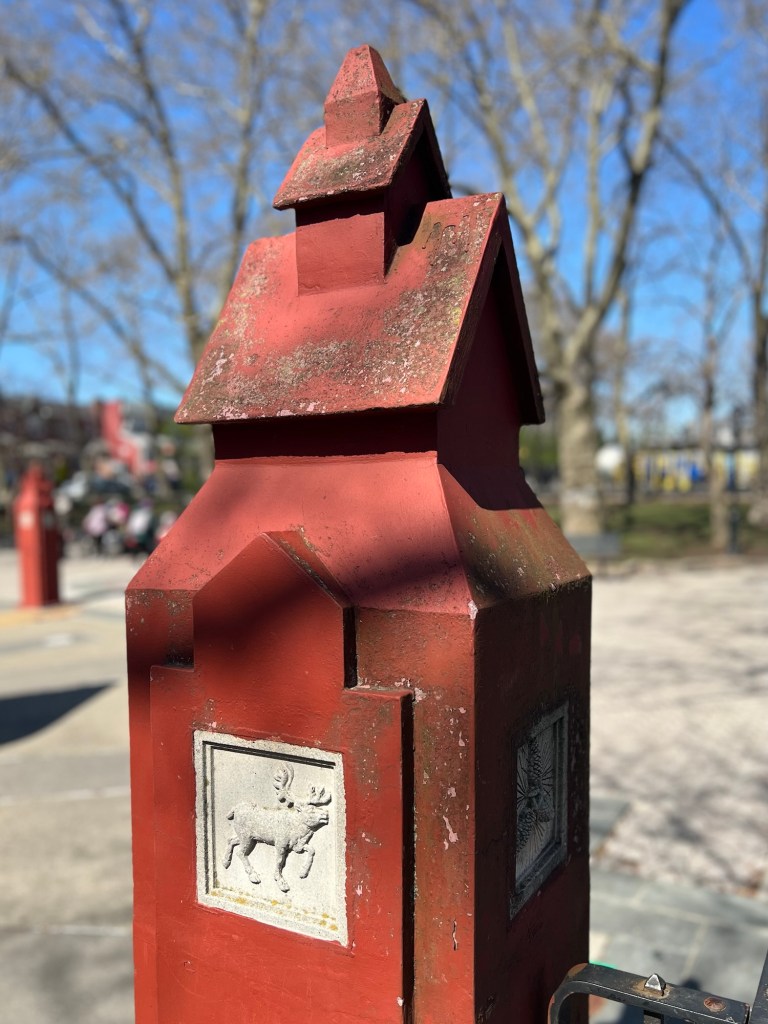
Decorative post in the shape of Borgund Stavkirke 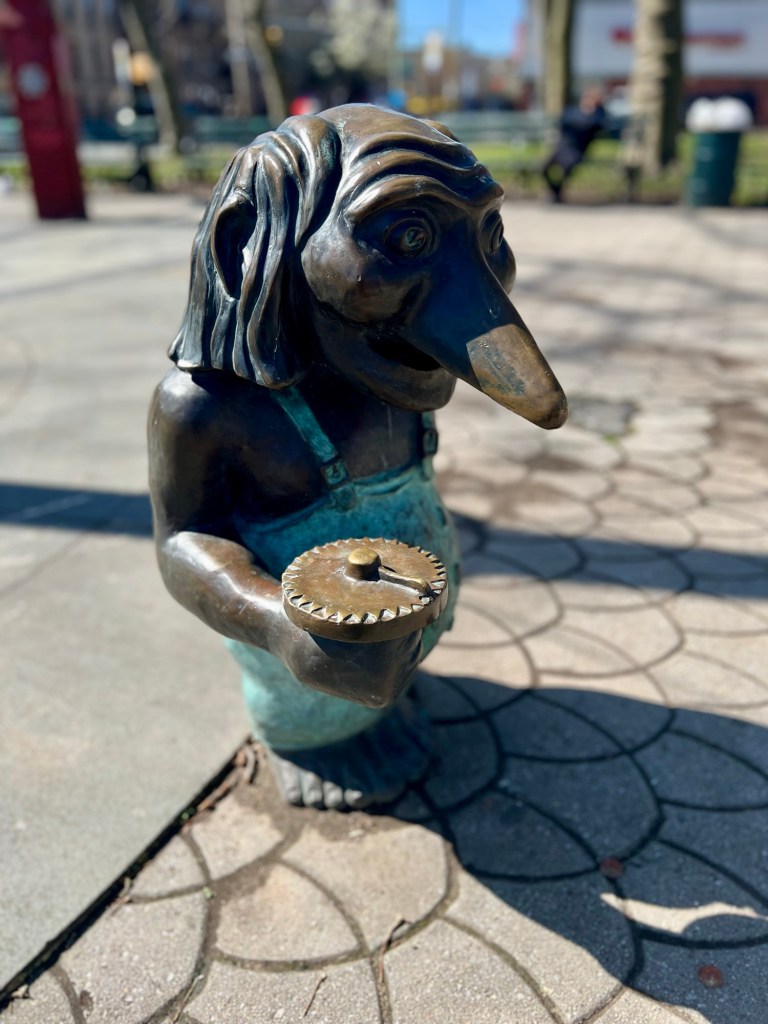
A troll! 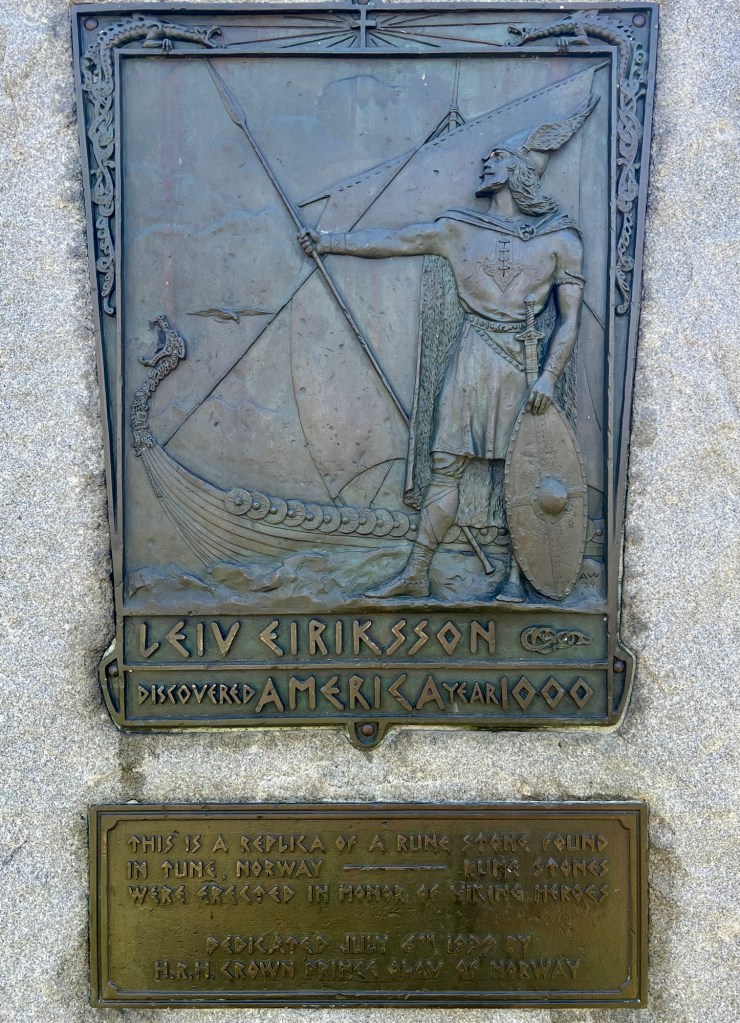
This stone was dedicated by Crown Prince Olav in 1939 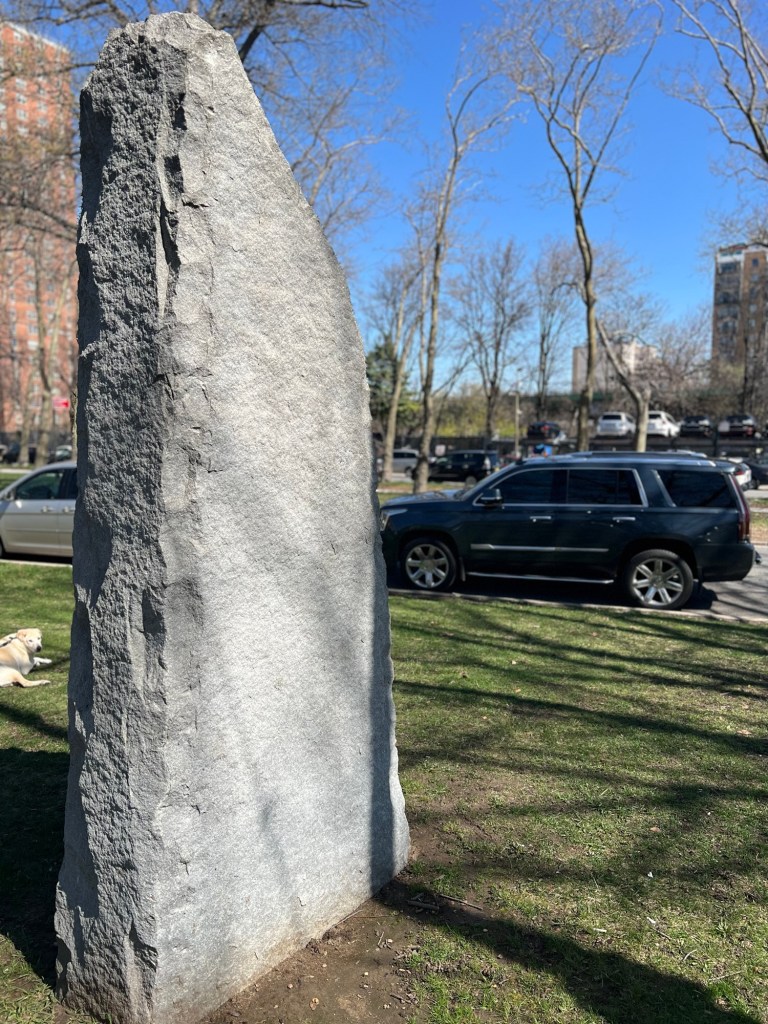
Replica of the rune stone found in Tune, Norway (Leif Ericson Park) In addition to being generally hard to find, Norwegian-American culture is arguably quite different from Norwegian culture. The separation of Norwegians from the motherland at a particular moment in history (mid-1800s to early 1900s) led to interesting divergences. Food culture provides some pertinent examples.
The two foods that many Norwegian Americans associate with their culture – the flatbread known as lefse and the preserved fish known as lutefisk – became less prominent in Norway once the economy improved in the early 20th century. These were, after all, foods rooted in the poverty of 19th century Norway.

Conversely, many of the food traditions that Norwegians most strongly associate with their culture – from cheese slicers to skolebrød (a sweet roll with custard and coconut) – are hard to find in a Norwegian-American kitchen, as these traditions came after the exodus. Americans of Norwegian ancestry tend to ignore these cultural divergences, let alone the differing political and religious views of their cousins across the pond.

The ostehøvel (cheese slicer) was invented by Thor Bjørklund in 1925. This one was a gift from my distant cousin, Gry Lindalen. 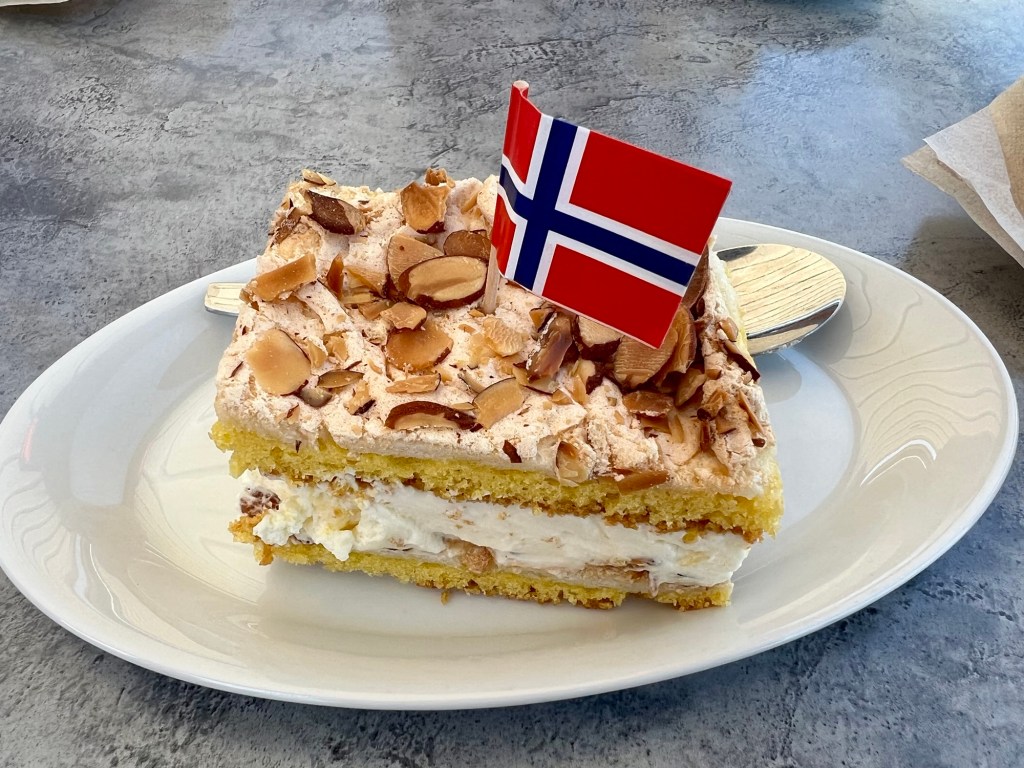
Another example of something hard to find in a Norwegian-American kitchen: kvæfjordkake aka “verdens beste” (world’s best cake). Invented in the 1930s and popularized in the 1970s. This is a slice I enjoyed with my family in Gjøvik. (For more info, see https://www.bbc.com/travel/article/20230825-kvfjordkak-norways-best-cake) Norwegian-American ethnicity is something sociologists like Herbert Gans, Richard Alba and others have termed a “symbolic ethnicity” — an ethnic identity that some people (e.g., white Americans) have the luxury of playing up or playing down as they see fit. One does not need to speak the language or have particular cultural knowledge to claim a symbolic ethnicity. One can simply opt in when it suits. Such asserted ethnic identities exist in stark contrast to ascribed ethnic identities: ethnicities that don’t just get trotted out around the holidays, ethnicities with deeper consequences for daily life.
Personally, this characterization of Norwegian-American ethnicity feels apt. And social observers during the immigrant era often commented on the ability and willingness of Norwegian immigrants to assimilate quickly. For instance, Norwegian scholar Ole Munch Ræder visited Wisconsin in 1847 and remarked that as soon as young men from Norway gain some success “they at once become strangers to their less fortunate countrymen and are very loath to admit their Norwegian origin.”**
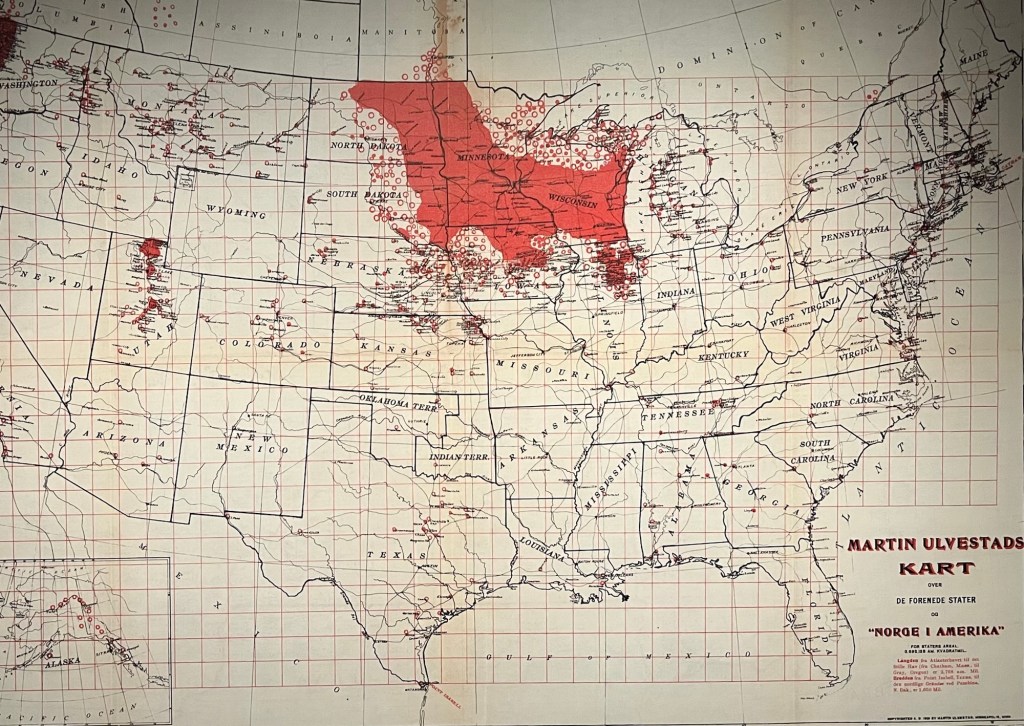
“Norge i Amerika” — a map from the early 1900s by Martin Ulvestad. This is part of a current exhibit at the National Library in Oslo called “Rett vest: Drømmer om et bedre liv i Amerika” (Due west: Dreams of a better life in America). Still, I find it interesting that after a century of very little immigration from Norway and after 200 years of successful assimilation efforts, there is still some ethnic feeling left among the Norwegian Americans. My hypothesis — unchecked by any real data or analysis — is that Norway’s major emigration period coincided with its nationalist movement, resulting in a critical mass of immigrants with nationalist sentiments. In this regard, Norwegian Americans may be more similar to German, Italian or Irish Americans than they are to their fellow Scandinavian Americans, as a national consciousness in Denmark and Sweden arose more gradually in the centuries prior to mass emigration. (What do you think of this hypothesis? Feel free to comment below!)
So far, I’ve contemplated the Norwegian diaspora from an immigrant-centric (and America-centric) perspective. But one country’s immigrants are another’s emigrants. To what extent does the diaspora figure into Norwegians’ collective imagination of their own history? And how do Norwegians think of their relatives in America? I’ll turn to these questions in a follow-up post.
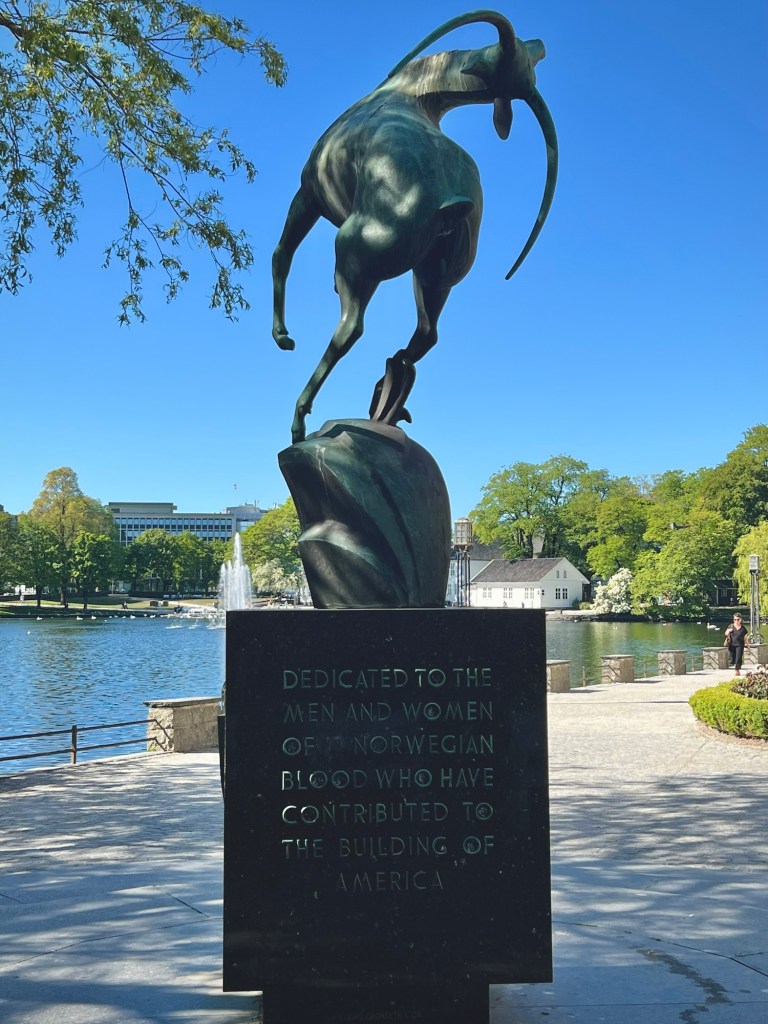
Memorial in Stavanger “dedicated to the men and women of Norwegian blood who have contributed to the building of America”
* Semmingsen, Ingrid. 1978. Norway to America: A History of the Migration. University of Minnesota Press.
** see p. 49 in Fapso, Richard J. 2001. Norwegians in Wisconsin. Wisconsin Historical Society Press.
American Midwest, assimilation, Crossings, diaspora, emigration, ethnicity, food culture, history, identity, immigration, Livsreise, musing, nasjonalbiblioteket, Norway, Norway House, Norwegian American Historical Association, Norwegian Americans, Norwegian National Library, Norwegian-American, Norwegian-American Genealogical Center and Naeseth Library, Restaurasjonen, social history, Sons of Norway, St. Olaf, Stavanger, symbolic ethnicity, Vesterheim -
Bertha Thorpe Veum and her family from Nes
As I mentioned in a prior post, my biological great-great grandfather, Erik Veum (1864-1942), made a journey back to Norway in 1921 with two of his daughters. Erik’s wife Bertha (1864-1937) did not accompany them. Perhaps she had less reason to travel. Unlike Erik, who had left many family members behind when he emigrated, Bertha brought Norway with her.
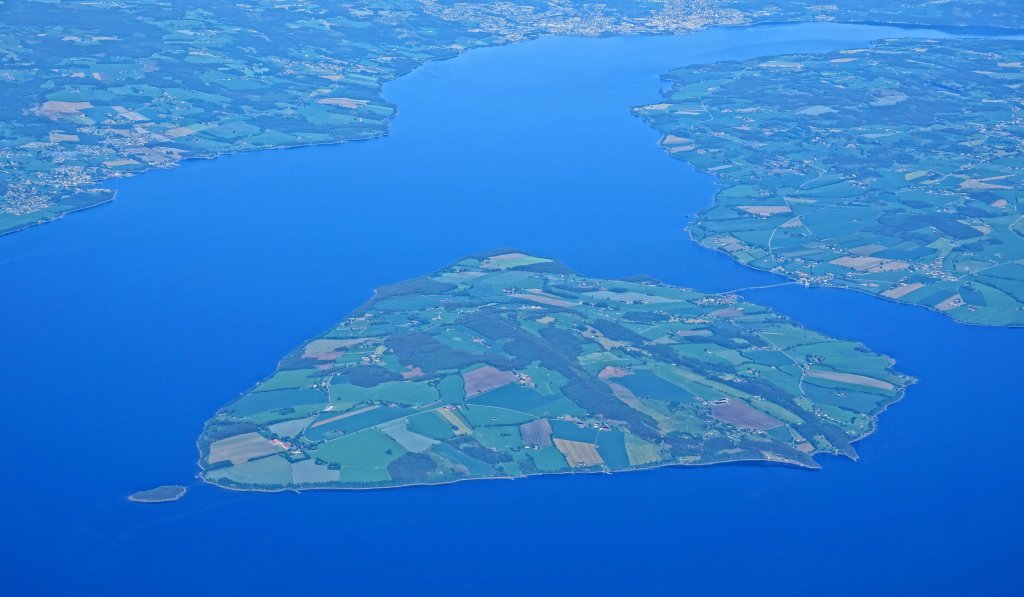
Aerial view of Helgøya and southern Nes (looking northwest); photo by Bjørn Christian Tørrison; downloaded from Wikipedia Bertha was one of seven daughters born in Nes Parish to Agnete Kristiansdatter (1831-1930) and Augustinius Bredesen Thorpe (1834-1912). In order of birth, they were: Dina, Mathea, Bertha, Gina, Andrine, Caroline and Anna. All seven of Agnete and Augustinius’s daughters emigrated as young adults to Wisconsin’s Rock and Dane counties in the 1880 and 90s. Agnete and Augustinius joined their children there in 1891. I believe that Bertha’s sister Mathea was the first in the immediate family to begin this chain migration, arriving in 1882, but other relatives preceded her in 1880 (see below). Around 1882, Erik Veum left Nes for Kristiania (Oslo) and probably departed for the US in 1883. It seems likely that Bertha followed in 1884, and they married in Wisconsin in 1885.
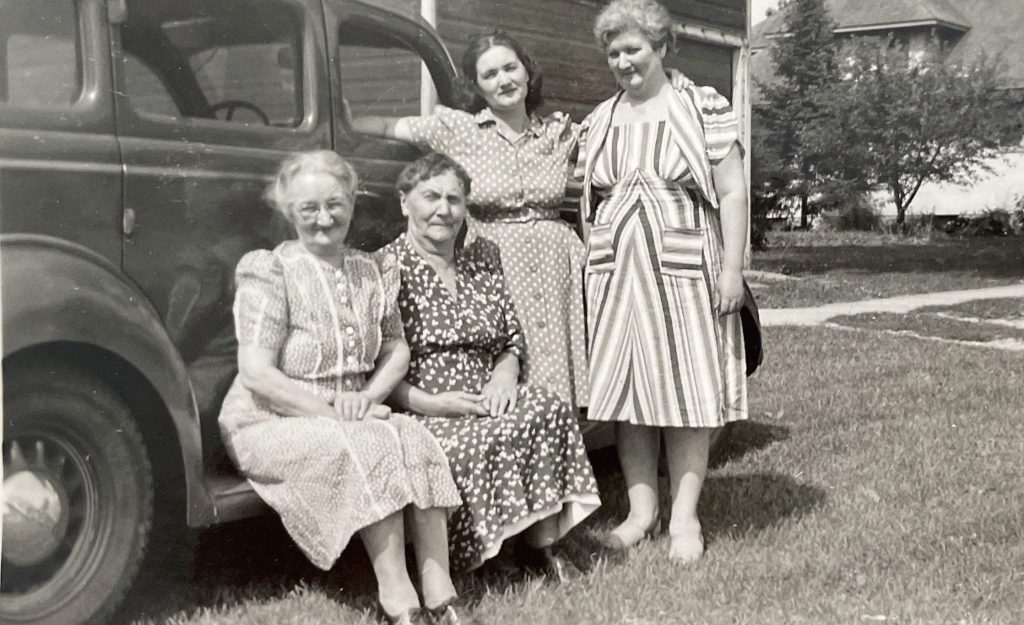
Gina Thorpe Christopherson (1867-1953), Bertha’s sister, is seated second from left (photo downloaded from Ancestry.com) Bertha’s father Augustinius was a husmann (tenant farmer) and kvegrøkter (cattle rancher) who grew up on Helgøya – the island in Lake Mjøsa. We do not know much about either Augustinius or Agnete,[1] but the fact that their seven daughters were born on four different farms suggests to me that they struggled to find consistent employment. Their first daughter, Dina, was born two years before Agnete and Augustinius married in 1860. But Dina was not Augustinius’s first child; in the year before Dina was born, Augustinius fathered two children by two other women.[2]
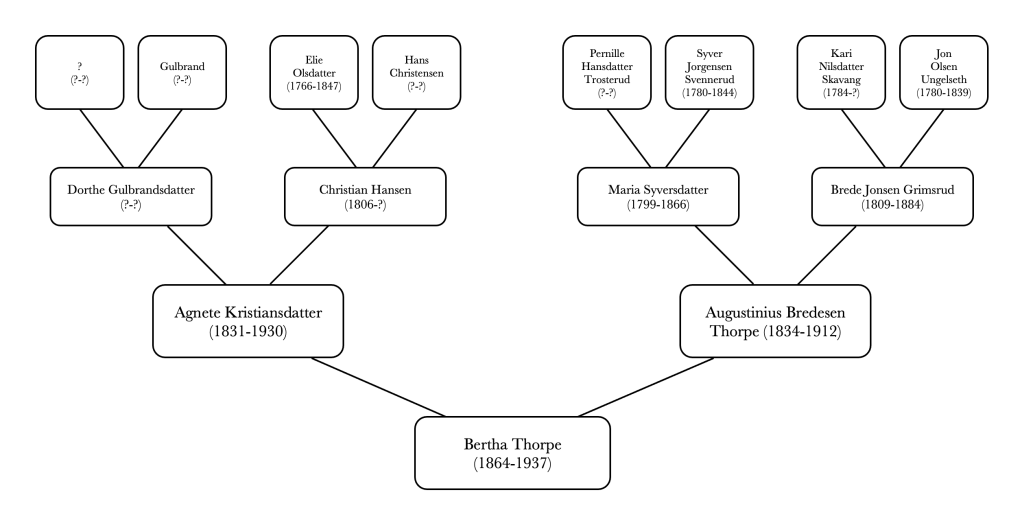
Pedigree chart for Bertha Thorpe Veum
(To see where this fits into my family tree, see Chart J on this page)The historical record tells a similarly complicated tale for Augustinius’s parents, Maria Syversdatter (1799-1866) and Brede Jonsen (1809-1884). Both Maria and Brede were born and raised on Helgøya. Maria was widowed after only three years of marriage to her first husband, Tor Andersen, and qualified to receive flour rations to support herself and her two young sons. She gave birth to a third child two years after Tor died. In 1830, Maria married Brede Jonsen, who had served as a soldier and apprenticed to be a shoemaker.
Maria and Brede went on to have seven children together, including Augustinius (Bertha’s father). Augustinius was born on the Maurud farm, but some of his siblings were born on the Grimsrud and Fjeld farms. After Maria died in 1866, Brede remarried and had two more children with his second wife, Tolline Jonsdatter. In 1883, Brede and Tolline qualified for poverty relief, and a year later Brede hanged himself. Tolline died the following year.
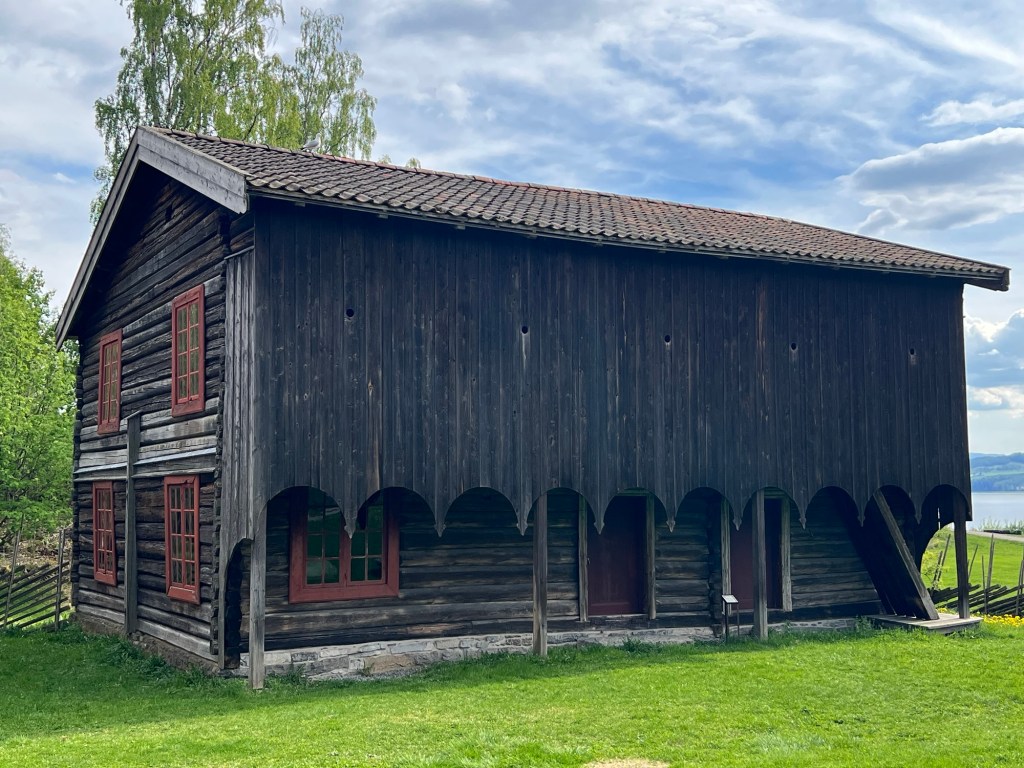
The main building from the Grimsrud Farm (built in 1775 and moved in 1906 to the grounds next to the Hamar Domkirke — the first building of the Hedmarksmuseet) 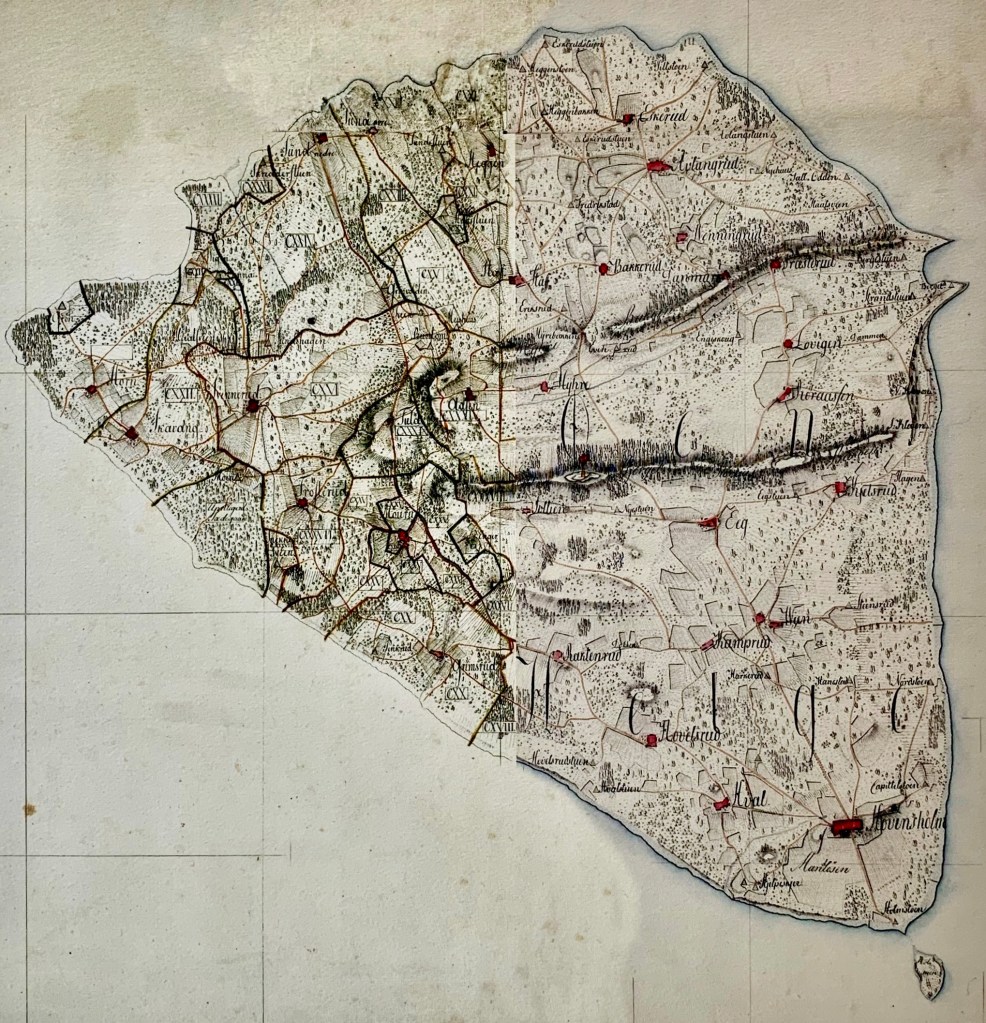
1806 map of Helgøya (Source: https://nesoghelgoyahistorielag.no/2019/04/26/kart-over-helgoya-1806/) If you have followed this so far, I commend you. It’s a confusing story. Details from those last three paragraphs were pulled from Kolstad’s Nes bygdebok, which provides a surprisingly comprehensive account of the family’s history. But the bygdebok actually missed one of Brede’s children. A year before he married Maria in 1830, Brede had a child out of wedlock with a woman named Pernille Iversdatter. This child, Johannes Bredesen, went on to marry Lisbeth Torgersdatter and have seven children of their own. Three of those children settled in or near Edgerton, Wisconsin – i.e., the same area where Erik and Bertha Veum settled. And the first of these to emigrate was Johannes and Lisbeth’s daughter Amalie, who came over in 1880. Johannes and Lisbeth ended up emigrating in 1886 and brought their two youngest children with them.[3] Thus, Bertha had several cousins (as well as sisters) living in the area when she and Erik established themselves in Wisconsin.
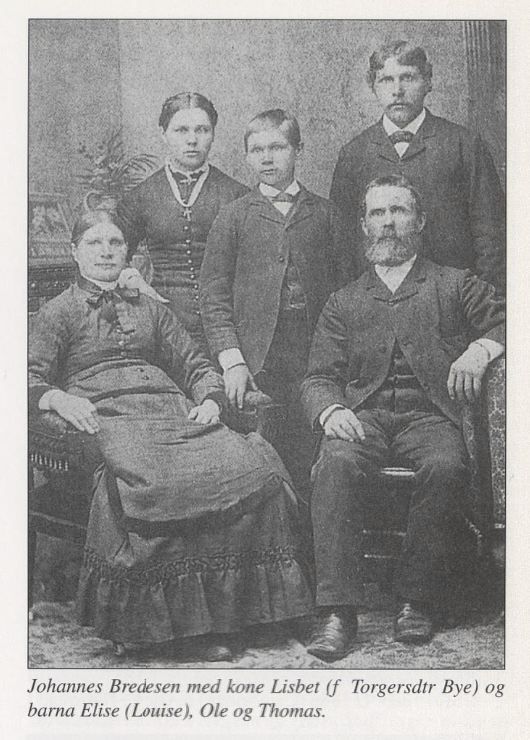
Above: Johannes Bredesen family of Edgerton, Wisconsin. Johannes was Augustinius’s half-brother. Reprinted from p. 121 of Nes og Helgøya: Utvandring til USA og Canada i tekst og bilder. 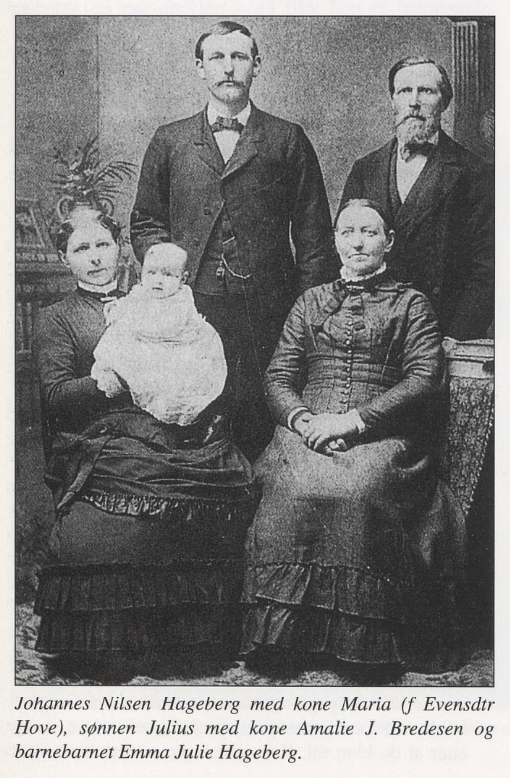
The young woman on the left is Amalie J. Bredesen, daughter of Johannes Bredesen (see prior photo). This family arrived in 1880 and lived in Utica, Wisconsin. Reprinted from p. 122 of Nes og Helgøya: Utvandring til USA og Canada i tekst og bilder. There is so much that is unknown to me about Bertha Thorpe’s family, including why they chose the surname Thorpe upon arrival in the US. I haven’t found evidence that they had lived on a farm of that name in Nes, but there is a bruk called Torp on the Østdal farm. It’s possible some family members worked there before emigrating; although the 1875 Census shows the family living on the bruk called Ramsberg on the Sølsberg farm.
I drove through this area earlier today (May 14, 2025) and took some photos of the countryside. Explorations like this don’t typically yield genealogical insights for me, but they do give me a sense of the place folks came from. Most of the buildings here appear to have been built in the last 100 – 150 years, but it’s not hard to picture what life was like before that. The local economy remains solidly agricultural. If they could see it today, Bertha Thorpe and her ancestors would be amazed by the changes in Norway’s farm technology, but they might be comforted to see that the pace of life in Nes and Helgøya hasn’t changed too drastically.
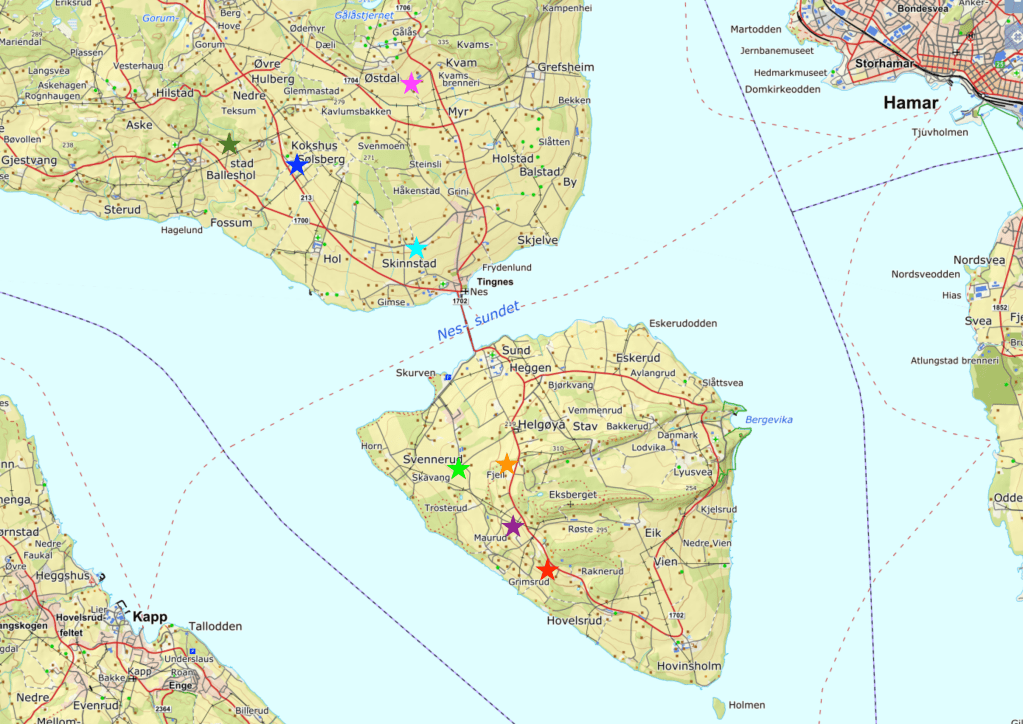
Dark green = Kolden (Bjørnstad), Dark blue = Ramsberg (Sølsberg), Pink = Nedre Østdal, Light blue = Mølstad, Light green = Svennerud, Orange = Fjeld, Purple = Maurud, Red = Grimsrud 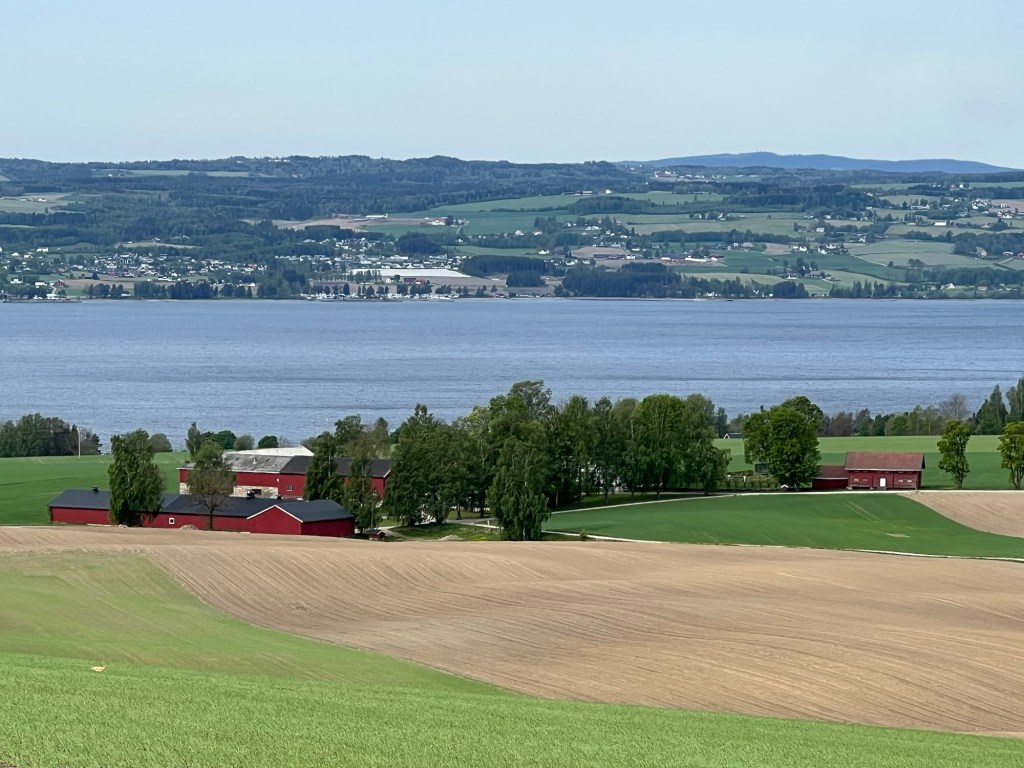
Svennerud 
Fjeld 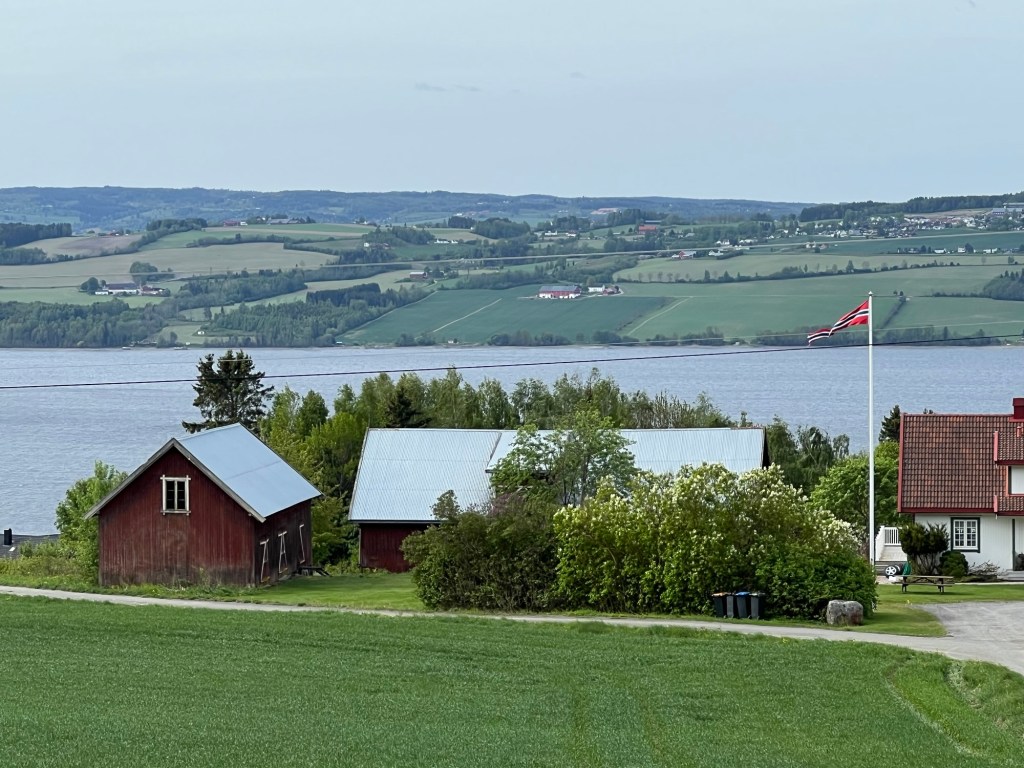
Maurud 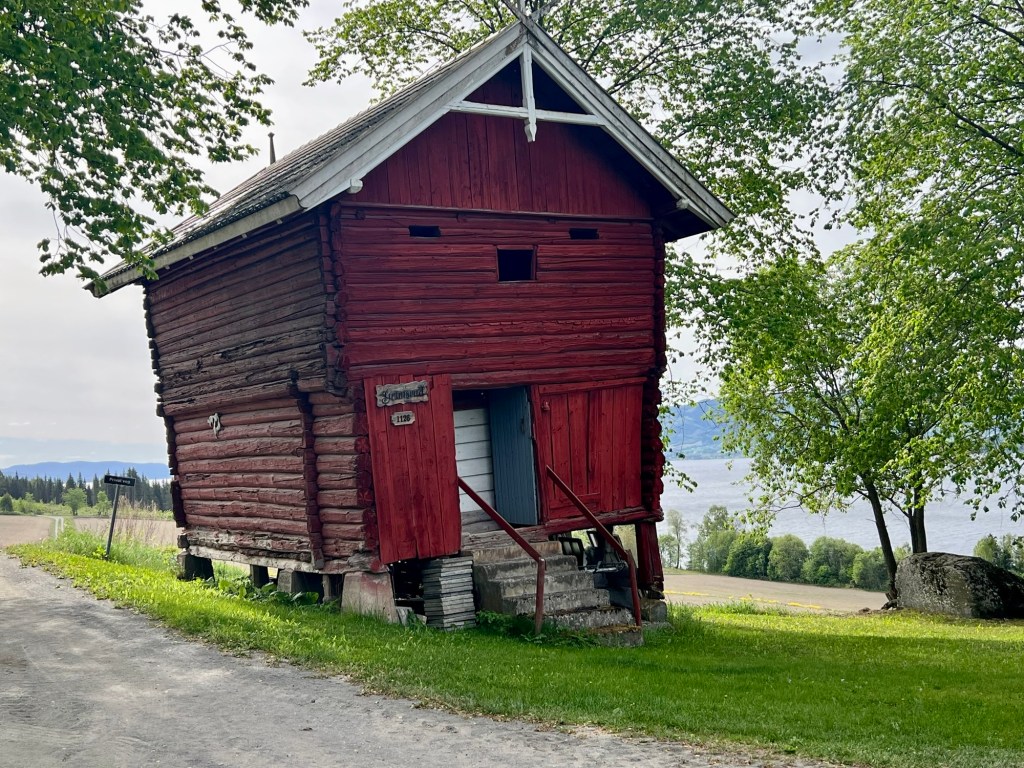
Stabbur (store house) at Grimsrud Helgøya Farms 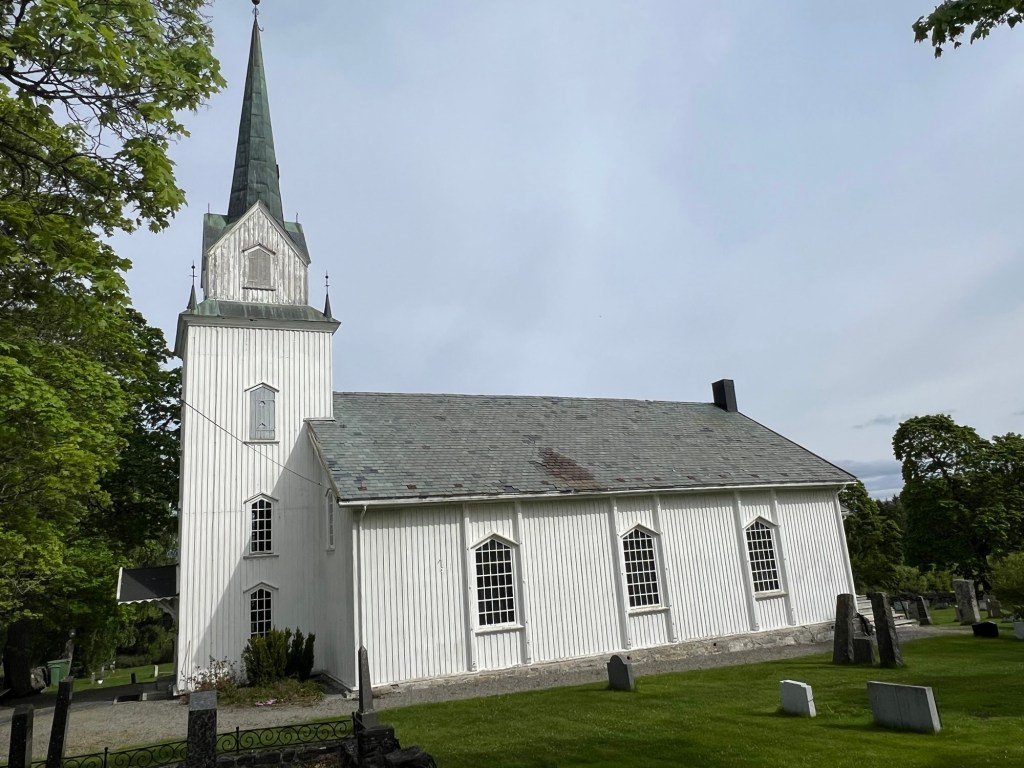
Helgøya Chapel, built in 1870, served as a secret ordination place for 18 priests during the Nazi Occupation in 1944. 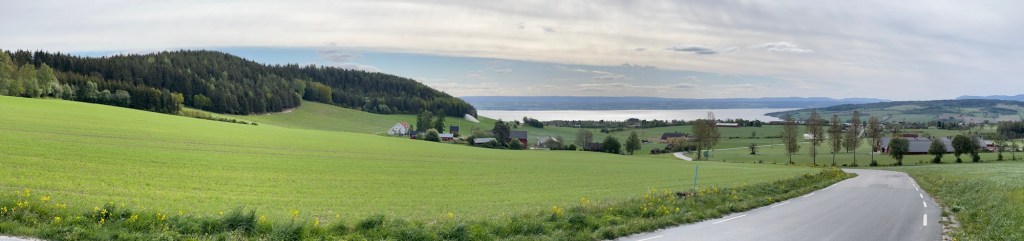
Nedre Østdal in Nes 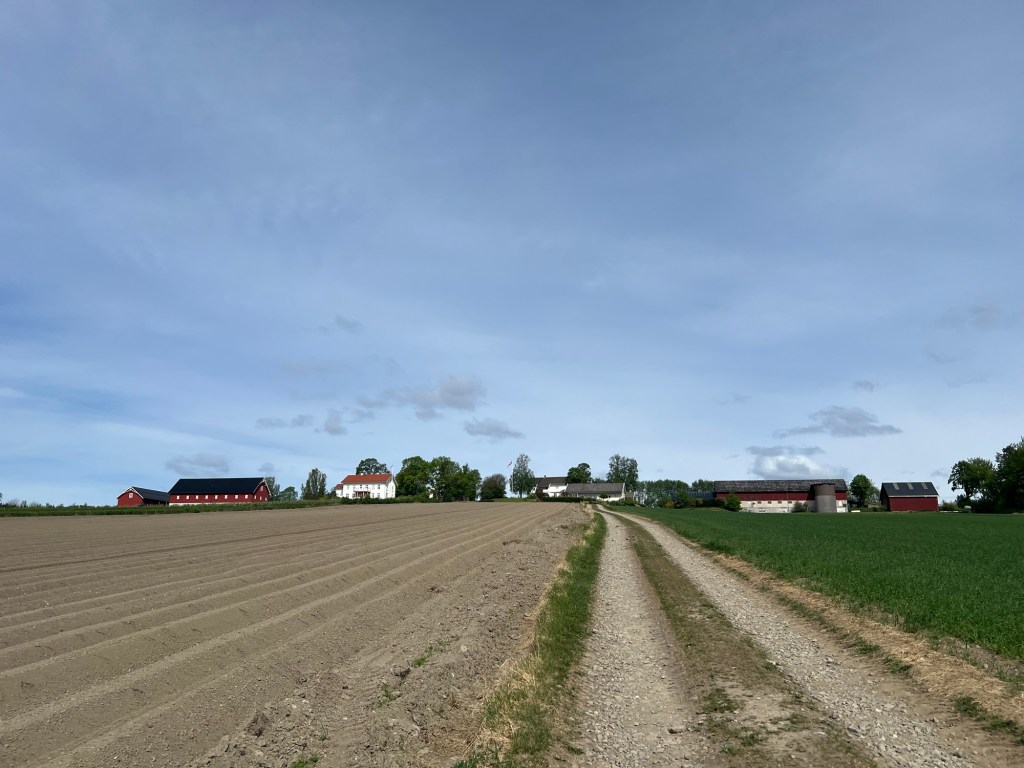
Mølstad 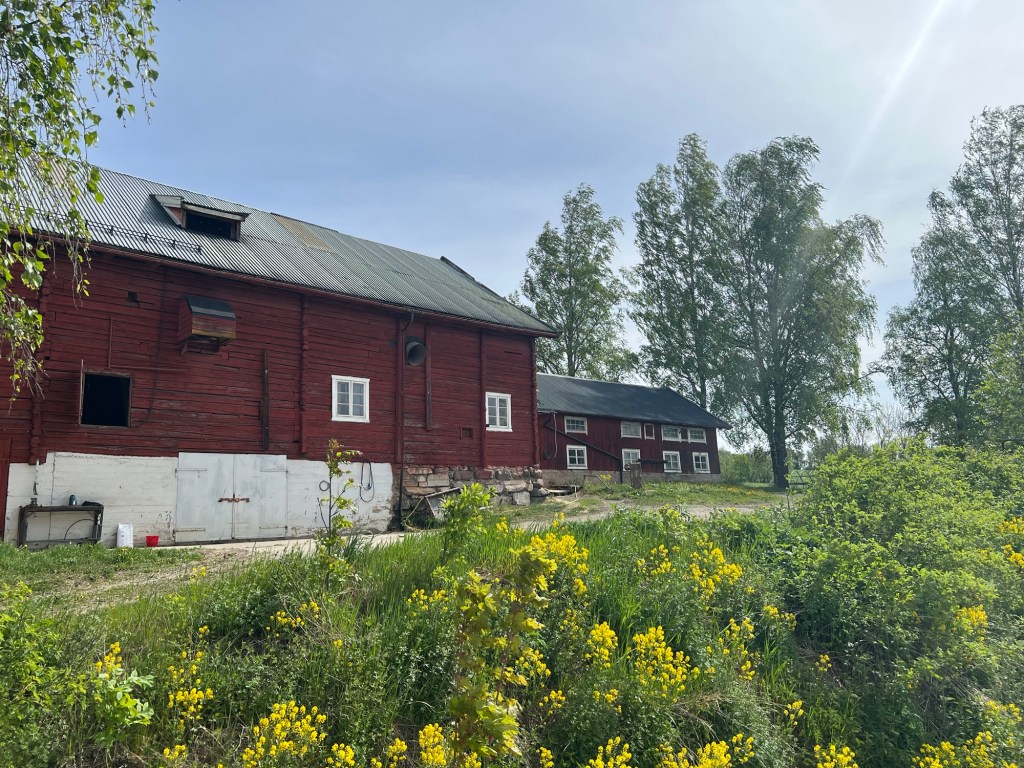
Sølsberg 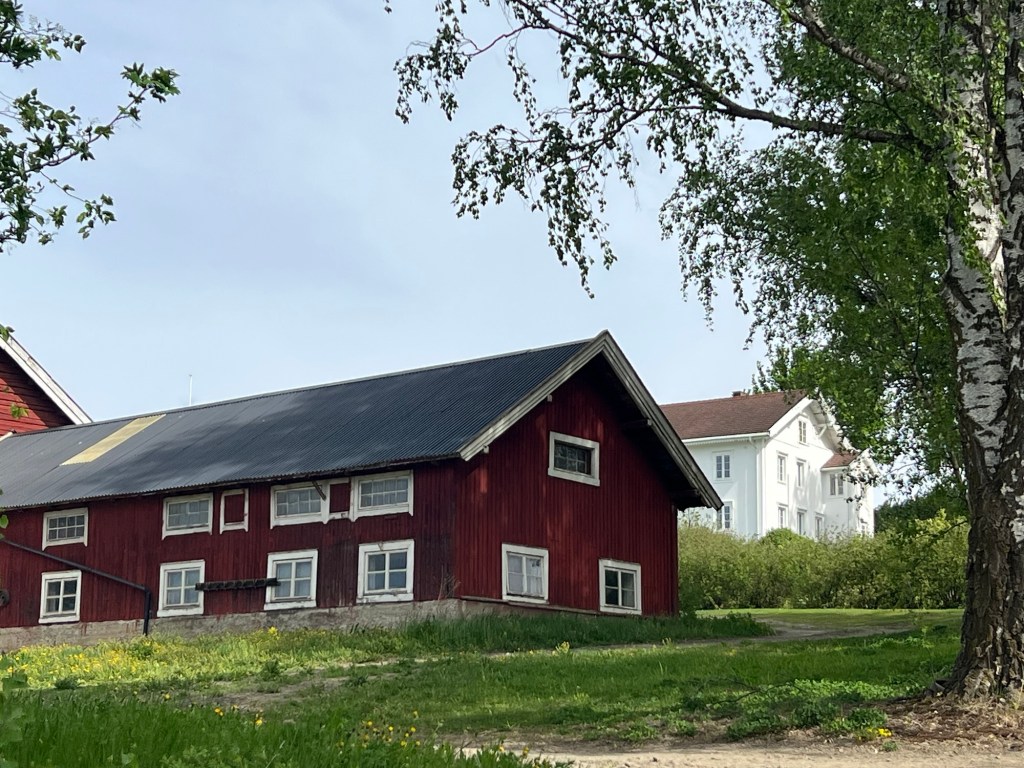
Sølsberg 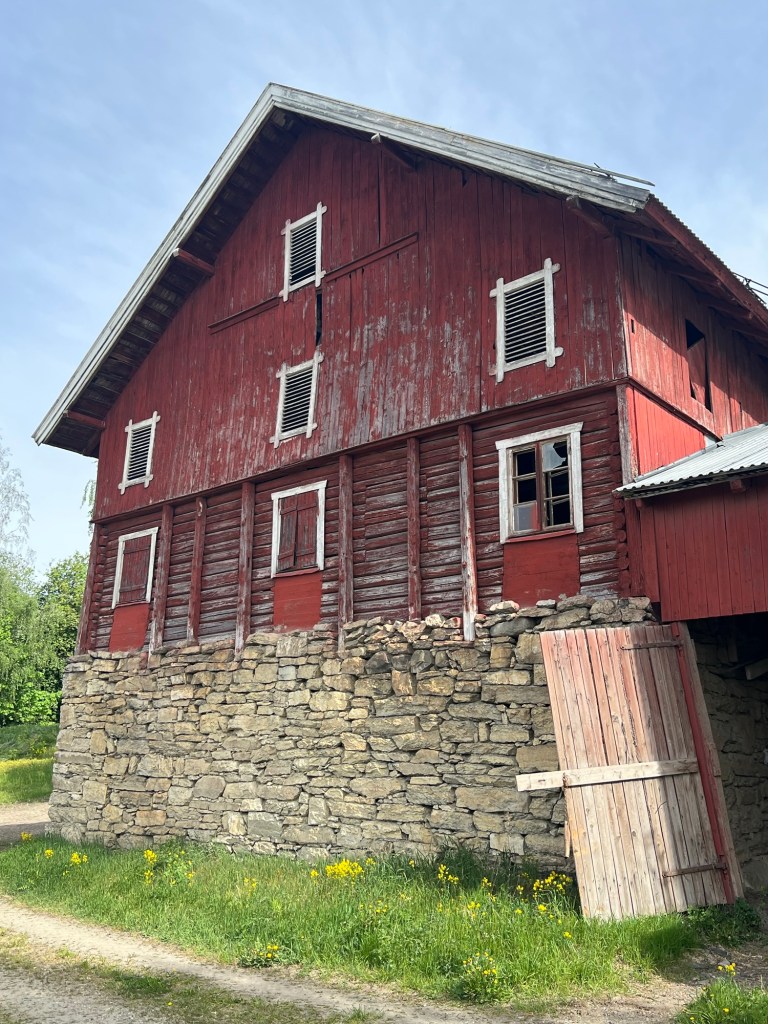
Sølsberg 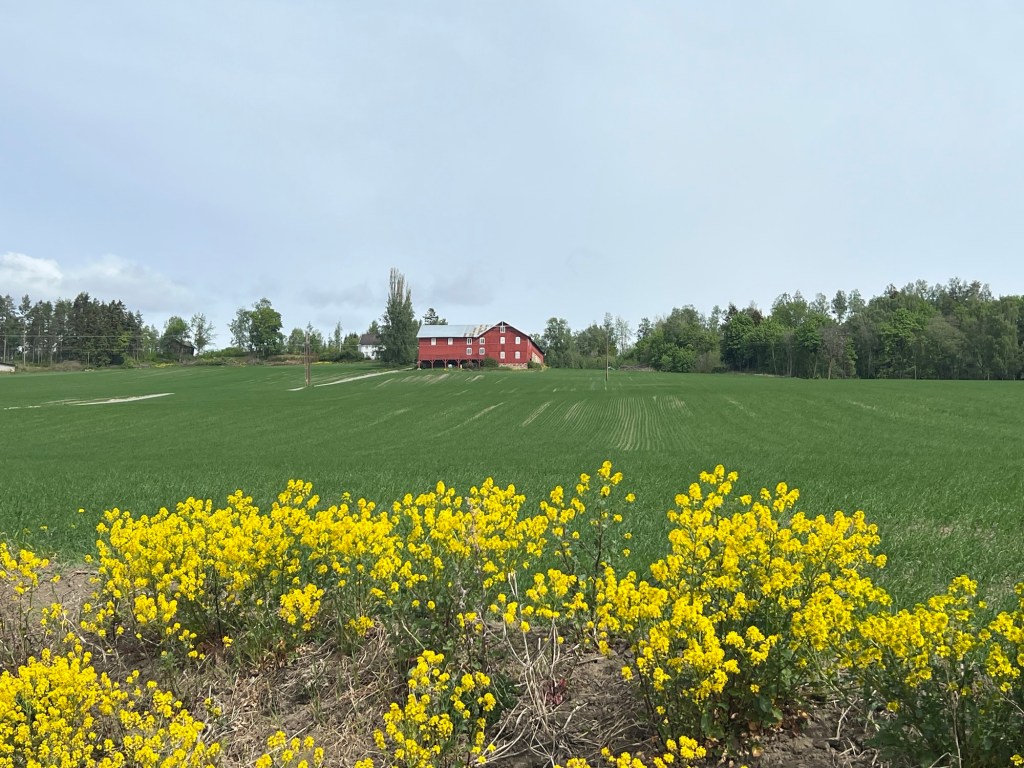
Bjørnstad Nes Farms
[1] Agnete’s family remains a mystery to me. Agnete’s parents were Dorte Gulbrandsdatter (1805-1869) and Kristian Hansen (1806-?), who married at Nes Church on December 4, 1830. Agnete was born on the Mølstad farm the following year. By 1835, the family lived at Nordre Østdal and had a son, Johannes (Agnete’s only known sibling). The 1865 Census shows Dorte living with Agnete and Augustinius on Kolden, a bruk (small land holding) under the Bjørnstad farm. Kristian had probably passed away by then; although Dorte is listed in the census as married, not widowed.
[2] Most of the information in this post comes from Gunhild Kolstad’s Nes bygdebok: Bruks- og slektshistorie, volume 2, section 1 (Helgøya, published 1990) and section 3 (Midtfjerdingen, published 2000).
[3] Details about the Johannes Bredesen family come from pp. 121-122 of Nes og Helgøya: Utvandring til USA og Canada i tekst og bilder, published in 2002 by the Nes historielag.
-
The ancestors of Erik Embretsen Veum, father of J. Oscar Veum
Three years ago, I wrote a blog post about my biological great-grandfather, Johan “Oscar” Veum, even while asserting my belief that family is not biology. I still strongly believe this. You’d think then that I might leave this branch alone. But that’s the funny thing about genealogy; you tug at a thread and it tugs back. You pull out a knot and then feel compelled to untangle it.
My biological great-grandfather’s family has several of these knots. Untangling them has been enlightening. I’ll never have it all figured out, but I’ll walk you through some of my discoveries.

Erik Veum’s passport application In 1921, Oscar Veum’s father Erik Veum traveled from Wisconsin to Norway with his daughters Dorothy and Emma. Erik was 57 then. Their mission was to see family and visit Erik’s old stomping grounds. Two blurbs in the Wisconsin Tobacco Reporter (predecessor of the Edgerton Reporter) describe the journey.
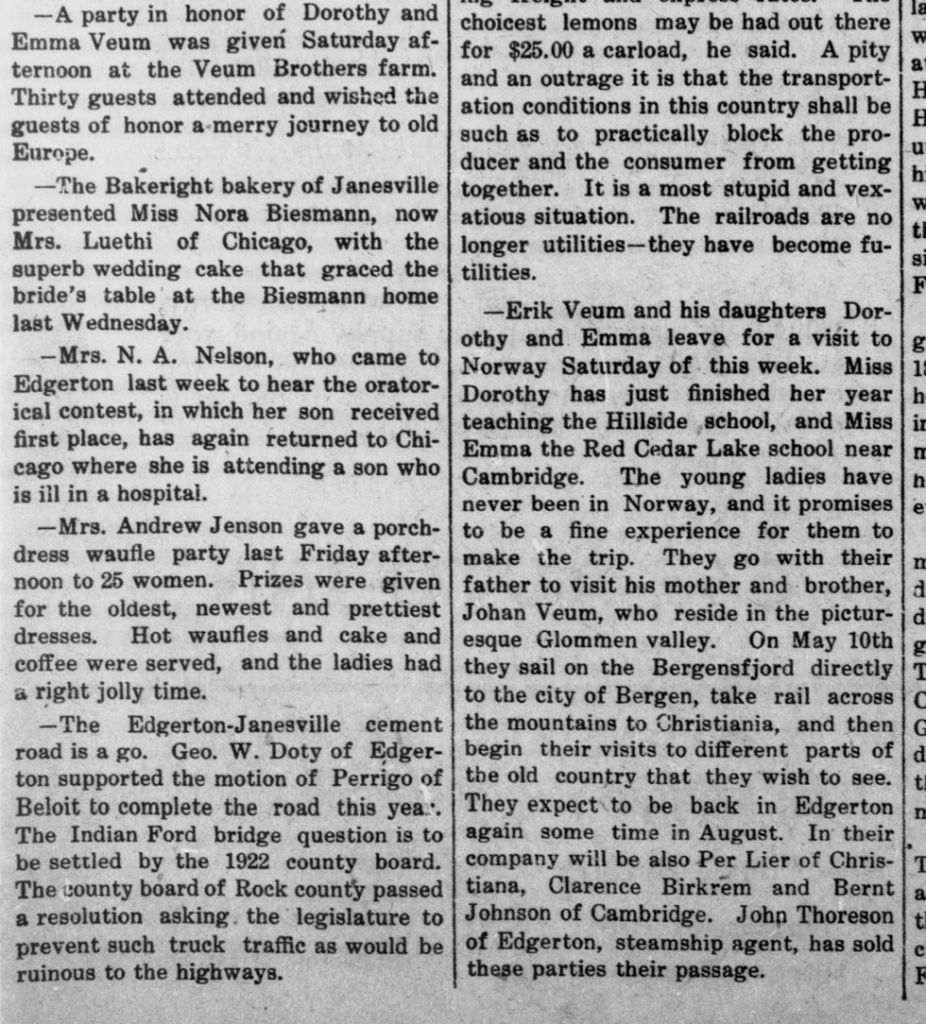
Wisconsin Tobacco Reporter, May 6, 1921 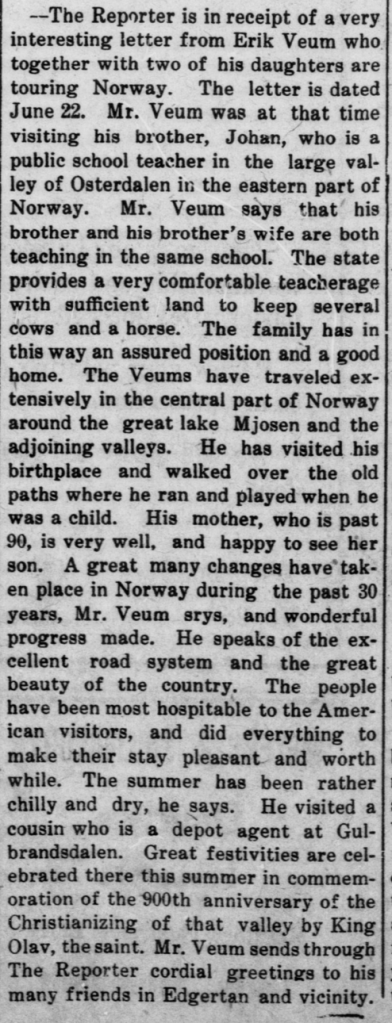
Wisconsin Tobacco Reporter, July 15, 1921 According to the Reporter, Erik, Dorothy and Emma visited Erik’s brother Johan and his family. Johan and his wife Karen were teachers in the Østerdalen area, northeast of Hamar.[1] (Erik’s other brother Petter had been a tailor but had died in 1886, aged 24, only one year after he had married and six weeks after becoming a father.[2])
Erik, Dorothy and Emma also spent time with Erik’s mother Oline, who was 90 years old then. She died two years after their visit. As I wrote in my previous blog post, Oline is an interesting figure because she is listed in the Nes Bygdebok as the operator of two farms, unusual for a woman in that era. Her husband Embret (father to Petter, Erik and Johan) had died at the age of 45. After Embret’s death, Oline purchased the Aarlien farm. Norway’s 1875 Census shows her living on Aarlien with her three sons. Oline managed the farm with the help of a farmhand named Peder Hågensen from 1872 to 1876, and the two married in 1881. She purchased the Veum farm in 1880 and didn’t sell it until 1918, when she was 87.

Pedigree chart for Erik Embretsen Veum
(To see where this fits into my family tree, see Chart J on this page)
Farm locations: Pink = Veum, Dark blue = Aarlien, Light blue = Berg østre, Green = Løkting / Kjerneby Erik Veum’s father’s family from Løten
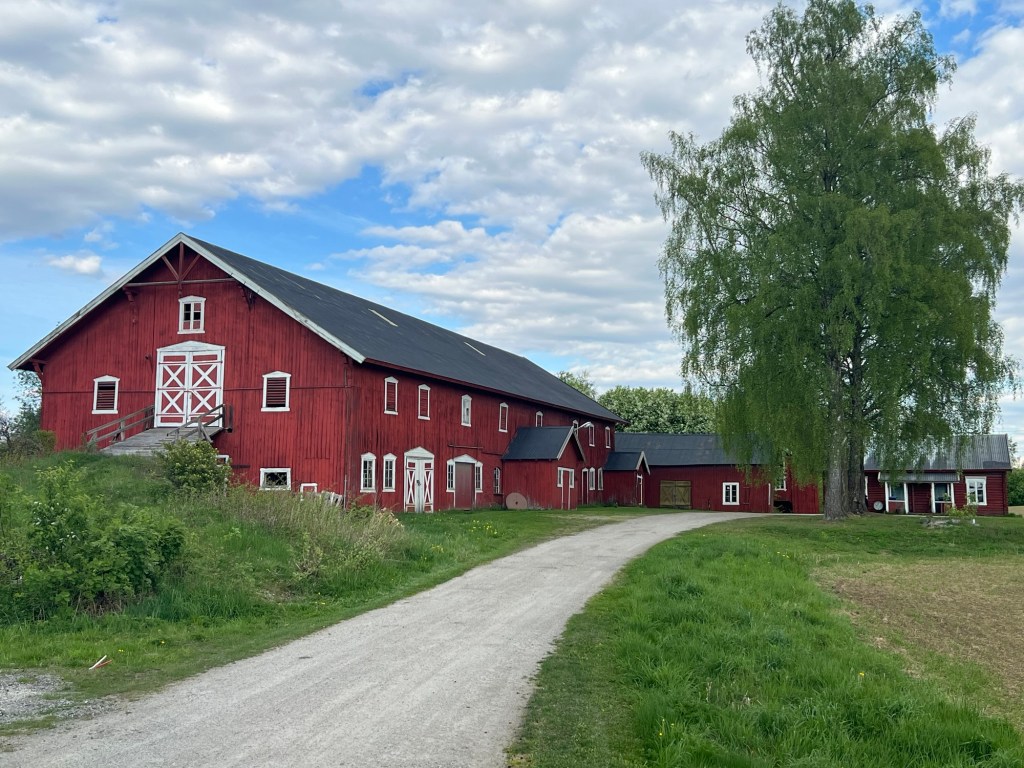
Erik’s father Embret (1824-1869) spent his childhood on a farm called Berg østre, located in the parish of Løten, just east of Hamar.[3] On Berg østre the family had been longstanding bygselmenn, meaning they leased the farm but the lease was inheritable. Indeed, the family’s connection to the lease goes back to 1672, when Lars Olsen Kolset (1638-1714) inherited the lease from his first wife’s family. One of Lars’s sons from his second marriage, Embret (1680-1767), inherited the lease and passed it on to his son Erik (1728-1782), who in turn passed it to his son Embret (1764-1808). This Embret’s eldest son, Erik, was only 13 at the time of his father’s death, so the lease transferred to Embret’s wife Ellen.[4]
Ellen remarried in 1809, and the man she wed, Ole Larsen, took over Berg østre. Ellen grew ill and died in 1813; but before she died, she and Ole agreed that the farm would pass to her son Erik when he was old enough to manage it. As Ellen’s affairs were being settled, Ole declared he would hand the farm over to Erik immediately, in exchange for a pension contract (føderåd). Erik struggled financially during those years, as times were tough in Norway following the Napoleonic Wars. When Erik died in 1833 (aged only 37), the family’s debts were so high that his widow Ingeborg Andersdatter had to auction off the lease and other property.
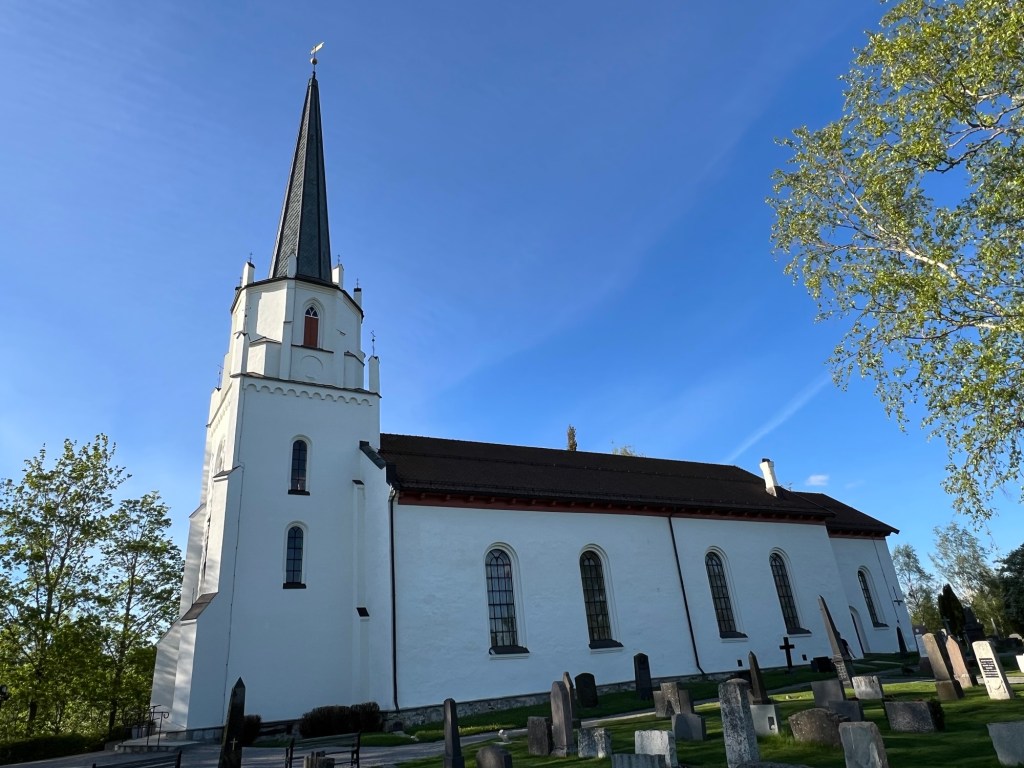
Løten Kirke was the parish church for the family at Berg østre. It was originally built in the late 1100s but has undergone multiple additions and renovations, most recently in 1875. 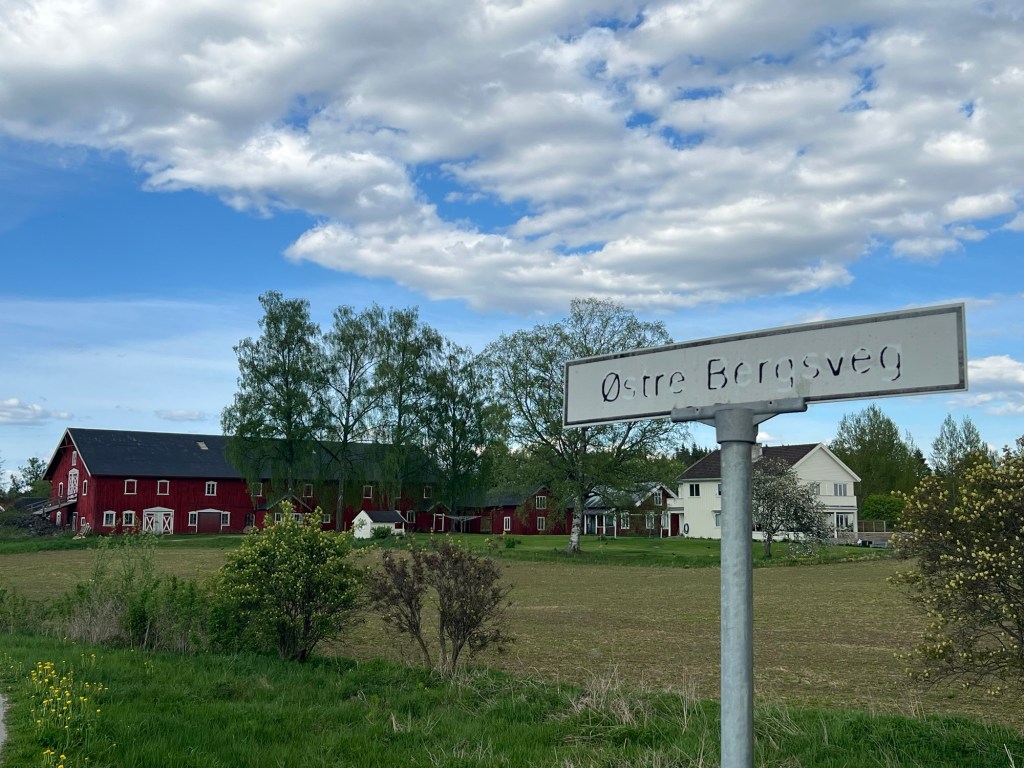
Photos from my stop at Berg østre It’s not clear where Ingeborg and her four children moved after the auction. But we know that the eldest son, Embret, came into contact with Oline Marie Pedersdatter from the neighboring town of Elverum. They married and spent their first few years together in Hamar (then part of Vang parish). Oline and Embret had their three boys there before the family moved to Nes. My best guess is that they moved to Nes sometime between 1866 and 1869, and they may have lived on the Åsen farm on Helgøya in the years before Embret’s death.
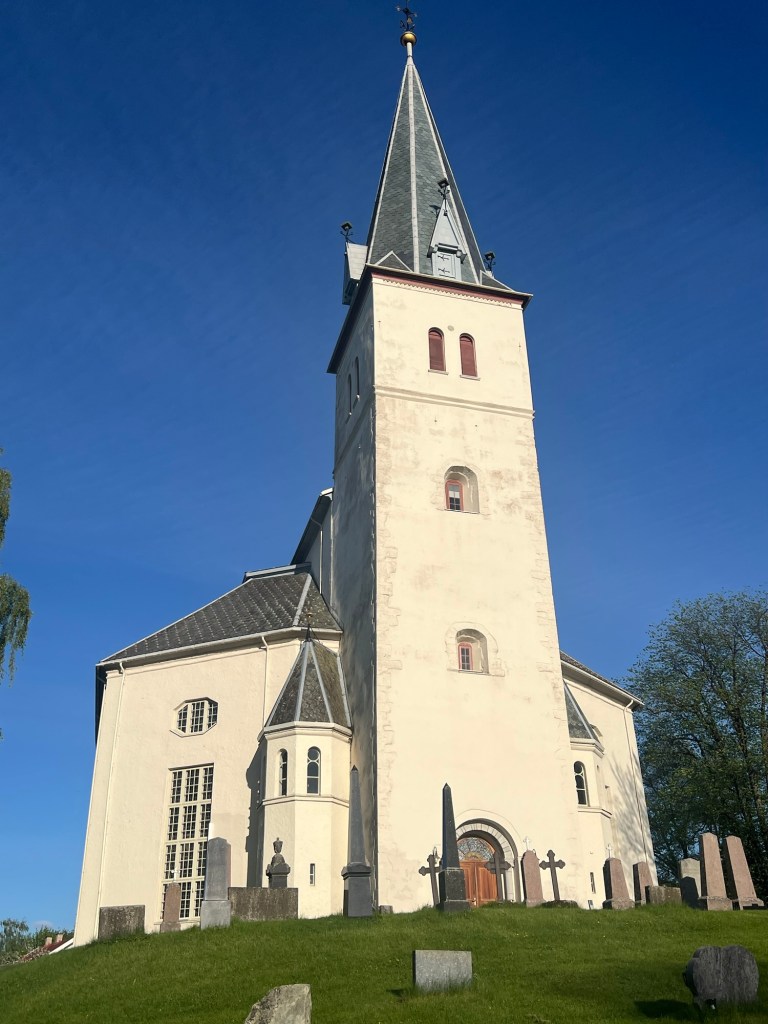
Vang Church, rebuilt 1805-1810 after a fire. Erik Veum’s mother’s family from Elverum
Embret’s wife (Erik’s mother) Oline Marie Pedersdatter was the fourth of six children born to Anne Olsdatter Koppang (1796-1875) and Peder Pedersen Bagstuen Løkting (1799-1854). The documentary evidence suggests that Oline descended from a prestigious family in Elverum. Her father Peder was an accomplished solider, who started his military career as a chief rifleman in the Østerdalen Battalion of the 1st Akershus Infrantry Brigade and was promoted multiple times in his lifetime. He lived at the Kjærnebye (Kjerneby) farm in Øverleiret (today part of Elverum), a property which he had purchased. For a last name, Peder chose his mother’s family name Løkting – a prominent local family that had held the Lille-Grindalen, Østby and Grindalen farms for several generations.[5]
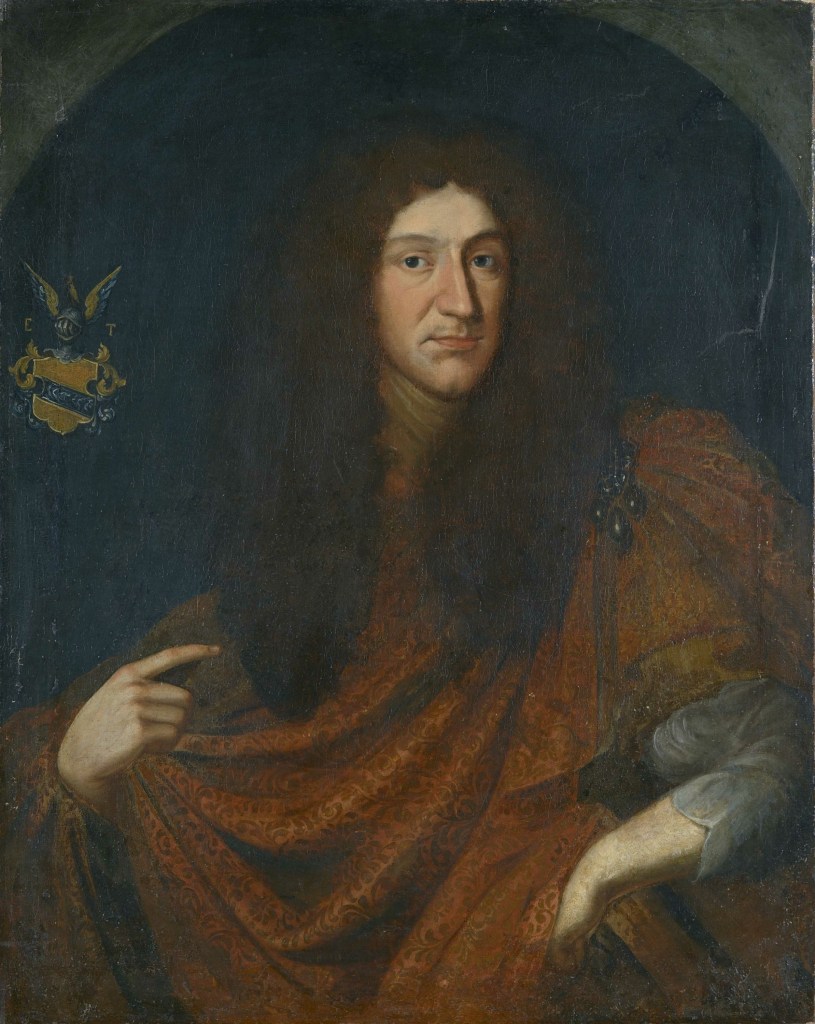
Peder’s great-grandfather Willum Jørgensen Løkting (1680-1726) served under Major General Hans Ernst von Tritschler (portrait of the general shown here). William had been a low-ranking, non-commissioned officer and a tenant on one of the general’s farms. Willum’s father Jørgen had worked as a baker at Kongsvinger Fortress. In 1710, Willum married Dorthe Marie Knudsdatter Hals (1700-1767), daughter of a wealthy captain, Knut Jensen Hals (1660-1725). Within a couple years of their marriage, Willum purchased two properties: Østby in Horndalen and Lille-Grindalen. In 1719, he was permitted to purchase Grindalen from the estate of General von Tritschler.
Willum and Dorthe’s third child, Ole Willumsen Løkting (1722-1768), was a First Lieutenant in the Sønnenfjell Ski Corps. He and his wife Siri Gulbrandsdatter Gobakken (1721-1801) first lived at Lille-Grindalen, and then Ole inherited Østby. Ole died when he was only 56, but Siri ran the farm for another five years.
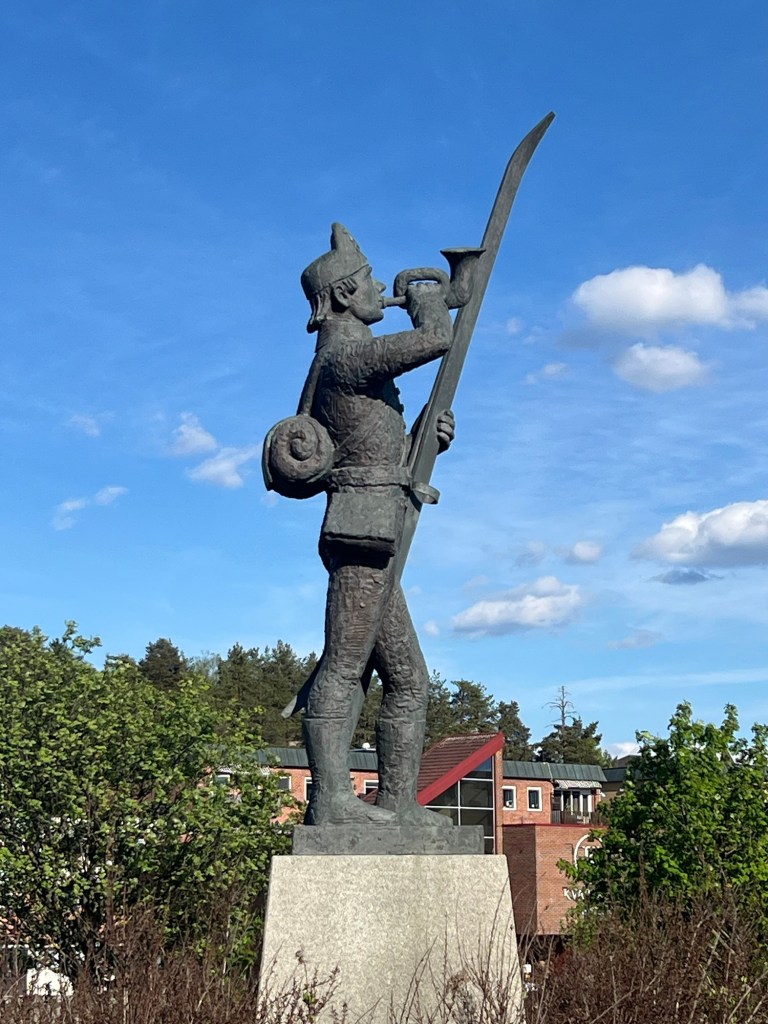
A tribute to the ski corps in downtown Elverum Ole and Siri’s third child was Oleana Maria Olsdatter Løkting (1756-1832). Oleana became a midwife and married a farmer by the name of Peder Helgesen Bagstuen (1799-1854). Oleana and Peder’s fifth child was the soldier Peder Pedersen, father of Oline Marie Pedersdatter.
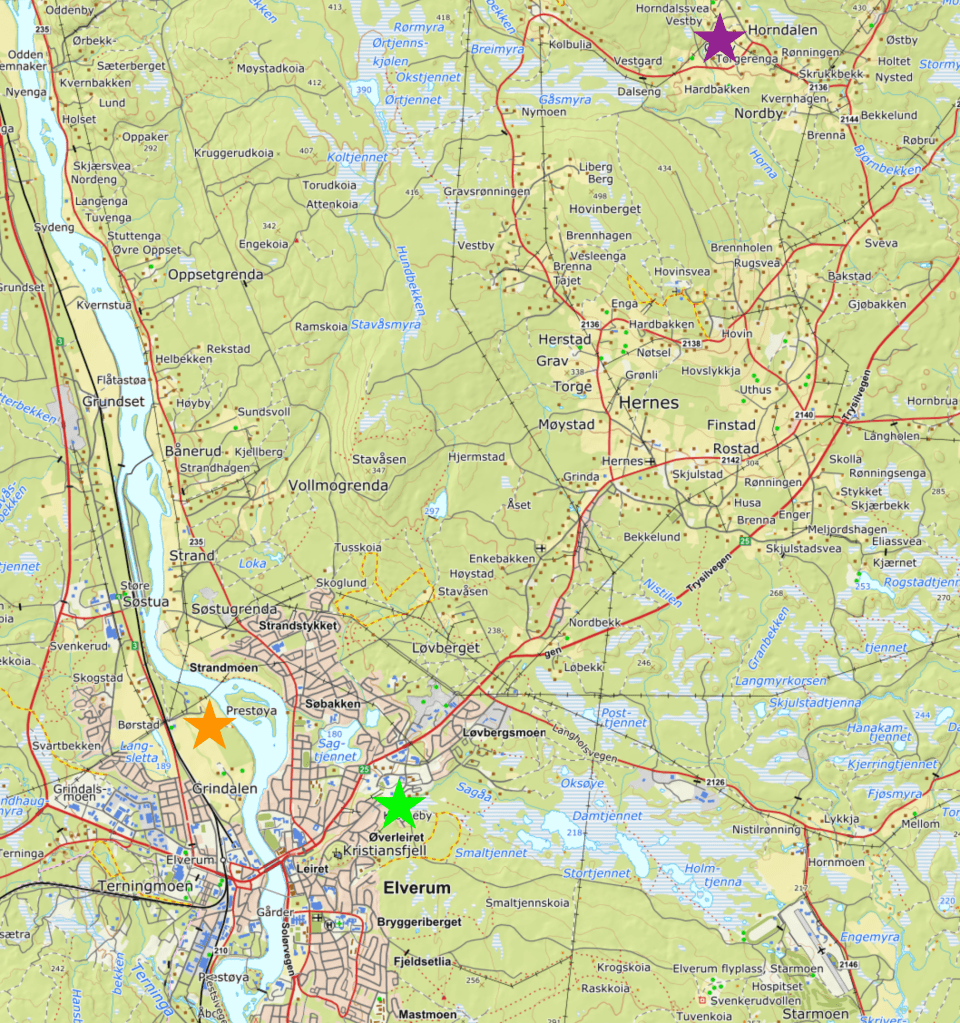
Kjerneby / Løkting = green, Lille-Grindalen = orange, Østby = purple 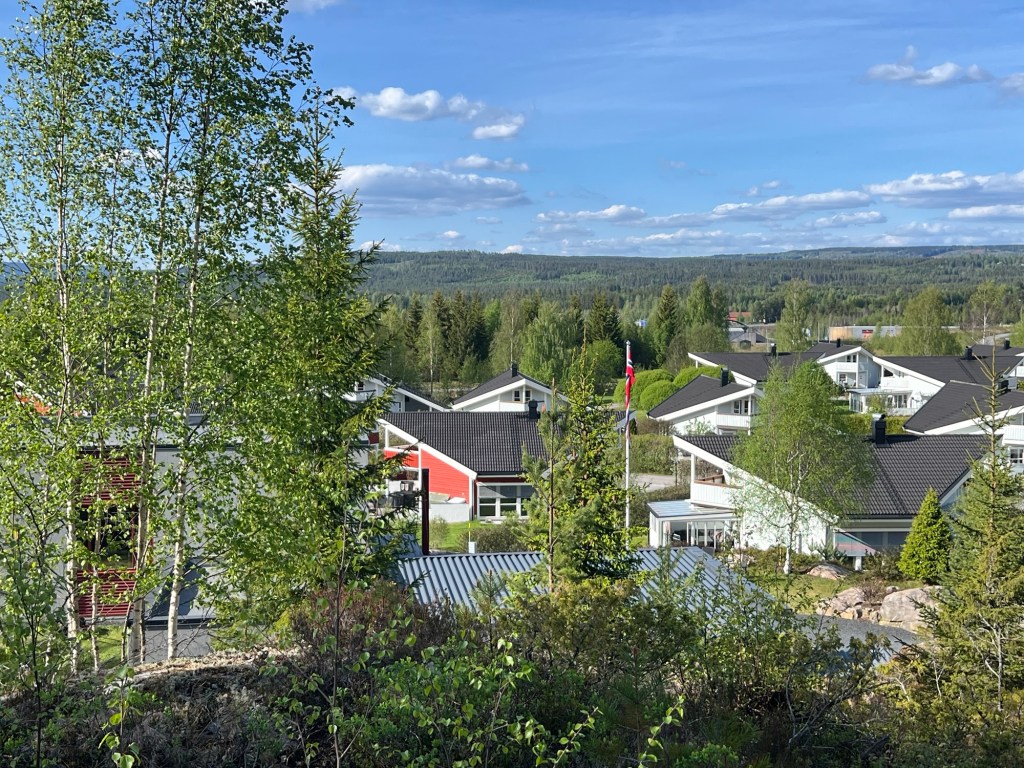
The Løkting estate at Kjerneby is now a suburban housing development 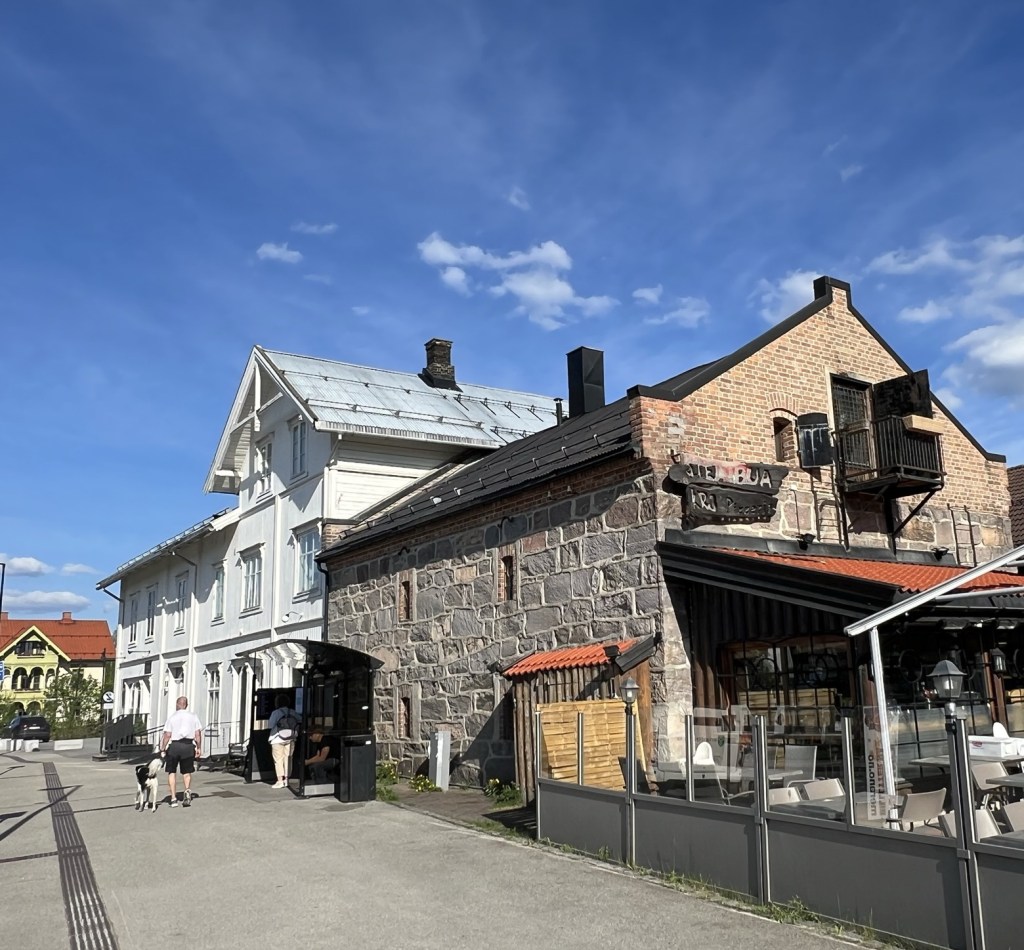
Downtown Elverum Some closing thoughts
I wonder if Erik Veum, visiting his family in Norway in 1921, was aware of the various twists and turns that led his parents from Løten and Elverum to Hamar and then to Nes. If Oline’s mind was still sharp at 90, did she impart any family knowledge to her son and granddaughters? If so, it is lost to time. We are left only with fragments gleaned from the historical record. Fortunately, Erik’s forbears – particularly some in his mother’s line – had the kind of status that leaves a trail. This was not the case with Erik’s wife Bertha’s family, which was of humbler origin. I turn to them in the next post.

The Glomma River in Elverum 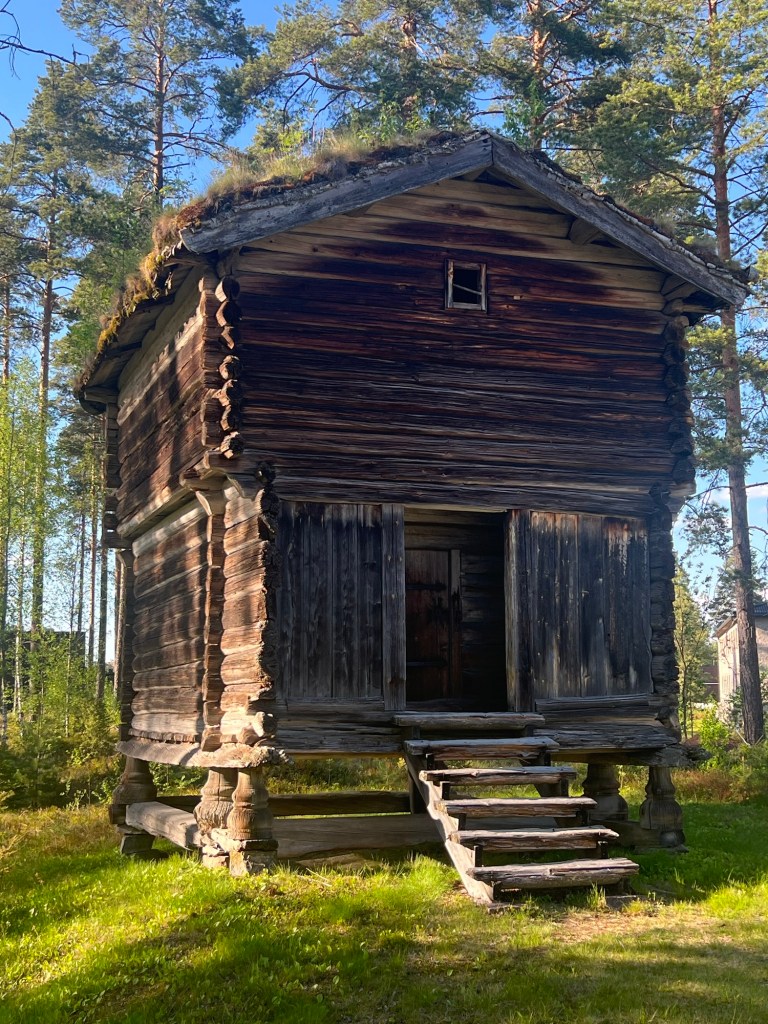

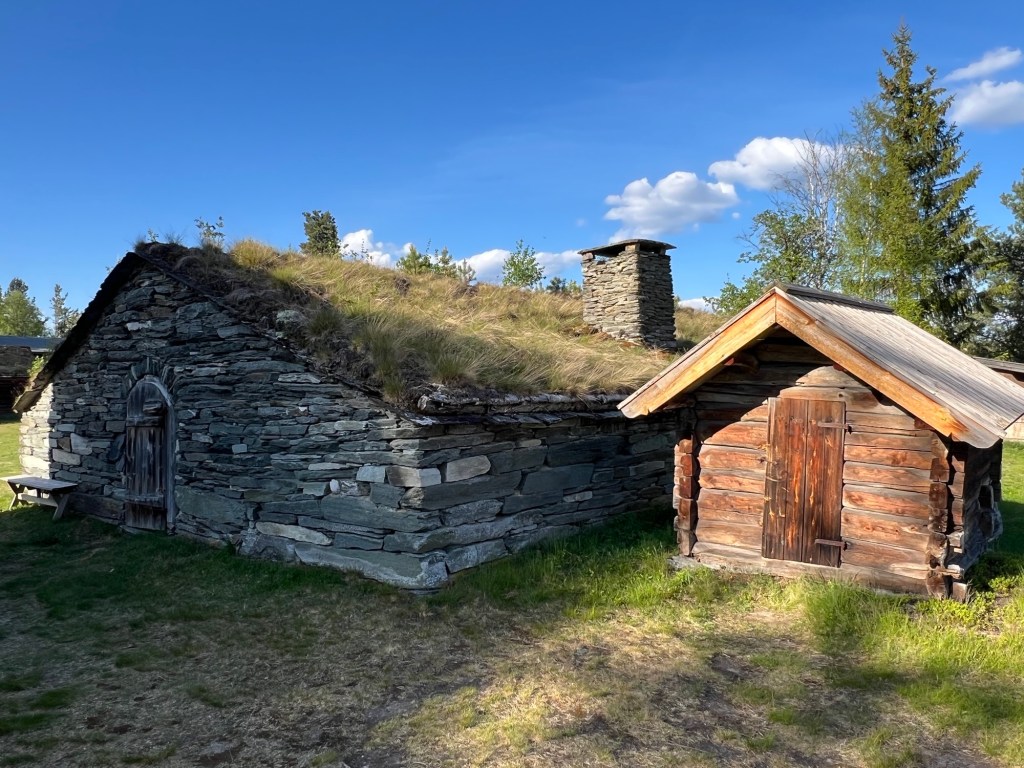

Images from my visit to the Glomsdalsmuseet in Elverum. This museum has a collection of nearly 100 historic buildings — some dating back to the early 1600s.
[1] The Nes Bygdebok states that Johan also served as an organist and singer in the Åmot Church, was a member of the Åmot Mens’ Choir, and directed the Rena Workers’ Choir (Arbeidersangforening). See p. 761 in Nes bygdebok. 2 D. 3 : Bruks- og slektshistorie [Midtfjerdingen].
[2] See p. 790 in Nes bygdebok. 2 D. 3 : Bruks- og slektshistorie [Midtfjerdingen]
[3] Spellings varied greatly in these days. Erik is often written as Erich, and Embret can be Ingebret or Engebret. The town of Løten used to be spelled Leuthen. And the Løkting name (see section on Erik’s mother’s family) has many variants: Løchting, Lückting, Løgting, etc.
[4] Information in this paragraph and the next comes from J.B. Morthoff’s (1953) Løtenboka: garder og slekter (bind 2), pp. 711-716.
[5] Information for this section comes from an online article written by Bjørn Rasch, member of the Sør-Østerdal Slektshistorielag (https://www.sor-osterdalslekt.no/lochting.html#_ftn1), and I draw directly from the Elverum Bygdebok as well.
-
The cup that launched a ship
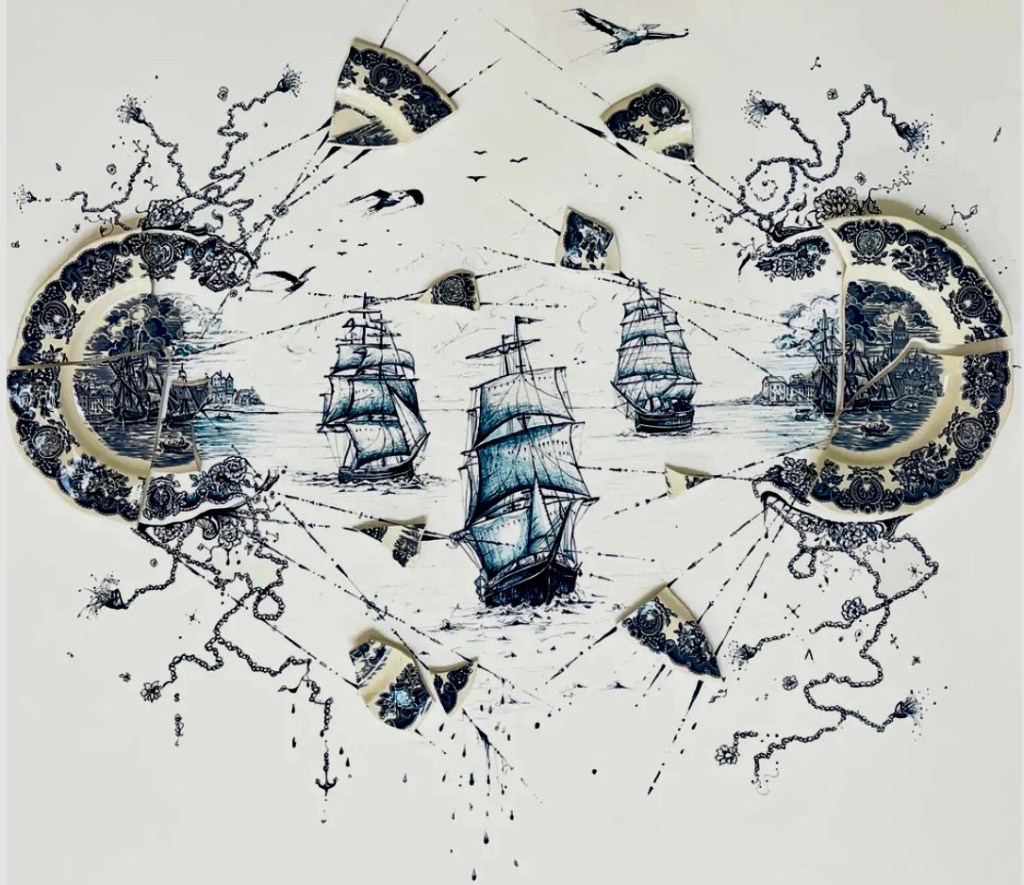
The year is 1850, and in a small village perched at the end of a fjord in Western Norway, a young servant hurries through her tasks. Malene has no education and very little savings, but for the first time in her life she is hopeful. Earlier that year a young man named Ole had come to the village from Bergen, looking for work. He didn’t find much work, but he found her.
Malene’s mind races ahead to when she can leave her employer’s house and meet him. The clock ticks. Her heartbeat overtakes it. One more hour. She turns abruptly, and in the corner of her eye she notices that she has dislodged a porcelein cup from its shelf.
It falls and she spins back to catch it, but…
The opulent furnishings of the dining room do nothing to muffle the sound of shattered china. Malene panics. Has anyone heard? There are no footsteps. No one calls out. Gingerly, she removes all the shards from the floorboards, some pieces as thin as grass blades, and places them in a rag.
She moves now, as if in a dream, out of the fine home and into the muddy road. She’s clutching the jumble of porcelain in the folds of her dress. Within a few minutes she’s home and Ole is there, too. Wordlessly, she shows him what she carries.
They stay up for hours, debating how to handle the situation. The plan was to marry at the village church later that summer and set sail for America after the harvest. But neither of them can afford to replace the cup. Attempting to do so would spoil those plans completely. Ole mentions that a ship to New York City would be leaving from Bergen on Wednesday of the following week. What if they were on it? [1]
Artwork by Robert Strati: https://sites.google.com/echobig.com/robert-strati/home We don’t know if the story about the broken cup is true — and we certainly don’t know if my imaginings above are accurate — but according to the church records for Førde, Malene Olsdatter Bruland was the parish’s first emigrant to America. She left on May 2nd, 1850. Six days later, she and Ole Jensen Hauge boarded the Nordlyset in Bergen and arrived into New York harbor on July 11th.
Malene and Ole were my great-great-great grandparents (paternal grandparents of my great-grandma Jessie Johnson Reiner).
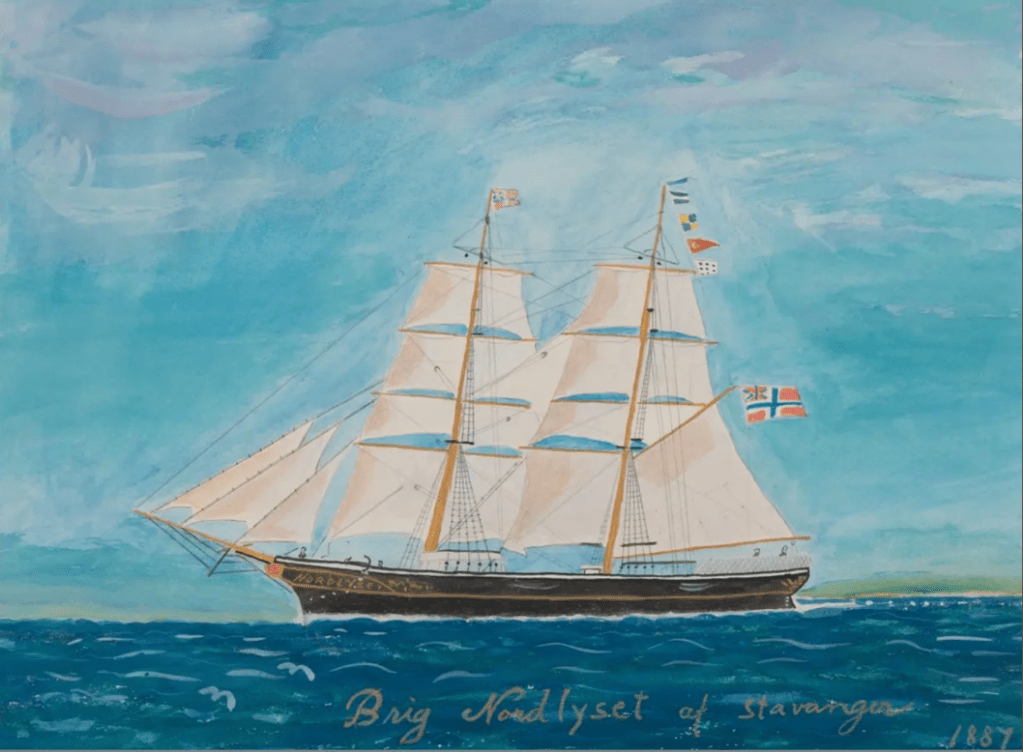
The Brig Nordlyset (Stavanger Maritime Museum) 
Excerpt from Historia om Førde – Bind 2 (published 2023) Local historian Stig Årdal discovered Malene’s out-migration entry in the church records and traced Malene and Ole’s journey to Wisconsin. In an article (see photo above), Årdal noted that Ole married a woman by the name of Susanna Strand in 1867, and he hypothesized that Malene had died prior to this.
Mr. Årdal was correct. We know that Malene, who went by Malinda in the U.S., passed away in 1865 at only 41 years of age, leaving behind a grieving husband and four children. Her grave lies next to that of Ole and Ole’s second wife at Hauge Cemetery near Deerfield, Wisconsin.
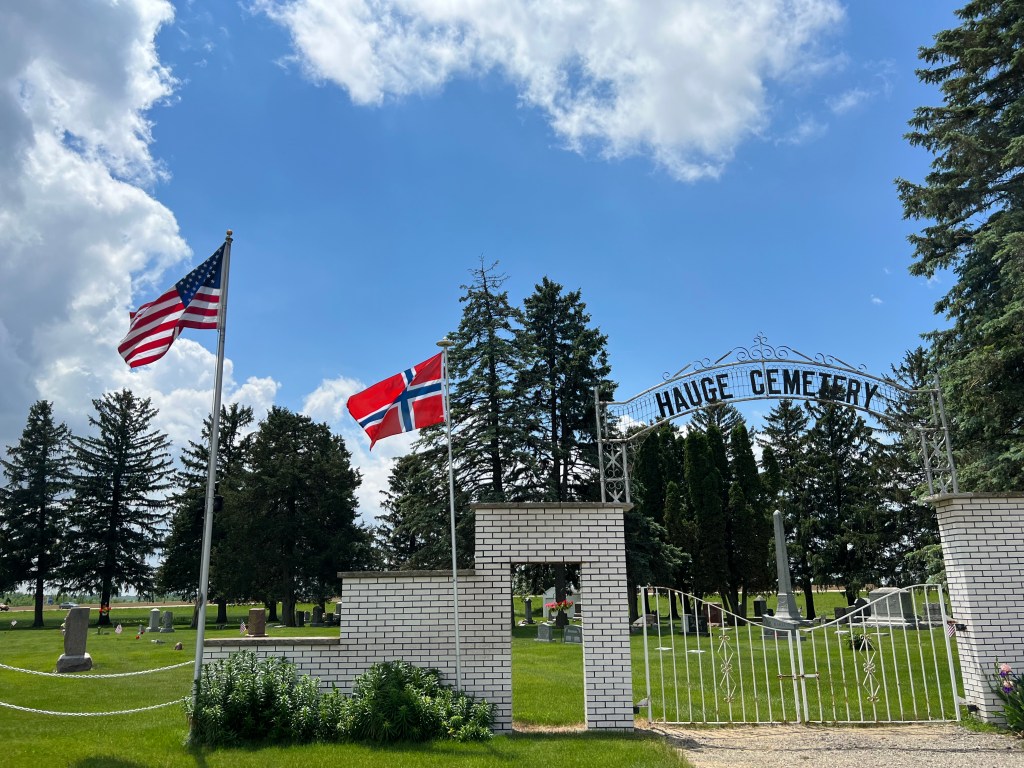
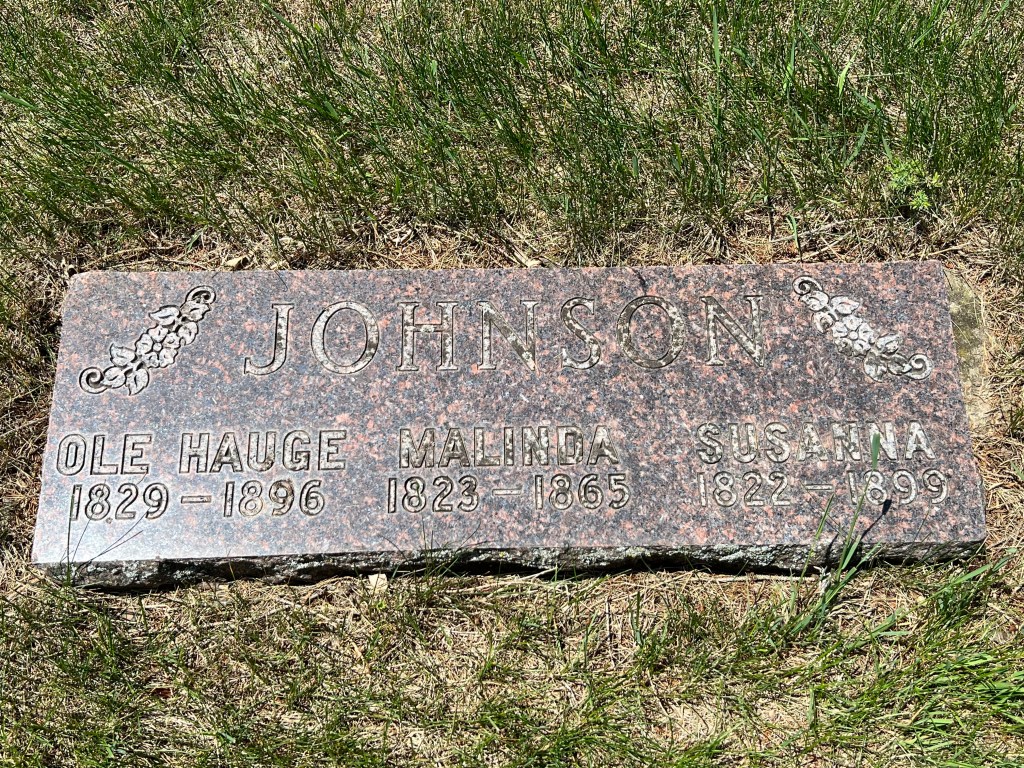
Hauge Cemetery near Deerfield, Wisconsin, where Ole and Malene (Malinda) and Susanna are buried Because she died at a young age and Ole remarried, little information about Malene was passed down in the family. We’re left only with the story about the broken cup — and with bits and pieces from the historical record. But even these scraps were hard won.[2]
* * *
I’ve traveled to Førde to see the place that Malene left behind so quickly, and to try to understand what her life was like in this place many years ago.
Prior to coming here, I reached out to an online group of local history enthusiasts, and I was extremely grateful to receive some excellent help. A local author, Mr. Vidar Fossen, helped me confirm some of the research I had done using the church books and the Førde bygdebok. But Mr. Fossen went further and pointed out some interesting quandaries in the historical record.
For instance, the bygdebok states that Malene was the only child born to Ole Gundersen Bruland (1771-1847) and Kirsti Andersdatter Åsane (1792-1851). But there is very little information about Malene’s father Ole Gundersen. In the 1824 marriage record for Kirsti and Ole, the church book states that Ole’s father’s name is Gunder Olsen. But Fossen believes that the priest may have written this in error. The bygdebok indicates that Malene’s family lived on a farmstead (bruk) within Bruland called Heggefjellet. In this same area there’s a farmstead Heggebruket run by Jakob Gundersen, who was a son of Gunder Rasmussen from Gjel. Fossen thinks Malene’s father Ole may have been another son of this man. Unfortunately, there is a gap in the church records from this era, and Ole’s 1771 birth falls into this gap, so we can’t know for sure. But another clue that ties Ole to the Gunder Rasmussen family is that one of Malene’s godmothers at her 1824 baptism was the daughter of Jakob Gundersen.
Mr. Fossen notes that Kirsti remarried in 1837 to a man named Matias Nilsen Åsane, but her first husband Ole Gundersen (Malene’s father) was still alive then — he died in 1847. Thus, it may be the case that Kirsti left Ole for Matias, unusual but not impossible for that time.
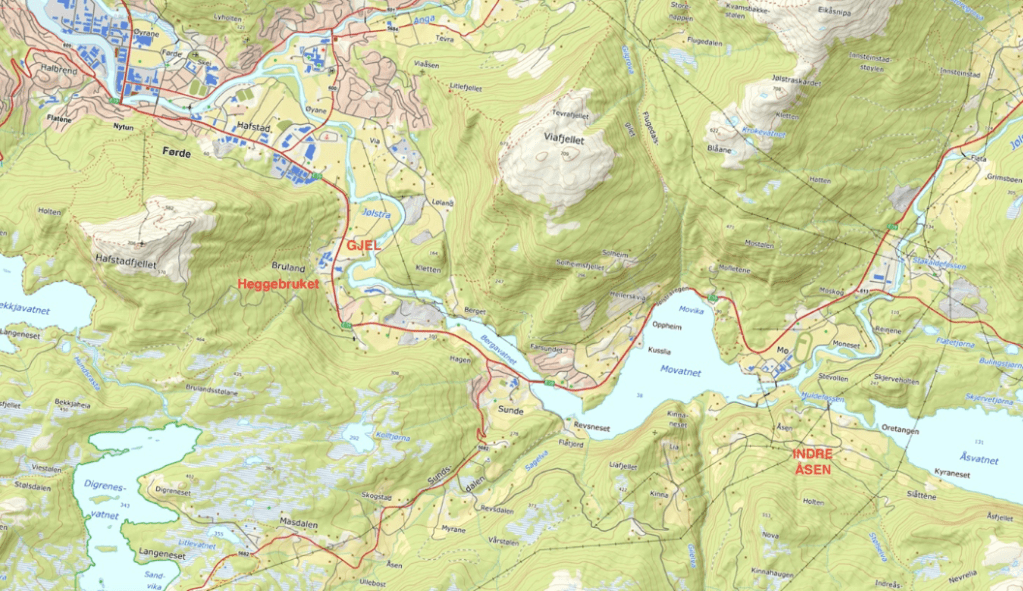
Map of the relevant farm locations, courtesy of Vidar Fossen Fortunately, Kirsti’s origins are easier to trace than her husband’s. Kirsti was born to Anna Madsdatter Svardal (1761-1820) and Anders Olsen Aasen (1733-1791). As that large age gap between her parents suggests, Kirsti was born from her father Anders’s second marriage. She had six older half siblings, in addition to two full brothers.
Kirsti grew up on the Åsane farm — Bruk 5, Indre Åsane, to be precise. Fossen tells me that Indre Åsane was not farmed by my family members after 1847, but the descendants of Kirsti’s siblings and half-siblings are likely to live in the area.
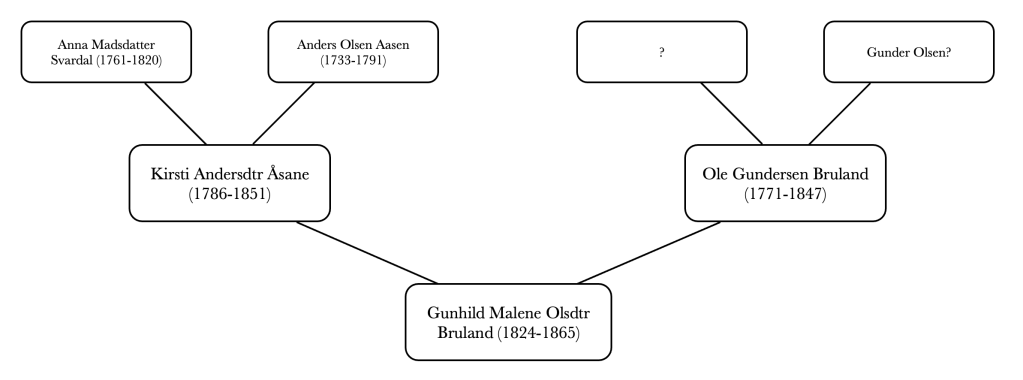
Pedigree of Malene Olsdatter Bruland
(To understand where this fits in my family tree, see Chart B on this page)I was unable to meet Mr. Fossen in person and thank him for all of the excellent research he kindly conducted on my behalf, but he put me in touch with three warm-hearted locals, who generously gave up their time today to give me a guided tour of the area. This was no ordinary tour — it was a tour they especially created for me to walk in my great-great-great grandmother’s footsteps. I am overwhelmed by their generosity.
I would like to introduce you to these dear people. They are (from left to right in the photo below): Ove Farsund, Judith Hegrenes, and Erik Olav Hagen. Each one of them has a wealth of local knowledge, but combined, the three of them have an encyclopedic understanding of their community. I felt like they brought me up to speed on what my family has missed here these past 175 years.
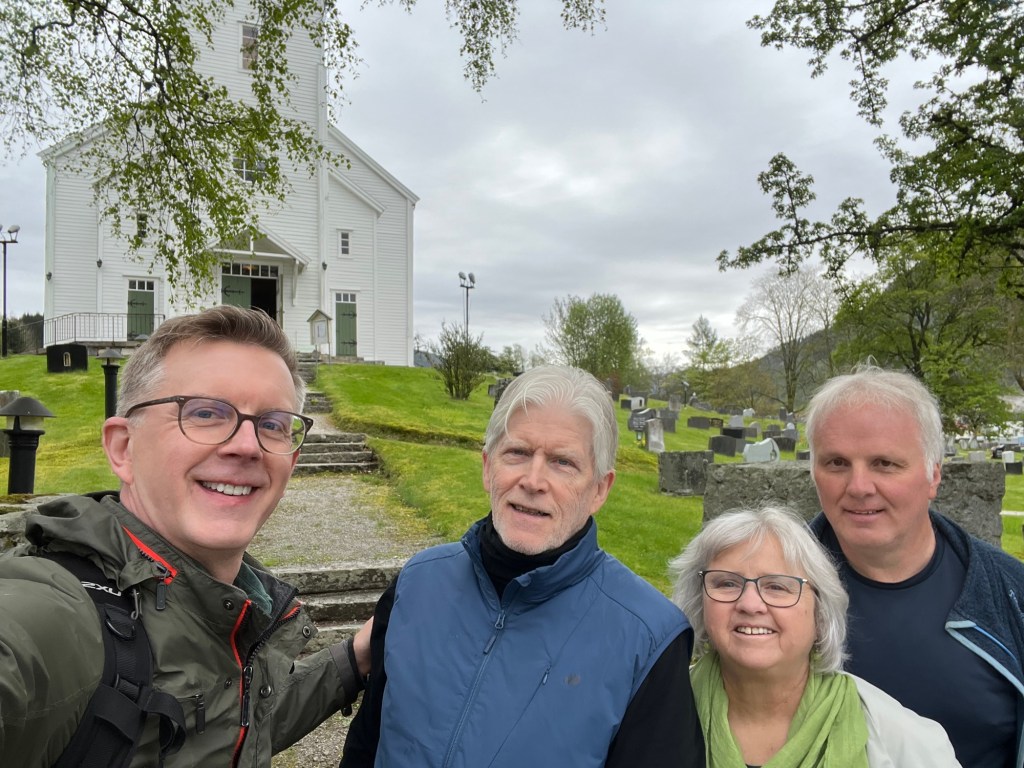
We are standing in front of the Førde Church, which was rebuilt in 1885 (after the time my ancestor immigrated) to make space for a larger congregation. 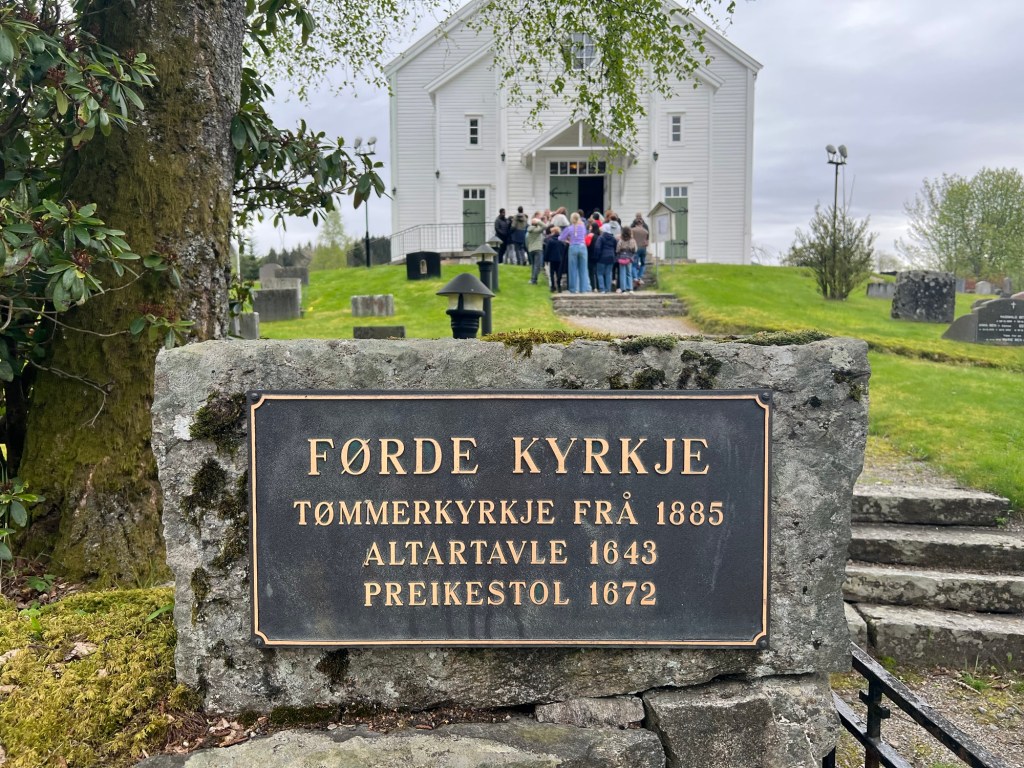
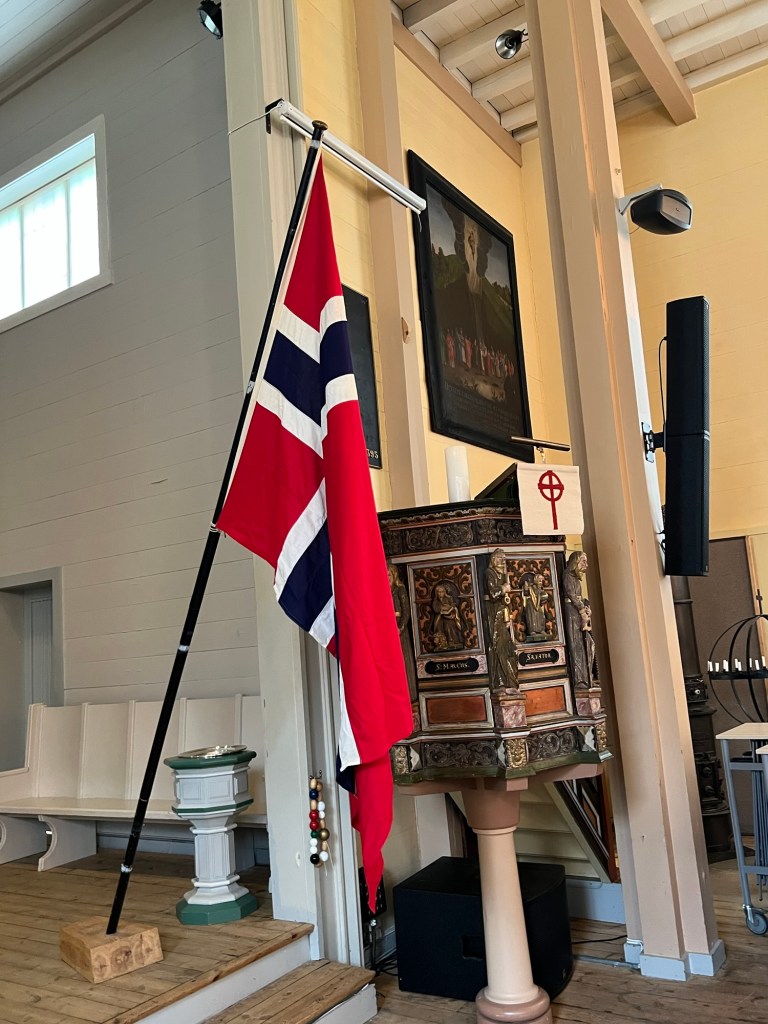
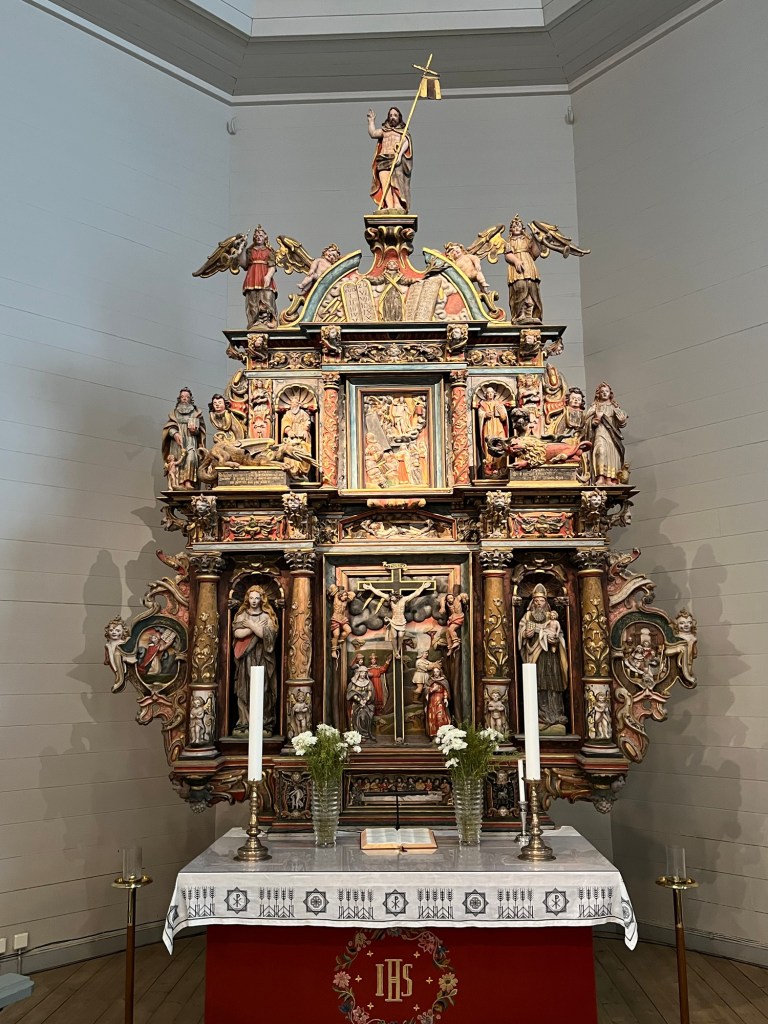
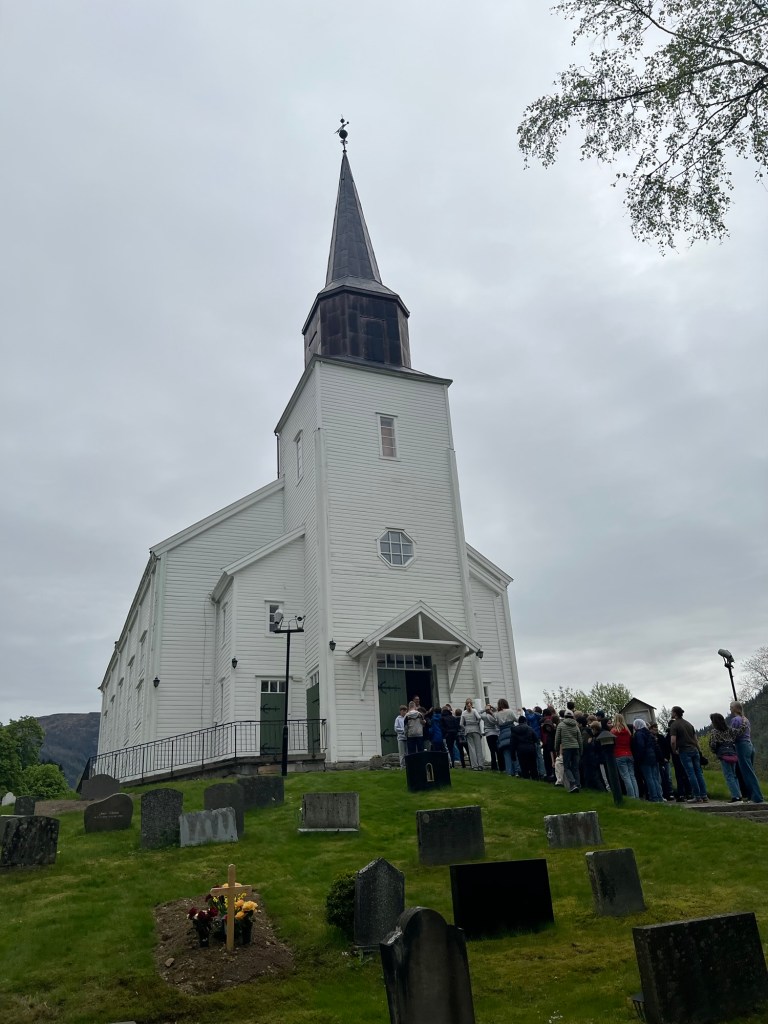
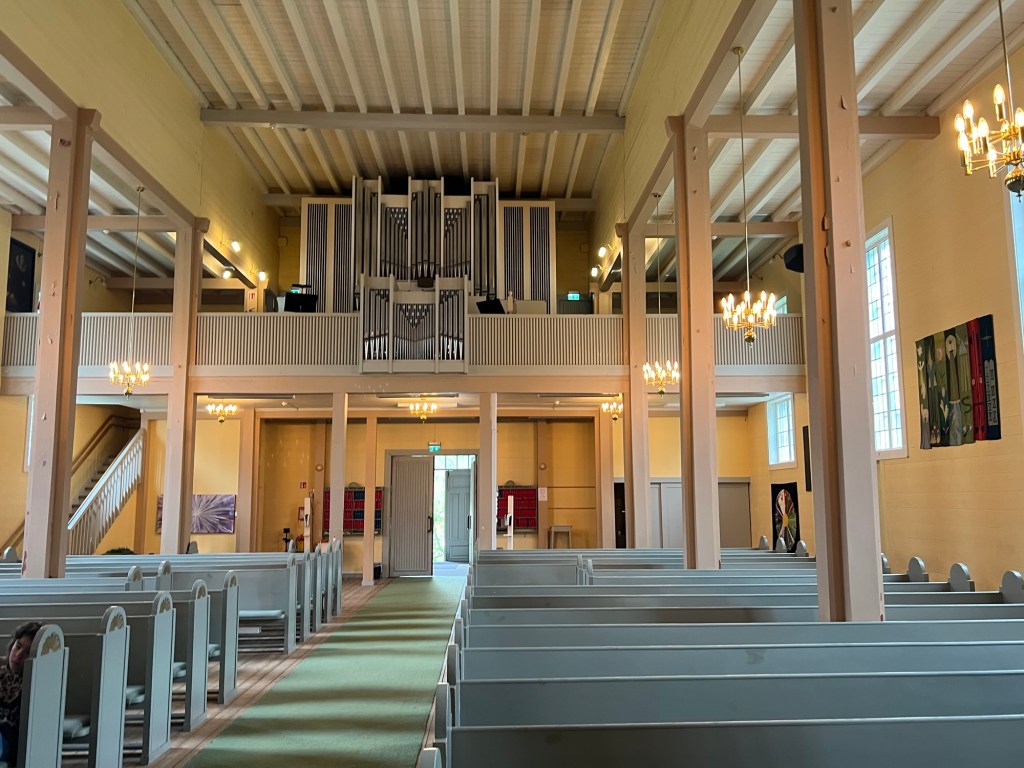
Our first stop was the Førde Church. The church’s magnificent altarpiece dates from 1643. Speaking of 175 years, it was 175 years ago today (May 8th) that my ancestor Malene Olsdatter Bruland sailed from Bergen for America. I had not planned my trip with this date in mind, so when I discovered this fact, I felt like Malene was winking at me from the beyond.
It was actually from the spot below that Malene left Førde. This was the port and the most important transportation hub in Førde in the days before trains, cars and buses.

Førde fjord 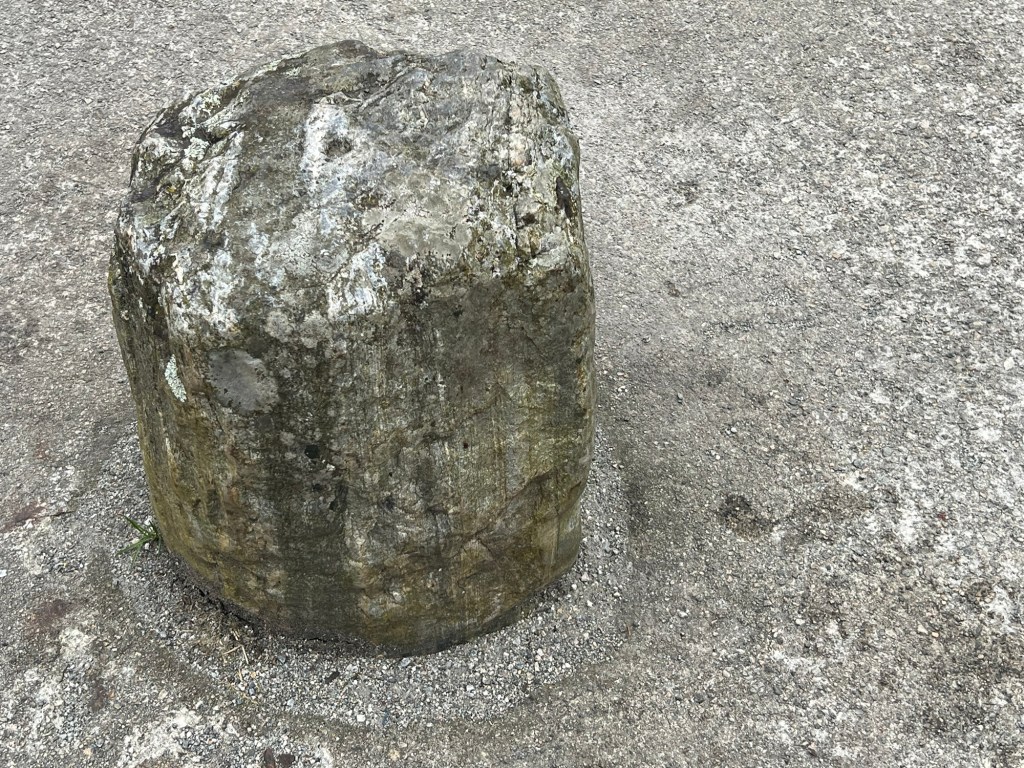
An old mooring post 
The dock at Steinavegen As I mention above, Malene grew up on one of the many bruk that comprised the Bruland farms. My guides took me to the exact spot where Malene once lived:
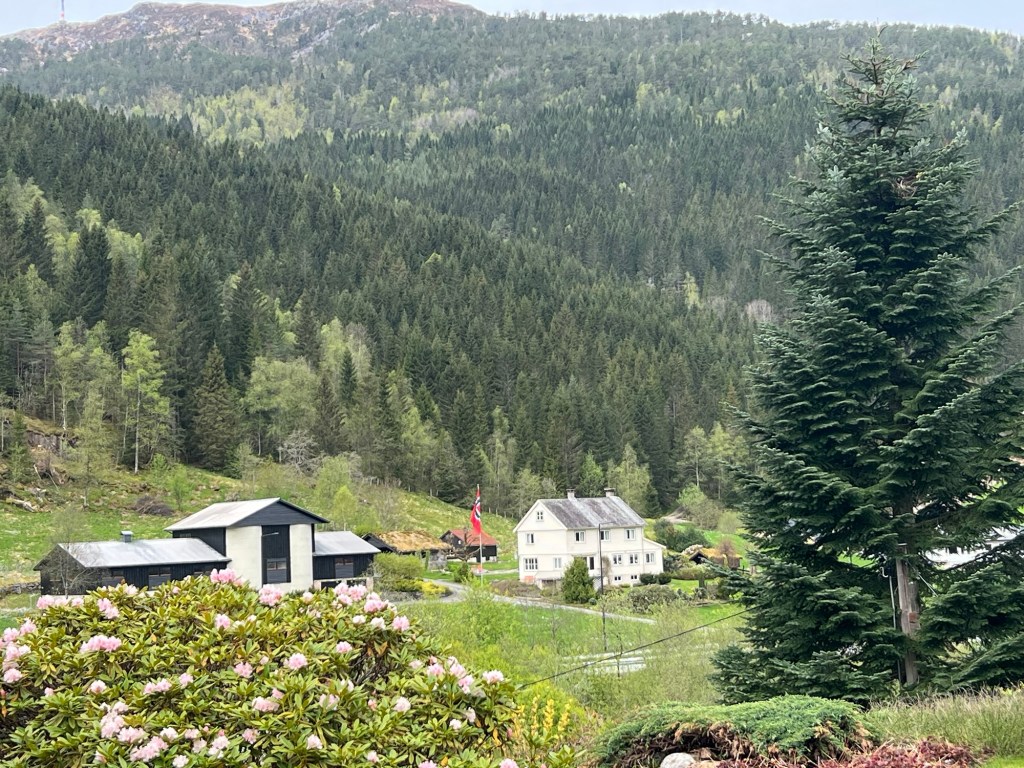
Heggefjellet on Bruland or what today is referred to as Per Tunet 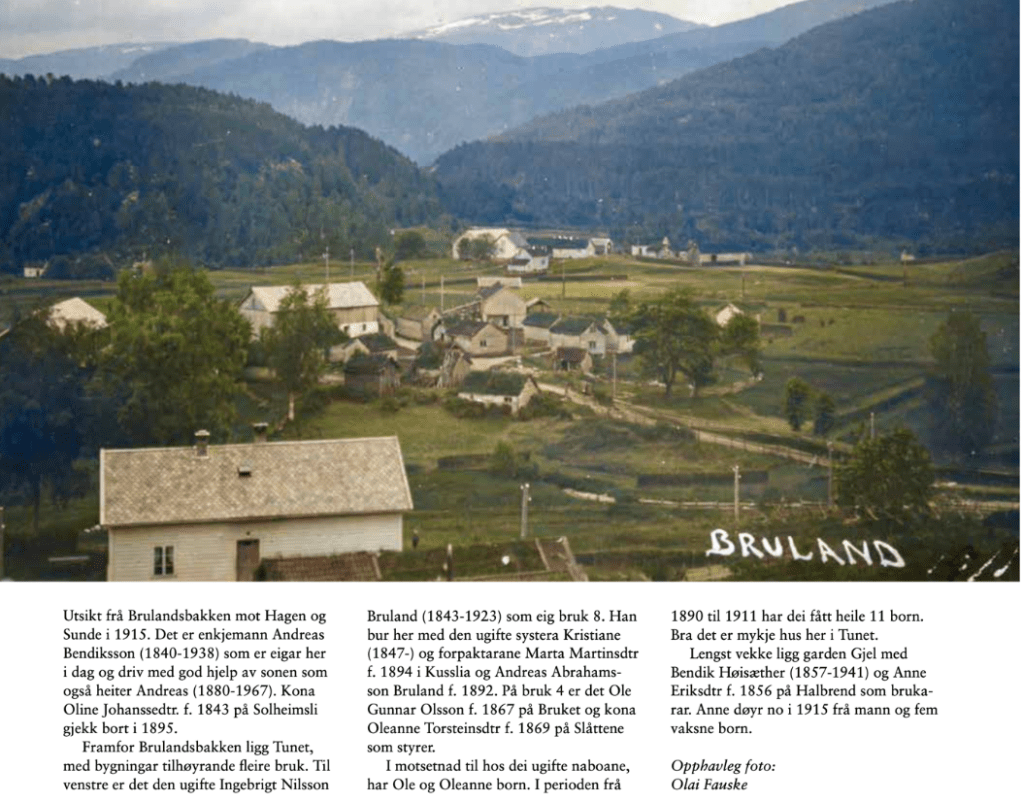
A 1915 photo of Bruland (Tunet and Gjel farm buildings), reproduced courtesy of Vidar Fossen from one of the books he wrote, “Gamle Førde i Fargar” Most of the buildings on this site today were built after Malene left, but they are built in a traditional style that pays respect to the area’s history. The property is now owned by Siv Bruland and Alv Avedal.
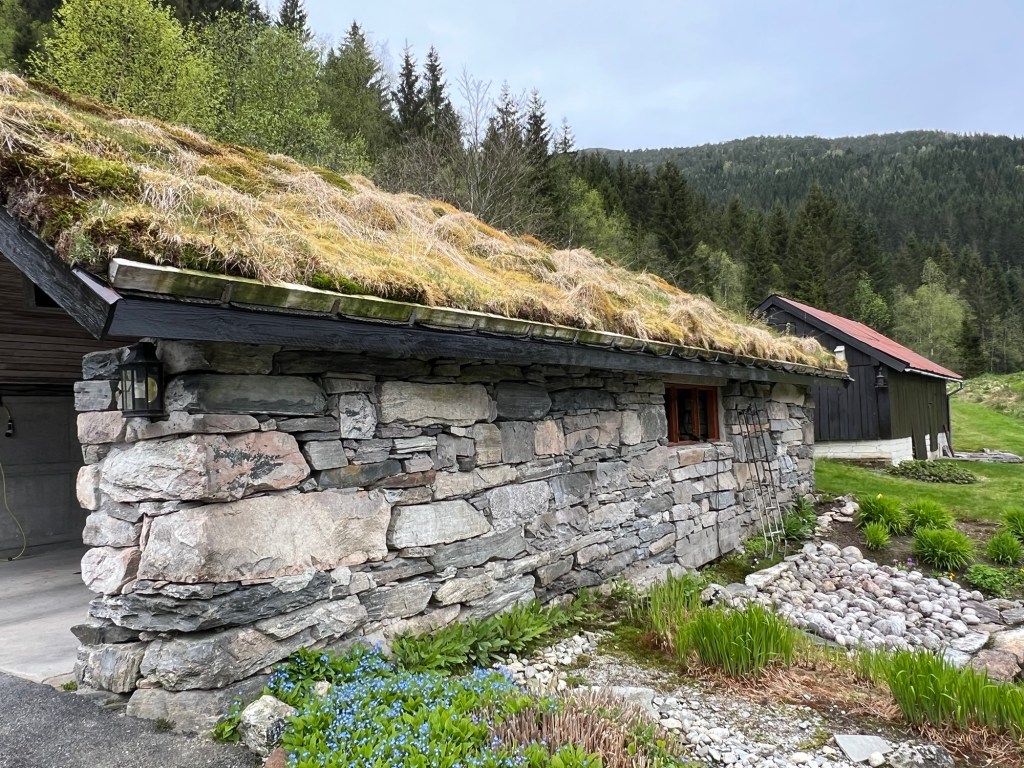
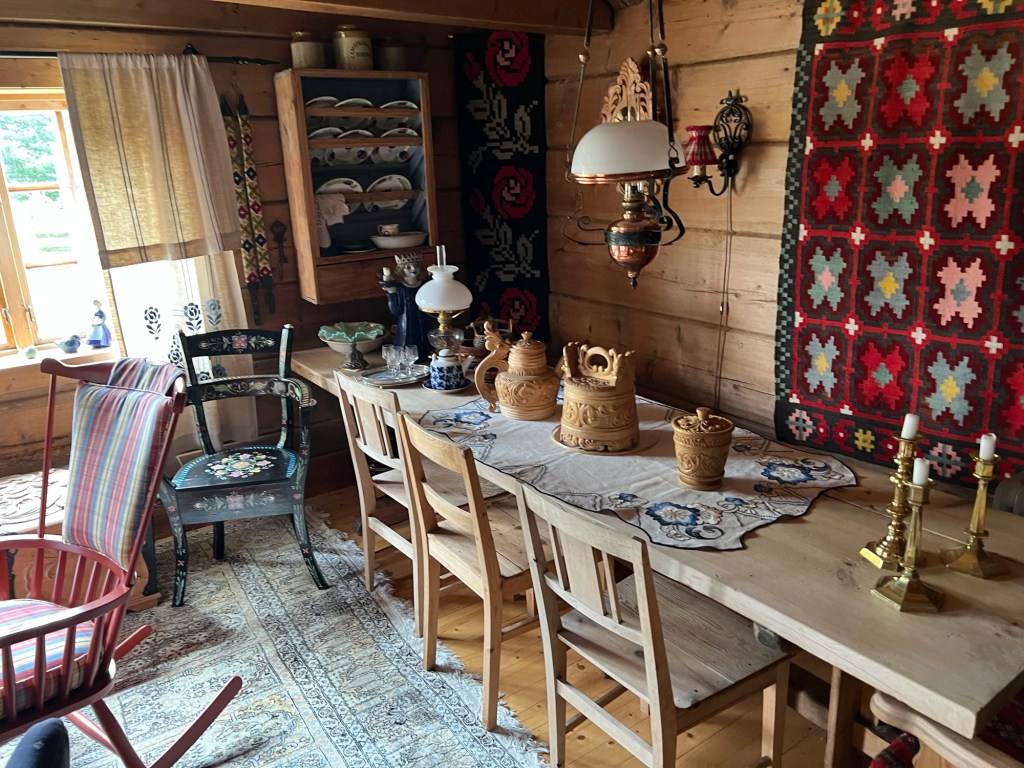
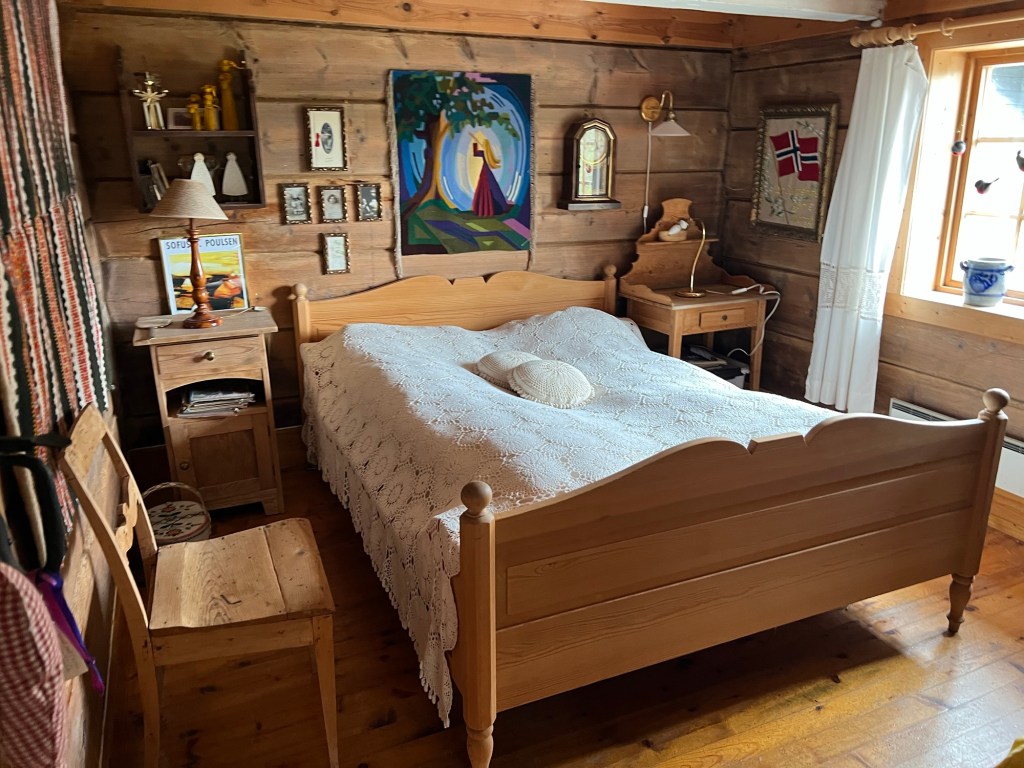
This building, now used as a garage, probably looked very similar in Malene’s time. Interestingly, the house that once stood at Heggefjellet was moved to a property across the road, owned by Siv’s mother Signe Bruland. Years ago, the family used the house as a rental property for fishermen who came seeking the giant salmon and trout that thrived in the Jølstra River. Today, Signe has transformed this place into a magical spot — a delightfully furnished guest home surrounded by immaculate gardens. Stepping into this home, I knew I was literally walking in my 3x great-grandmother’s footsteps — she may have personally lived here. And even if not, she would have known this house well.
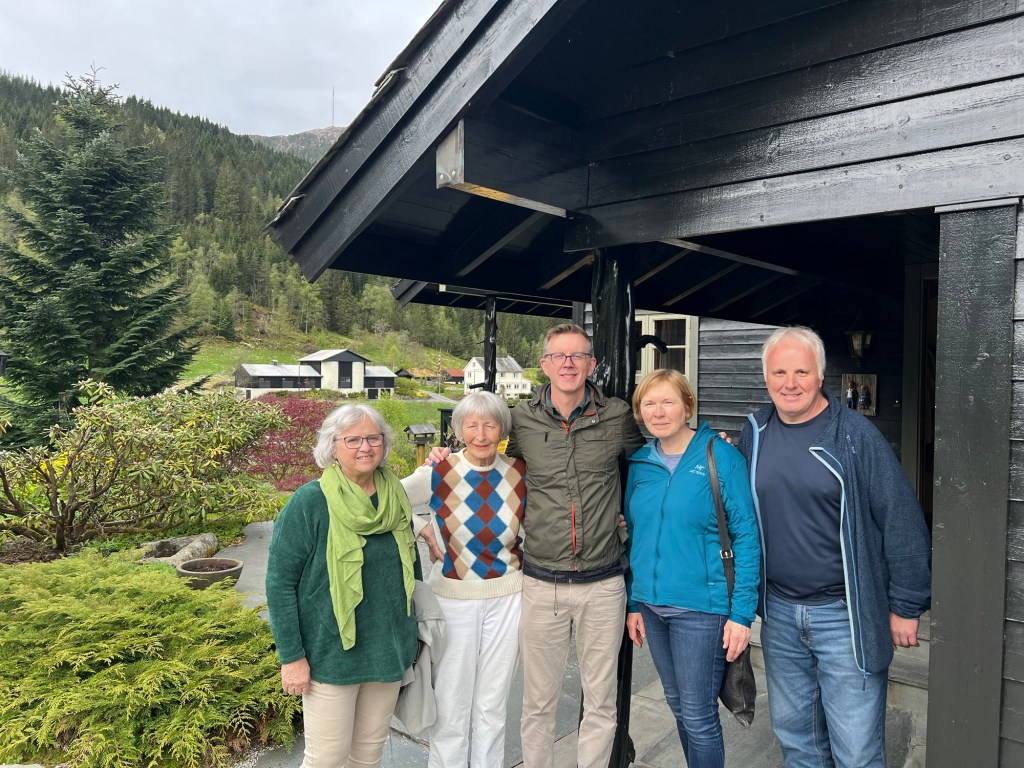
From left: Judith Hegrenes, Signe Bruland, Jesse Rude, Siv Bruland, and Erik Olav Hagen (photo taken by Ove Farsund) 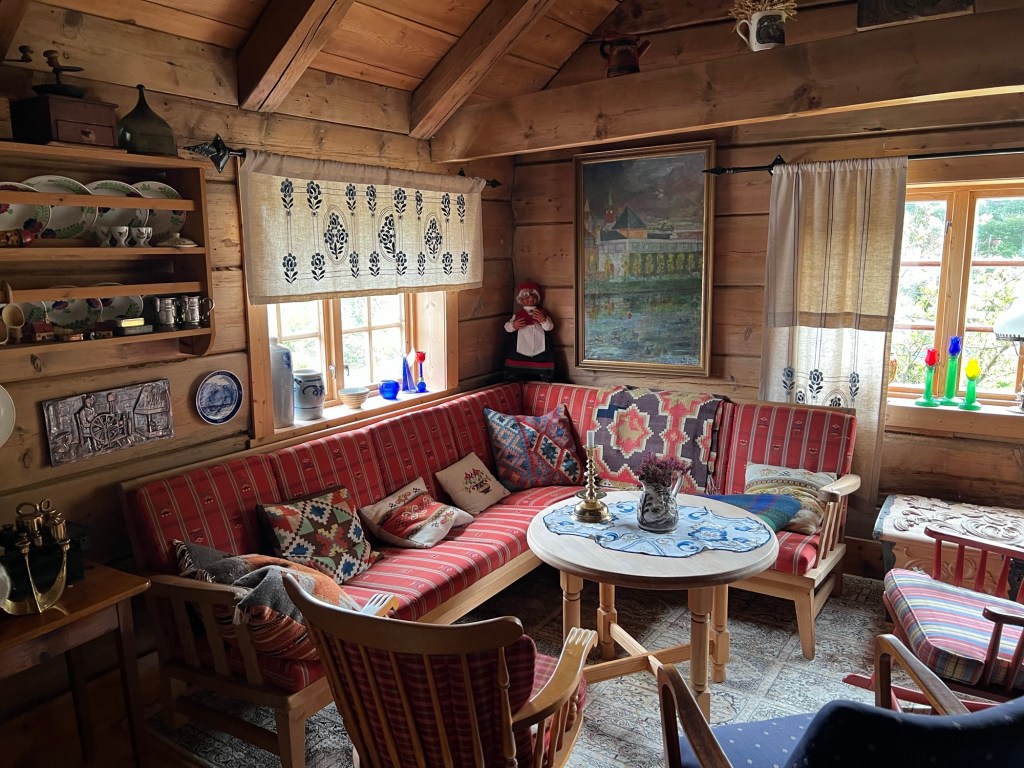
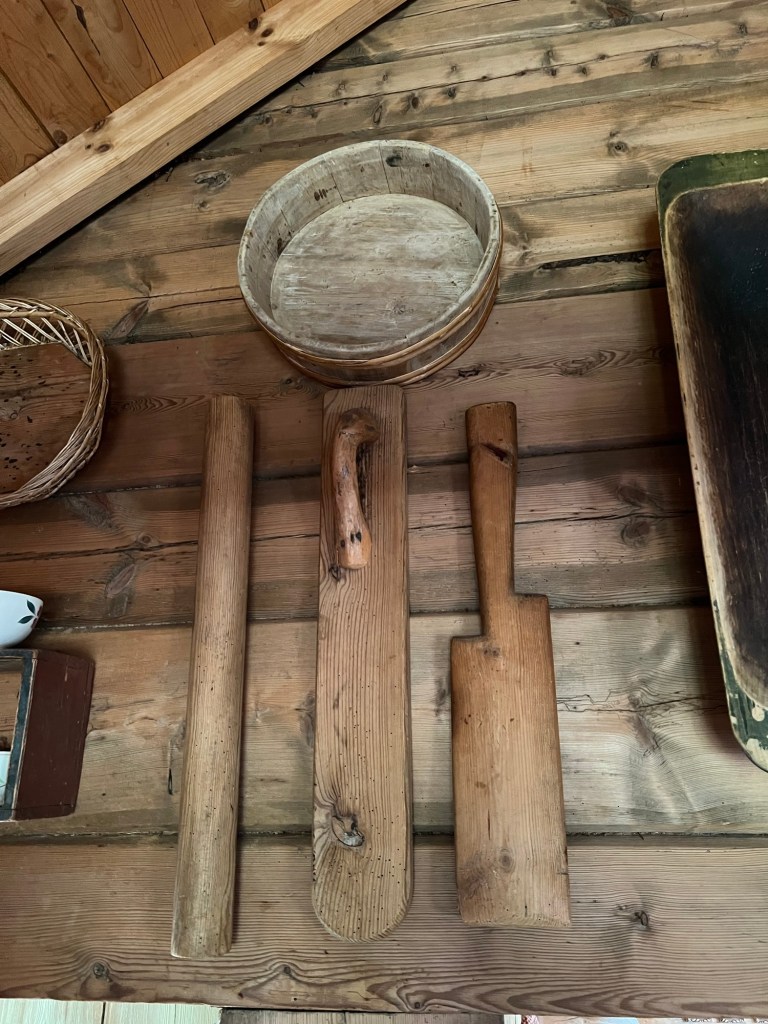
Traditional implements used to make rømaske (a pudding made from the first milk of a cow that has just given birth) 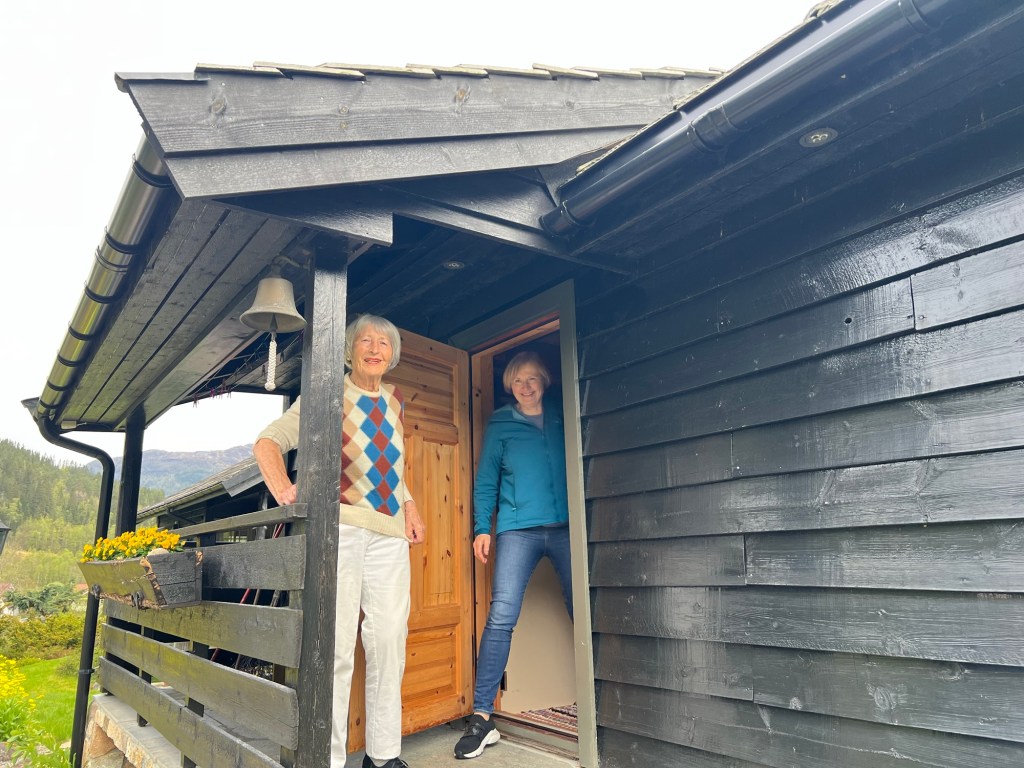
Signe and her daughter Siv Bruland From here our group traveled to Åsane, to see the farm where Malene’s mother Kirsti Andersdatter grew up. Today the farm is owned and operated by Ole Johan Åsane, who took time out of his busy schedule — it’s currently lambing season — to show us around the property. Åsane is tucked away in the uplands beyond the Huldafossen Waterfall. The farms up here have breathtaking views of the mountains.
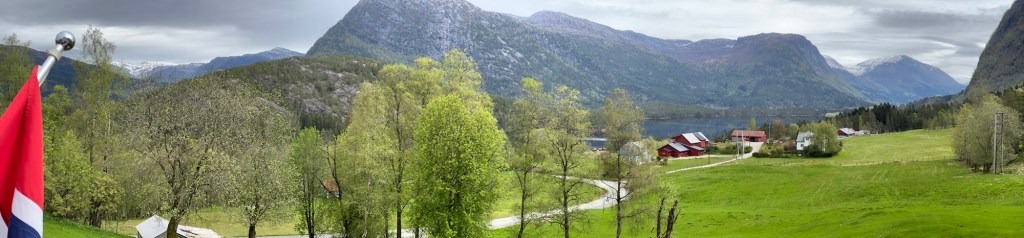
The view from Åsane 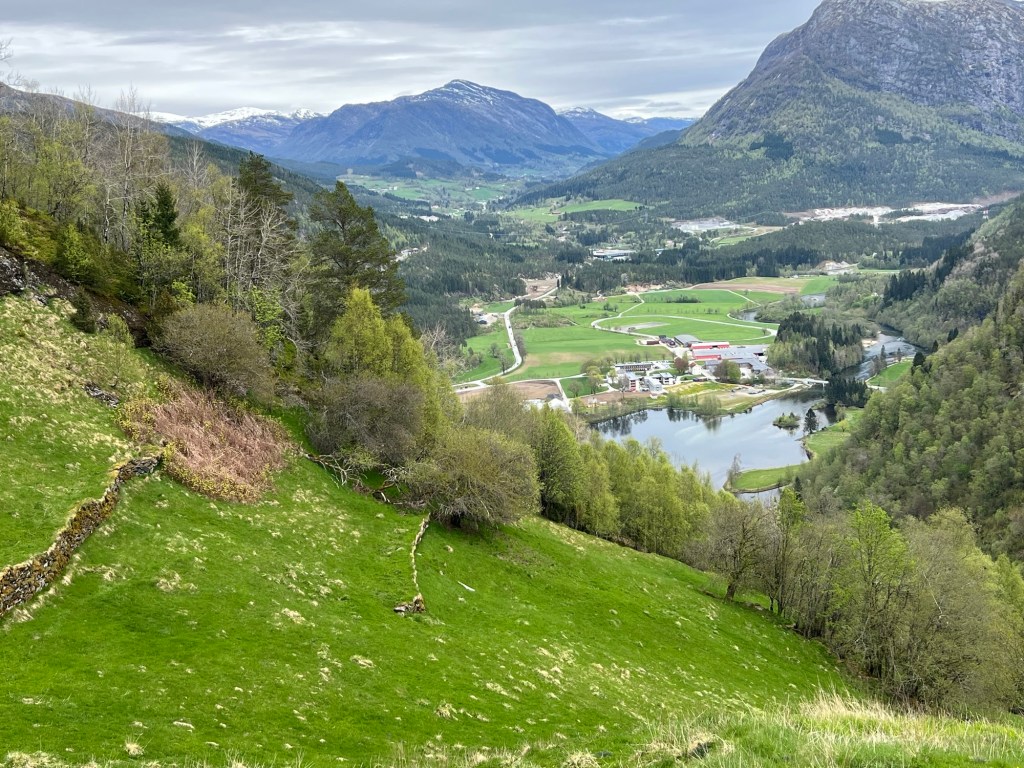
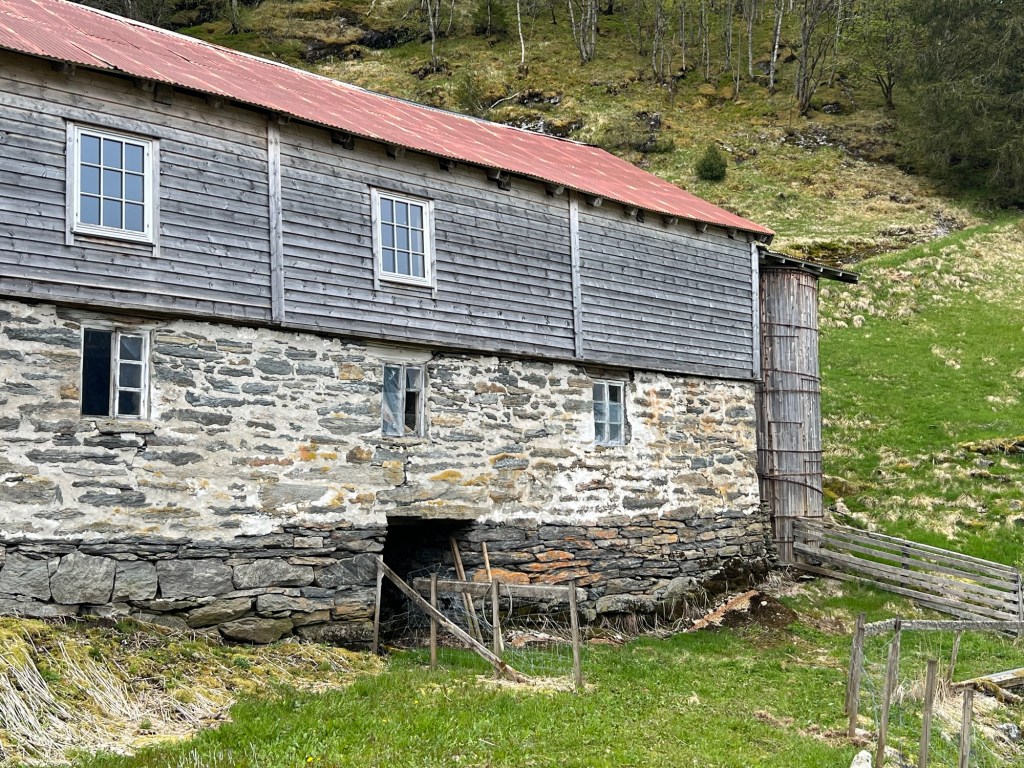
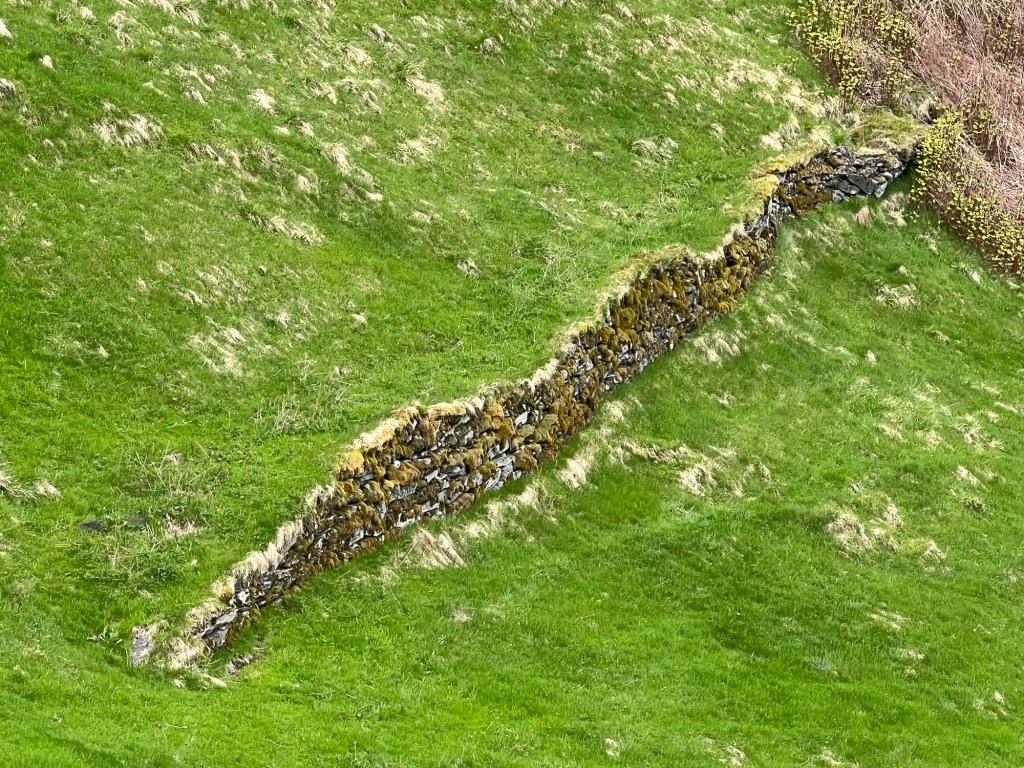
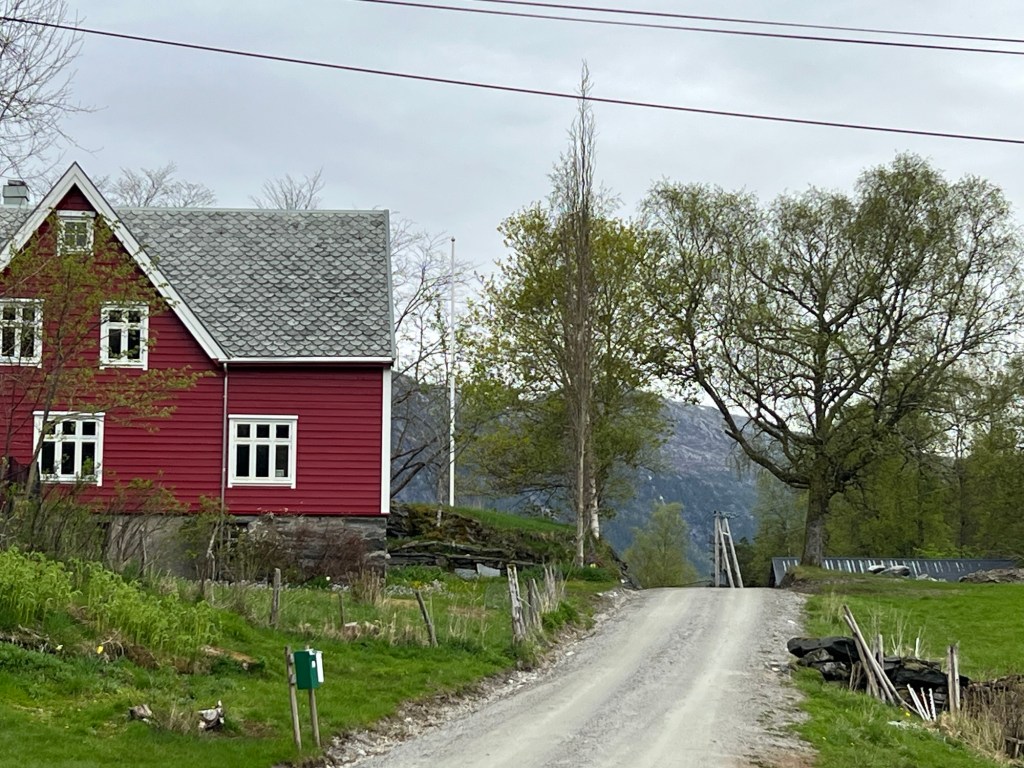
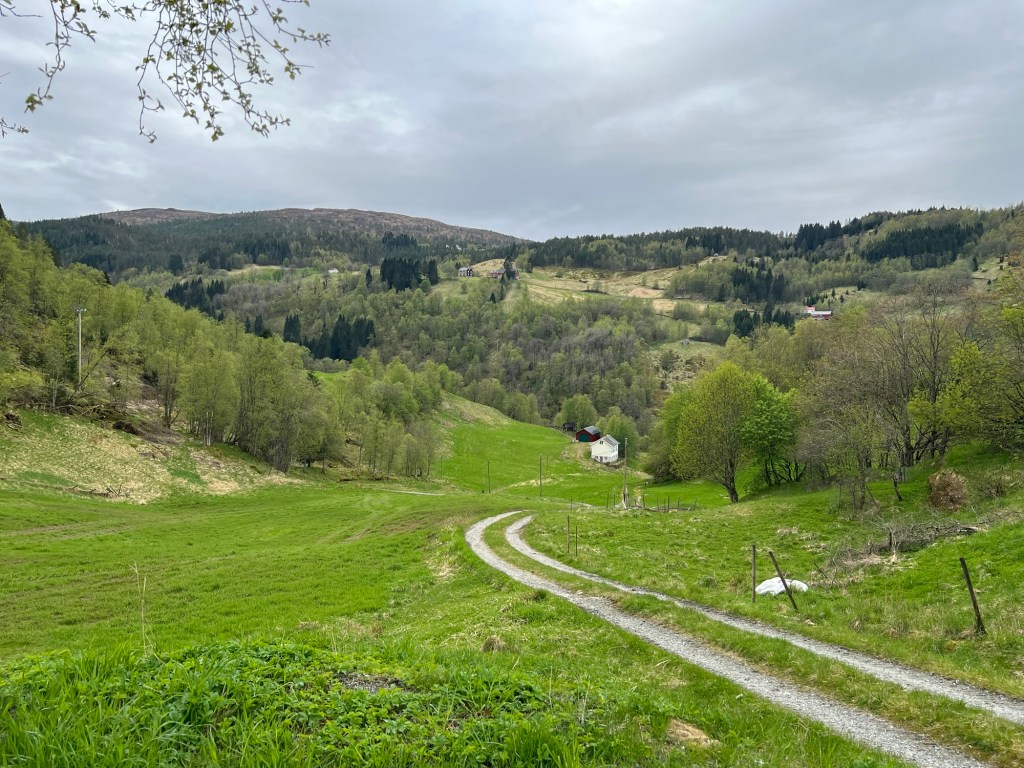
Some photos to give you the flavor of the countryside here — near the Kinnaneset, Kinna and Lia farms 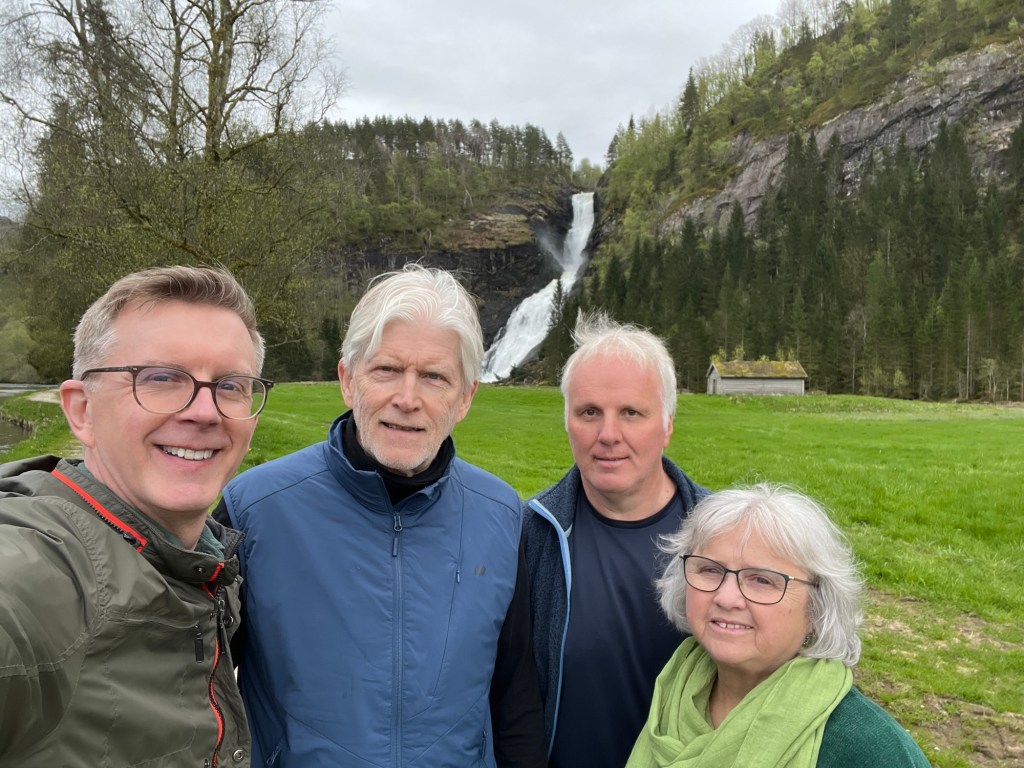
Our group in front of the Huldafossen. The waterfall is named after a kind of mythical being, the huldra. According Scandinavian folklore, huldre inhabited the forests and could help or harm humans. One of our final stops of the day was at the bruk called Gjel at Bruland. As I write above, Mr. Fossen believes (and I’m inclined to agree!) that Malene’s father Ole Gundersen Bruland came from this farm. Gjel lies on a serene bend in the Jølstra River. Here the current owner, Mr. Høgseth, has been working hard to revive and conserve the native salmon population.

The farm as it used to look 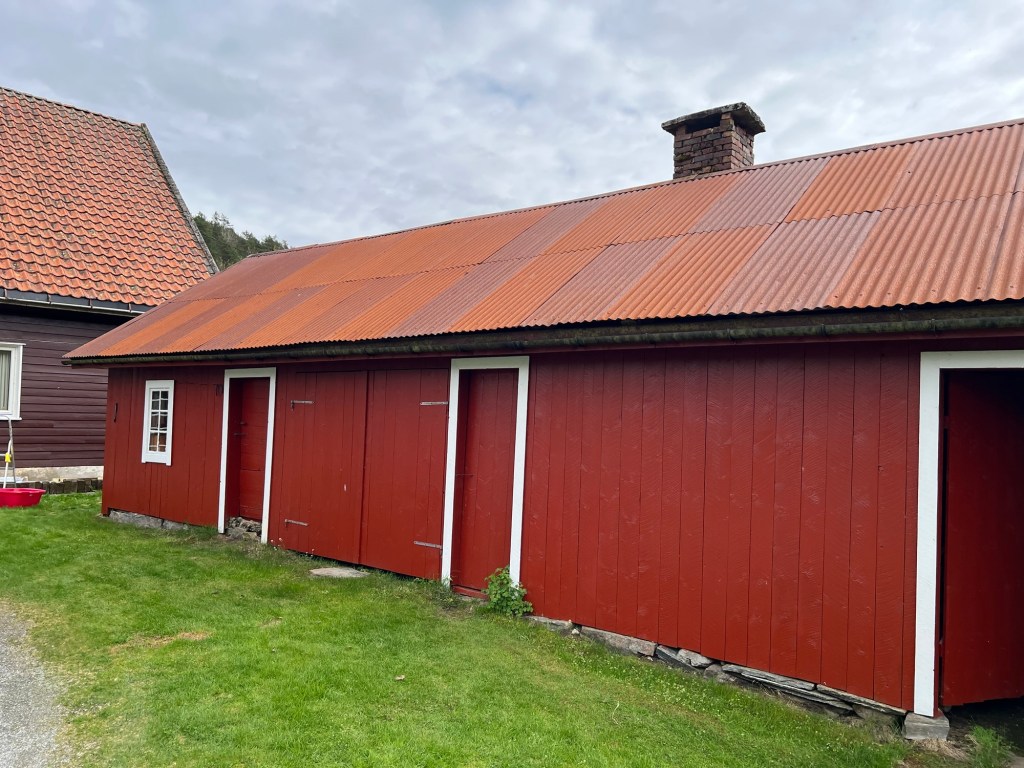
Outbuildings at Gjel 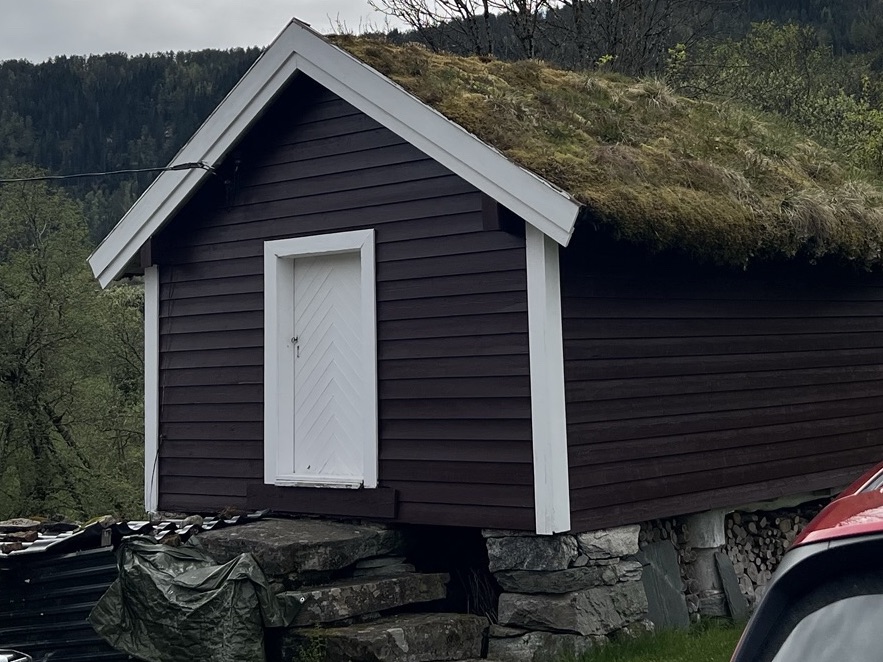
The stabbur (store house), raised to protect from mice 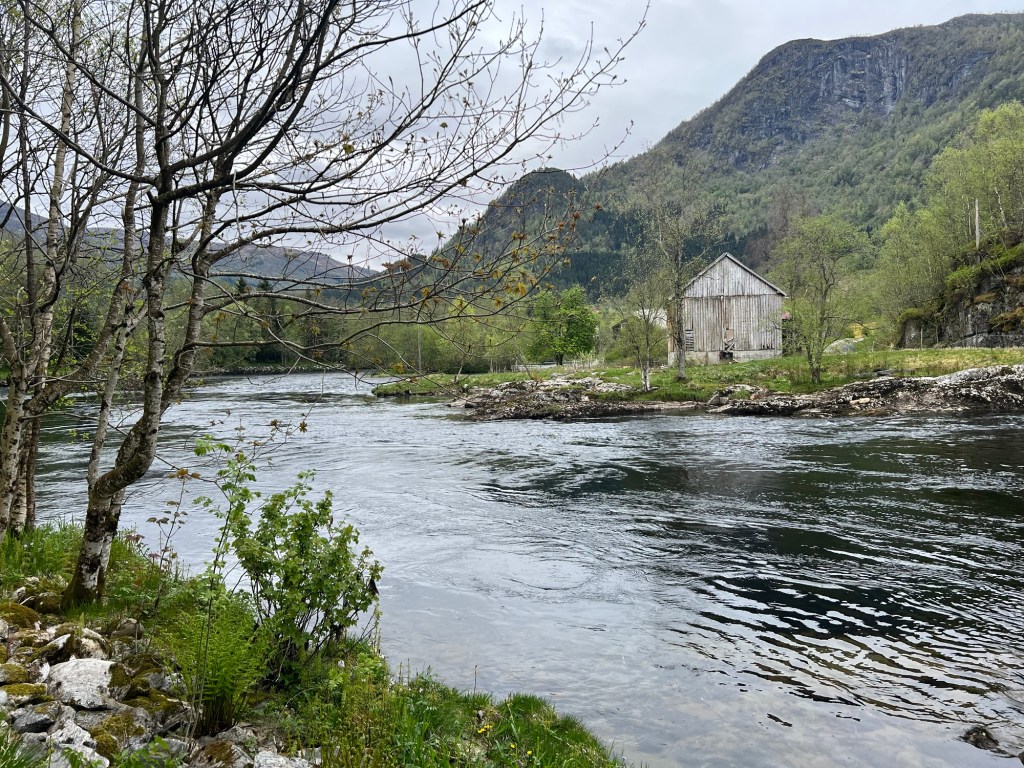
Along the Jølstra 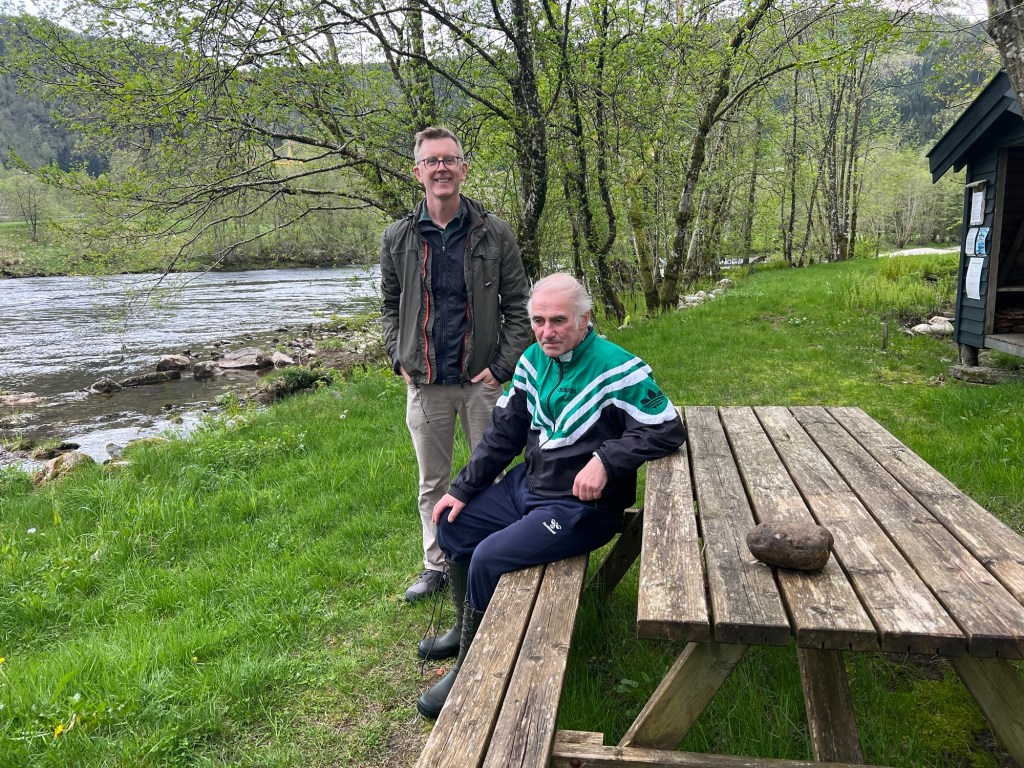
Mr. Høgseth and I I could probably make this post 10 times longer without trying too hard — my generous hosts packed so much into this amazing day for me.
I will simply conclude by saying that my ancestor Malene Olsdatter left this area 175 years ago with a mixture of emotions that I can only imagine — sadness over saying goodbye to loved ones, excitement for a new life with her fiancé, and probably a healthy dose of fear about what was in store for her in America. Tomorrow morning I’ll be leaving Førde with a different set of mixed emotions: joy over making new friends, gratitude for all of the kindness that was shown to me here, and a pang of regret for the shortness of my visit. I hope I can make it back here one day.
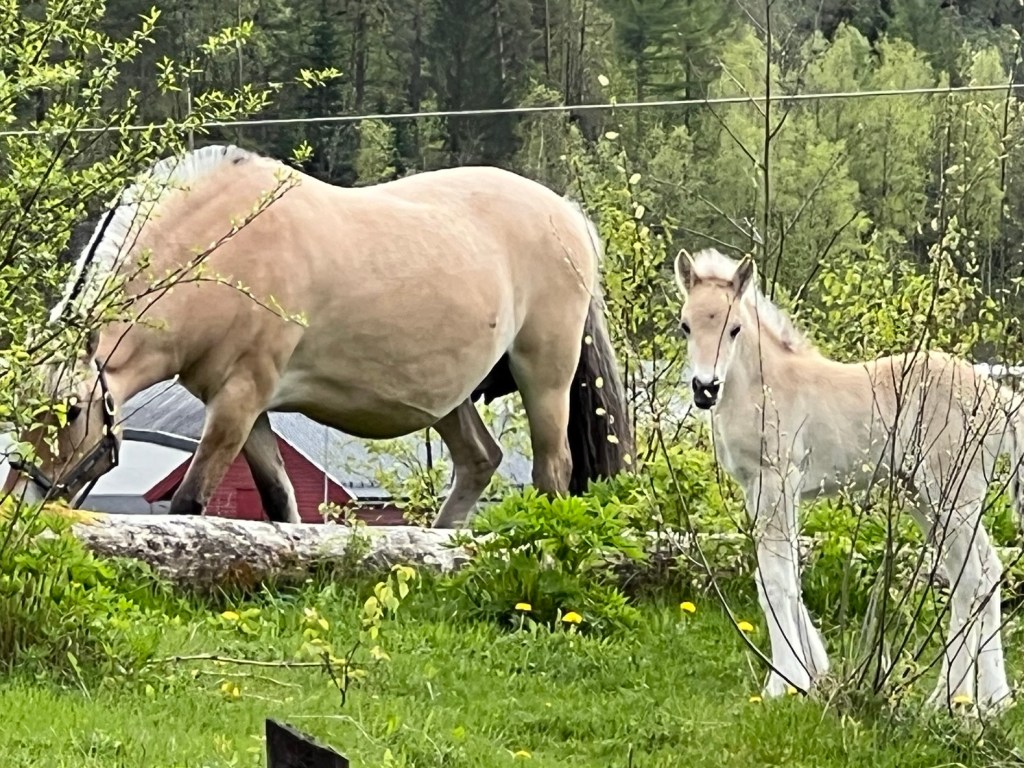
A fjordhest and her foal 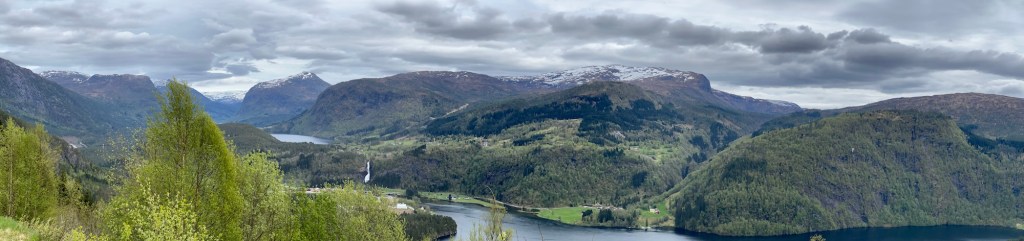
The view from Solheim over Movatnet and the Jølstra River Valley
[1] I took a great deal of artistic liberty with the italicized introduction to this post. This “dramatization” is based on fragments of a story passed down in our family. We have no evidence that Ole was actually in Førde, but the family story that was passed down (see this post) suggests he was there. Church records show that Ole migrated out of the parish on April 16th, 1849 — “to Bergen”. We might assume he left Bergen for Førde sometime later that year or in early 1850.

[2] Not everyone wants to read how the genealogical sausage gets made, so I’ll footnote this: Locating the correct Malene Olsdatter Bruland was a long process. In 1975, my great-aunt Helen wrote to the renowned Norwegian-American genealogist Gerhard Naeseth asking for help. Mr. Naeseth managed to find Ole and Malene’s names on the ship manifest of the brig Nordlyset, but when it came to their families of origin, even he was at a loss. He suggested Helen solicit the help of a scholar in Bergen by the name of Lars Oyane, and Helen wrote him immediately.
Mr. Oyane did some research and could not discover any trace of Ole Jensen Hauge. This was because he was looking for Ole in the area near Førde — a logical but false assumption. (We now know that Ole was from Arna, near Bergen. I wrote about his origins in this post.) And regarding Malene, Mr. Oyane concluded that she was born Louise Malene Olsdatter on the Bruland farm in Førde in 1824. But what Oyane had overlooked was that there was another Malene Olsdatter born on the Bruland farm in 1824. Last year I discovered this Malene in the Førde bygdebok with the note: “Gunhild Malene. f. 1824, det var truleg ho som kalla seg Malene Olsdatter og emigrerte til Amerika den 2. mai 1850, den første registrerte Amerika-farar frå Førde” (Gunhild Malene b. 1824, it is believed she called herself Malene Olsdatter and emigrated to America on the 2nd of May, 1850, the first registered emigrant to America from Førde).
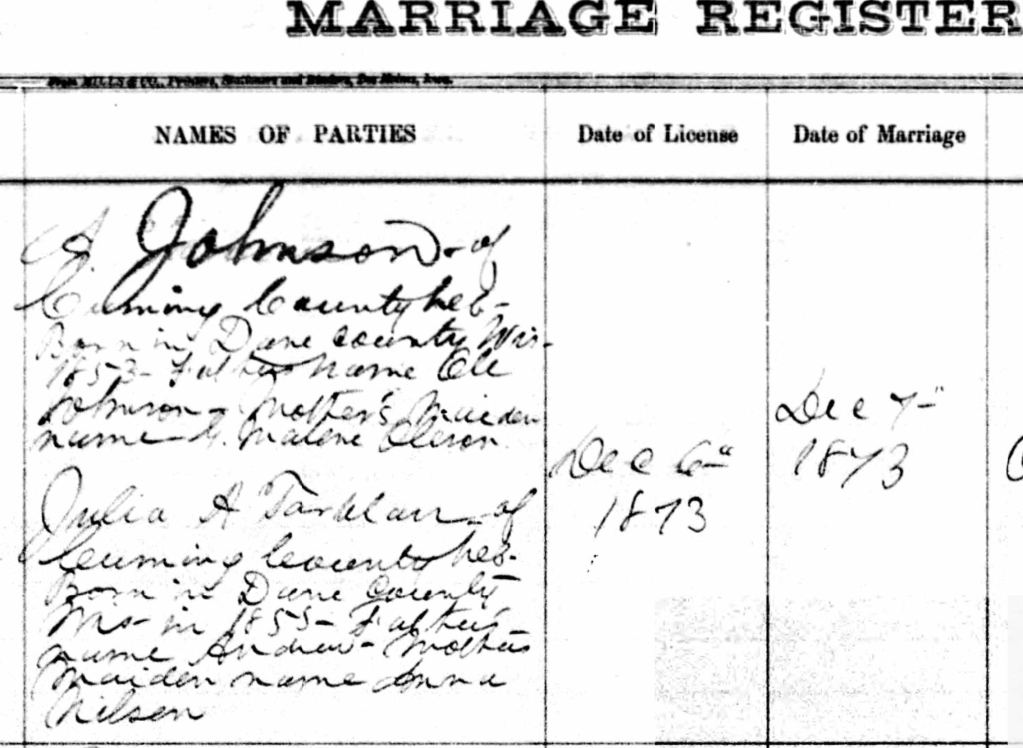
Could that be right? Bygdebøker are secondary sources and not as reliable as the primary sources they are based on. For several months I tried to find some kind of evidence — documentary or DNA — that would establish which Malene was ours. Eventually I gave up and asked for help from the local archivists at Vestland fylkeskommune. To my surprise and delight, Ms. Anett Ytre-Eide at the archives got back to me with conclusive evidence that Louise Malene had stayed in Norway until the end of her life, while Gunhild Malene disappeared from Norway’s records in 1850. Neither first name (Louise nor Gunhild) are used in any American documents I can find, but if you look carefully at the Nebraska marriage record for my great-great grandparents, Albert and Julia Johnson, it does appear to list Albert’s mother’s maiden name as “G. Malene Oleson”. (Incidentally, Albert and Julia moved back to Wisconsin shortly after marrying in Nebraska.)
-
A history of the Hauge farms of the Arna Valley, by Ole Johan Hauge
When I was preparing for this trip to Norway, I posted on a Facebook page for the community of Arna that I was seeking some local history expertise. I had discovered that my great-great-great grandfather, Ole Jensen Hauge, emigrated from Arna, but I didn’t know anything about the area. Local volunteers kindly came to my aid and put me in touch with two people: Arne Storlid, a distant relation of mine, and Ole Johan Hauge, a local history expert. I had the great pleasure of meeting Ole Johan Hauge this morning, and then we went together to meet Arne Storlid. (I write about that meeting here.)

Ole Johan Hauge and I — out on the Hauge Farm, Arna, Norway These days Ole Johan is a volunteer teacher at the Espeland Prison Camp Museum, the only preserved prison from Norway’s occupation era. Formerly, Ole Johan was the chairman of the museum’s foundation. The facility at Espeland was set up by the Nazis to incarcerate political prisoners, and it stands as a testament to the horrors inflicted during the occupation. Before he retired, Ole Johan worked around the world for over 25 years for the International Red Cross. His last call of duty was in North Korea, but he also helped direct the rescue operation after the tsunami disaster in Indonesia in 2005. Additionally, he worked in Sri Lanka, Bosnia during the war, in China, Myanmar, Lebanon and Malaysia.
Ole Johan Hauge’s family hails from one of the several Hauge farms clustered in Arna’s Langedalen Valley — not the one where my immigrant ancestor grew up but one close by. Still, it’s likely that he and I are distantly related.
A few weeks before my visit, I had asked Ole Johan if he would be willing to meet me for a coffee and tell me a little about the local history, particularly about the conditions in those years when locals like my ancestor Ole Jensen sailed for America. Ole Johan agreed, and then he went the extra mile: he actually wrote a local history of the Hauge farms and sent it to me. This act of generosity completely floored me. I have done my best to translate Ole Johan’s excellent history, and I’ve pasted it below, along with the photos and drawings he included. I hope you enjoy it as much as I do.
A HISTORY OF THE HAUGE FARMS OF THE ARNA VALLEY, written by Ole Johan Hauge

The Hauge farms in the 1800s
The green valley of our childhood, Langedalen, is located within the lovely Arna Valley and about 20 kilometers from the center of Bergen. Beautifully situated in this valley in one of the side valleys popularly called Oladalen are several Hauge farms (“Haugegårder”).
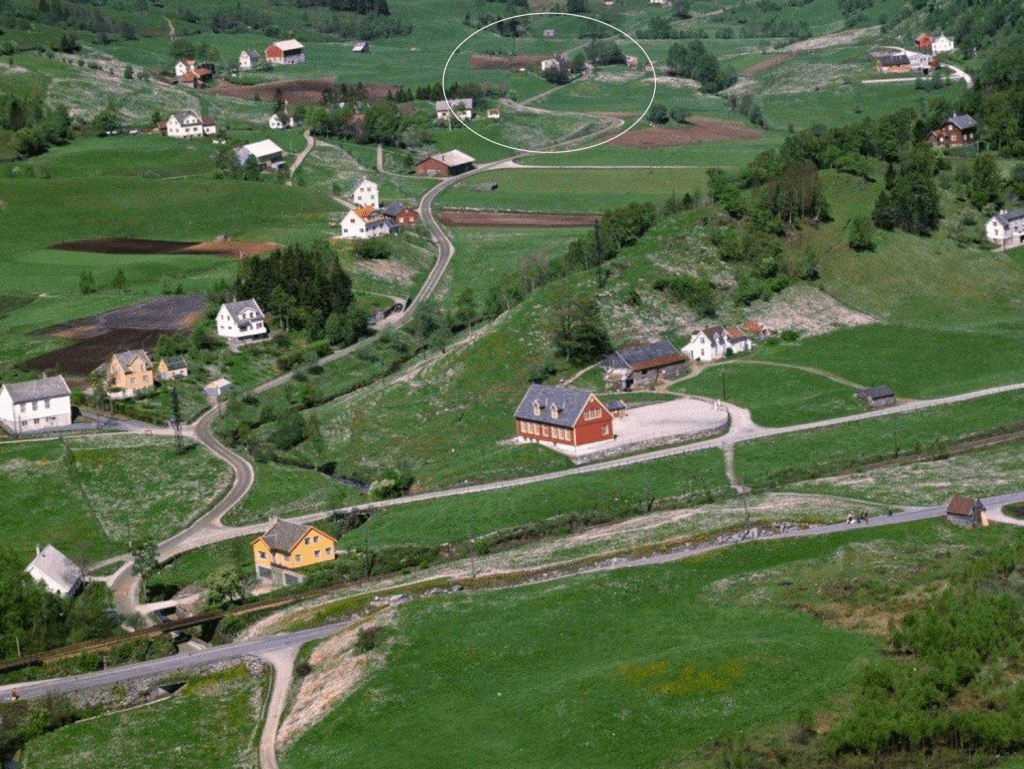
The green valley of our childhood (Hauge Farm is circled) In the 19th century, Norway was a poor farming country with little contact with the rest of Europe. That was also the case in Arna. There were many small farms that could not feed many people. And there were many children in the families then, and only the eldest son (odelsgutt) could take over the farm. The rest of the children had to find work outside the village as there was little industry in the 1800s.
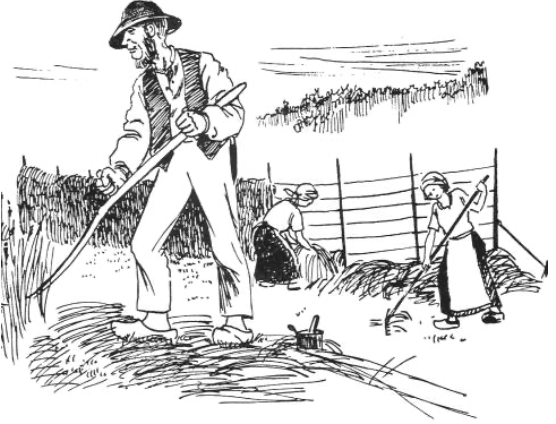
It was hard to do farm work in Vestland, steep slopes and and much heavy labor. Everyone on the farm had to pitch in, and from the time they were little the kids had to work too.
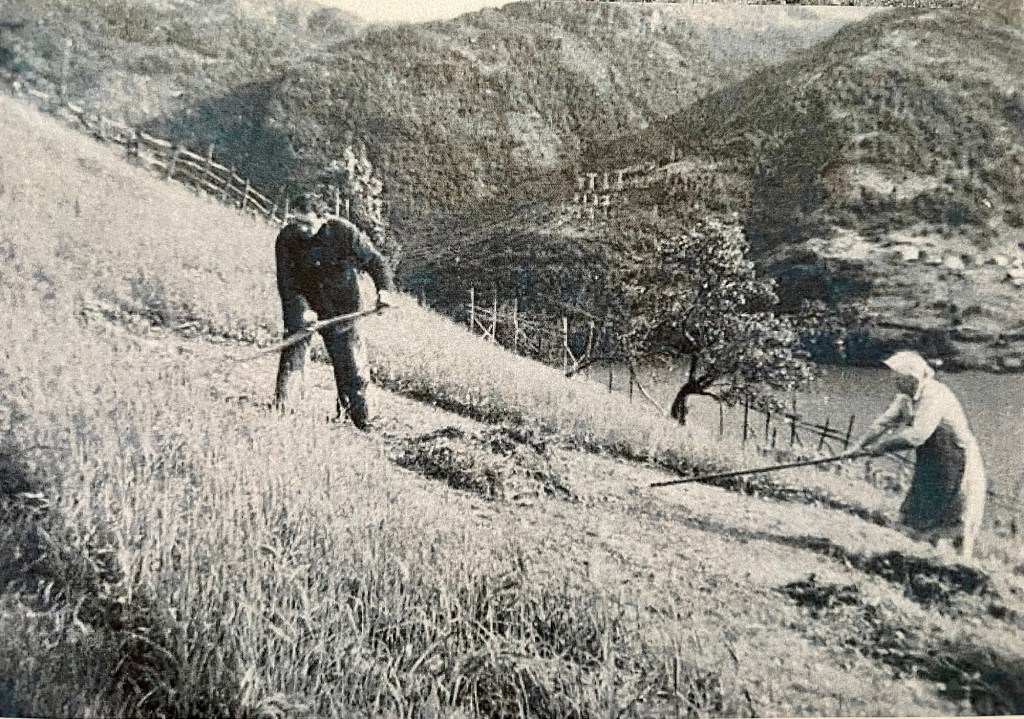
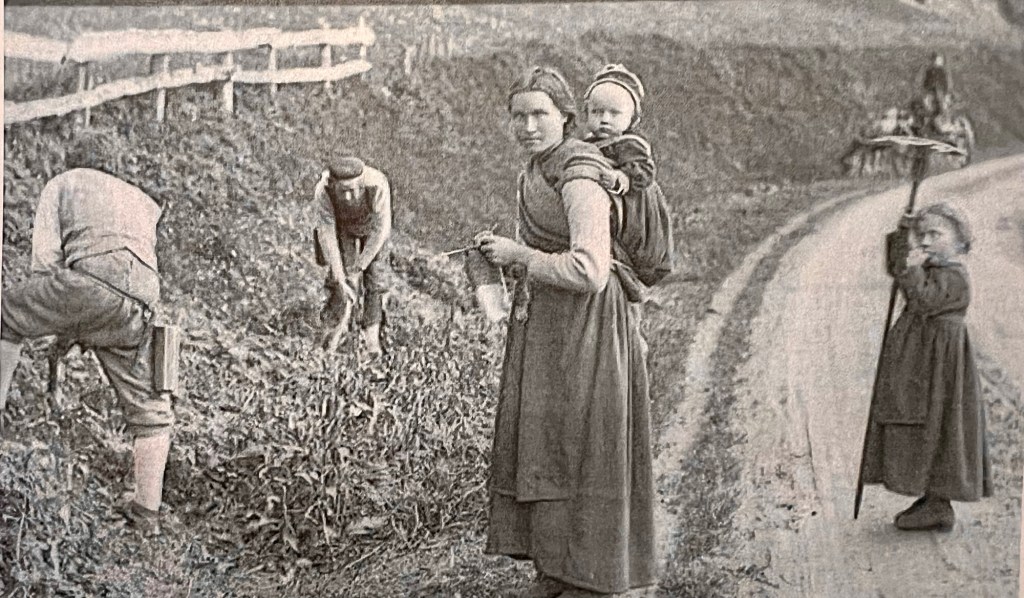
But when the children grew up, most of the children in a family had to make a choice. The oldest boy took over the farm, the girls were married off, and the rest of the sons had to find something to do outside the village. So they had to leave, and the closest place where many settled was Bergen. Or they went to other industrial towns in Vestland. And for some the dream was to come to America.

Dreaming of America
Early on, the youngest boys in the large families were dreaming of getting out and finding a place to live and work. For many, the dream of America, far away on the other side of the ocean, was just that — a dream. But some took the chance and set out.
It was tough to say farewell to home and everyone who lived there, but for many this was the only way out.
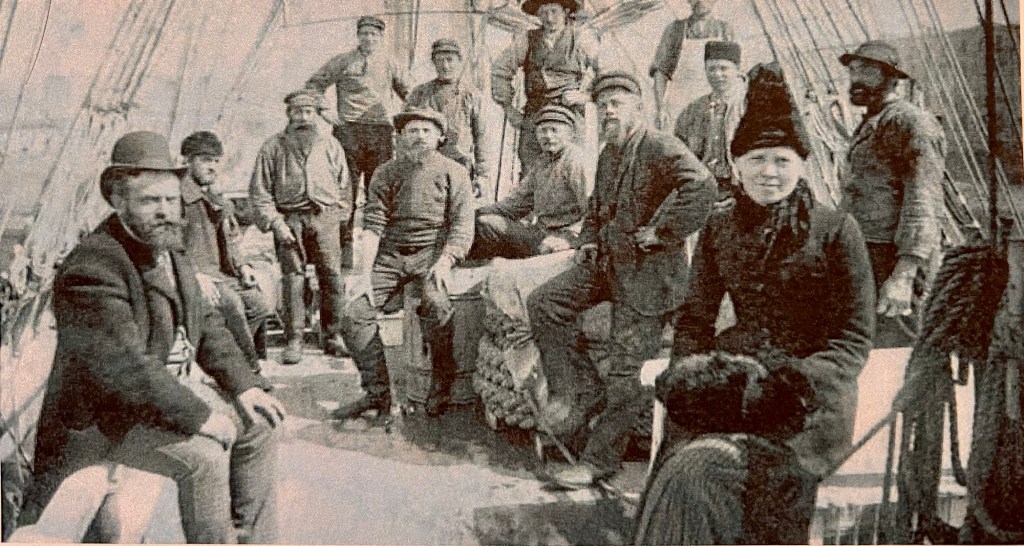
The voyage across the ocean was a long and tiring journey, and many were probably afraid of what awaited them in an unknown country.
Once in America it was a matter of finding a place they could settle down and work the land.
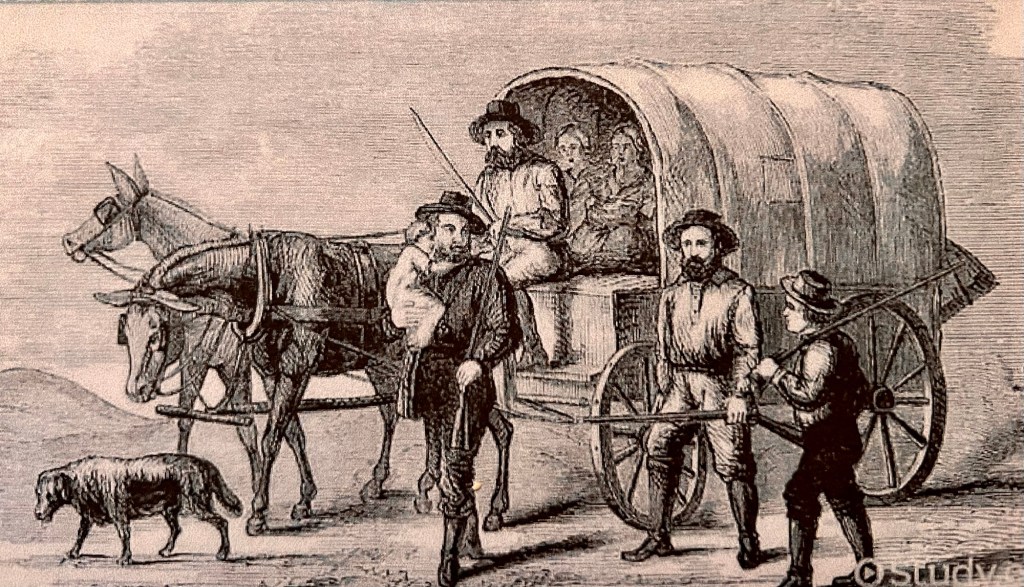
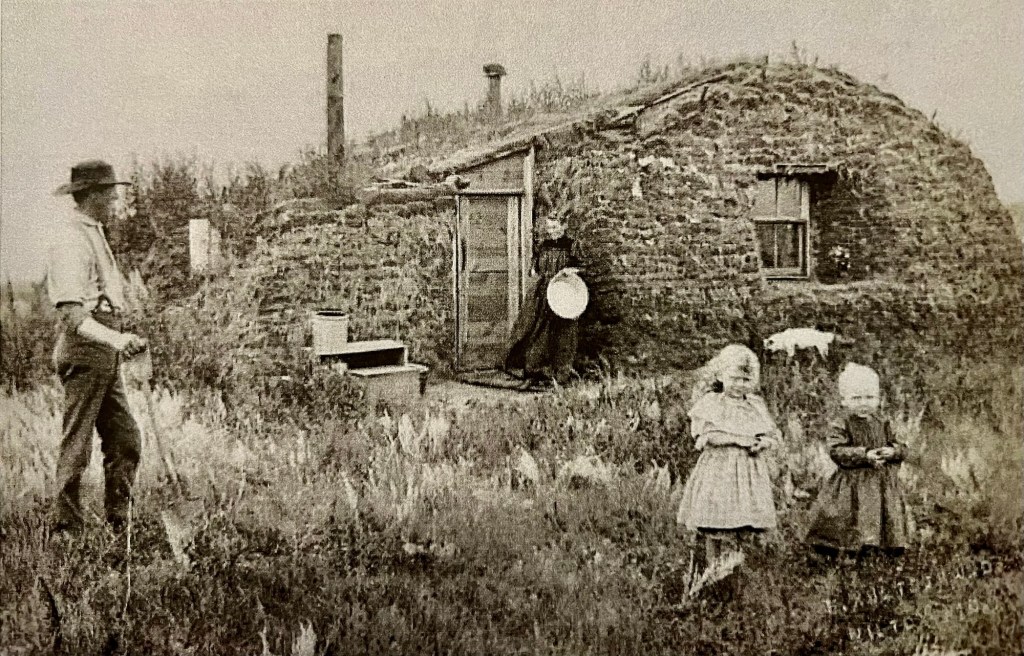
For many this was a tough existence, but most managed to build a life for themselves in that new land. They could never, however, forget those they left behind in Norway.
The community school (omgangsskolen)
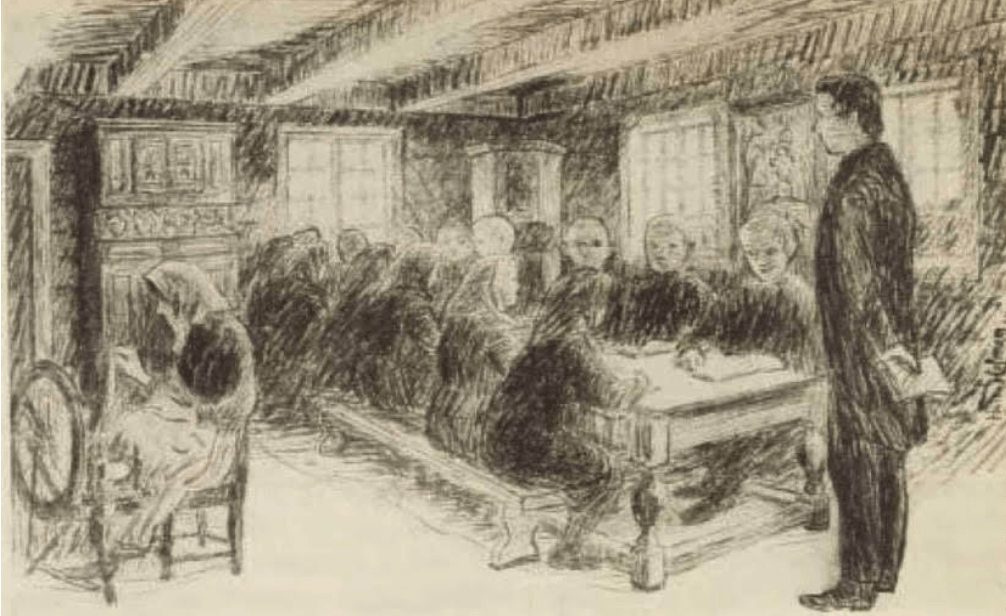
At the beginning of the 19th century, there was no regular schooling for children who grew up in the countryside. Sometimes a “community teacher” (omgangslærer) would come to the village. He would live on one of the larger farms and the children would come to that farm. School was held in the main room on the farm, and the community teacher would be there for several weeks. Such community schools continued until the 1880s. Of course, they did not exist in the cities.
Here is a drawing depicting teaching in a so-called community school in the countryside of Norway at the beginning of the 19th century.
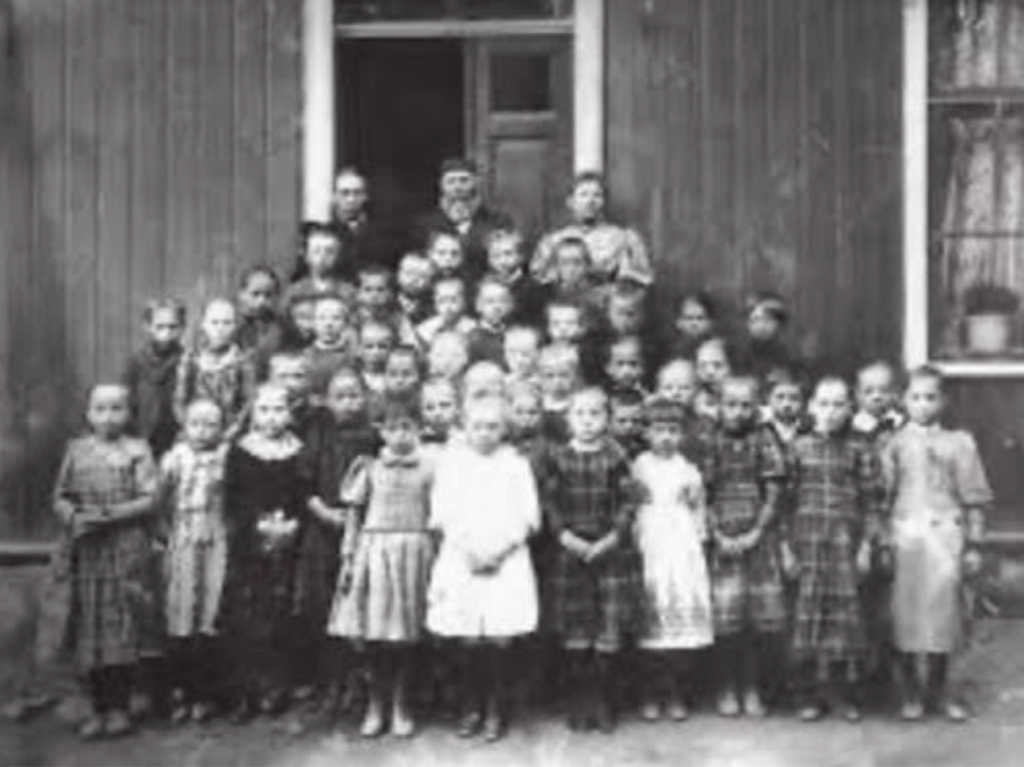
The photo shows children who were provided community schooling in the 19th century.
Borgaskaret, an important pathway
When the farmers of Hauge went to Bergen to sell or exchange their farm products, the trip over the mountain to Bergen was the shortest way. Then they had to go via the Borgaskaret Path over the mountain to the city.
Borgaskaret has been an important route to get from Langedalen and over Byfjellet to Bergen. This path was for hundreds of years the most common way to get to Bjørgvin town (the old name for Bergen) where the farmers of Langedalen could exchange important trade goods.
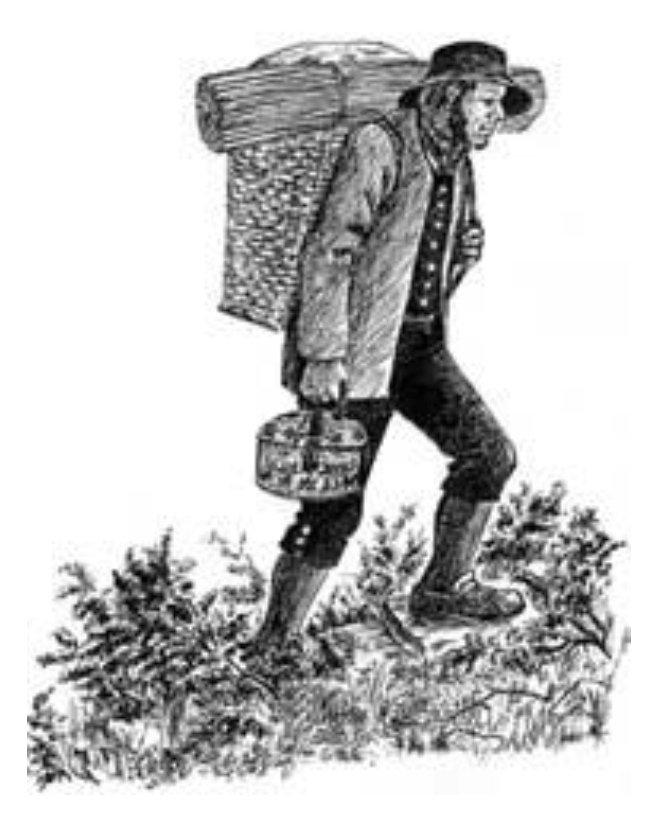
There was another path you could take if you wanted to go from Langedalen to Bergen, and that was the old postal road. It went over Natland and Kolstien, through Erdalen, over Bratland and then down through the slopes to Hauge. From there it went on over to Lone, Espeland and on to Arna and Garnes. But this road came much later when people started using carts and horses to transport goods. The trip via Borgeskaret was only for those who walked on foot and carried their goods on their backs.
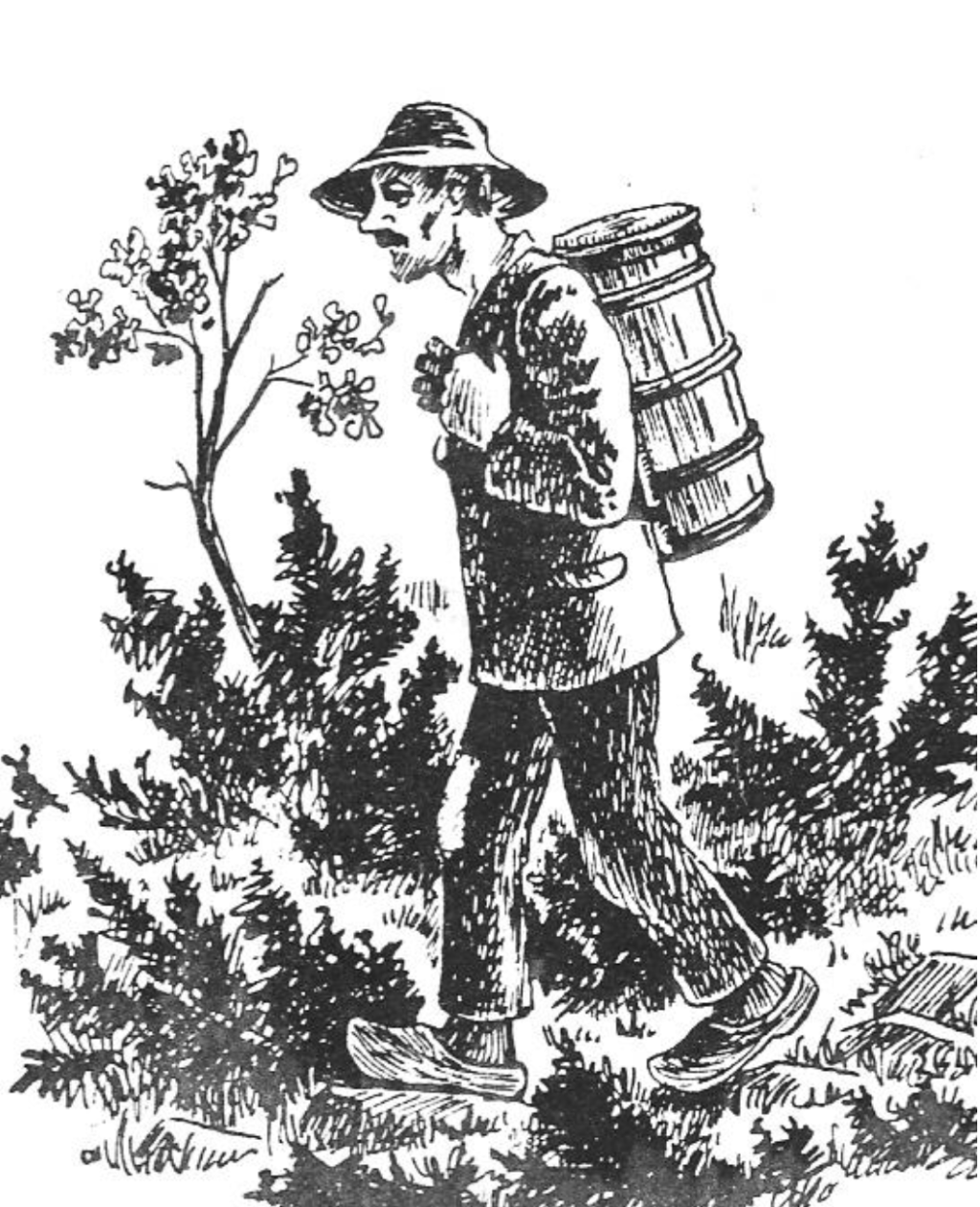
Until the postal road was put into use, the path up Borgaskaret was the most commonly used. If there was something that needed to be traded, whether it was meat, potatoes or milk, you had to walk Borgaskaret with a load on your back, and it was an effort like no other. Those who have walked that path know that it is terribly steep up from Borge even without a huge load on your back. People from Fjellgården and Unneland also had to take this road when they were going to town. There is a place between Londalen and Hauge that is still called Odlandsskaret because the folks from Unneland used to come here walking over Neset and Lone via Odlandsskarert to Hauge and so on to Borgaskaret. Through the mountain pass, the path continued to the other side of the mountain and down to Tarlebø, past Svartediket and down to Kalfaret.
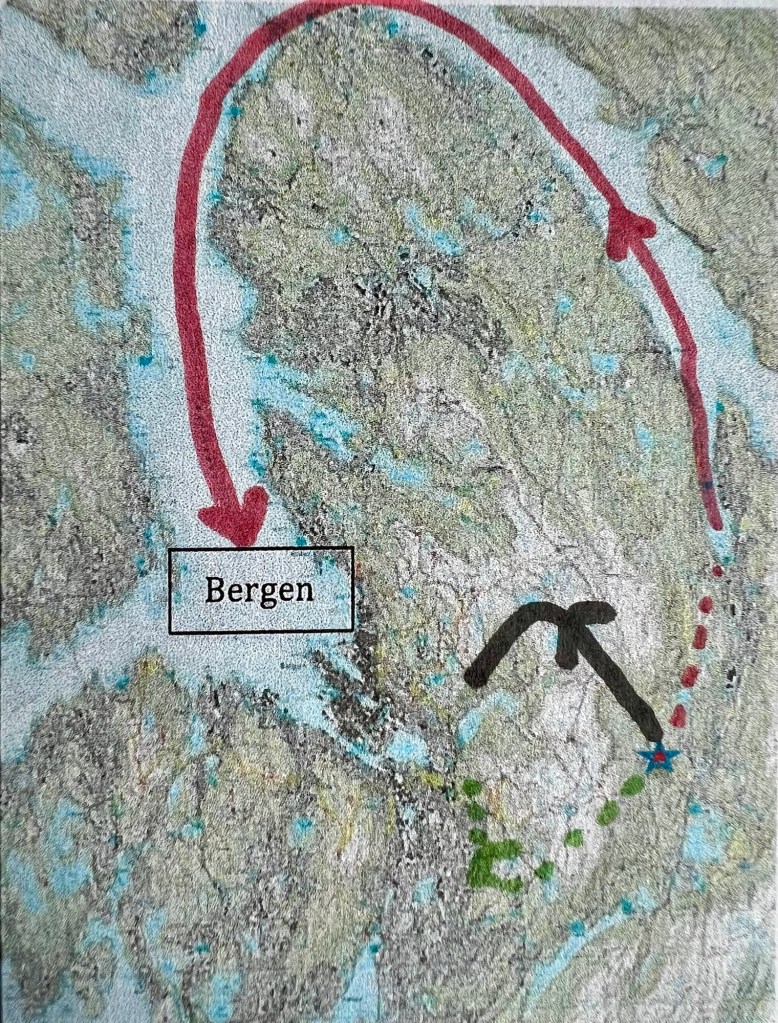
The star marks the Hauge farms, the black road is the Borgaskaret, the green is the postal road, and the red is the sea route. Borgaskaret was the shortest but the hardest for carrying heavy goods, the postal road was longer but easier. And the sea route was long but allowed you to bring many goods to barter with. Settlement on Hauge in the Viking Age
The farm Hauge is located up in Langedalen, beautifully situated in the shelter of “Hauafjellet”. People have lived on Hauge since the early Middle Ages, but the land was used as far back as the early Viking Age.
There is a written record of farms and ownership from 1519, and at that time it was Sigmund on Hauge who was the owner. He was born in the 1450s and is the first of our ancestors whose name we know. Already in the Viking Age there were people who farmed in Langedalen. It was usually noble families in Bjørgvin who owned the land around the town, and they usually hired slaves or others to farm for them. In the beginning, no one lived where the land was; that happened when the land began to yield a return. Only later did people settle in the valley, but they did not own the land. The valley was at that time divided in two: the southern part went from Borge southwards all the way to Unneland, and the northern part went from Borge northwards. This is how Langedalen was divided for hundreds of years.
The entire Langedalen was under “Skjold Skipreide”. A skipreide was an administrative division of Norway into geographically delimited areas where the inhabitants were collectively responsible for building, maintaining, equipping and manning a leidang ship. The skipreides were not only located on the coast.
Exactly how old the skipreide division is is not known, but the skipreides originated together with the leidang system, and according to Snorri Sturlason, the laws were developed/improved under Håkon the Good and Sigurd Jarl in the mid-900s.
Towards the end of the 13th century, the skipreides became used only for fiscal purposes, and they remained the basis for tax administration until the 1660s. Skjold Skipreide was one of eleven skipreides in Nordhordland, which included large parts of the current Bergen municipality.
The first settlement on what is today Hauge was sometime in the late Viking Age. Two families, probably from Fana in Skjold Skipreide, are said to have come and settled in the valley where the Hauge farm is located. They settled there and built a house together – two families with a common living room but each one with its own space on the short sides of the house. Then they began to cultivate the land just below what we today call Byfjellet Mountain. It was quite common during that time to use slaves for the heavy farm work.
The first farmer on Hauge that we know anything about is Sigmund on Hauge who was born around 1450. Most of the church books before that time have been burned, and it is impossible to find previous owners. So it is likely that there have been landowning farmers on Hauge long before 1450.
The conflict between the Baglers and the Birkebeiners
We know that there were farms on Hauge and Borge when the conflict between the Birkebeiners and the Baglers* was at its worst in the 13th century. Many legends from this time still survive. One of these is related to the Hauge farm. The Baglers who lived in Bjørgvin had learned that the Birkebeiners were heading west to subdue the town. Afraid of being caught with their trousers down, the Baglers sent some soldiers up to Byfjellet to see if they could discover the Birkebeiners before they came over the mountain. One night with a full moon, they saw to their horror that hundreds of soldiers were lined up down on the Borge and Hauge farms. They ran down to the town where all the church bells were rung to warn the townspeople of the danger that was lurking.

But nothing happened, and the next evening the soldiers went up again and then down to Langedalen. Great was the surprise when they discovered that the “soldiers” were corn stalks – not Birkebeiners. But later the real soldiers did come and they defeated the Baglers down in Bjørgvin. This story has been told for generation after generation.
The “skaffers” on Hauge
The old postal route between Bergen and Christiania (Oslo) went via the Hauge farm, and in the 18th century the farm became part of the so-called skyss-stasjon system of the Norwegian government. This meant that the farm had to provide rested and healthy horses when someone came on public business. There were many such “skyss stations” or “skaffer farms” on the long route between Bergen and the capital, and this system worked excellently. Eventually, the farmers on Hauge were nicknamed “Skaffer” Lars, “Skaffer” Ola and so on. It was an honor to become a skaffer farm, which also meant that everything had to be in order. The horses were well-groomed and in order, and pretty much as the public demanded.
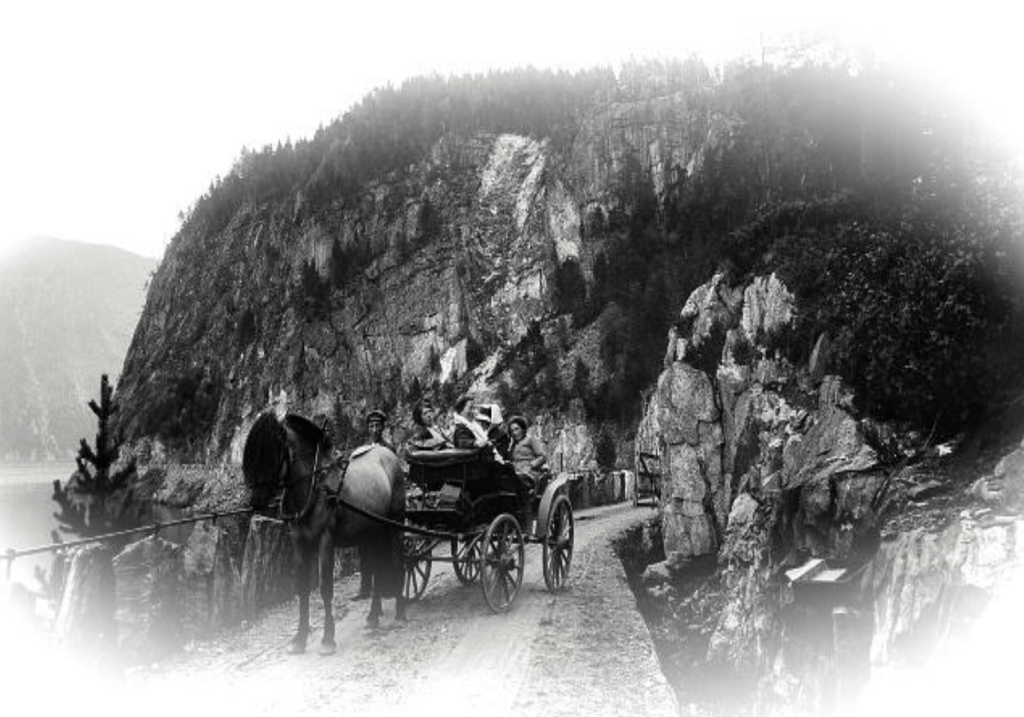
Throughout history, many officials came by postal road over the mountain and down to Hauge. There they changed horses before continuing their journey east. This was a service that meant a lot to the farms that were part of the skyss-station service, and the arrangement lasted for several hundred years.
A new era

When the train came to Indre Arna in 1885, it was the start of a new era Up until 1880, there was almost no development in Arna. There were mostly small farms and large families with children. Therefore, most of the youngest boys in the families left the village to find work. It was either to Bergen or to other places in Western Norway. Many also went over the sea to America. Young people from most families in Vestland went to America in the 19th century.
In 1885, something important happened for the development in the Arna Valley. The railway between Oslo and Voss was extended all the way to Bergen, and it was a great revolution for the development of Arna and Hauge. Thanks to the railway, several industrial leaders began to see the possibility of establishing industry in the village. There was plenty of electric power from the surrounding mountains, and in 1895 the Janus factory in Espeland was established.** This meant that the young people did not have to leave the village but could find a job near the farm.

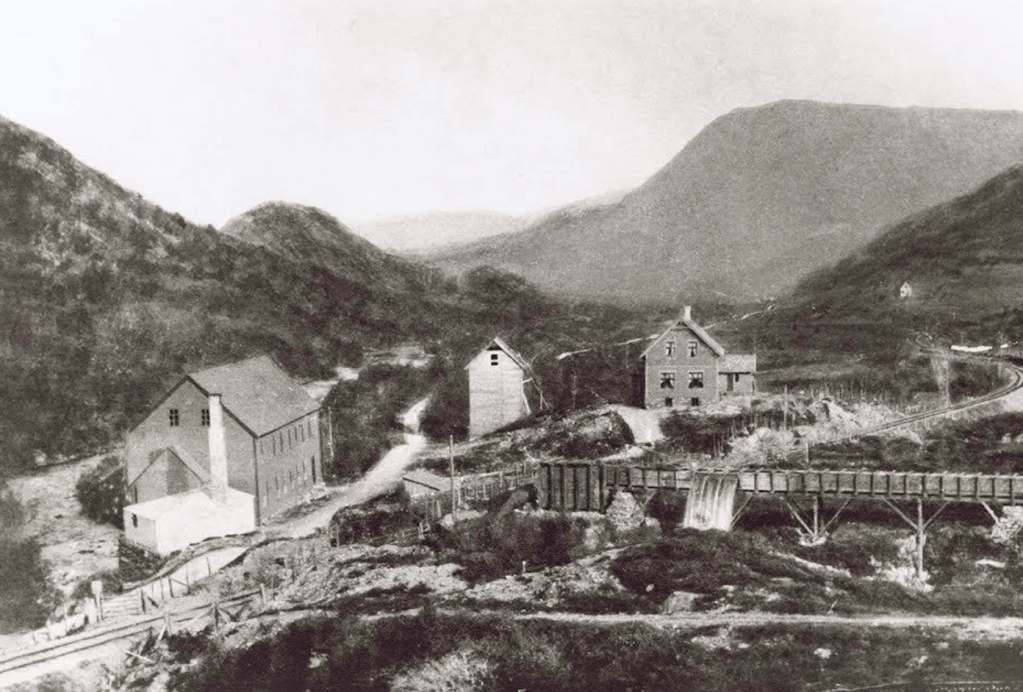
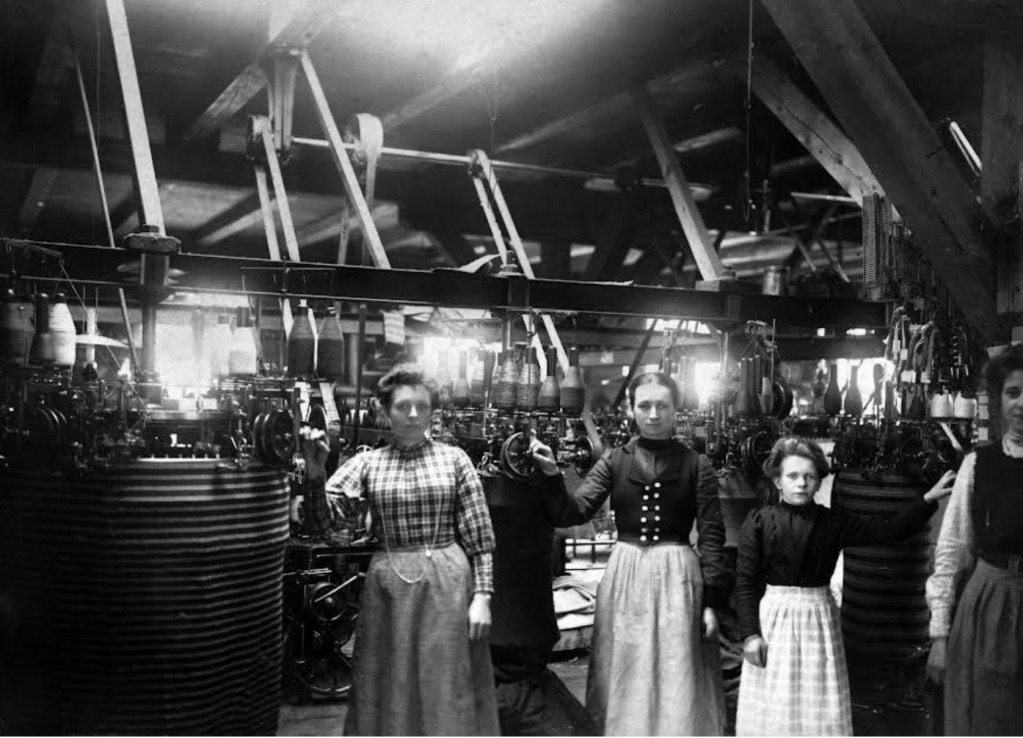
Here the Janus factory set up its first building, and the venture was underway. 
When the Janus factory was established, major changes occurred in the Arna Valley Around the Janus factory, many homes were built for those who worked at the factory. In addition, there were shops and schoolhouses. This meant that those children in the family who could not live on the farms could find work at Janus, which many did. With the arrival of the railway, the road into Bergen was not so long, and many could have jobs in the city while living in Arna. After 1900, so much happened in the Arna Valley and it developed rapidly.
* A note from your translator: The Birkebeiners (Birkebeinerne) and Baglers were two rival factions in the Norwegian civil war era (1130-1240). They supported different contenders for the throne of Norway and controlled different regions of the country until the reign of Haakon IV, the king who is generally credited with reunifying the country.
** Janus produces woolen knitwear and is one of the oldest knitwear factories in Europe.
-
Oh, those Johnsons
My grandmother’s Aunt Glenrose – my great-great aunt – was a beloved character, full of stories, jokes and poems. A spinster for life, she was always taking care of others in the family: nursing parents and siblings through sickness and old age, looking after one and then the next generation of children. My parents sometimes left me in Aunt Glenrose’s care when they were busy with work or school, and I can still picture my dear, white-haired auntie sitting in her chair, launching into a recitation of a poem she knew by heart.
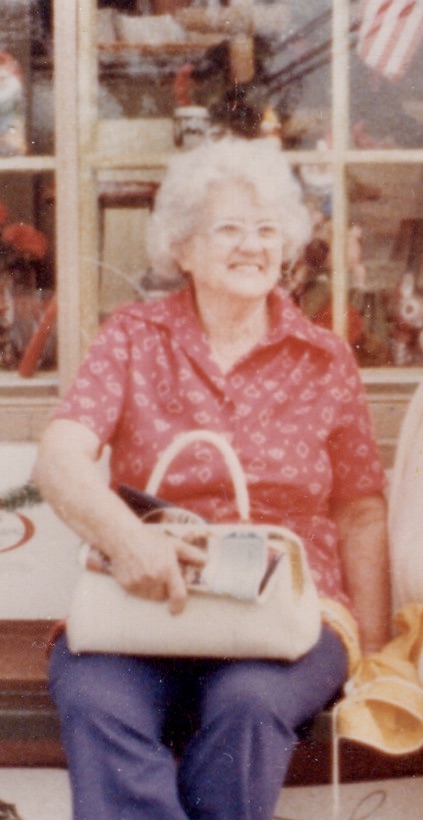
Aunt Glenrose as I remember her in the mid-to-late 1970s Some of her favorite stories were about her own family. Glenrose Johnson was the last of 11 siblings, and before her mind clouded over with dementia, she could regale you for hours with funny episodes from her youth. She would giggle recalling when she introduced herself at school as yet another Johnson sibling. “Oh, those Johnsons,” a local gossip had remarked, “They are so prolific!”

Glenrose with her brothers George and Leslie (circa 1903) And it’s true. We are! When I was a child, I knew about Glenrose’s siblings and the large generations of Johnson descendants that followed. What I didn’t know was that Glenrose’s father Albert had four siblings and one half-sibling, and Albert’s father Ole – our immigrant ancestor – had at least seven siblings.
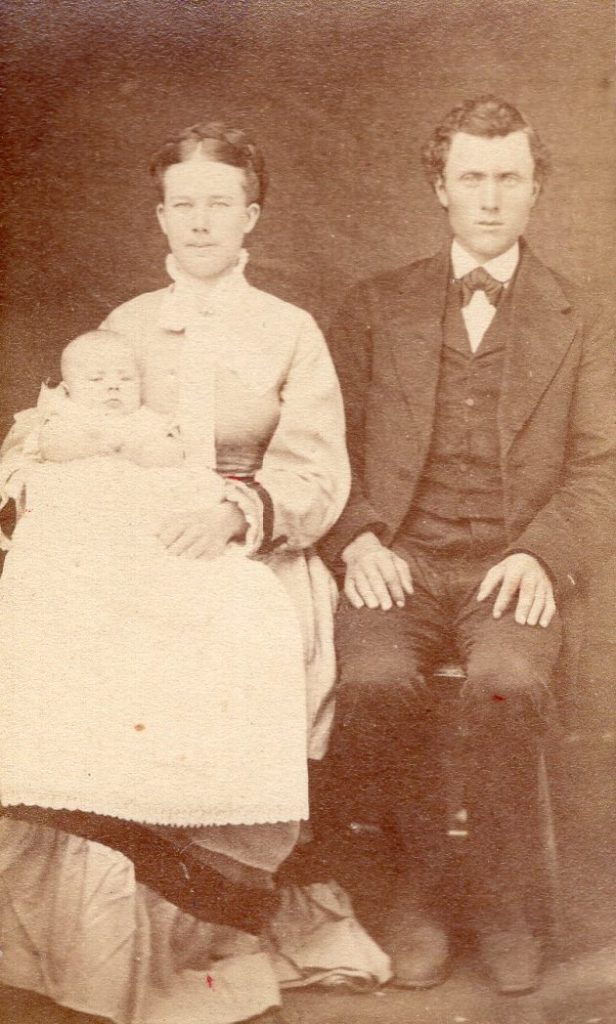
Albert and Julia Johnson with one of their first children, 1870s (Albert was the son of Ole Jensen Hauge and Malene Olsdatter) Ole’s origins had been a mystery for quite a long time. According to the family history that Glenrose wrote in the 1970s, Ole Jensen Hauge was born in Bergen, Norway in 1826, immigrated to Wisconsin in 1850 with Malene Olsdatter (his bride-to-be), and operated a farm in the area of Deerfield, Wisconsin. He changed the family’s name to Johnson at some point, probably to seem more American. Glenrose had listed Ole’s parents’ names in her book – Jens and Marie – but we knew nothing about them.
Right before my trip to Norway in 2022, I discovered the records I’d been looking for; I found Ole’s baptism record in the church book for Haus Parish (located just outside Bergen) and his parents’ names matched up. I rushed to locate the Hauge farm in Haus and made sure to drive by it when I arrived in Bergen (see this post). But a few months ago I discovered a problem: Haus had more than one Hauge farm, and I had gone to the wrong one.[1]
Today I corrected that error.

Hauge farm in Arna’s Langedalen marked above Today I had the pleasure of speaking with a local historian named Ole Johan Hauge, who met me for coffee and gave me tour of the Arna Valley — a beautiful valley that lies just east of Bergen and stretches from Arna in the north to Fana in south. Towards the middle of that valley is a kind of side valley called Langedalen. This is the area where my Hauge ancestors were living.
In an act of kindness I will never forget, Ole Johan took the time to write a detailed local history for me, and I’ve translated it (see this post).

The beautiful Langedalen — view from the Hauge farm After giving me a tour of the area, Ole Johan delivered me to the Hauge farm itself, where one of my relatives, Arne Storlid, was waiting for us. Arne is the great-great grandson of Marta Jensdatter Hauge, who was the sister of my great-great-great grandpa Ole Jensen.

Pedigree of Ole Jensen Hauge
(To understand how this fits with my family tree, see Chart B on this page.)After figuring out how we were related, Arne and I met up with a cousin of the local historian — also named Ole Hauge! — who currently lives on one of the Hauge farms.
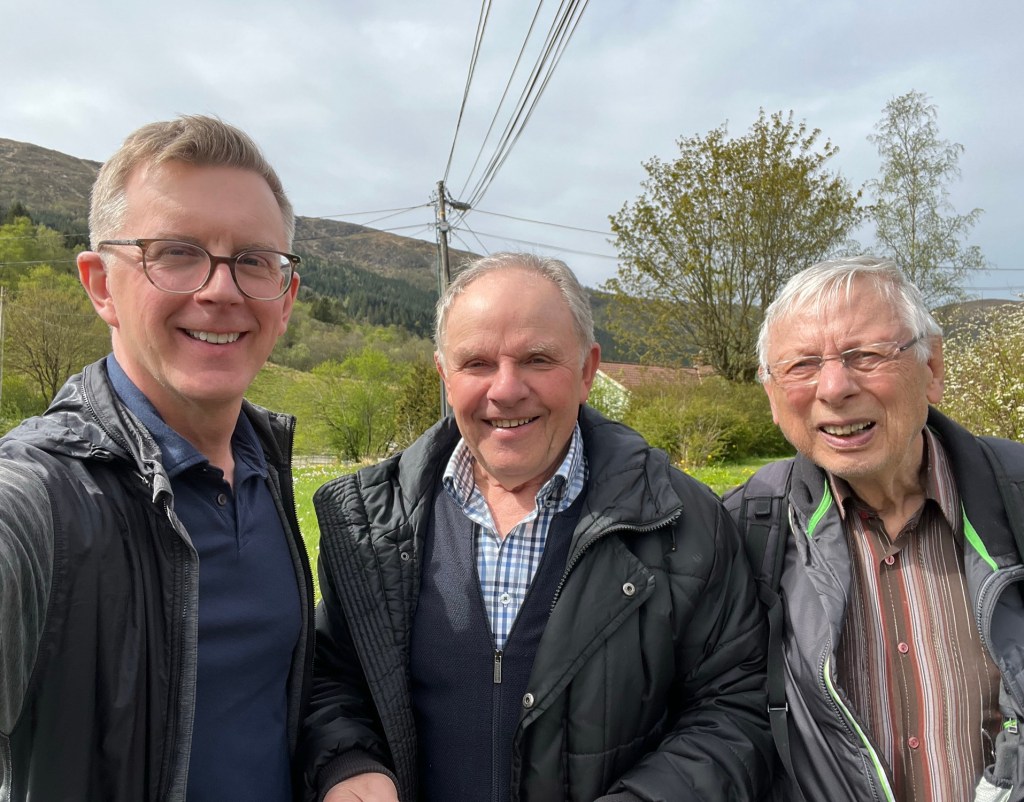
To my right are Ole Hauge (cousin of the local historian, Ole Johan Hauge) and Arne Storlid, my distant cousin I say Hauge farms (plural) because like most farms in Norway, Hauge was broken into several smaller landholdings (bruk). The one that my ancestor grew up on was called Det Jensane, but there was also Det Framme, Det Kauppane, Det Borte and Det Nære. Before about 1900, all of the houses were clustered together in what was called a klingetunet, with their respective farmland surrounding the homes.
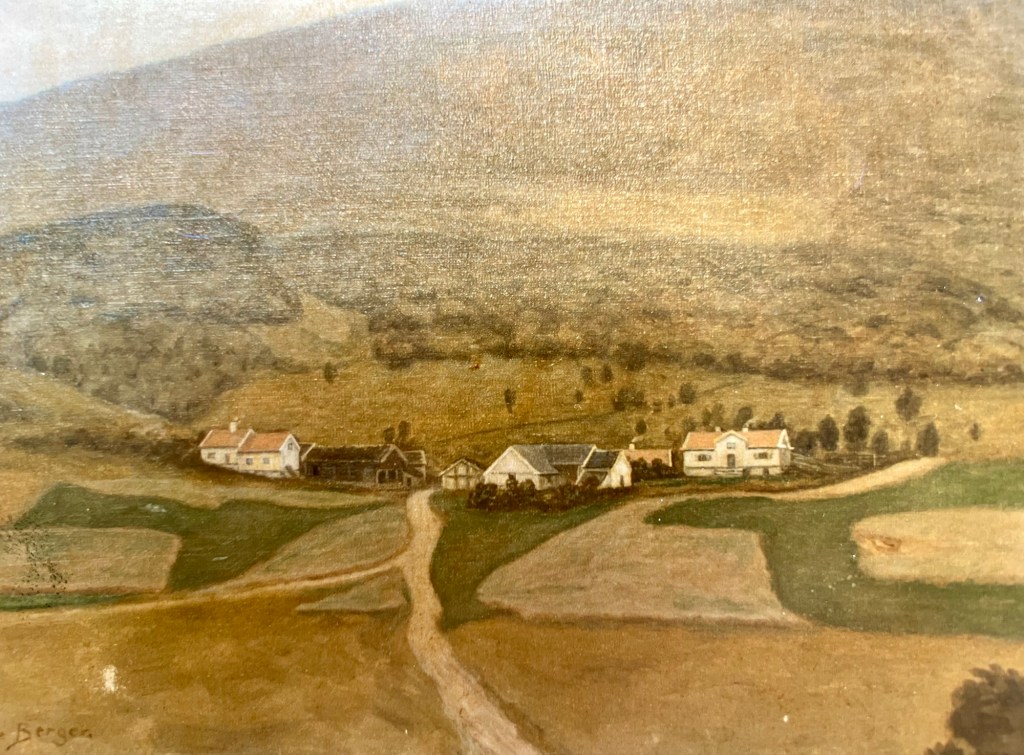
This is what the klingetunet looked like before the houses were moved onto their own properties. This is a copy of a painting of the Hauge farms from the 1890s, courtesy of current resident, Ole Hauge. 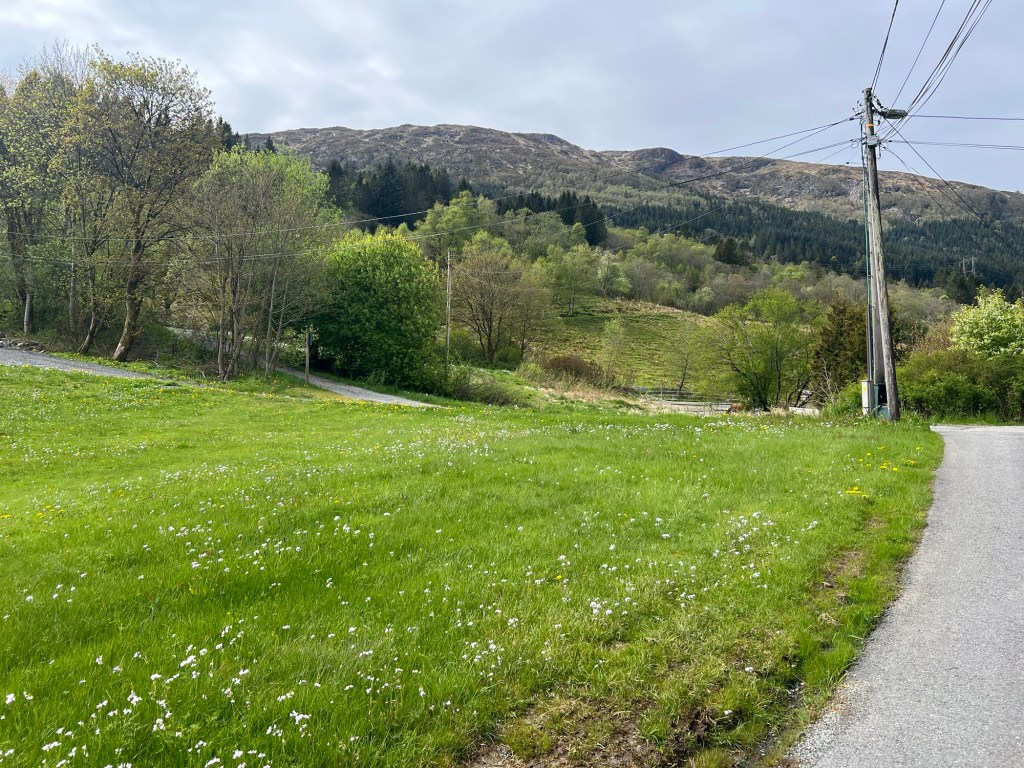
Jensane — the bruk where my ancestor farmed 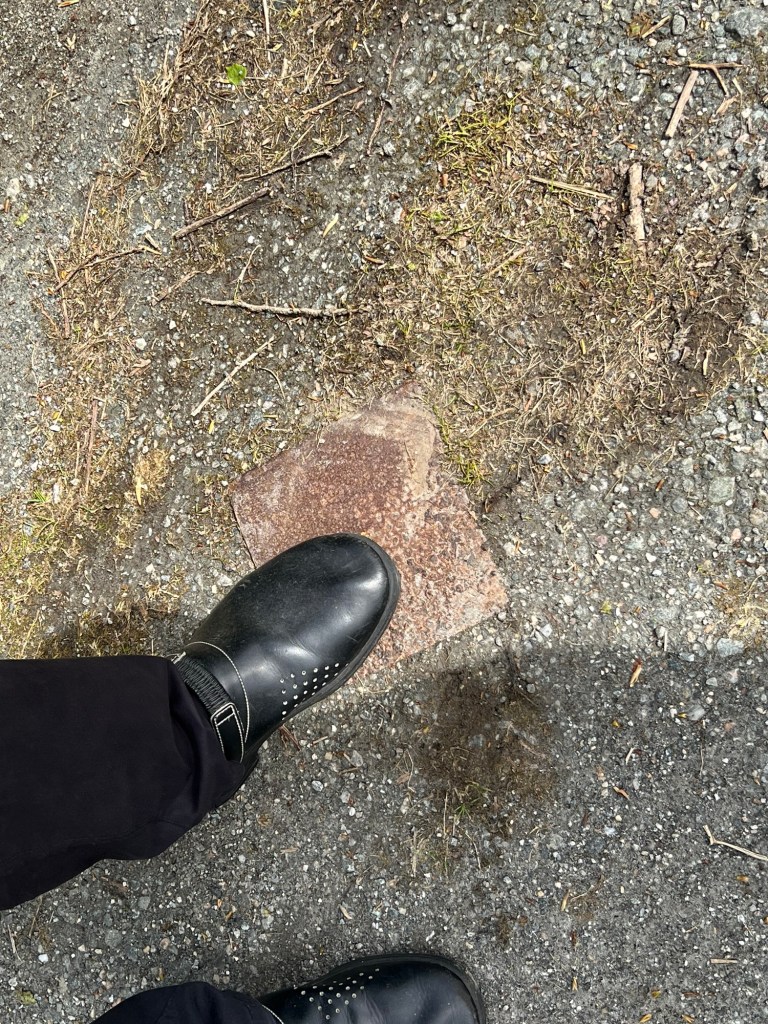
Property marker which stands at the place where three of the bruk come together Over coffee and cinnamon rolls, these gentlemen engaged me in a fascinating discussion of what life was like in the days of our common ancestors. I only wished my poor Norwegian comprehension didn’t get in the way!
But I am left with the overall impression that life in Langedalen hasn’t always been easy. While the land in the valley is relatively fertile, the fields are fairly small by American standards, and very few owed their own land in the 1800s — they were tenant farmers (husmenn). The prospect of large and mostly flat farmland that one could own outright must have been enticing enough to risk that journey across the Atlantic.
According to the bygdebok for Arna, my ancestor Ole had two other brothers — Mons and Johannes — who made that journey as well. But what became of them, I have yet to discover. Curiously, my own ancestor didn’t go directly to the U.S. The church records indicate that he left for Bergen in 1849. From there, we think he must have gone north to Førde (in Sunnfjord), perhaps looking for work. And I am grateful for that! If he hadn’t, he would never have met his future wife, my great-great-great grandma, Malene Olsdatter Bruland. It’s her story that I’ll turn to next.

Arne Storlid and I on the Hauge farm
[1] More precisely, Haus Clerical District (prestegjeld) had been divided into three parishes (sokn): Ådna, Haus, and Gjerstad. Our family was actually from Ådna sokn and lived on the Hauge farm located there – not the Hauge farm in Haus sokn. The relevant source is Lars Martinusson Ådna’s (1964) bygdebok — Haus i soga og segn. 17 3 : Ætt og æle : (ættarbok) Ådna sokn.
Hope you enjoyed this blog post. Feel free to subscribe!
-
O Christmas Tree

Christmas trees look even more out of place in Costa Rica than I do. Michael and I don’t have one at the AirBnB that we’ve rented, and it’s probably for the best. Christmas itself seems slightly out of place here.
Plastic tree with medium rare gringo Back in our Minnesota living room, our own Christmas tree is undoubtedly bone dry by now. I can already picture the trail of pine needles I’m going to make as I drag it to the curb. Even though I knew we’d be away for the holidays, I could hardly wait to get a tree. I bought one as soon as they popped up in front of the grocery store — with Mame’s “We Need a Little Christmas” playing on repeat in my head.
Our first stop on this trip was a small resort in Drake Bay perched high on a hill overlooking the Pacific. The resort is slightly worn around the edges, but the fact that it’s run by two gay Frenchmen ensures a certain level of fabulousness. Besides us, there were only two other groups in residence: a quiet couple from the U.S., and a trio from London consisting of a middle-aged woman and a rather elderly husband and wife.
The little airstrip at Drake Bay, Costa Rica The Frenchmen had arranged our daytrip into the wilds of Corcovado National Park. “Are you sure you don’t want a private tour?” one of our hosts had asked me. “No, we’re happy to share a guide,” I replied. And thus it came to pass that Michael and I would be trekking into the jungle with the three Londoners.
Our guide Jairo peppered us with jungle trivia throughout the day, some of which turned out to be slightly off-base (according to later Google searches). But what he may have lacked in precision, Jairo made up for in patience. The five tourists in his care turned out to be quite a handful. First, there were the two Minnesotans (that’s us!) who kept wandering off trail to take photos of every damned flower, toadstool, leaf and twig.

Fungus which caught my attention Then there was the elderly couple, Monika and Peter, who were quite fit for their age, but nonetheless struggled through the mucky jungle terrain. Peter was still attempting to regain his strength after a near-fatal bout of COVID and pneumonia this past year. Monika, a retired herbalist and acupuncturist, looked to be a touch older than her husband, and she flagged in the midday heat. But when engaged on a topic she enjoyed (e.g., the evils of processed foods), Monika would suddenly spring to life. Michael made the mistake of giving her his undivided attention, resulting in her chatting him up for the duration of the tour.
A discussion between Monika and Jairo about ficus leaves’ medicinal properties And then there was Louisa — Monika’s friend and former acupuncture client — who, as the day wore on, seemed increasingly likely to become some creature’s supper.
“You probably don’t want to go any closer than that,” Jairo would warn, and then Louisa would advance a couple yards towards the animal in question. If this were Charlie and the Chocolate Factory, I thought, Louisa was our Veruca Salt. “But I want a closeup of the viper!!”

We had been warned At the edge of a lagoon full of crocs, Louisa lobbed a stone into the water. “I just wanted to see if one would move!” she sputtered, as an irritated ranger escorted us out of that section of the park. Louisa protested that Jairo had done the same thing a moment earlier. The rest of us hadn’t seen Jairo do that, but then again Jairo’s capacity for discretion probably surpassed Louisa’s. Either way, the park ranger wasn’t having it.
The episode made me think of my mom’s older brother, Glenn. On a hike some 40 years ago, Uncle Glenn had scolded me for picking up a daddy long-legs spider by one of its spindly appendages. I was copying an older cousin who had done the same thing not five seconds before. “That’s no excuse,” Uncle Glenn told me. “How would you feel if someone did that to you?” How would I indeed. The lesson stuck, especially since my uncle had never spoken sharply to me before.
I met up with Uncle Glenn this past June in Madison, Wisconsin, right after he’d finished a workout at his CrossFit gym on Williamson Street. Frankly, I don’t think I’d survive more than 10 minutes of CrossFit, but my uncle barely looked winded. The gym is located right over the spot where my great-great-great grandparents, Johann Jacob and Elsbeth Reiner, built their home and blacksmith shop in the 1840s.
Glenn and I chatted as we walked my dog Spence around the neighborhood, stopping of course to visit the Reiner Tree. This is the evergreen that was planted to commemorate the Reiners’ footnote in Madison history. A plaque beside the tree describes J.J. and Elsbeth’s funny German custom of bringing a conifer indoors and decorating it for Christmas — a sight their Madison neighbors had never seen before.

Glenn & I at the Reiner Tree 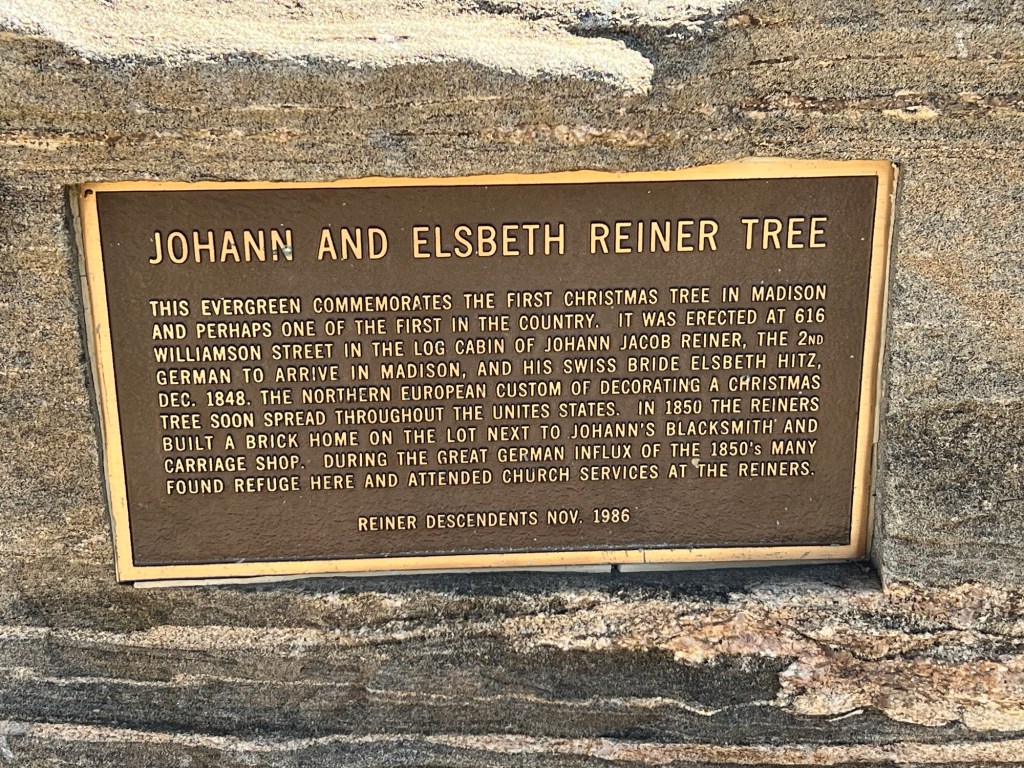
The plaque at the Reiner Tree 
In the Capitol rotunda, shortly before Capitol police asked us to take Spence outside 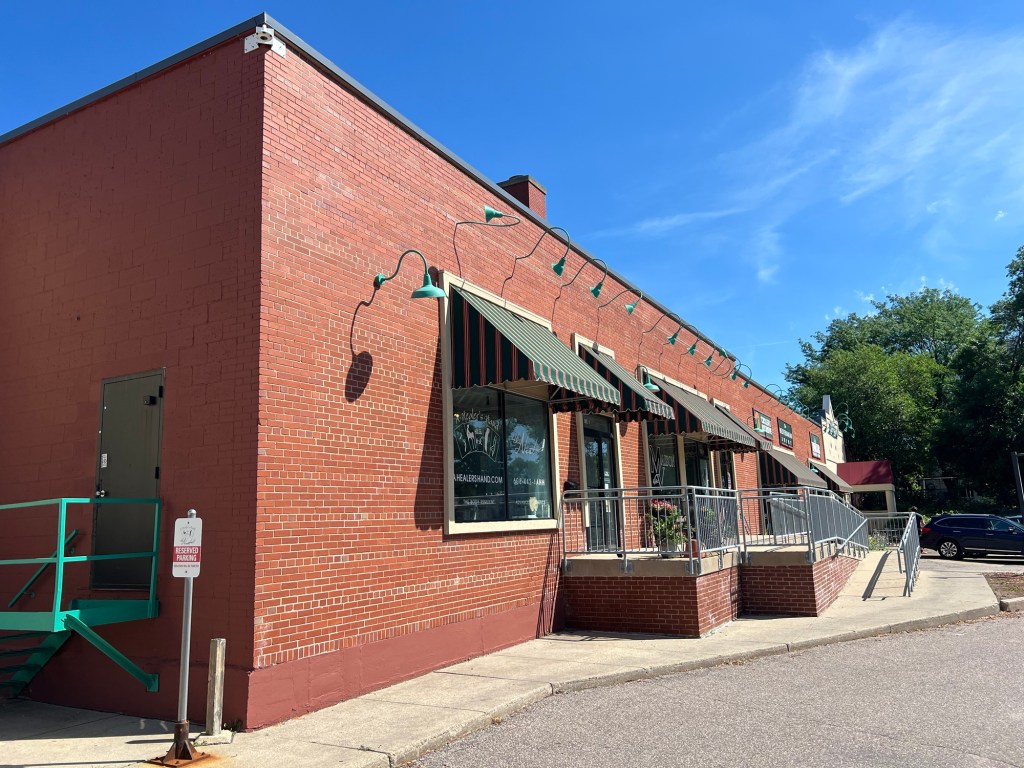
Former location of the Reiner home and blacksmith shop, now a CrossFit 
A photo of the Reiner residence (courtesy of the Wisconsin Historical Society); the brick home (built in 1851) replaced an earlier log cabin It’s hard to imagine Christmas without Christmas trees, but they were virtually unheard of in America before 1850. It wasn’t until Queen Victoria and Prince Albert put one up in Windsor Castle in 1848 that the tradition started to take off in the English-speaking world. But the practice of bringing evergreens inside in December is much older, dating back to pagan celebrations of the winter solstice and its promise for rebirth.
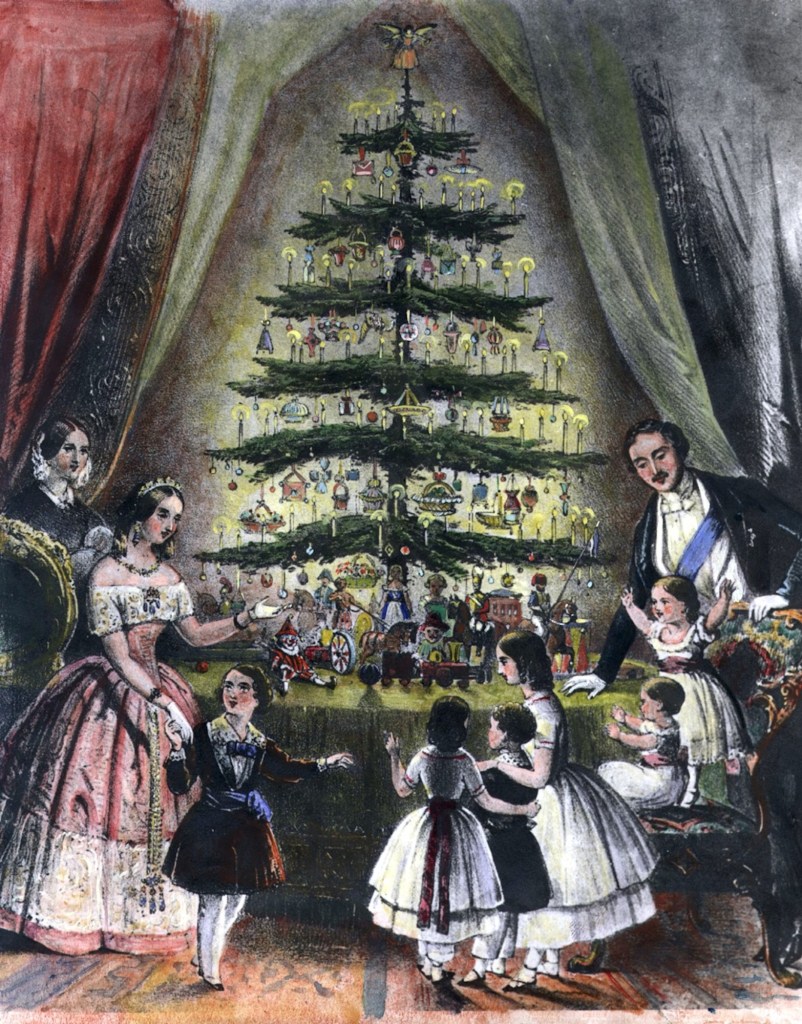
Queen Victoria, Prince Albert, and their children, gathered around the Christmas tree (source: this link) Intuitively, it makes sense to me that piney branches should hold promise for people in northern latitudes. While everything else looks dead, the boreal forest persists. Its roots spread in a more or less continuous circle across the global north — from Scandinavia through the whole of Russia, from Alaska to the shores of Labrador. Having a piece of this greenery indoors during winter’s darkest days is a reminder that, despite all appearances to the contrary, life will return.
O Tannenbaum, O Tannenbaum, we learn from all your beauty
O Tannenbaum, O Tannenbaum, we learn from all your beauty
Your bright green leaves with festive cheer, give hope and strength throughout the year
O Tannenbaum, O Tannenbaum, we learn from all your beauty
— translation of the third verse from “O Tannenbaum”
Here in Costa Rica, however, the lines between birth, death, and rebirth are not so stark. Everything is in constant flux, and the seasons are governed more by the coming and going of the monsoon rains. An evergreen doesn’t hold the same value in a place where things stay more or less green year round.
Jairo led our eccentric little group through a part of the jungle thick with towering ficus trees. Normally chatty, the five gringos grew quiet at the feet of these giants. “The roots of the ficus,” Jairo explained, “stretch out in every direction so that they touch all of the other ficus in the area. If one of the trees needs more nutrients, they pass those nutrients along to the one in need. If one is in trouble, the others come to its aid.”
Here was a different tree with a different lesson — one that I think each of us realized we needed to hear.
The roots of the ficus
Deep Roots
Reflections on family history, identity and geography
Home
Welcome! I’ve created this site to share family history and collective memories.

