-
Missed connections
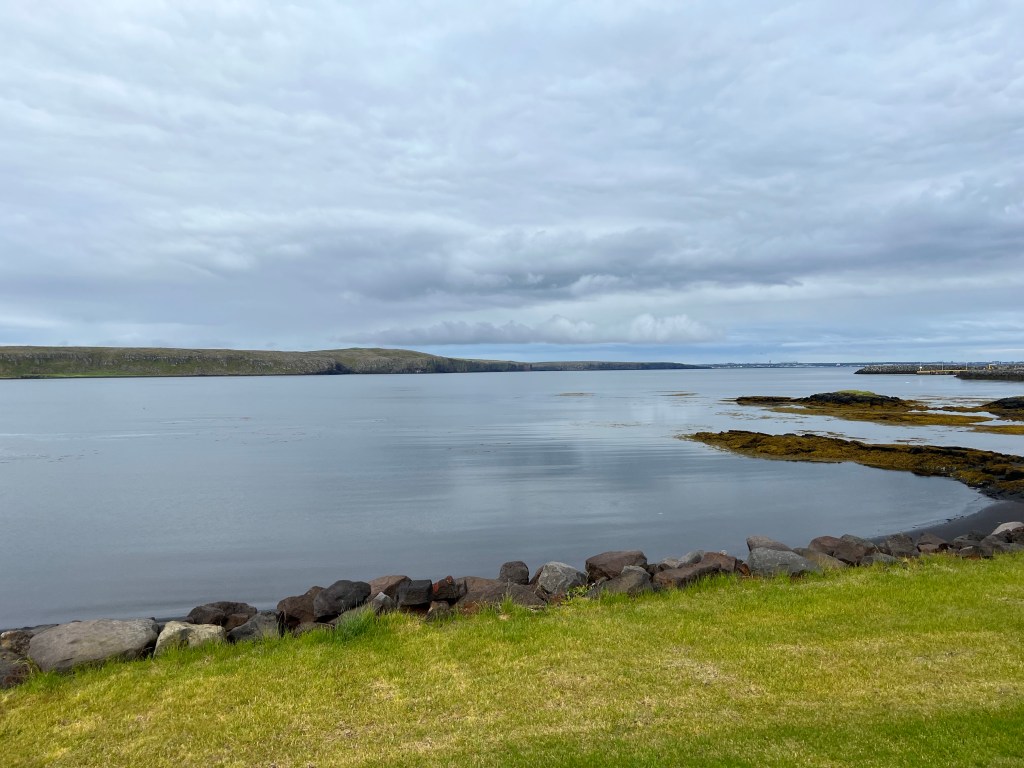
Hello from Iceland! This stop was not on my itinerary, but I missed my connecting flight in Reykjavik so I’ve spent the night here.
This got me thinking about the less-than-obvious connections between the two countries I’ve just visited — Norway and Germany.
Physically, Norway and Germany are separated only by a couple of modest-sized bodies of water: Skagerrak and Kattegat. Skagerrak is the strait just south of the Oslofjord between Norway and Denmark. Kattegat is the strait just south of this, between Denmark and Sweden. Collectively, these two straits and the Danish islands separate the North Sea from the Baltic (or what people in most Germanic-language countries call the East Sea).

Map of Skagerrak and Kattegat, shamelessly stolen from Wikipedia Last Tuesday I had the pleasure of journeying by boat between Oslo and Kiel, which took me through this narrow passage (in point of fact, “Kattegat” derives from the Dutch for “cat’s gate” — a gate so narrow only a cat could get through).
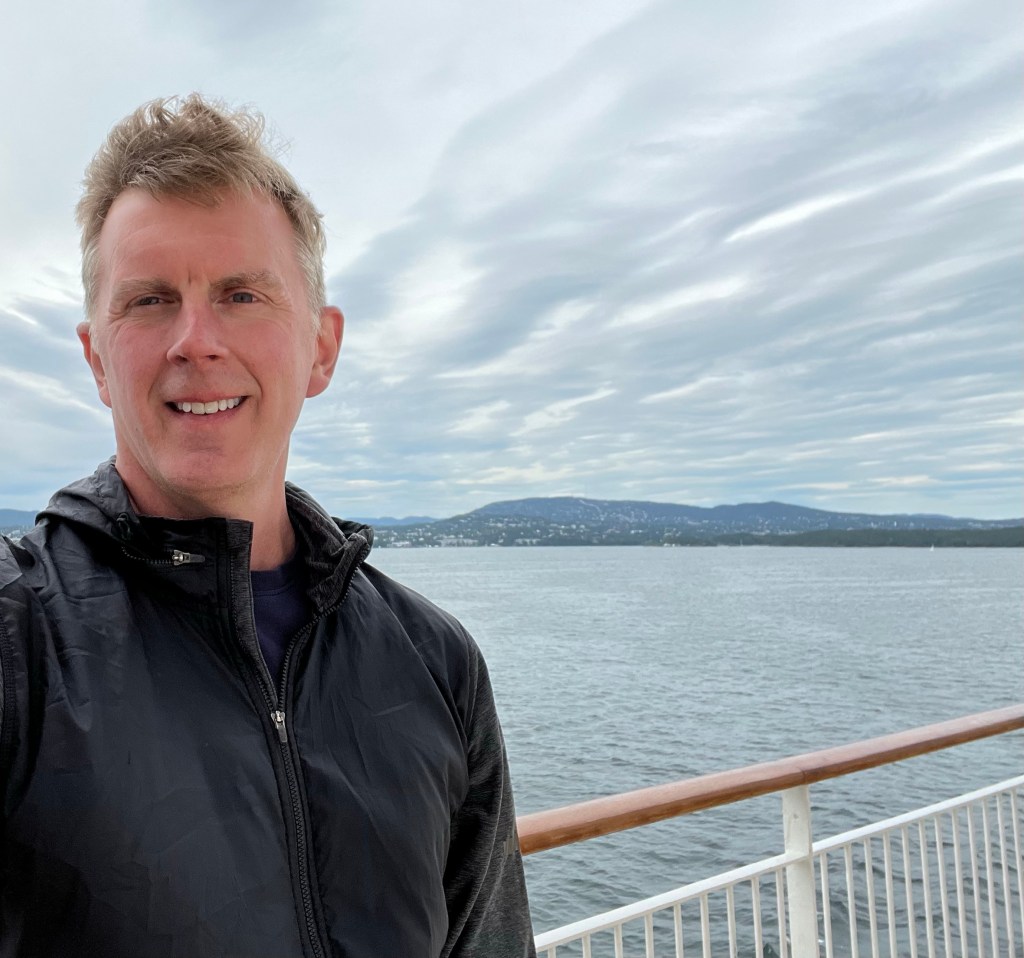
Bad hair day 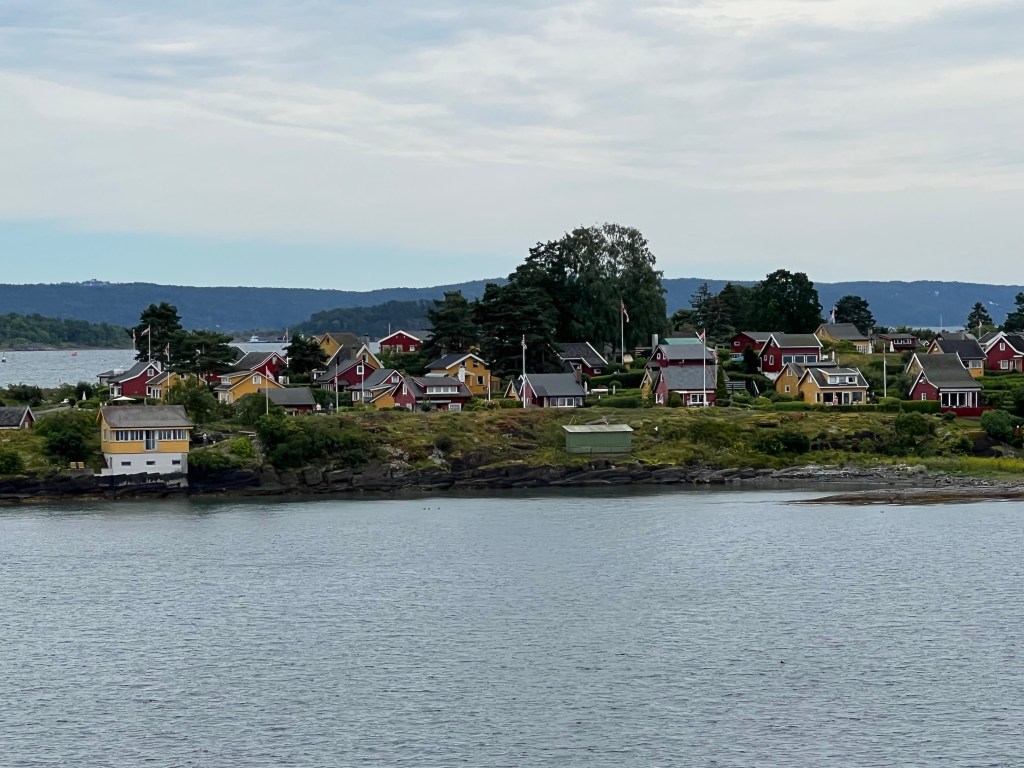
View of the Oslofjord from the boat Which brings me to that first not-so-obvious connection between Germany and Norway: the historically important trade in stockfish — i.e., freeze dried fish, typically cod. Skagerrak and Kattegat were the shipping lanes used by the Hanseatic merchants who dominated these seas for centuries. It’s easy to forget about the Hanseatic League, but this confederation of member cities and ports operated a little like its own country from the 13th to the 15th centuries. Some even say it was a precursor to the European Union.
At its center was Lübeck, where the Hanseatic merchants occasionally met to make joint decisions. I took a stroll through Lübeck on Wednesday — a city simply dripping with history.
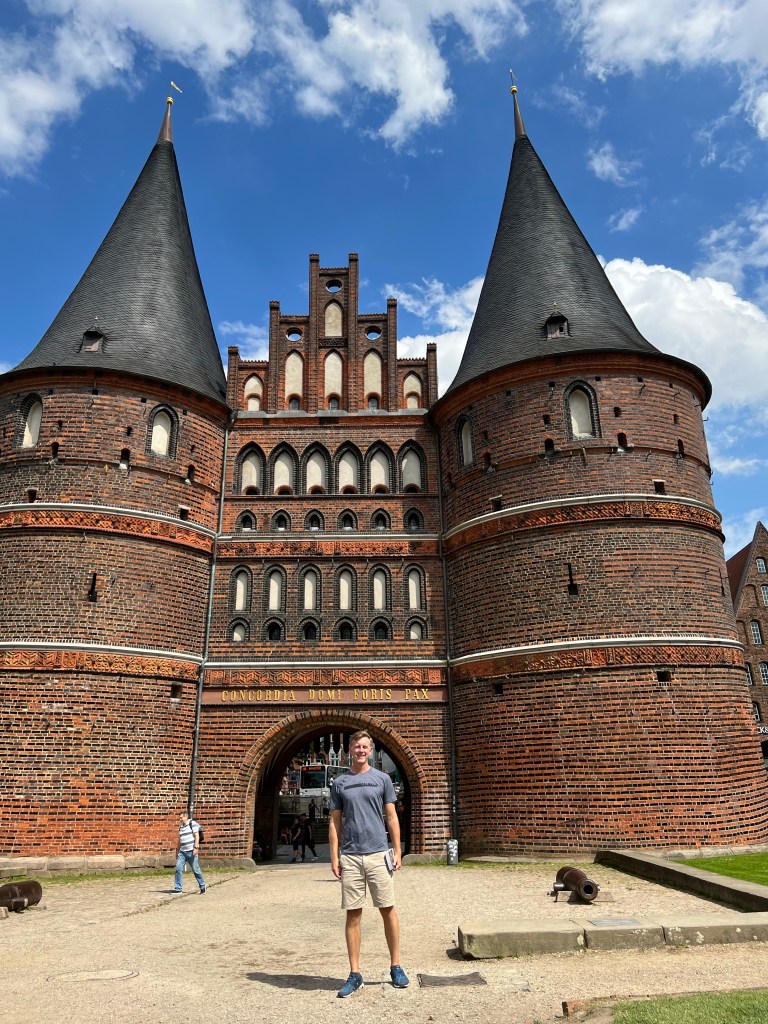
The Holstentor (Holstein Gate) in Lübeck 


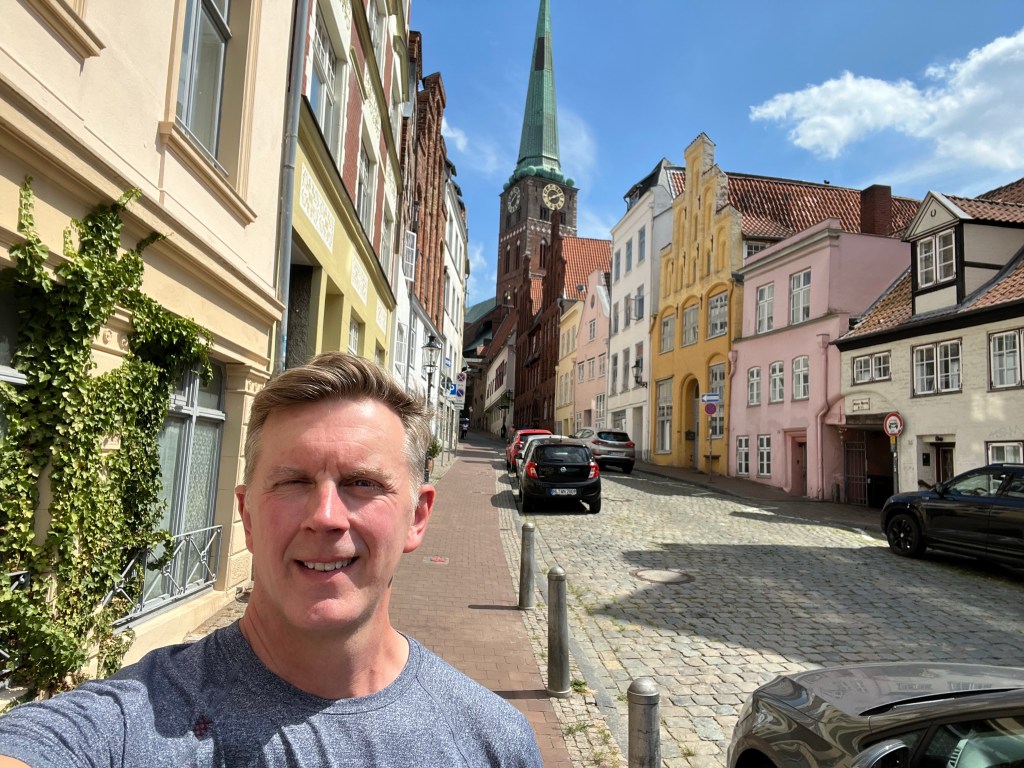

Scenes from Lübeck And I visited two other important Hansa cities — Rostock and Greifswald, each with a sure sense of its place in the world. Rostock in particular was decimated by the War and was rebuilt as a showpiece of Germany history.
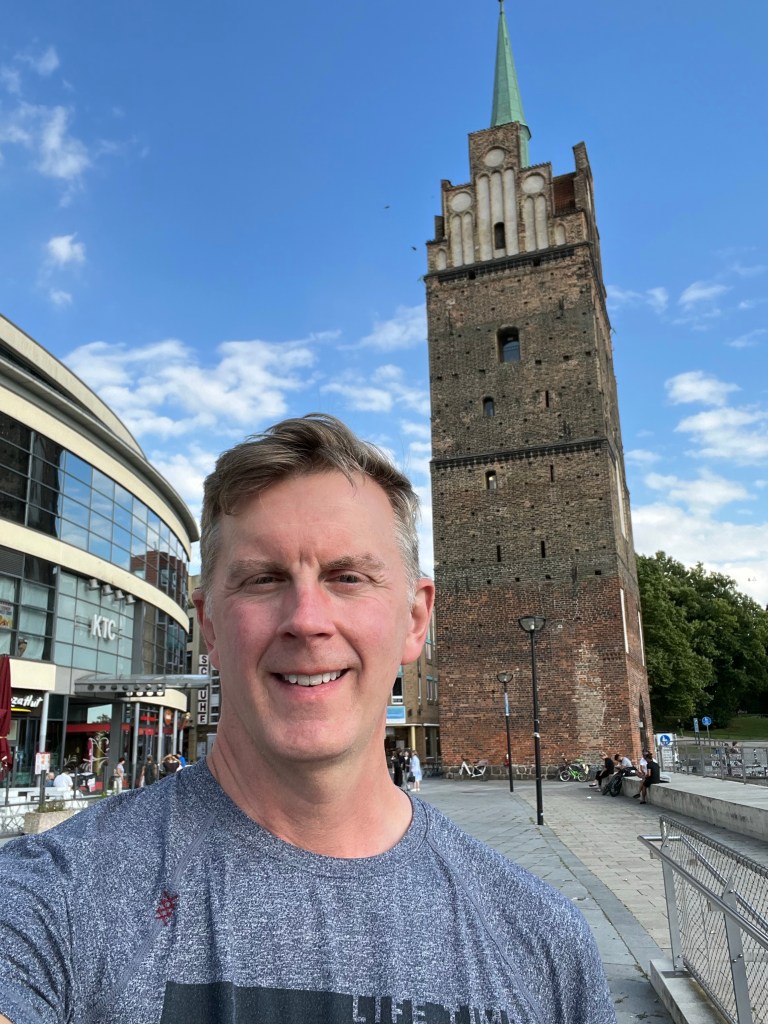

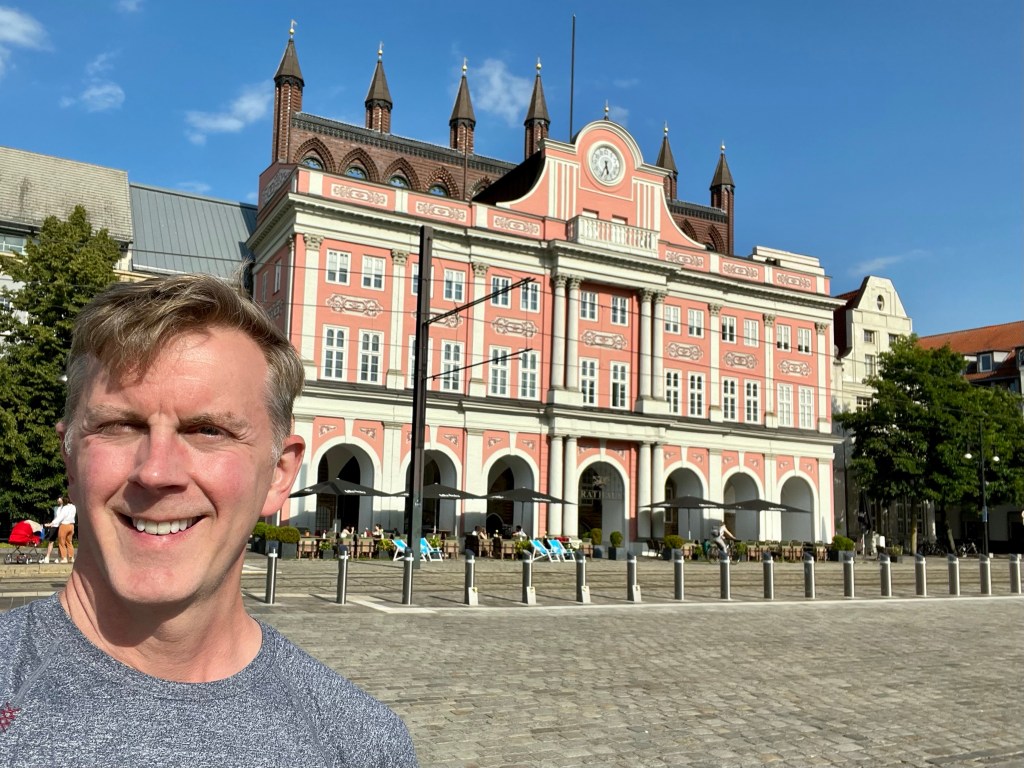

Scenes from Rostock 


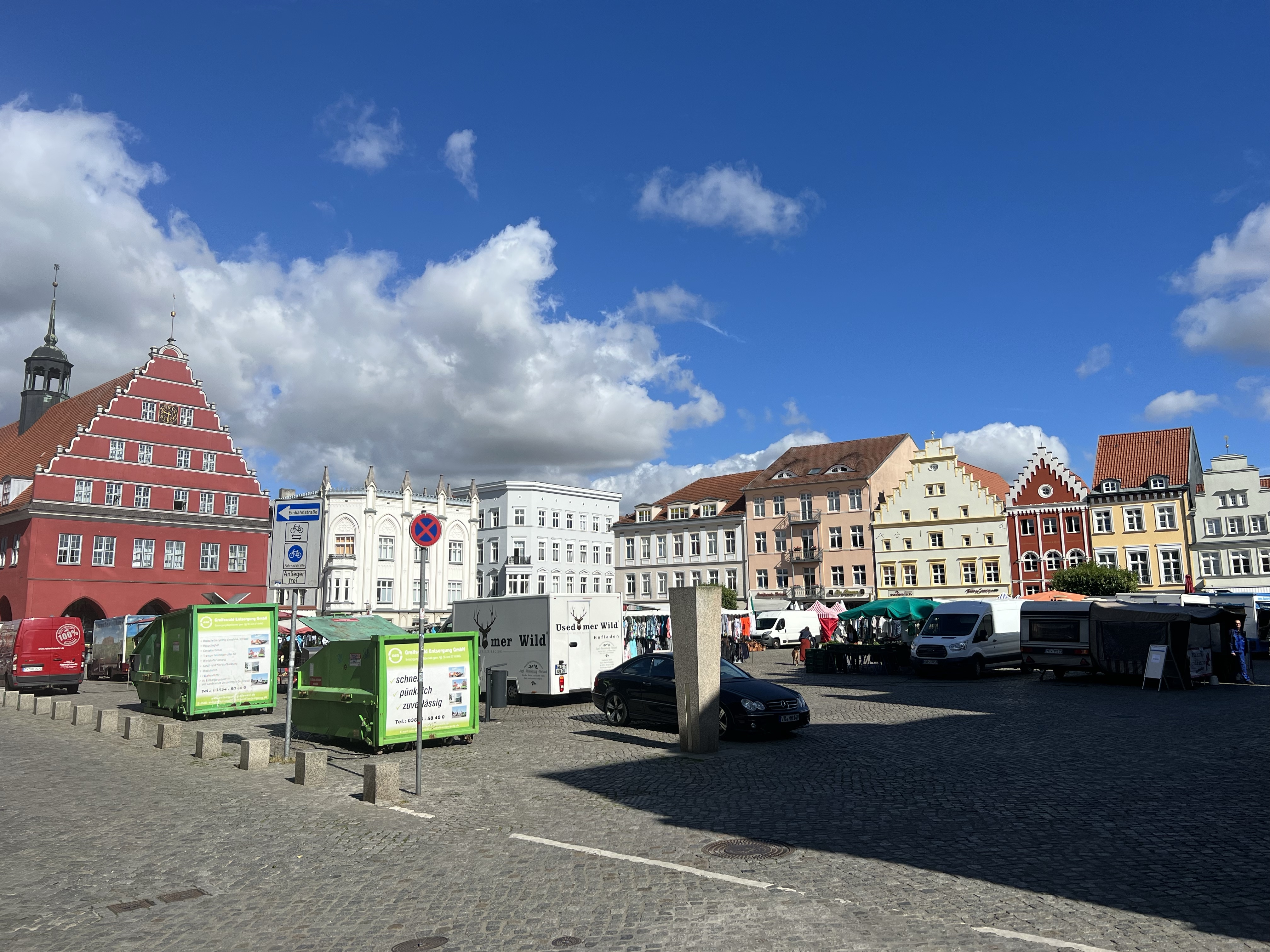
Scenes from Greifswald At this point you must be thinking, “Very pretty pictures, Jesse, but what does this have to do with the trade in stockfish?” Ah… that’s where Norway comes in. One of the most important Hanseatic outposts was in Bergen (see my post from a couple of weeks ago). The Hanseatic merchants’ kontor in Bergen was where Europe got its stockfish. And stockfish was big business back in the days before refrigeration.
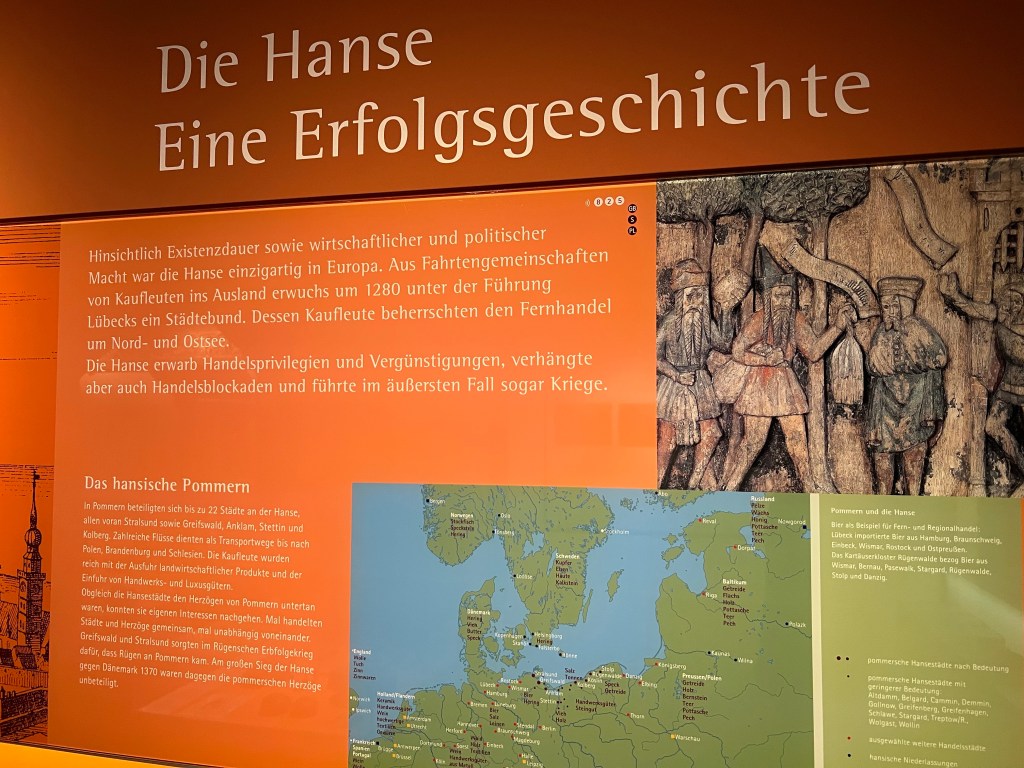
Dorking out on Hanseatic history at the Pomeranian State Museum (Pommersches Landesmuseum) in Greifswald, Germany 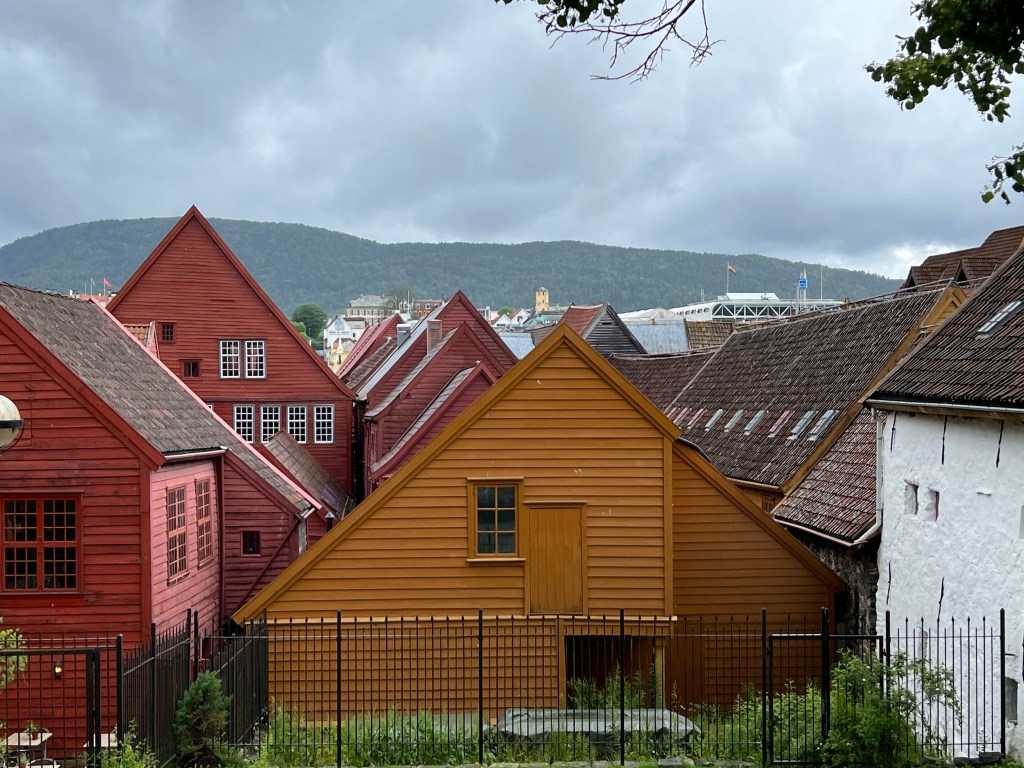
Can you imagine what Bergen smelled like in 1422? 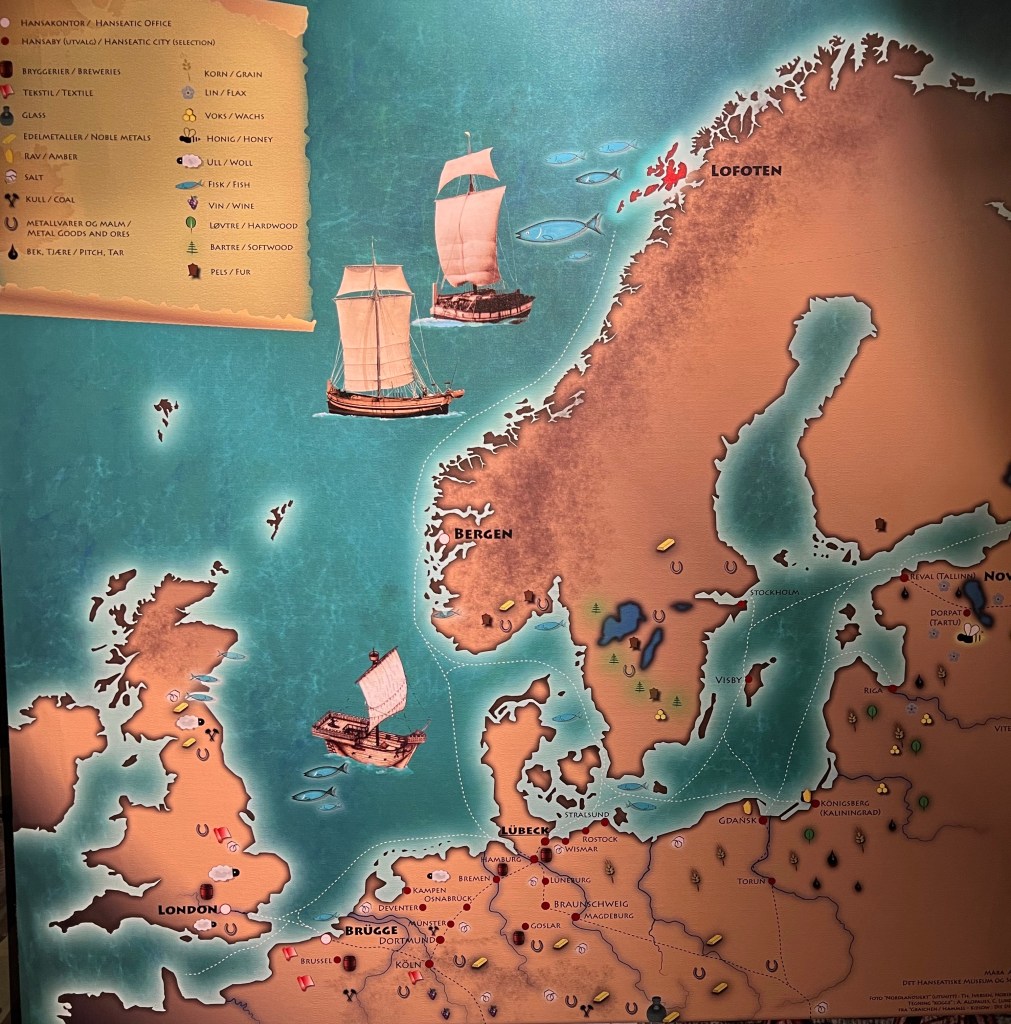
In Cod We Trust. A map of Hansa trading ports from the Hanseatic Museum in Bergen. 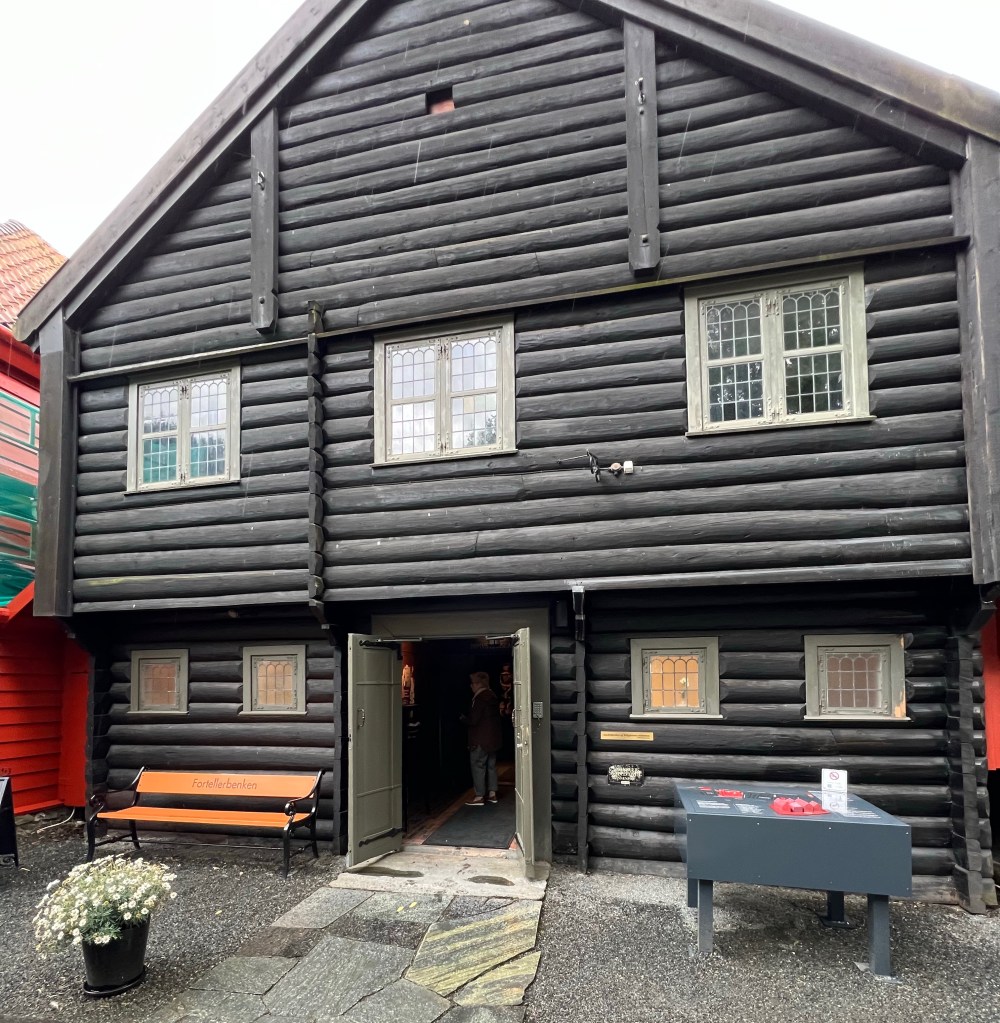
Bet you didn’t think you’d be reading about stockfish today!
This is a photo of the exterior of a Hansa Kontor in Bergen.One of the most obvious connections between Norway and Germany is the fact that between April 1940 and May 1945, Norway was occupied by Germany under the Third Reich. (And as I’ve mentioned in a prior post, there’s a fascinating outdoor art exhibit at Roseslottet in Oslo that explores the occupation years.)
But one facet of those War years that is sometimes overlooked is that one of the key leaders of the German resistance against the Nazis exiled himself in Norway (and later Sweden after Norway fell to Germany). That leader was Herbert Frahm. Never heard of him? Of course you haven’t. The world knows him by the name he gave himself while working as a student journalist in Norway — Willy Brandt.
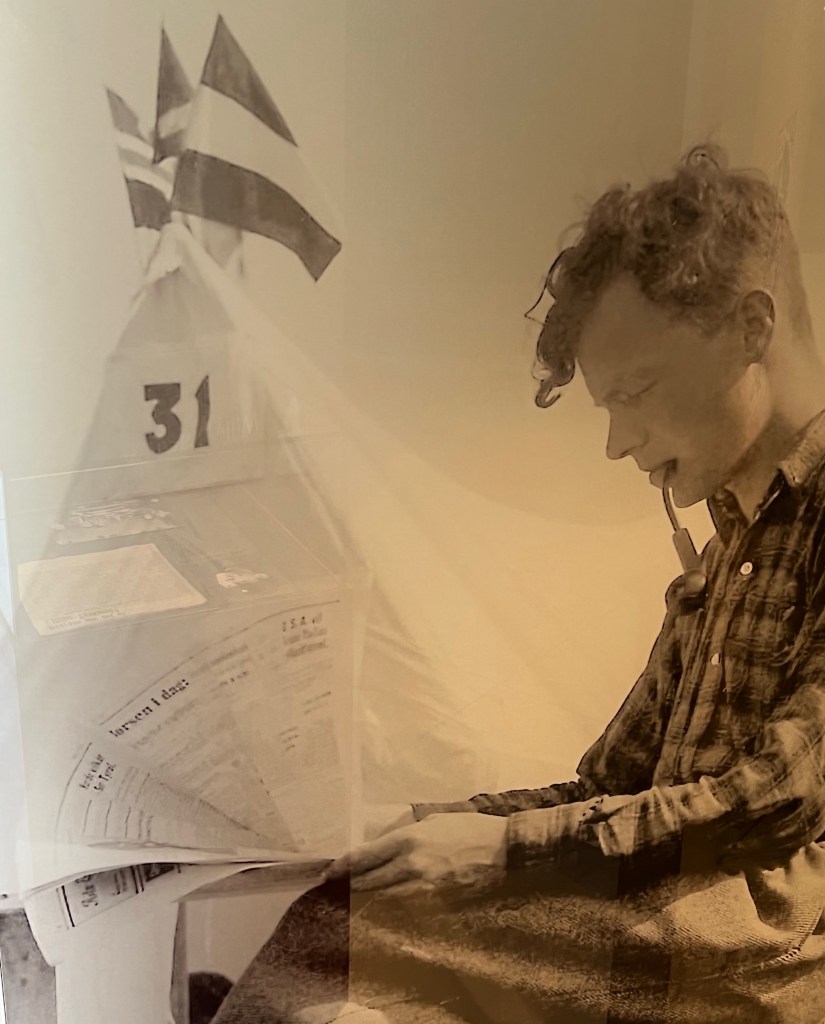
Brandt in exile in Norway, ca. 1935 (photo of a display at the Willy Brandt house museum in Lübeck) After the War, Brandt went on to become one of Germany’s most famous politicians and leaders. He led West Germany’s Social Democratic Party from 1964 to 1987 and served as the country’s chancellor from 1969 to 1974.
Brandt came to Norway in 1933 to escape persecution from the Nazis, and he quickly became involved with leftist politics and journalism in Norway. Within weeks Brandt was publishing articles in Norwegian about Hitler’s rise to power and urging Norwegians to resist fascism. He also became involved in helping support the nascent workers movement in Norway.
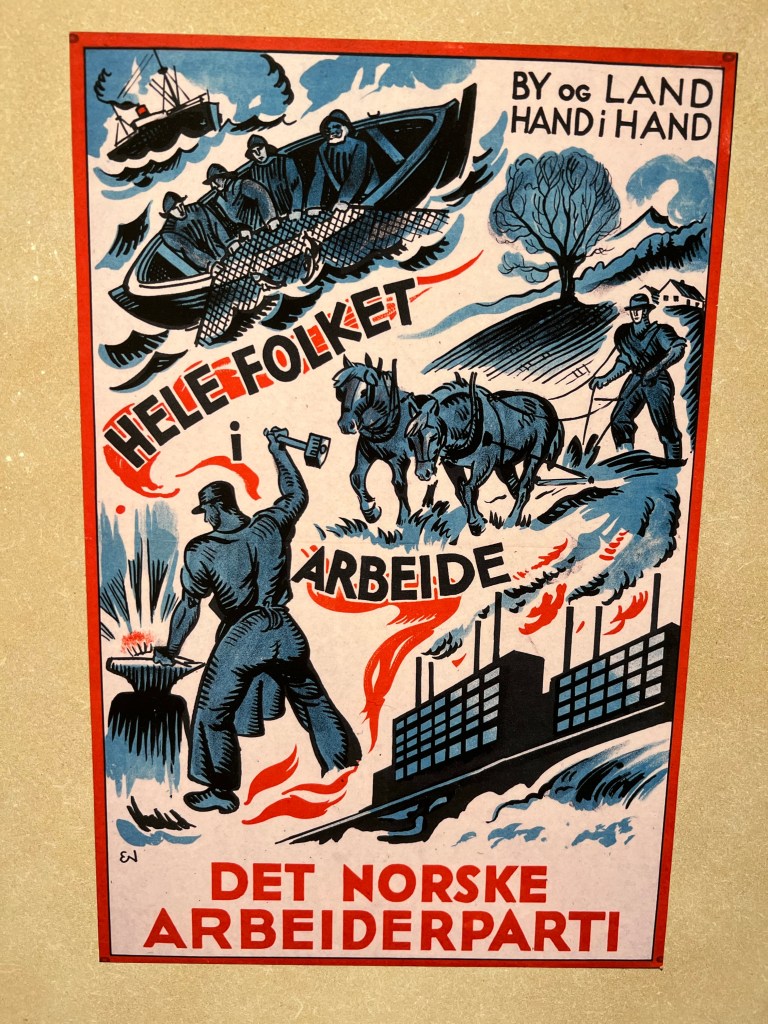
Norwegian workers party poster from the Willy Brandt home in Lübeck 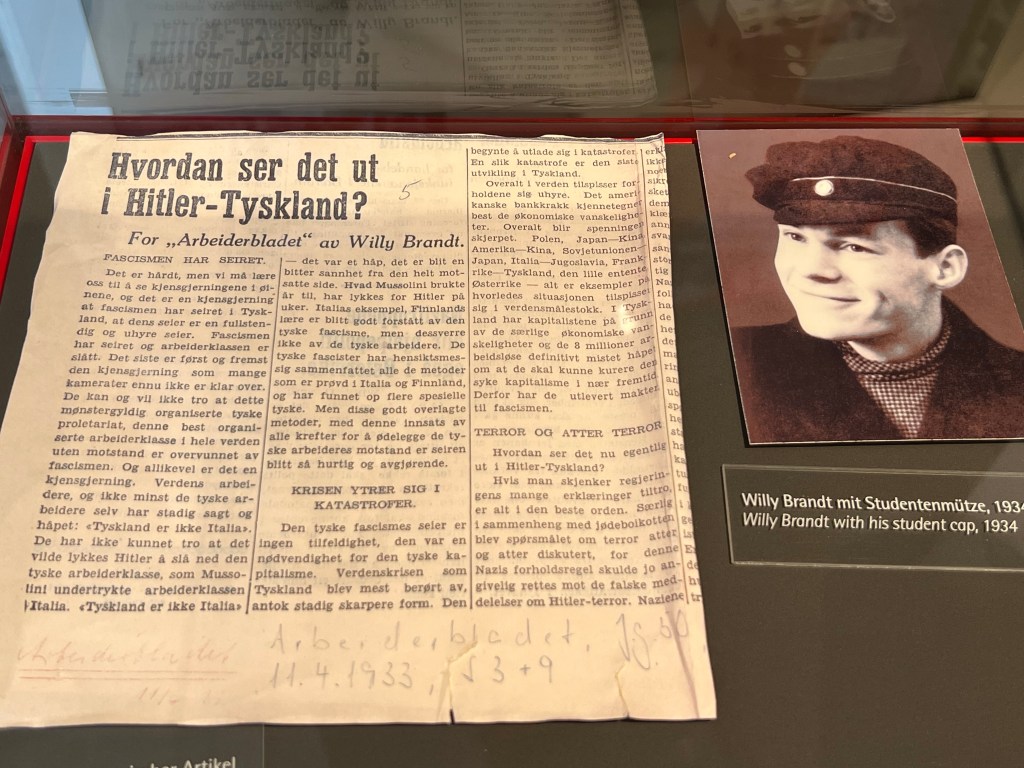
Brandt’s journalism in Norway on life under Hitler in Germany Brandt honed his political philosophy in Norway, becoming less revolutionary and more pragmatic. But he never gave up on the idea of a free and democratic Germany. In reaction to his journalism, the Nazi authorities stripped him of his citizenship in 1938. When Germany invaded Norway in 1940, Brandt fled to Sweden and was granted a Norwegian passport there.
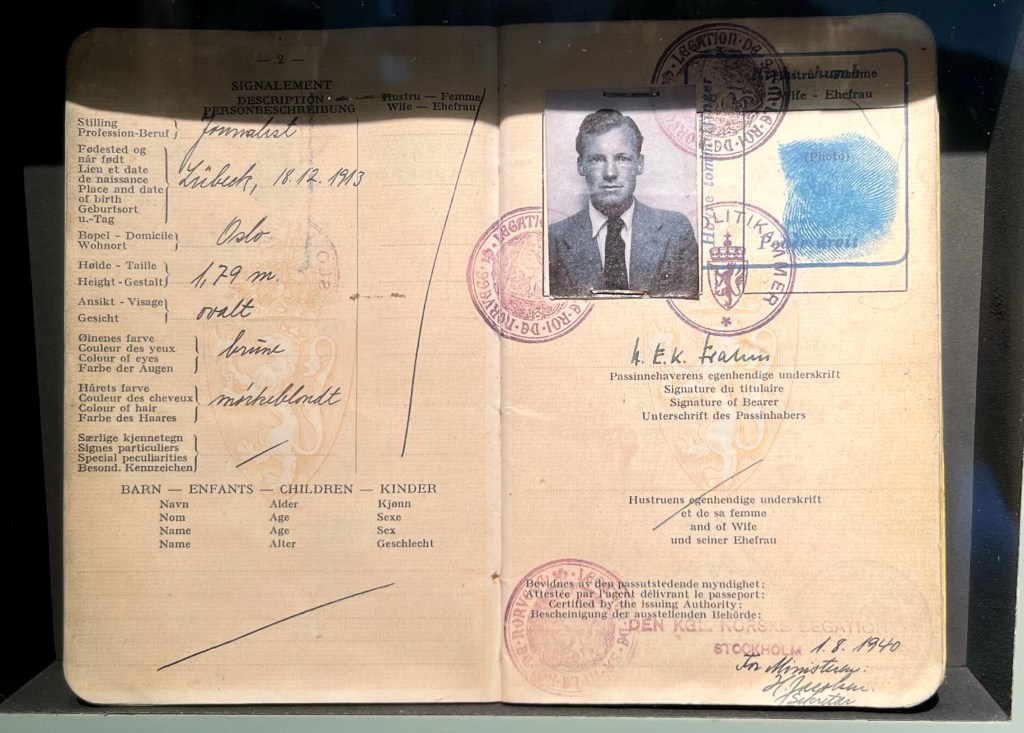
Brandt’s Norwegian passport (on display at the Brandt home in Lübeck) After the War, Brandt helped forge a new Germany. While he continued to be an outspoken anti-fascist, Brandt used his political power to achieve reconciliation between West Germany and the Eastern Bloc. For these efforts, Brandt was awarded the Nobel Peace Price in 1971.
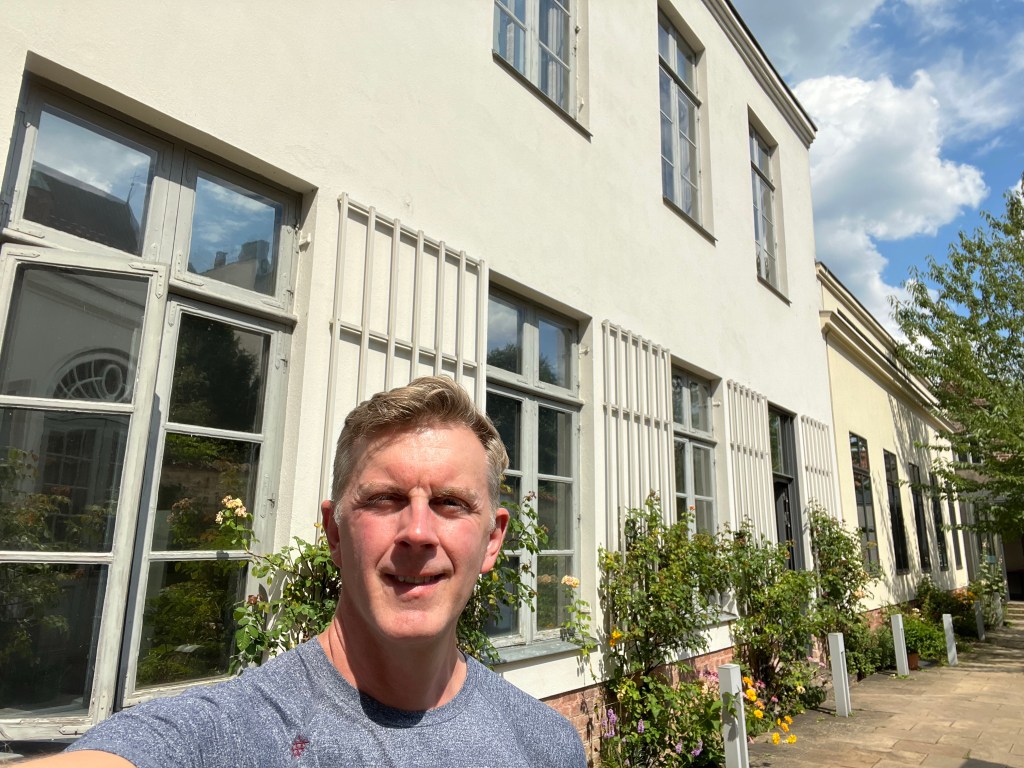
Willy Brandt home in Lübeck 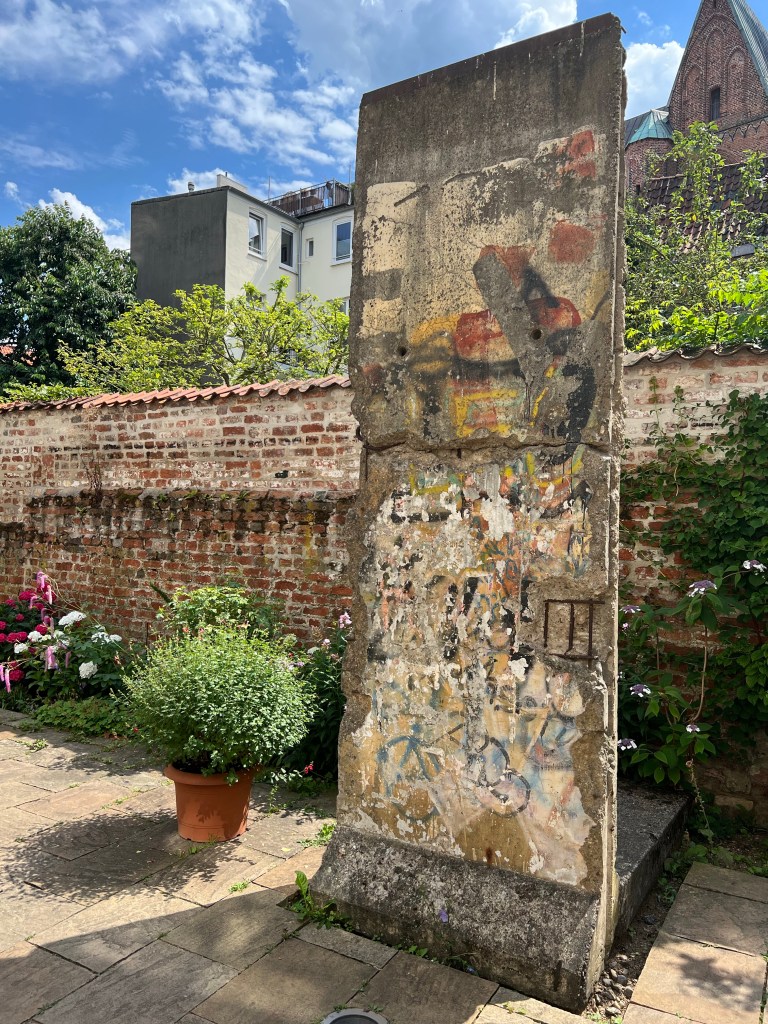
A piece of the Berlin Wall on display at the Willy Brandt home in Lübeck 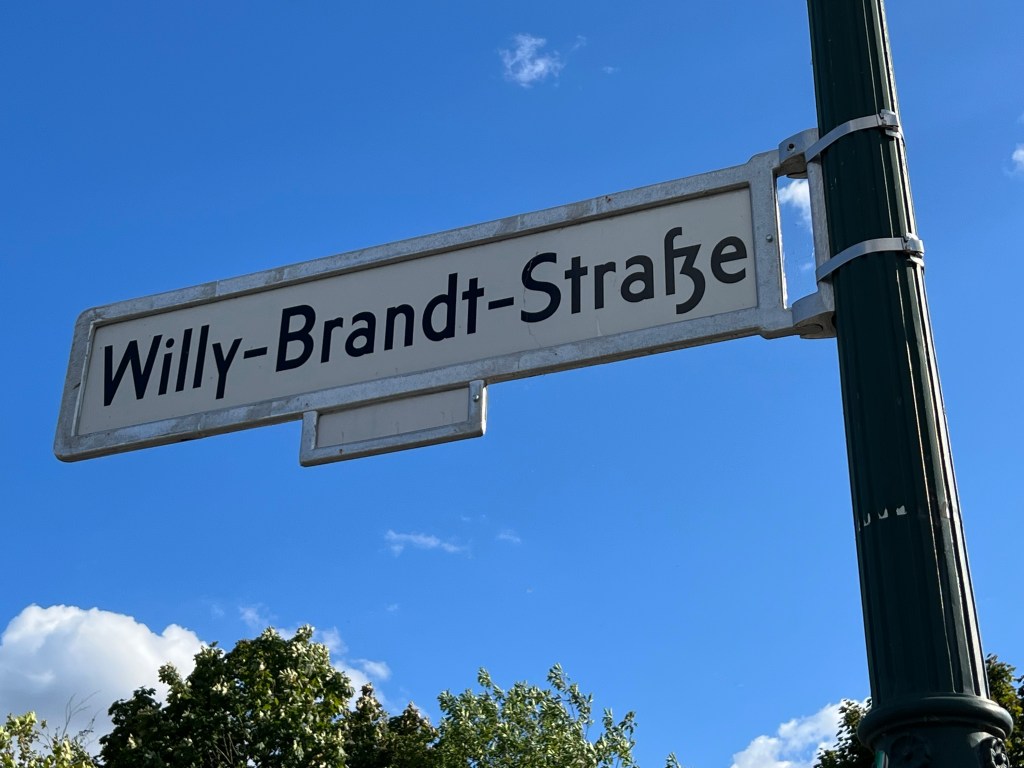
Willy Brandt Street (Berlin) 
Vebjørn Sand’s portrait of Willy Brandt when he was a young Herbert Frahm; Rose Castle (Roseslottet) in Oslo Yesterday as I flew out of Berlin’s Willy Brandt Airport, I asked myself, “Would Germany be the same today if Brandt had not been influenced by Norwegian political thought in the 1930s? Would Norway be the same today if Brandt had not published his ‘insider accounts’ of German fascism in Norway’s newspapers?” Both countries were enriched by this connection.
And speaking of connections, I must go now and make my next one. Because as fascinating as all of these travels have been, the place I most want to be right now is home.
-
In search of the Lehmanns
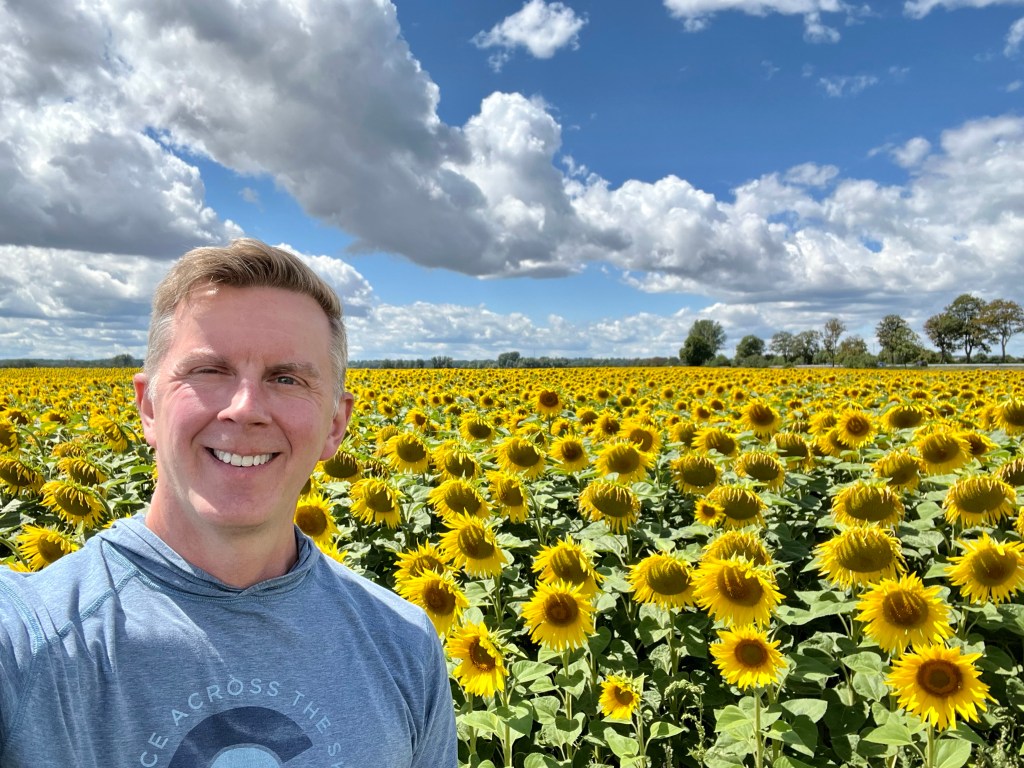
I drove out into the German countryside today to get a sense of where my grandma’s grandma came from.
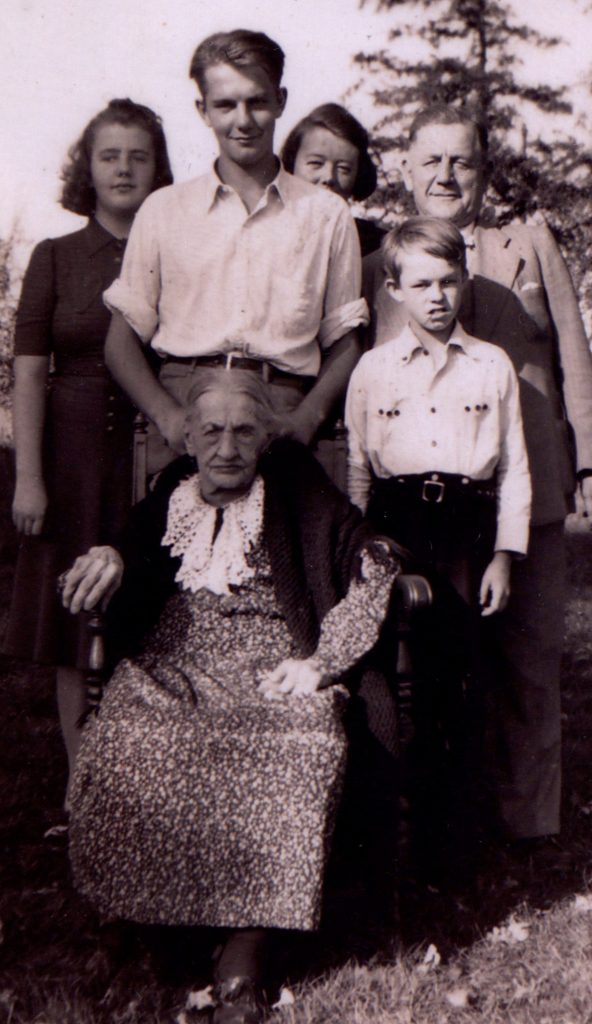
Standing at back: Barbara Jean Kaufman, Ruth Clark Kaufman, and Edward Carl Kaufman; standing in front: Edward Clyde Kaufman and Jack Kaufman; seated: Louise Lehmann Kaufman 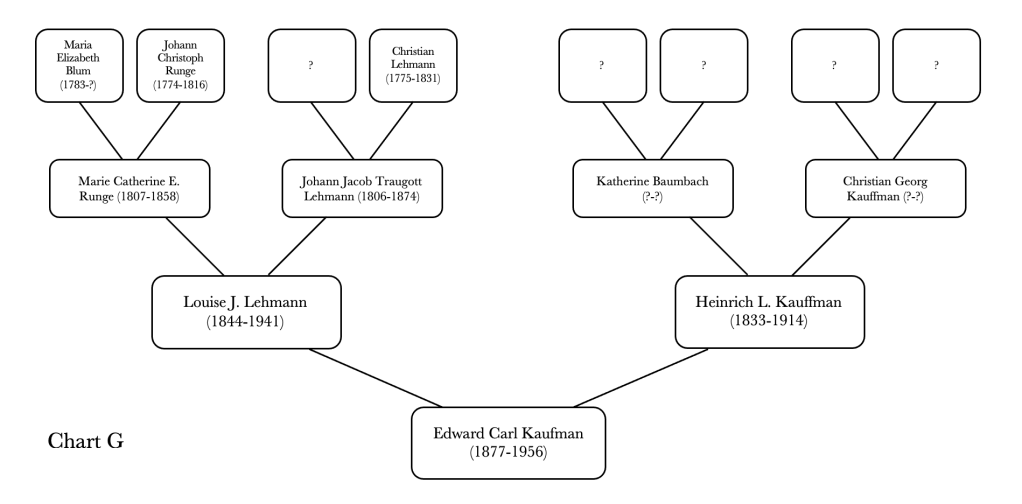
Direct ancestors of my great-grandpa Edward Carl Kaufman The grandma in question is Louise Lehmann Kaufman, the mother of my paternal grandma’s father, Edward Carl Kaufman. My great-grandpa Ed Kaufman is the man on the right in the photo above. His mother Louise is the old woman seated below. And her granddaughter, Barbara Jean Kaufman (standing at left), is my grandma, who is nearly 96 years old now and still going strong.
Grandpa Ed was born on August 9, 1877 in Edgerton, Wisconsin. Both of his parents — Louise Lehmann Kaufman (1844-1941) and Heinrich (“Henry”) Kaufman (1833-1914) — immigrated from Germany. But whereas Grandpa Heinrich arrived as an adult in the 1860s, Grandma Louise came as a girl with her parents in the 1850s.
Grandma Louise’s parents (i.e., my great-grandpa Ed Kaufman’s maternal grandparents) were Maria “Catherine” Runge and Johann “Jacob” Traugott Lehmann, immigrants to Wisconsin from the province of Brandenburg within the Kingdom of Prussia. At the time Catherine and Jacob married in 1831, Prussia was the most powerful member of an alliance of 39 German kingdoms and duchies called the German Confederation, which predated the German Empire established in 1871. In the mid-19th century, the province of Brandenburg straddled the Oder River, which now separates Germany from Poland.
My best guess is that Catherine Runge and Jacob Lehmann were born in farming towns a few miles north of Frankurt an der Oder (not to be confused with the much larger city of Frankfurt am Main in the west). I am not entirely certain of their towns of origin, but it appears they married in Groß Neuendorf on January 2, 1831.
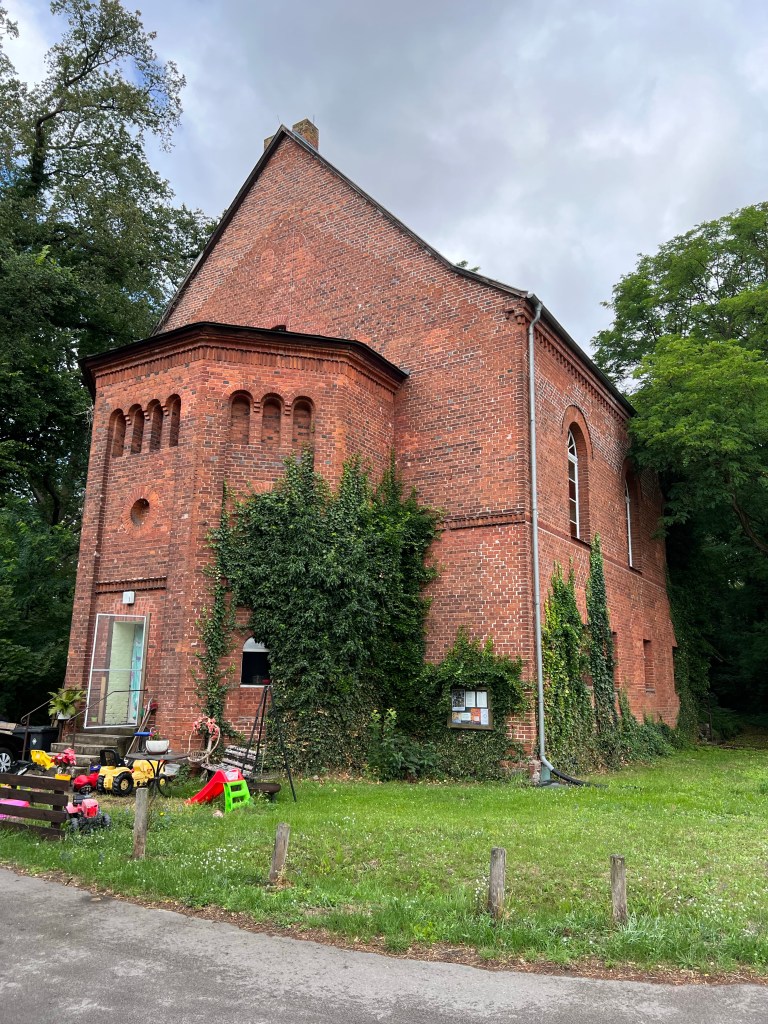
The current church in Groß Neuendorf, which dates to 1850, replaced a church here from 1703. That earlier church may be where our ancestors married.
(And no, I have no idea why there are a bunch of children’s toys on the front steps. It looks like a family may be living in this church.)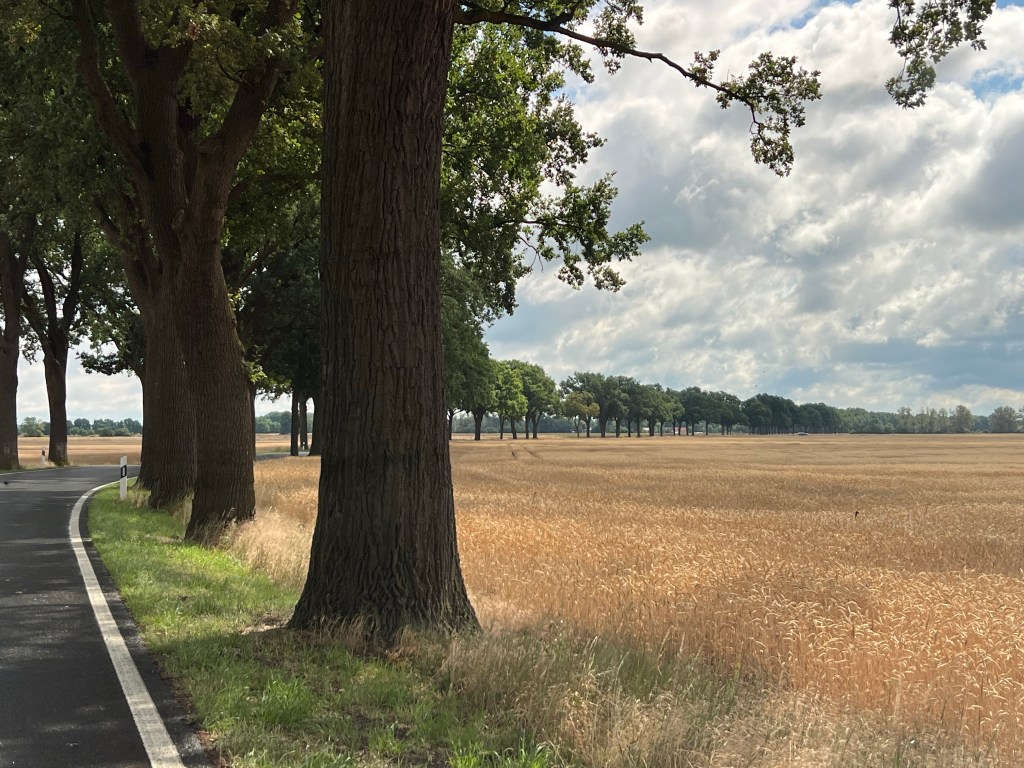
The road to Groß Neuendorf, like many German country towns, is lined with oaks. 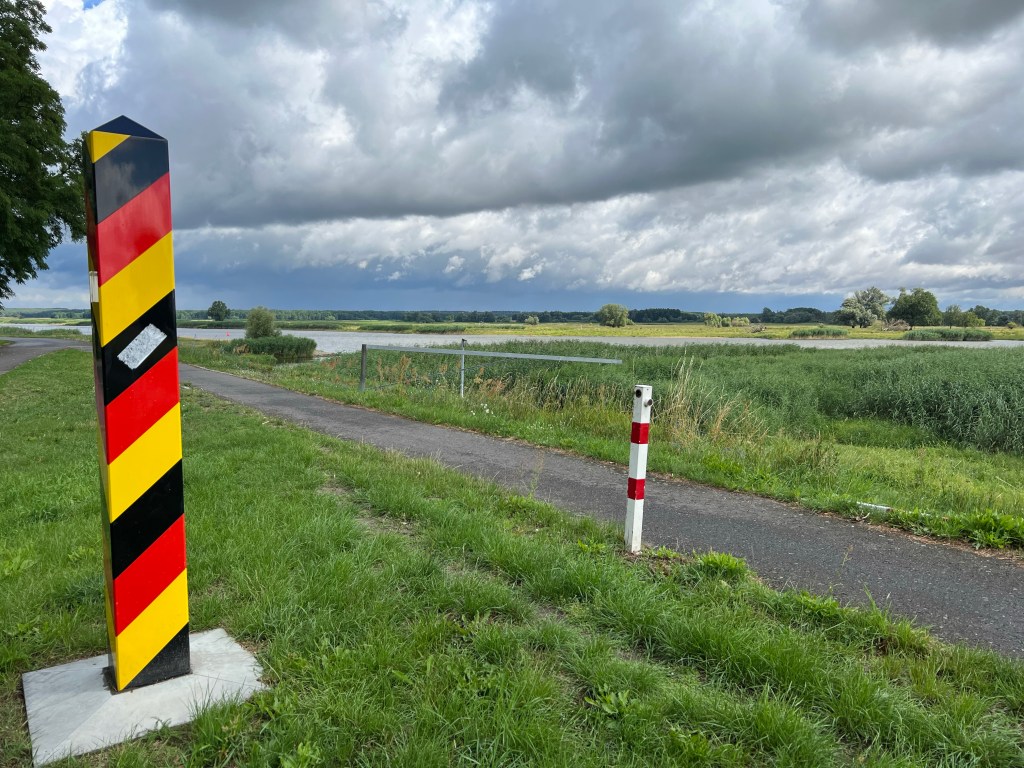
Looking across the Oder River from Groß Neuendorf to Poland 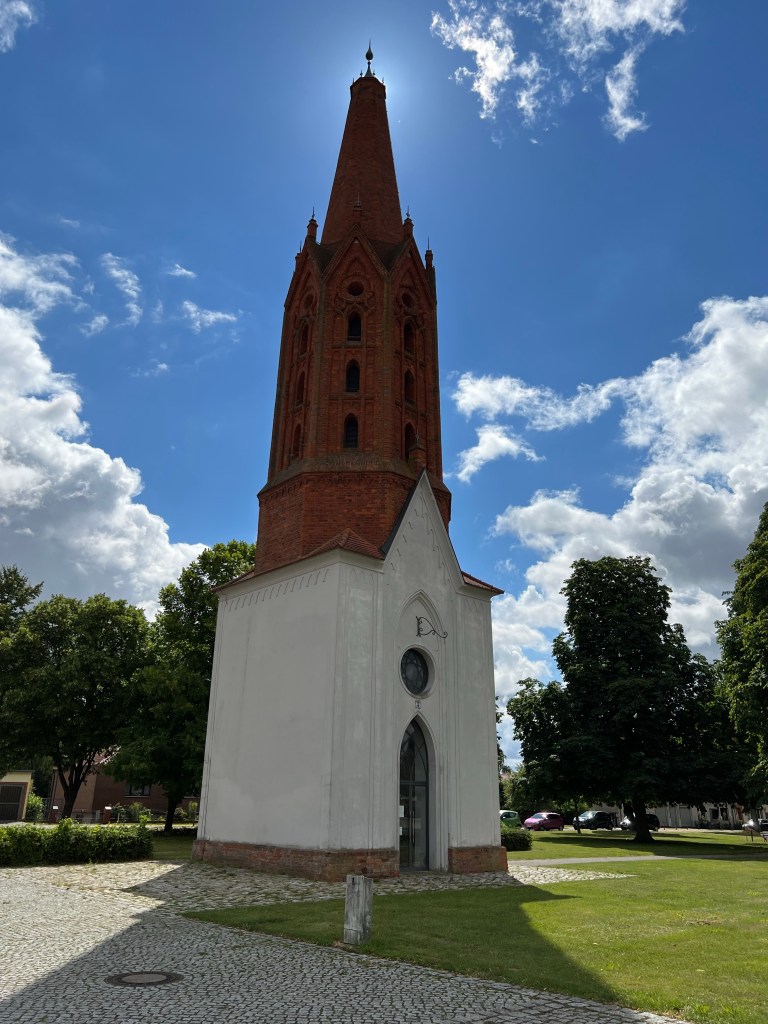
Here’s a sight our ancestors might recognize — the tower from the church in neighboring Letschin, which now stands on its own. It was originally constructed by Karl Friedrich Schinkel in 1818-1820. In the years after Catherine and Jacob married, they leased a farm in a small village once called Zicher in the section of Brandenburg on the east side of the Oder called Neumark. The village later became known as Cychry, Poland after the Soviet army gained control of the area in 1945 and has since been annexed into the administrative region of Dębno. I took a drive over there to check out the area.
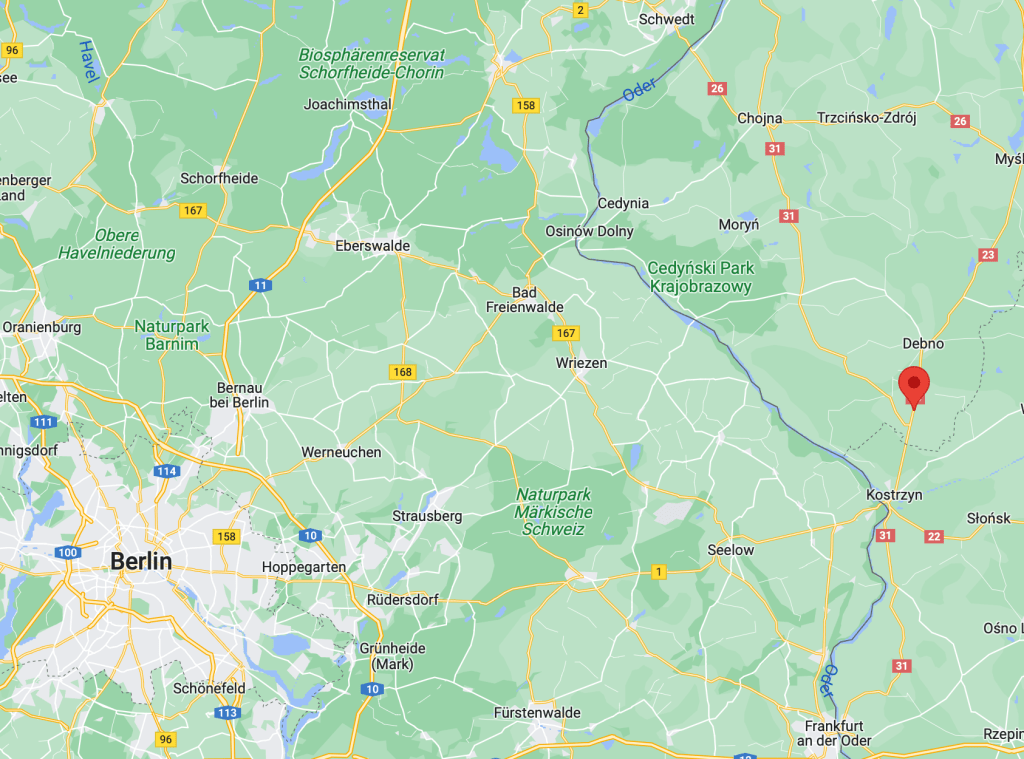
Location of Zicher, Neumark (now Cychry, Poland) 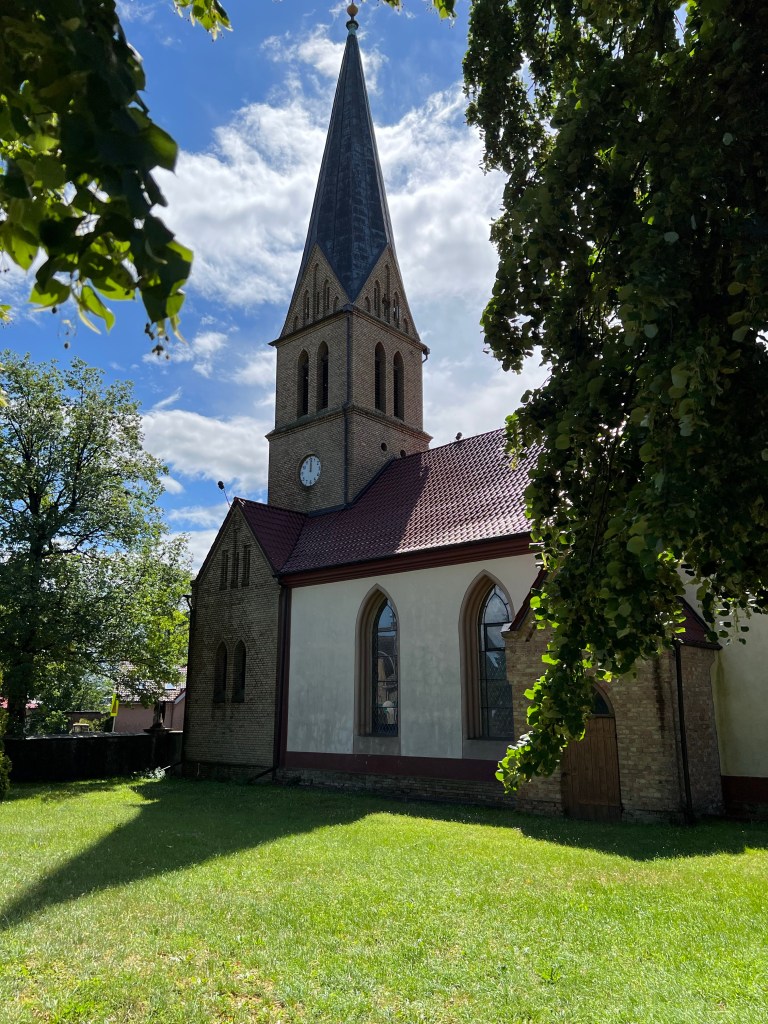
Does the tower look familiar? This is the church just south of Cychry in Sarbinowie, Poland. It was built in 1832 and yes, the tower was also designed by Karl Schinkel. Today the church is Roman Catholic (Kościół Wniebowzięcia Najświętszej Maryi Panny w Sarbinowie). 
There are still many examples of German-style architecture on the east side of the Oder River. 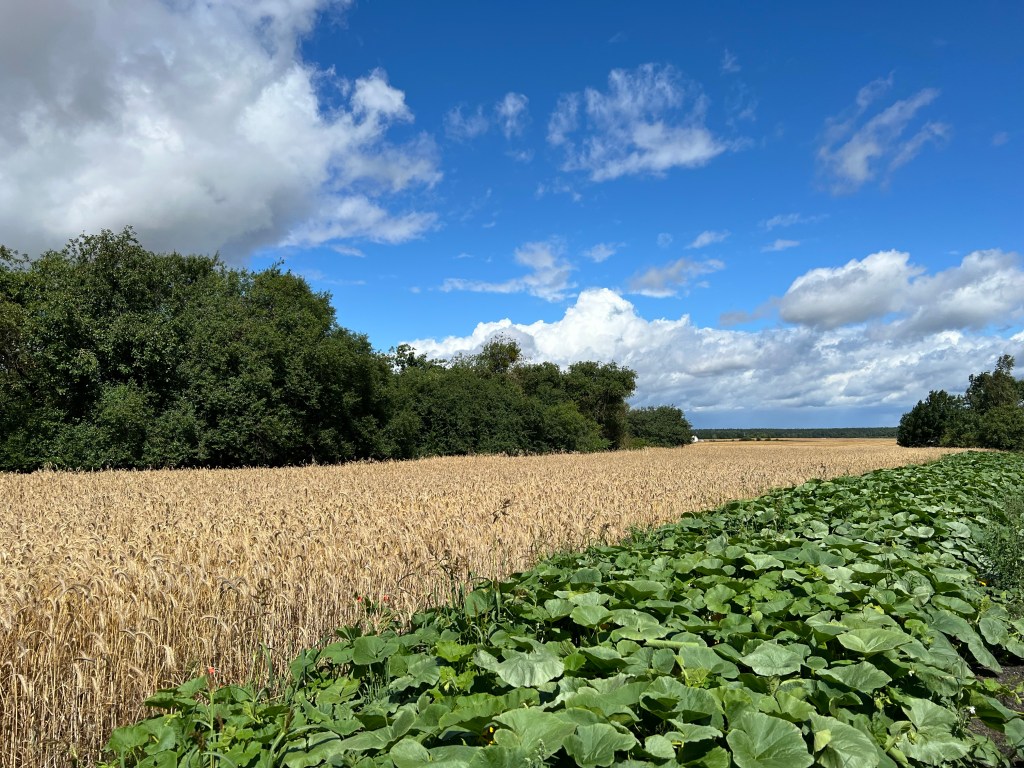
Farmlands in the former Neumark, now Poland Catherine and Jacob Lehmann had seven children in Zicher before emigrating: August (1833), Johann (1836), Carl Frederick (1839), Augusta (1842), our ancestor Louise (1844), Wilhelmine (1846), and Caroline (1849).
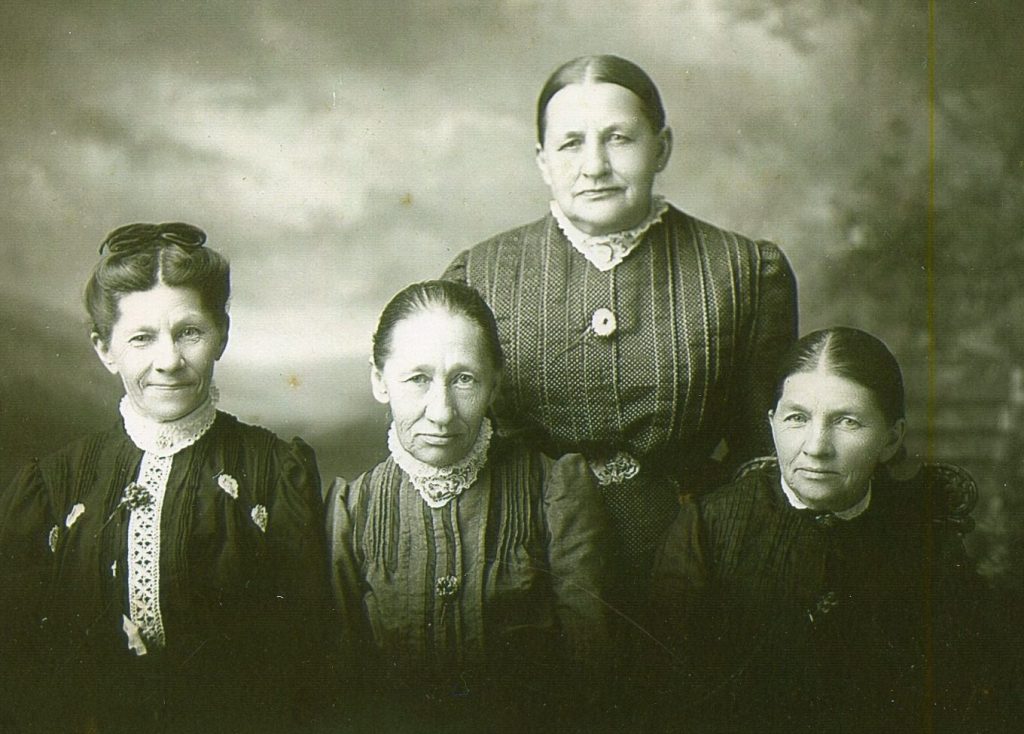
Grandma Louise Lehmann Kaufman standing with her sisters seated (left to right): Wilhelmina (Mina) Lehmann Goede, Augusta Lehmann Ruosch, Caroline Lehmann Gessert-Schachtschneider In 1856 the Lehmanns journeyed to Hamburg and boarded the Rhein for New York. The voyage took more than six weeks, and we can imagine how stressful it must have been for the family of nine.[1] My great-great grandma, Louise, was 11 at the time. The family made their way to Watertown, Wisconsin (Jefferson County), and no doubt quickly tapped into the thriving Germany community that had been established there since the late 1840s.
After visiting the lands on both sides of the Oder, it was clear to me that settling in Wisconsin must have felt somewhat like home to the Lehmanns. With its rolling farmlands, these regions in Germany and Poland have much the same feel as Southern Wisconsin.
Sunflowers growing in the Märkisch-Oderland *** Update and correction based on the information from Teddie Anderson Hill (see her comment below) ***
The exact village the Lehmanns lived in was Neu Zicher, not Zicher, which corresponds to Suchlica, Poland today. I drove through Suchica, and in fact the photo above of “Farmlands in the Neumark” (with squash and wheat) was taken in Suchlica.
Teddie is correct in saying that there is no church in Suchlica. (There’s not much of anything in this tiny village!) There’s a church that dates to the times of our ancestors just south of Suchlica in Sarbinowie (photo is above). And there’s also a Roman Catholic church in Cychry, which was Protestant before the 1950s. The building dates back to the 13th century and the tower dates to 1768. It’s likely that either this church or the one in Sarbinowie was the home church for the Lehmanns before they emigrated.
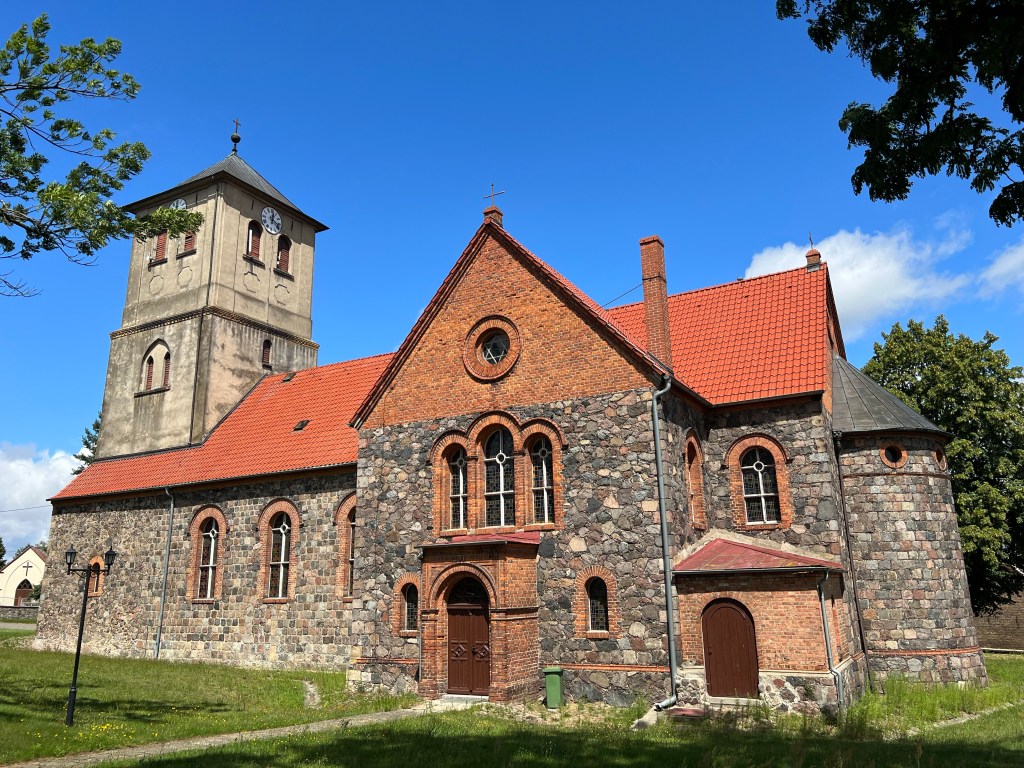
Church of Saint Stanislaus in Cychry (Kościół Rzymskokatolicki p.w. Św Stanisława) 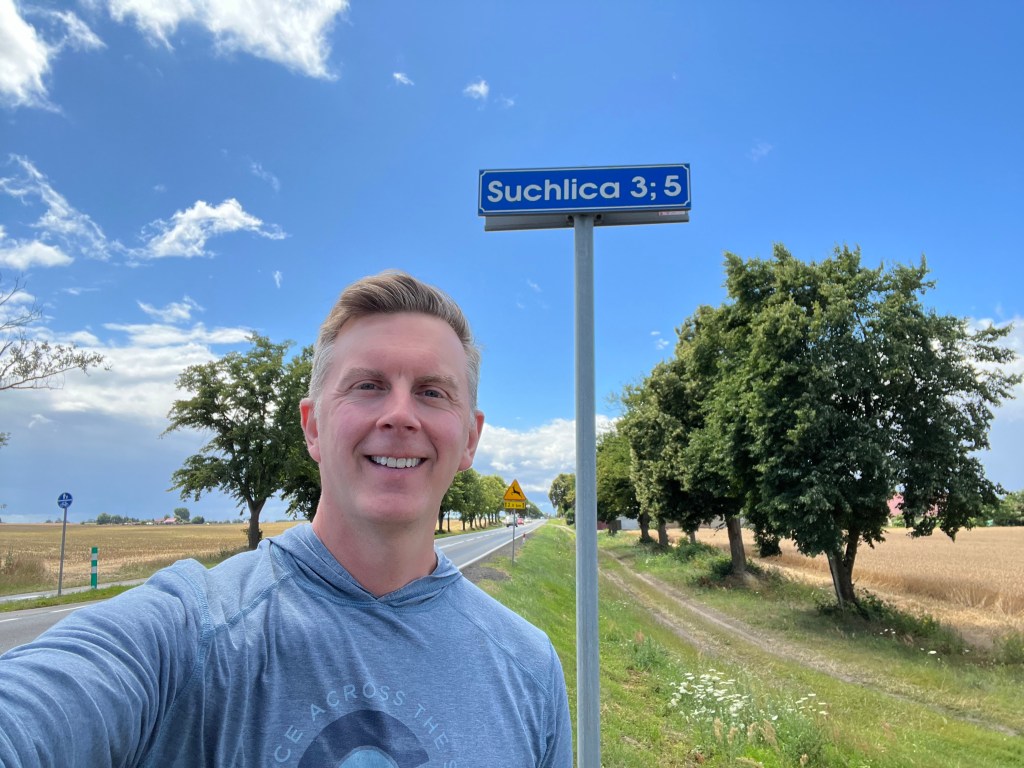
Just outside of Suchlica (formerly Neu Zicher) in Poland
[1] Much of what we know about the Lehmanns is thanks to the genealogical research of Teddie Lynn Anderson Hill and her mother Darlene “Donna” (Lehmann) Eichorst, descendants of Grandma Louise’s brother John T. Lehmann.
-
The Hahn and Sahr families of Woltersdorf
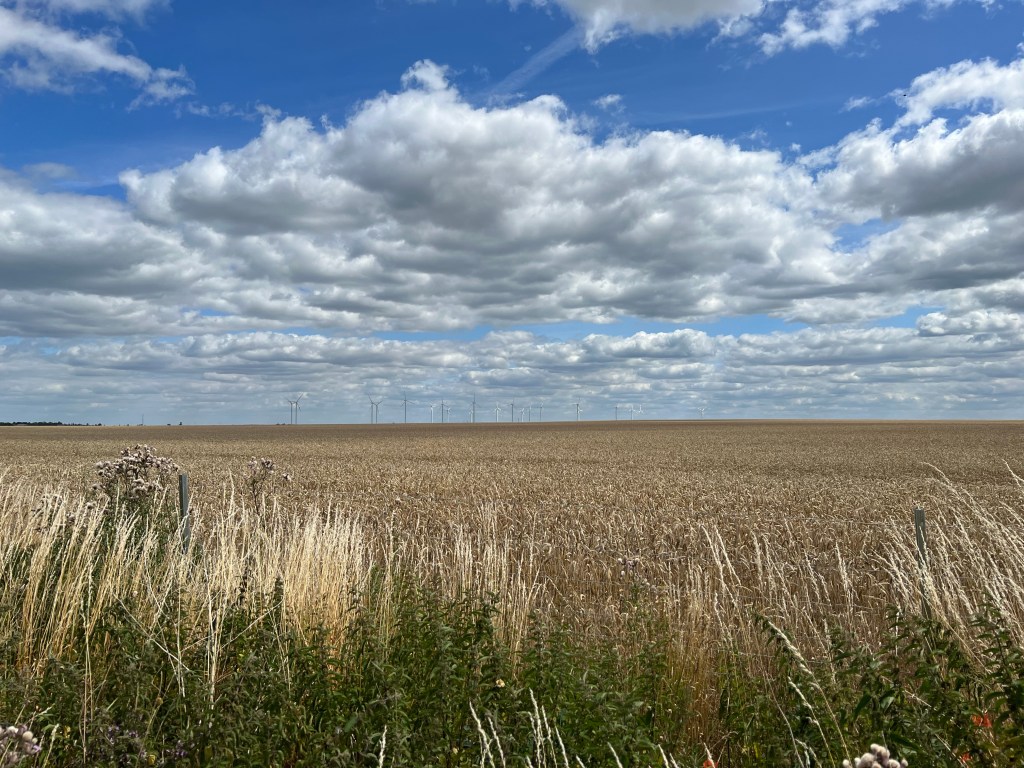
Today I visited Woltersdorf, Wartin and Blumberg — small villages that were home to my great-grandpa Frank Smith’s mother’s families — the Hahns and Sahrs. (For information about Grandpa Frank’s father’s family, see this post.)
The farmland just outside Woltersdorf 
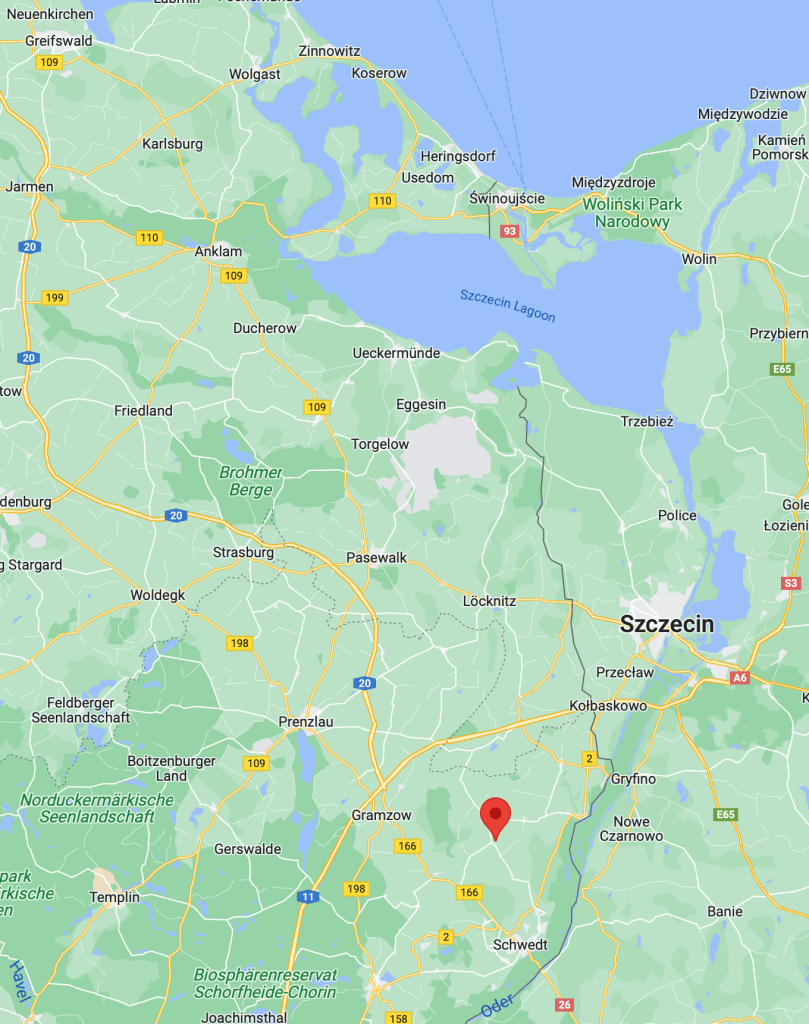
Location of Woltersdorf (formerly in Kreis Randow of Pomerania, now in Brandenburg) The region is home to sprawling farm fields — mostly wheat and hay, but occasionally corn and sunflowers. In some places giant wind turbines dominate the landscape. In each of the villages, I visited the local church, walked the graveyards, and tried to find names that I recognized. Unfortunately, I came up against the family historian’s biggest foe — time.
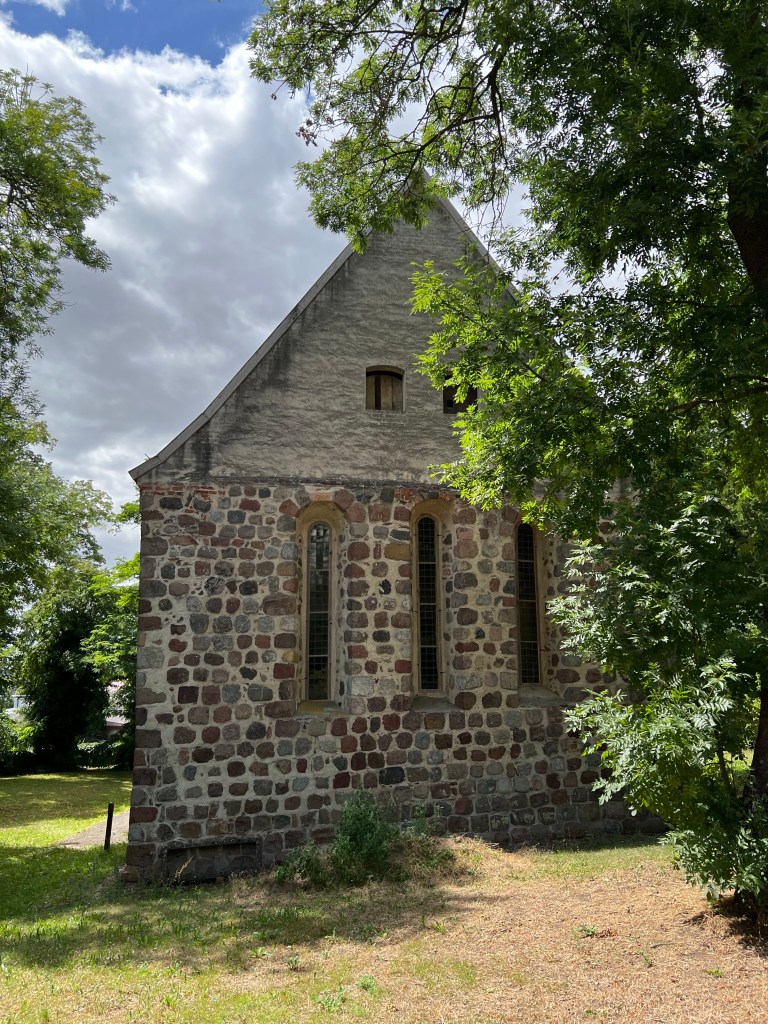
Woltersdorf Church is now a rundown shadow of its former self. 
Gravestones have been moved to the side of the churchyard (Woltersdorf Church) and many of the names are illegible. 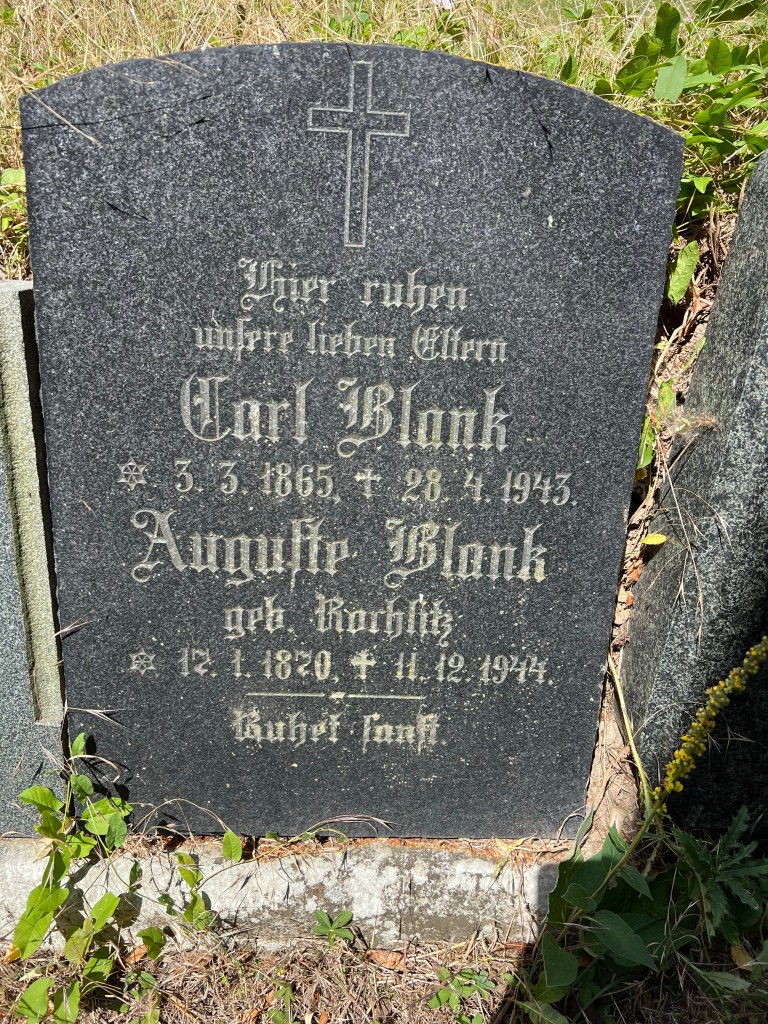
One name I recognized at Woltersdorf— Blank. My great-great grandma Augusta Hahn Schmidt’s brother Wilhelm C. Hahn married Caroline Blank. 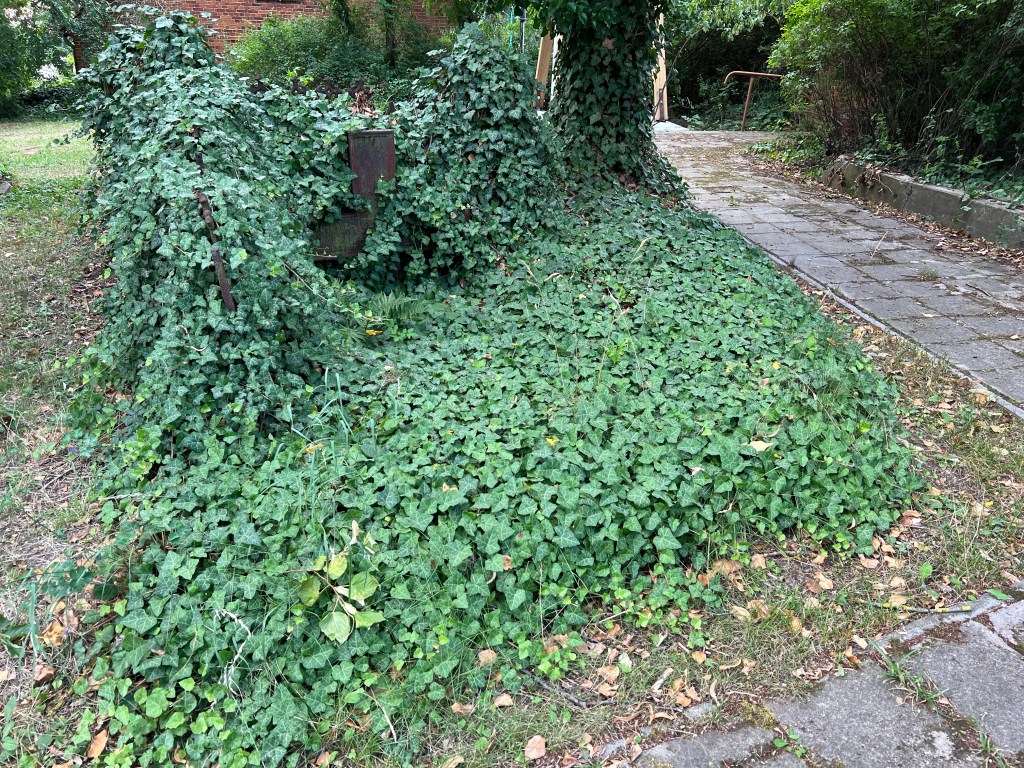
A family plot at Woltersdorf that is completely overgrown. Is this my family plot? Is it yours? Who knows? 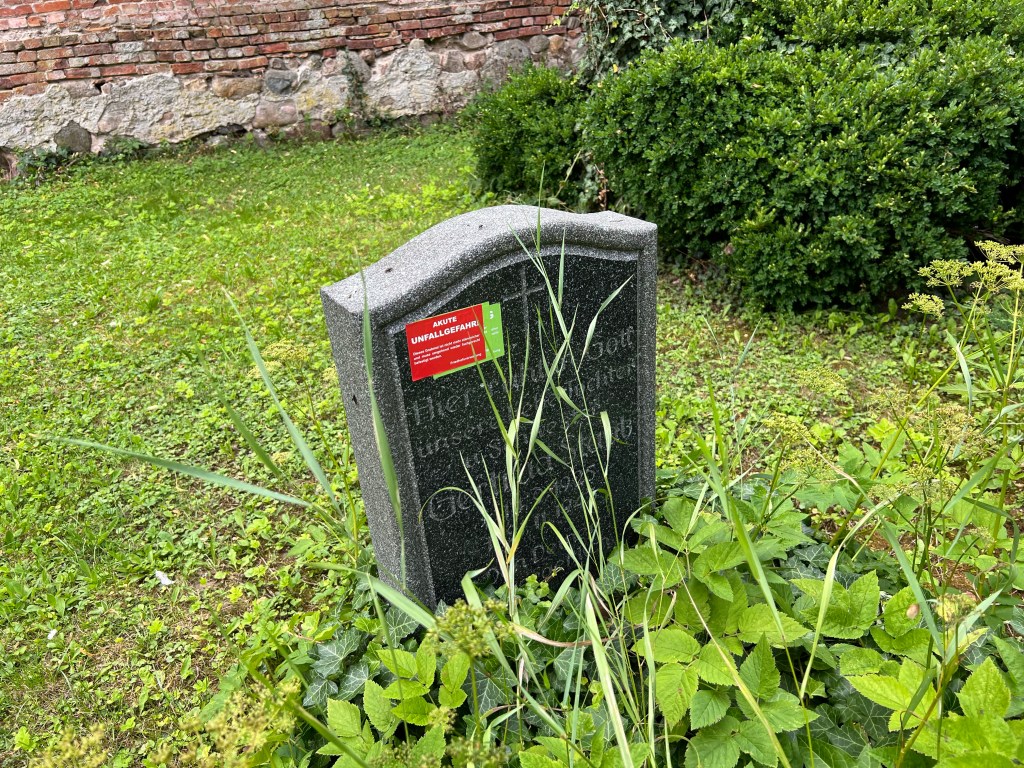
Churchyard at Wartin — The notice on this grave reads: “Acute risk of accident. This grave marker is no longer stable and must be professionally repaired immediately.” My assumption is that when no action is taken within a given time (after the two “green” warnings and the “red” warning), the grave marker is removed to the side of the churchyard. 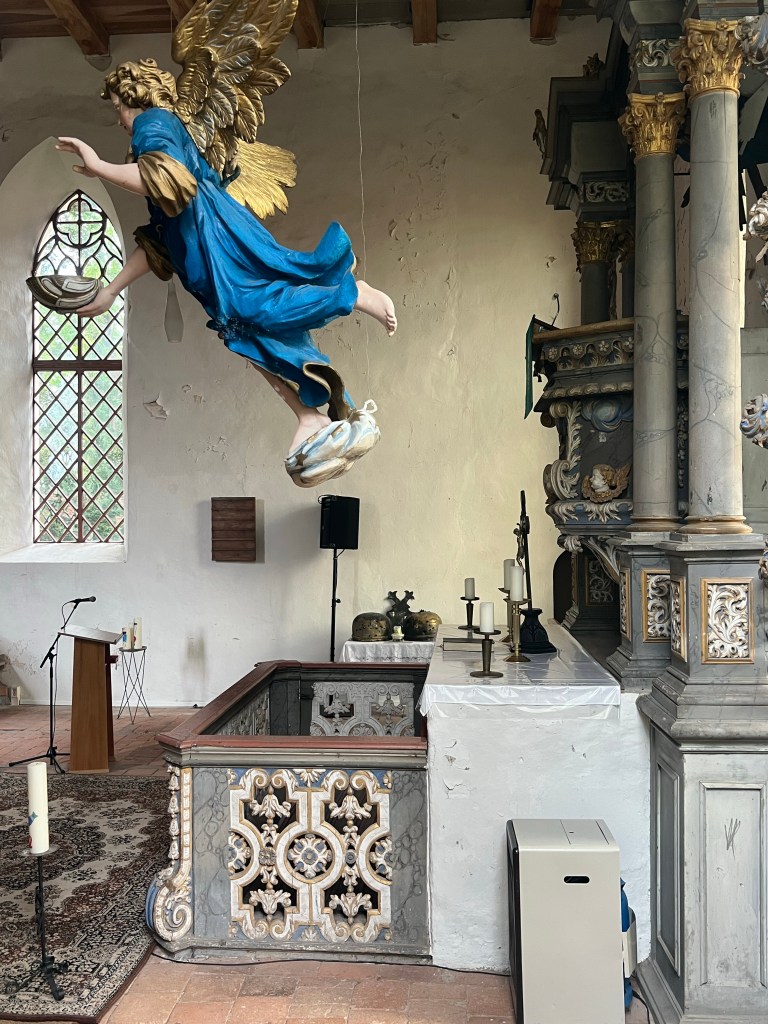
A peek through the windows at the Wartin Church. Like Woltersdorf, Wartin was a 13th century Gothic fieldstone church, but it suffered great damage and had to be rebuilt in the late 1600s. 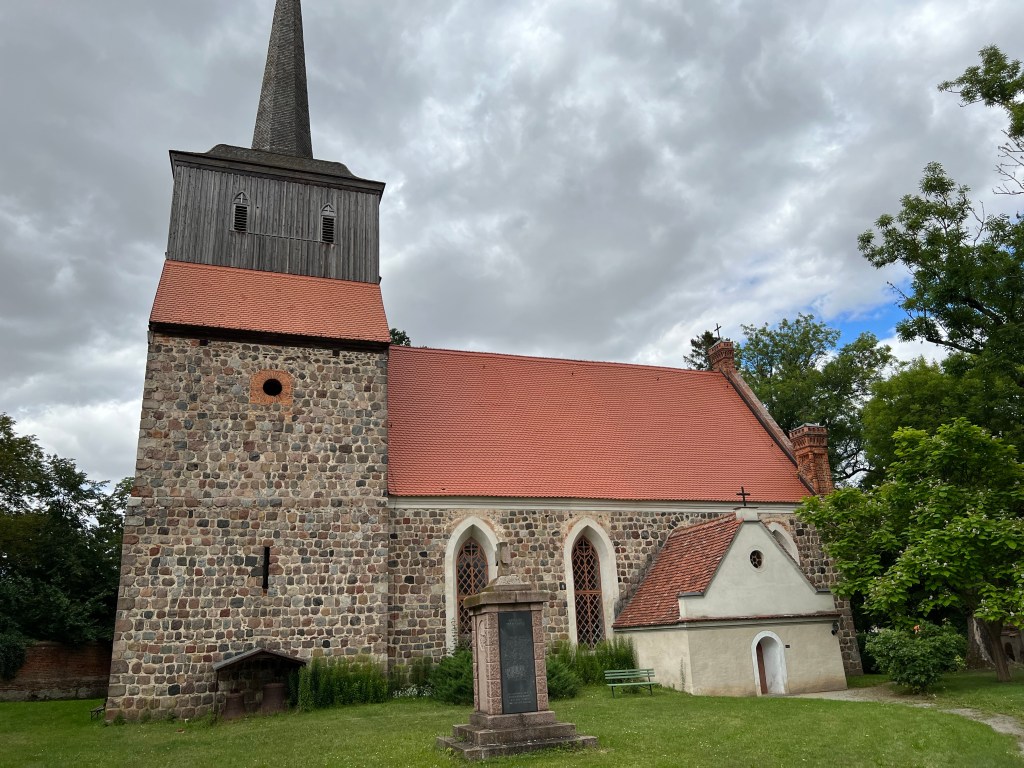
Wartin Church exterior. The marker in front commemorates WWII dead from the area. 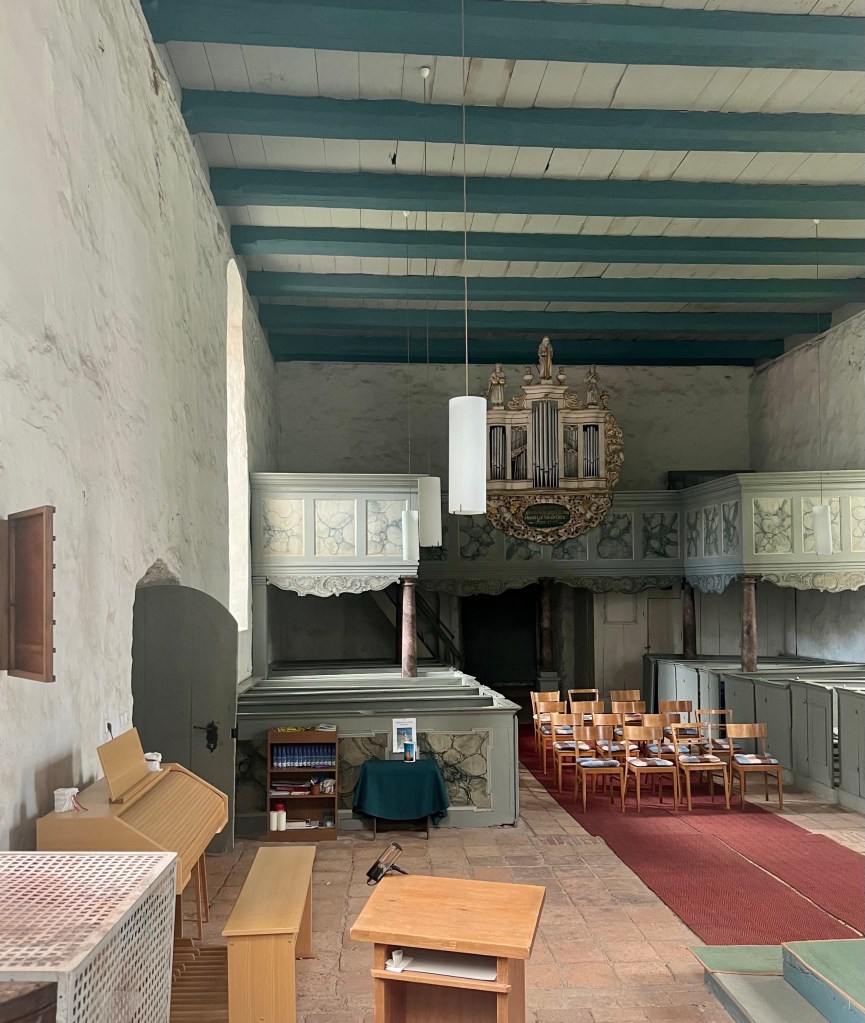
A peek through the windows at Blumberg Church — another 13th century fieldstone church used by our family. 
Blumberg Church exterior My great-grandpa Frank’s mother Augusta was born as Auguste Luise Friederike Hahn on September 14, 1858. Her birthplace of Woltersdorf was part of what was then Kreis Randow, the county southwest of Stettin in Pomerania.[1] Today the area is part of the town of Casekow, which is only a few miles from the Polish border and just within the boundaries of the modern German state of Brandenburg. Augusta’s parents were Wilhelmine Caroline Sahr and Johann Gottfried Hahn.
Augusta’s mother Wilhelmine Caroline Sahr was born on February 28, 1826 in nearby Wartin to Marie Matsdorf and Ludwig Sahr. Augusta’s father Johann Gottfried Hahn was born in Woltersdorf on September 26, 1823, and his parents were Maria Luise Nagel and Carl Hahn – a day laborer (Tagearbeiter).[2]
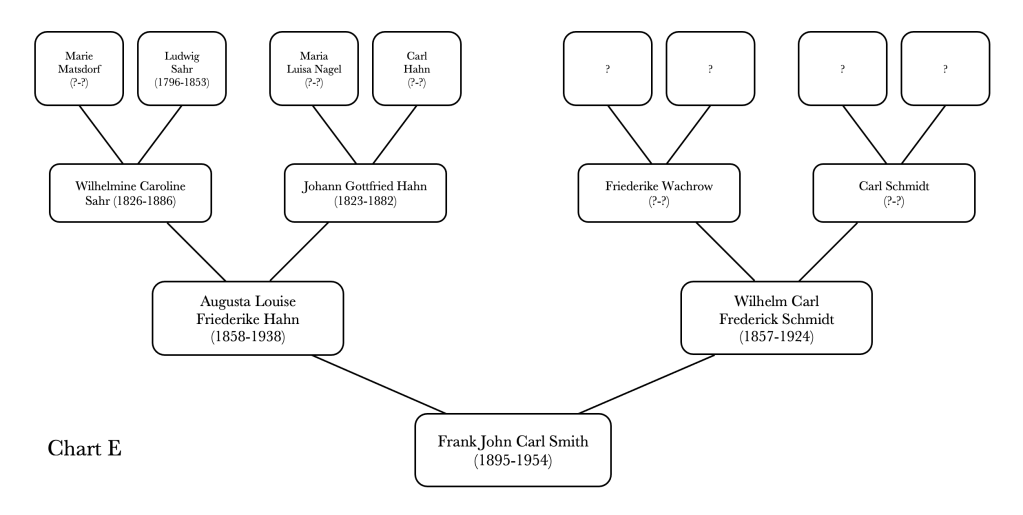
Direct ancestors of my great-grandpa Frank Smith Augusta was one of at least eight children born to Wilhelmine Caroline and Johann Gottfried Hahn after they had married in Woltersdorf on September 6, 1849.[3] From church records, we have been able to identify the children as follows: Carl Ludwig Wilhelm (1849), Johann Wilhelm (1851), Johanne Caroline (1852), Wilhelm Martin Friedrich (1854), August Carl Wilhelm (1856), our ancestor Augusta (1858), Wilhelm Carl (1860) and August Wilhelm Carl (1862).
Four of the Hahn siblings – the eldest child Carl L.W., our ancestor Augusta, Wihelm C., and the youngest child August W.C. – immigrated to Wisconsin in the early 1880s, along with their widowed mother Wilhelmine Caroline. August C.W. died at age two and it’s likely that Wilhelm M.F. died young as well. It’s unknown whether the second and third siblings – Johann and Johanne – stayed in Prussia.*

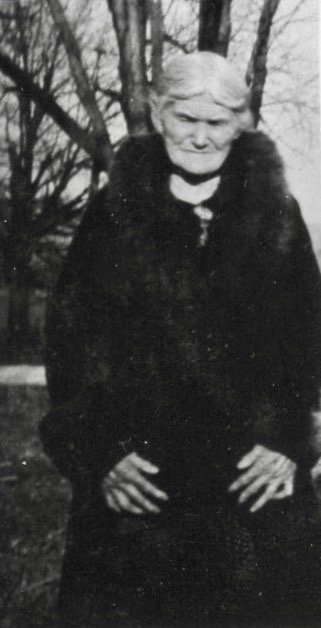
Both photos above are of Augusta Hahn Schmidt in the 1930s When I look at photos of my great-great grandma Augusta, I see pain as well as great strength. It’s hard for me to imagine everything she endured in her lifetime. In 1886, not long after arriving in the United States, Augusta’s mother Wilhelmine Caroline “Colleen” (Sahr) Hahn died at age 60. Grandma Colleen, as she became known in the U.S., had immigrated with her children after the death of her husband Johann. The next year, Augusta and Wilhelm’s daughter Anna died of croup before her third birthday. A decade later they lost their eldest daughter Millie from seizures caused by the measles. Millie was only 26 years old.
Augusta’s husband Wilhelm (William) Schmidt drank heavily and could be abusive towards Augusta and the children when intoxicated. He was arrested five times and convicted three times for such offenses. On one occasion in February of 1912, William attacked Augusta with a chair. Grandpa Frank’s brother Art feared for his mother’s life, tried to intervene but was threatened by his father with a revolver. Augusta decided she could endure this no longer. In July of 1912 she filed for divorce – a very rare thing for a woman to do at this time. The court sided with Augusta, awarding her custody of Frank and his brother John (the other children were legal adults by this time). Furthermore, the court granted Augusta sole ownership of the farm and created strict rules around when William could visit the property and use the horse for his masonry work.
According to my great-aunt Shirley, Grandma Augusta sold the farm and spent her later years living in a duplex in the Milwaukee area (not far from her son Art). She worked at a factory that made pots and pans, and in her spare time she knitted and sewed clothing for her grandkids. Aunt Shirley believes she had a “gentleman friend” in those years as well. I certainly hope she did.
[1] Augusta Hahn’s birth is recorded in the Hohenselchow-Woltersdorf church book for 1858 (Seite 87, Nr. 18), Blumberg Parish records at the Kirchenkreisarchiv Greifswald. These records were found thanks to the efforts of local historian and volunteer, Mr. Hartmut Wegner.
[2] Johann Hahn’s birth is recorded in the Hohenselchow-Woltersdorf church book for 1823 (Nr. 10), Blumberg Parish records at the Kirchenkreisarchiv Greifswald.
[3] Documentation of Wilhelmine Sahr and Johann Hahn’s marriage is found in the Hohenselchow-Woltersdorf church book for 1849 (Seite 152, Nr. 1), Blumberg Parish records at the Kirchenkreisarchiv Greifswald.
* All of the documentary evidence about the Hahns in Germany comes from the digital archives of Hartmut Wegner, the local historian in Mönkebude that I wrote about in yesterday’s post.

The Hahn family tree that Hartmut created for me on his computer based on church records that he found -
From Müggenburg to Aztalan – the Schmidts

I’ve spent the day visiting the villages where my great-grandpa Frank Smith’s family originated in northeastern Germany.
I have fond early memories of my maternal grandpa’s mother, Elvina Anderson Smith (1899-1983) but I never knew my grandpa’s father, Frank Smith (1895-1954). My mom has only a couple fuzzy memories of him. But I love that one of the few things she does remember is Grandpa Frank taking her and her brother Glenn fishing on the Rock River in Fort Atkinson, Wisconsin. Frank loved to fish.

Frank Smith ice fishing (1940s) Frank was born as Franz Johannes Karl Schmidt on March 17, 1895 in Aztalan – a very small town east of Lake Mills in Jefferson County, Wisconsin. Frank’s parents were Augusta Hahn and William Schmidt, who had met, married and had their first child in Prussia before immigrating to Wisconsin.
Frank was William and Augusta’s sixth child, after Emilge or “Amelia” (1882), Anna (1884), Arthur (1885), Ida (1889) and William (1893). And following Frank there was one more child, John (1897). So, like his wife Elvina, Frank was born in the United States but his childhood was heavily influenced by his parents’ recent immigration experience.
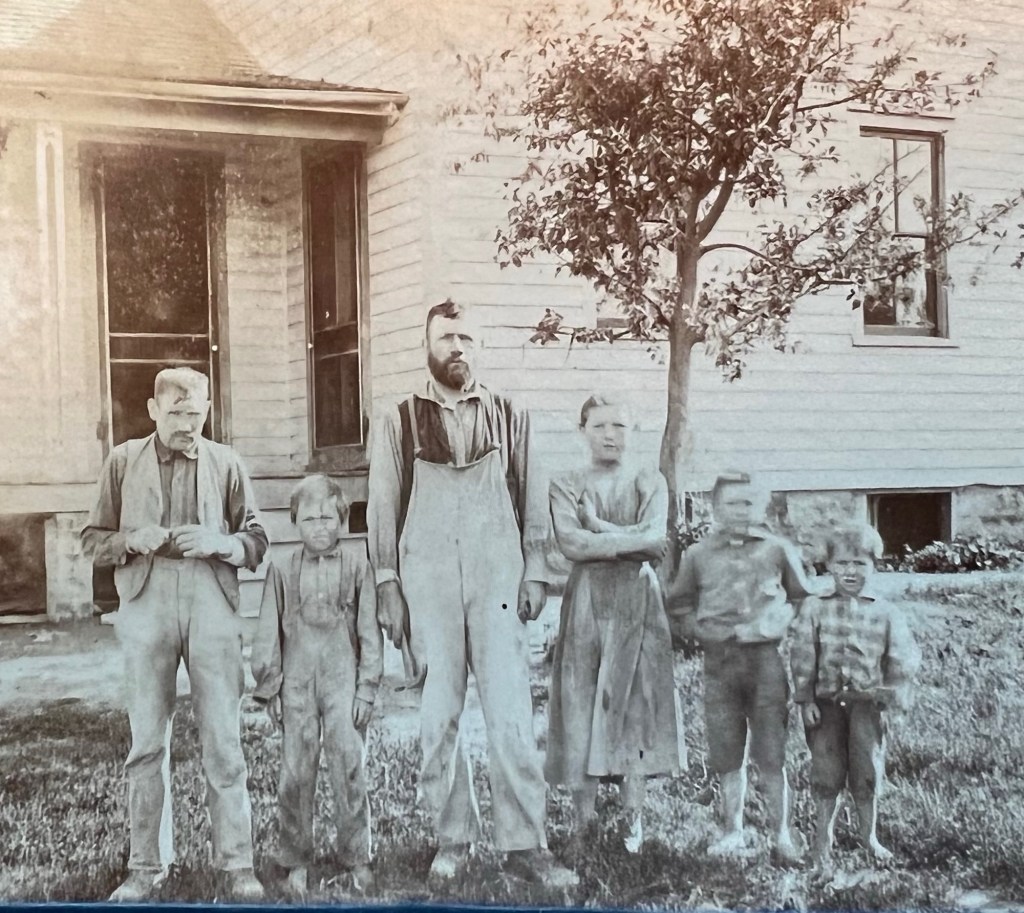
The Schmidts outside their home in Aztalan, Wisconsin in 1900: (from left) an unknown man, Art, William Sr. (Wilhelm), Ida, William Jr., and my great-grandpa Frank.
(Photo courtesy of Dianne Hrobsky, granddaughter of William Schmidt Jr.)Frank’s parents both originated from villages near the city of Stettin in the Prussian province of Pommern (Pomerania). Pomerania has a complicated history, and it is likely that our family’s ancestry reflects this complexity. Prior to Treaty of Westphalia in 1648, the area where Frank’s family came from was part of the Duchy of Pomerania, a vassal state of the Holy Roman Empire. For 150 years, the region was bitterly contested by Prussia-Brandenburg and Sweden, it became a site of intensive German colonization efforts (Ostsiedlung), and like many parts of Europe it experienced the horrors of the Nazis’ “ethnic cleansing” campaigns. With the conclusion of World War II, Pomerania was divided between Allied-occupied Germany and Poland, and Stettin became the Polish city of Szczecin. After 1949 the villages where our ancestors came from were part of the German Democratic Republic (i.e., East Germany, the “DDR”) until the fall of the Berlin Wall in 1989.
Given the region’s tumultuous history and fragmentary records, it’s tough to trace the family’s origins much further back than Frank’s grandparents.
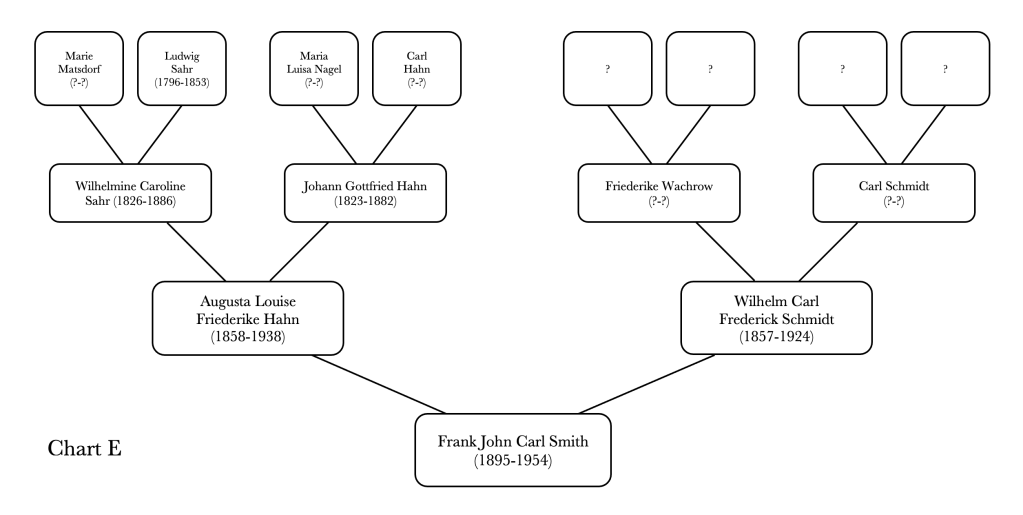
Direct ancestors of my great-grandpa Frank Smith Frank’s father William was born as Wilhelm Carl Friedrich Schmidt on April 12, 1857 in a small village called Müggenburg (near Torgelow, northwest of Stettin) in what is now the district of Vorpommern-Greifswald in the state of Mecklenburg-Vorpommern, Germany. At the time of Wilhelm’s birth, Müggenburg was located in Pomerania’s Kreis Ueckermünde. Wilhelm’s parents were Friederike Wackrow and Carl Schmidt. When Wilhelm was born, his father Carl worked as an Arbeitsmann (laborer), and it is possible that he was employed by one of the many industries in the area. The region was especially known for brickmaking.

Location of Müggenburg, where the Schmidts come from In his youth, Wilhelm received a religious education from the state church in Pomerania (Evangelische Landeskirche), he apprenticed as a mason, and he served in the Prussian army. We also know that he had at least one older brother, Carl (1854), who immigrated to Jefferson County, Wisconsin a couple of years after Wilhelm. How Wilhelm Schmidt and Augusta Hahn met is unknown. Both Wilhelm and his brother Carl were stonemasons by trade, and it seems possible that Wilhelm’s work could have taken him south to where the Hahns lived.
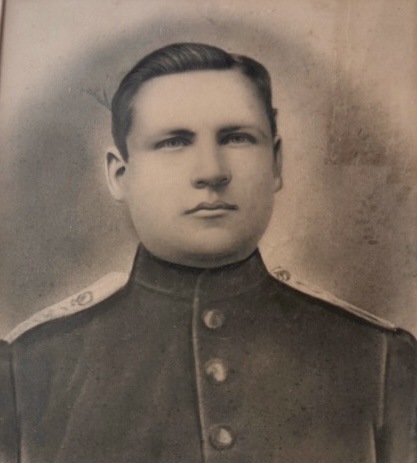
Wilhelm Schmidt during his time in the Prussian military (1870s) Augusta and Wilhelm married on March 19, 1882, just before their first child, Emilge, was born. The following spring the new family of three boarded the SS Strassburg out of Bremen and traveled to Baltimore, arriving on May 26, 1883. From there, they took the train to Wisconsin and joined Augusta’s siblings who had settled on farms near Lake Mills and Watertown. Augusta’s older brother Carl L.W. Hahn, his wife Gustine and their three oldest children Carl, Herman and Albertine had taken the Strassburg to Baltimore the prior October, so they probably gave Augusta and Wilhelm some instructions on how to do it.
* * *
Before I share some of the photos of the Schmidts’ hometown in Germany, I’d like to give you some insight into how the genealogical sausage was made. Much of the documentary evidence that I have for Frank’s parents’ origins in Germany comes from one person — a kindly local historian named Hartmut Wegner, who lives in Mönkebude with his wife Helga.
I first contacted Hartmut in May of 2021 after a volunteer genealogy group in Germany referred me to him. I had the names, birthdates and approximate birth locations of both of my great-great grandparents — William and Augusta (Hahn) Schmidt — but I had no documents from Germany that confirmed this information. There was nothing available online; I had tried everything.
Hartmut took on my case. To my great surprise, he tracked down both the Schmidts and the Hahns in the church record books. He did so by using a digital archives of his own creation. Over the past few years, Hartmut has been traveling to local archives in Vorpommern and northwest Poland to personally digitize thousands of records — records that do not exist anywhere online.
Who is this guy? I wondered. What kind of person does this? I had to come to Germany to find out.

Hartmut and I outside his home in Mönkebude, Mecklenburg-Vorpommern It turns out that Hartmut’s local history work goes far beyond what I’d realized. Since retiring from teaching, he has written several books on the history of the area, its schools, churches, and military dead. He has built family trees for friends, colleagues and even perfect strangers like me. His own family history is a massive tome.
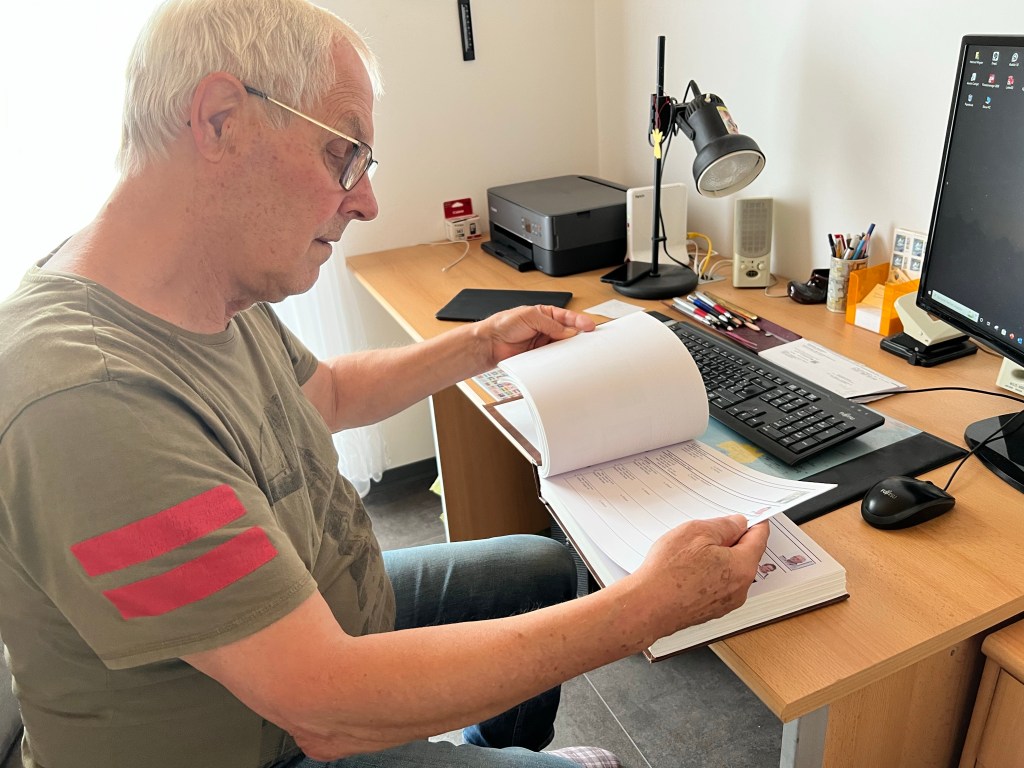
Hartmut showing me the history he wrote about his own family 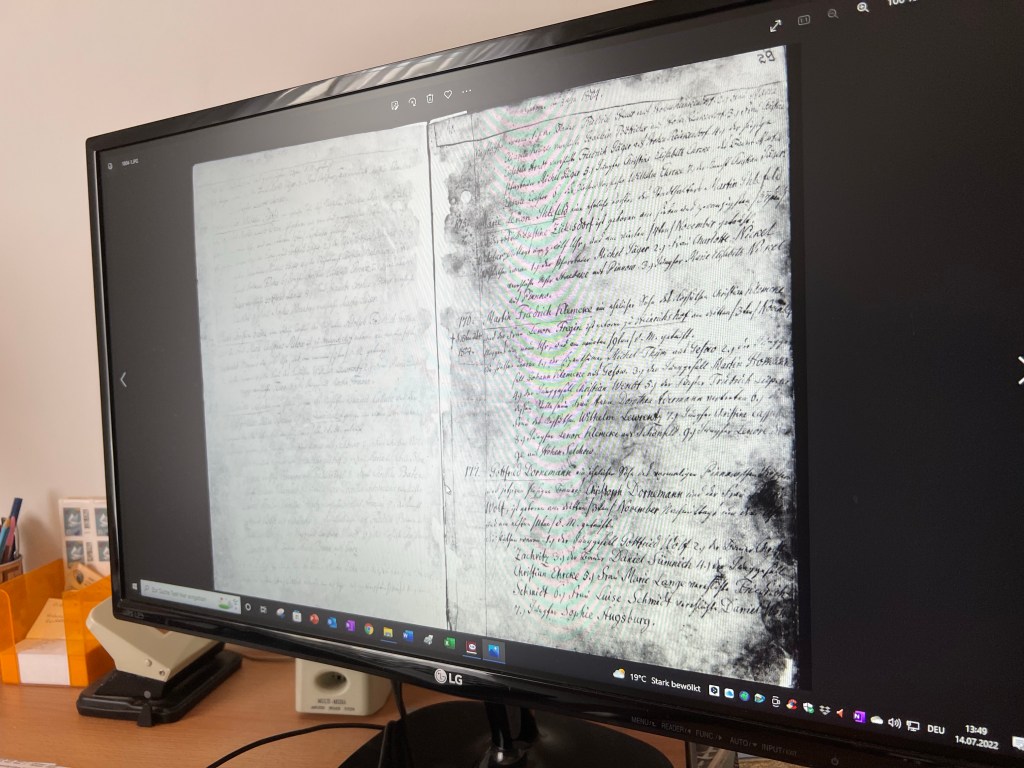
One of the thousands of scans of church records Hartmut has stored on his computer. I hope this guy has a backup drive! 
I took the Wegners out to dinner to thank them. We all had creamed herring. * * *
I knew from an obituary that my great-grandpa Frank Smith’s father Wilhelm Schmidt came from Müggenburg. And thanks to help from Hartmut, I knew which Müggenburg to visit — there are several in Germany and two of them in this part of Pomerania.
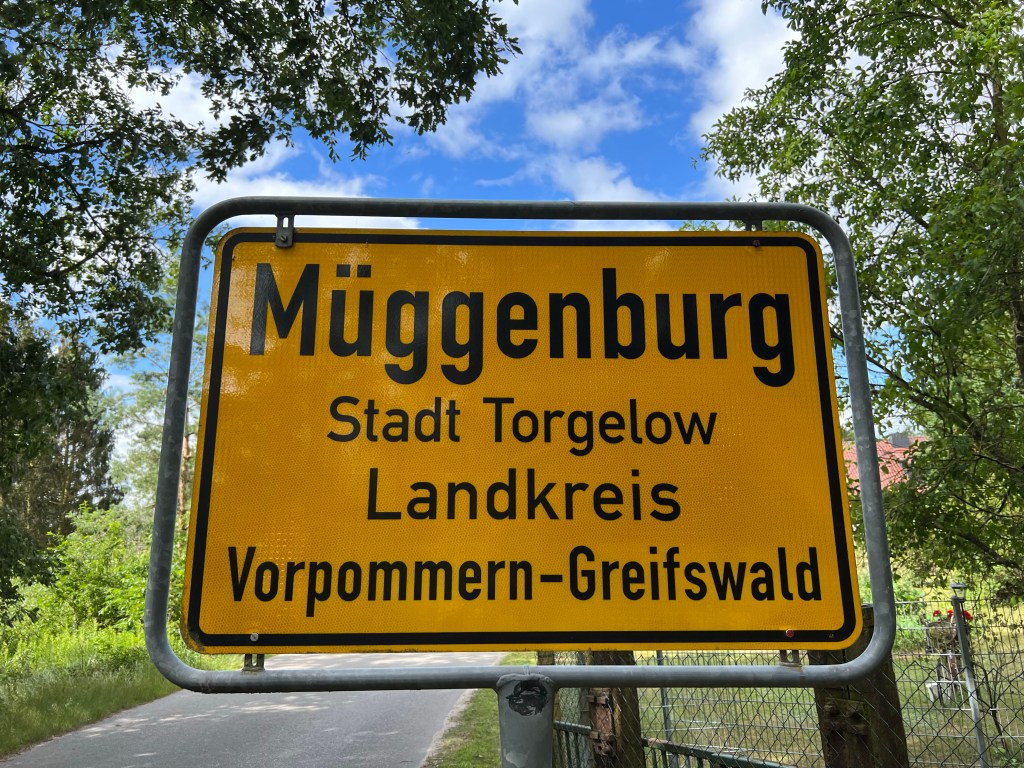
Don’t blink — you might miss this village! The road to Müggenburg The village lies where a tiny road dead-ends in a forest clearing. There are no more than 10 houses. A couple of guys were chatting outside one of the houses, and I explained in a laughable mixture of German and English what I was up to and who my family was. They recognized one of the names I mentioned — Wackrow — and one of them said, “Follow me in your car. I’ll take you there.” Or at least, I imagine that’s what he said in German. And so off we went. We drove through the woods about a half a mile, and then he pointed toward a house next to a huge yard full of scrapped cars. With that, the guy waved and drove back to his own house.
There are no Schmidts in Müggenburg these days, but the local auto scrapyard is owned by Bernd Wackrow. Wackrow was the maiden name of my 3x great-grandmother Friederike Schmidt (Wilhelm’s mother). So naturally I knocked on the door and said “Guten tag”!
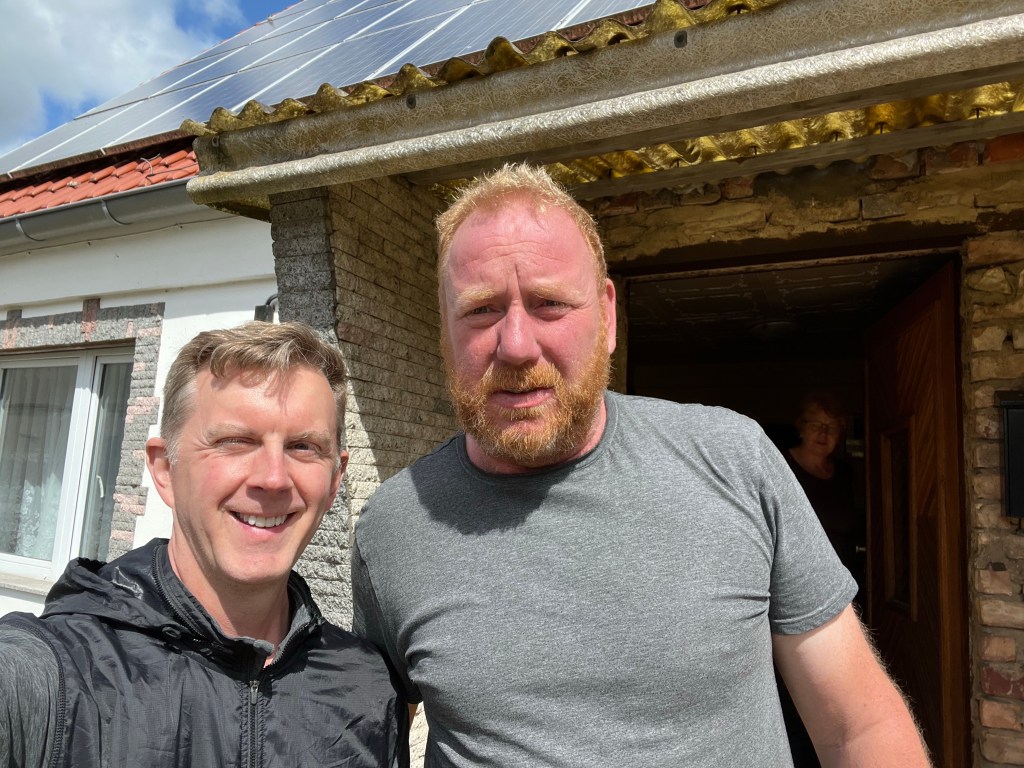
The surprised looking guy on the right is Bernd Wackrow It’s uncertain if Bernd and I are actually distant cousins, but I’d say the chances are good considering how small the village is. He even reminded me a little of an uncle of mine on my mom’s side.
Regardless of whether there is a real connection or not, Bernd thought there was — and so did I. He invited me in for a coffee, and we attempted to communicate using Google Translate. As I was heading out, I showed him a translated message on my phone that said, “It’s been so good to meet a family member from Germany.” To my surprise, his eyes welled up and he pulled me in for a giant bear hug.
Germany felt much “homier” from that moment on.
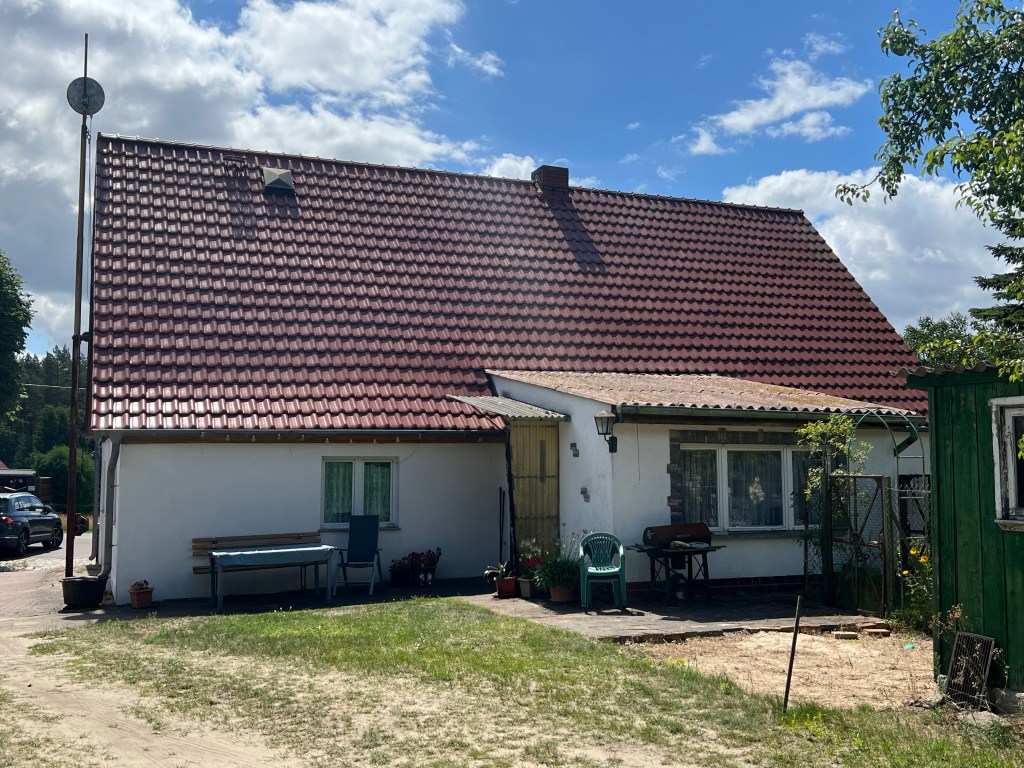
The house that the Wackrows have lived in since the 1880s 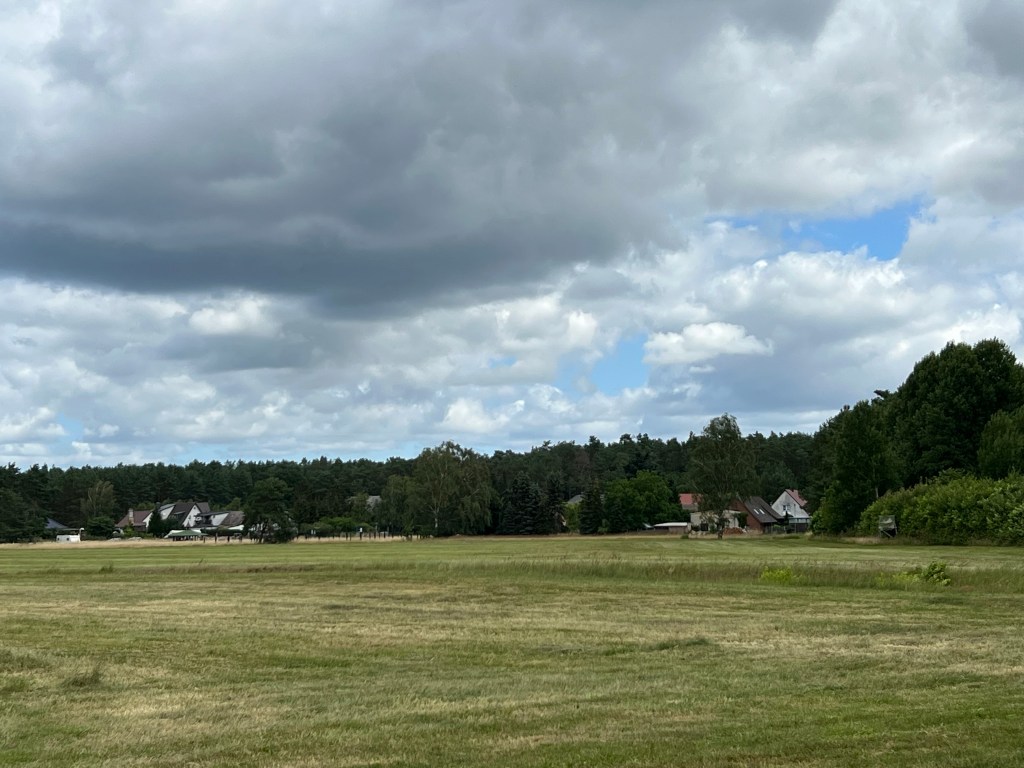
The village of Müggenburg 
Family history is a little like this scrapyard. You never know what you’re going to find. -
Who was Oscar Veum? The search for a biological ancestor.
There’s a word in the Dano-Norwegian language used by 19th century Norwegian priests that sounds just as ugly as it does in English: uægte. It means “illegitimate”. And if you scroll through as many old Norwegian church records as I do, you’ll notice how often it comes up. In the old record books, whether a child was born to a married couple (ægte) or an unmarried couple (uægte) was deemed important enough to warrant a separate column on the page.
Today in the United States, almost no one cares whether a child’s parents are married or not. Every day in the U.S., roughly 10,000 children are born, 40% of whom are born to unmarried couples. In the minute it has taken you to read these last two paragraphs, roughly three American children were born “out of wedlock”.
There may still be some legitimate reasons to care about “legitimacy” (e.g., it can sometimes signify things about the stability of a child’s home life), but the moral stigma of being an unwed parent – particularly harmful for unwed mothers – is largely absent today. This was not the case a century ago in Wisconsin when my paternal grandpa, Bob Rude (1925-2009), was born. The story of who fathered him and the circumstances surrounding that – these things were simply not spoken of.
But in the late 1980s, as my great-grandpa John Rude was approaching 90 and starting to get his affairs in order, it came to light that my Grandpa Bob had never been formally adopted in 1930 when his parents married. They rectified this at the courthouse and officially changed my grandpa’s last name from Helgestad (his mother’s maiden name) to Rude (the name he had used for almost all of his life).
For a brief moment, this taboo subject was spoken of by members of the family, albeit in hushed tones. We knew that Grandpa Bob’s biological father’s name was J. Oscar Veum. We knew that this J. Oscar Veum had worked at the Highway Trailer Company for a number of years. We knew that he’d died of a heart attack at age 49. But we knew nothing else. What was the nature of his relationship to my great-grandmother? Was she taken advantage of? Did he deny paternity? Anyone who could have answered those questions was long gone.
Over the past decade or so, I’ve done research into the questions that could be answered: Who was J. Oscar Veum? Who was his family? And where were they from? Through newspaper articles, church and Census records in Norway and Wisconsin, and limited exchanges with biological relatives, I’ve managed to piece together some rough biographical notes on J. Oscar Veum and his family.
Johan “Oscar” Veum was born on April 5, 1893 in Edgerton, Wisconsin – the fourth of seven children born to Bertha Thorpe (1864-1937) and Erik Ingebretsen Veum (1864-1942). The Veums worked in tobacco on a farm in Christiana township not far from where my great-grandma Borghild Helgestad’s family lived in Busseyville (north of Lake Koshkonong in Wisconsin). The Veums attended the same church as the Helgestads – the East Koshkonong Lutheran Church – and the families would have been familiar with one another.
Oscar’s parents, Erik and Bertha, married in Norway in 1885 and immigrated to Wisconsin the next year. In the photo below, Erik (at right) is overseeing work in one of his tobacco fields. The East Koshkonong Lutheran Church is in the background.

Erik Veum (right) with tobacco field workers, Christiana Township, Wisconsin The March 7, 1919 issue of the Wisconsin Tobacco Reporter (precursor to the Edgerton Reporter) referred to the Veums as “prosperous farmers”, and one indicator of that properity is that their son, Oscar, was sent to the private Albion Academy for his schooling (articles from Dec 11, 1908 and March 5, 1909). Erik also travelled to Norway with two of his daughters in June of 1921 and sent dispatches back to the paper about their trip.
According to a Veum family member I’ve been in touch with, Oscar served in the Navy during the First World War. That family member sent me the two photos below.
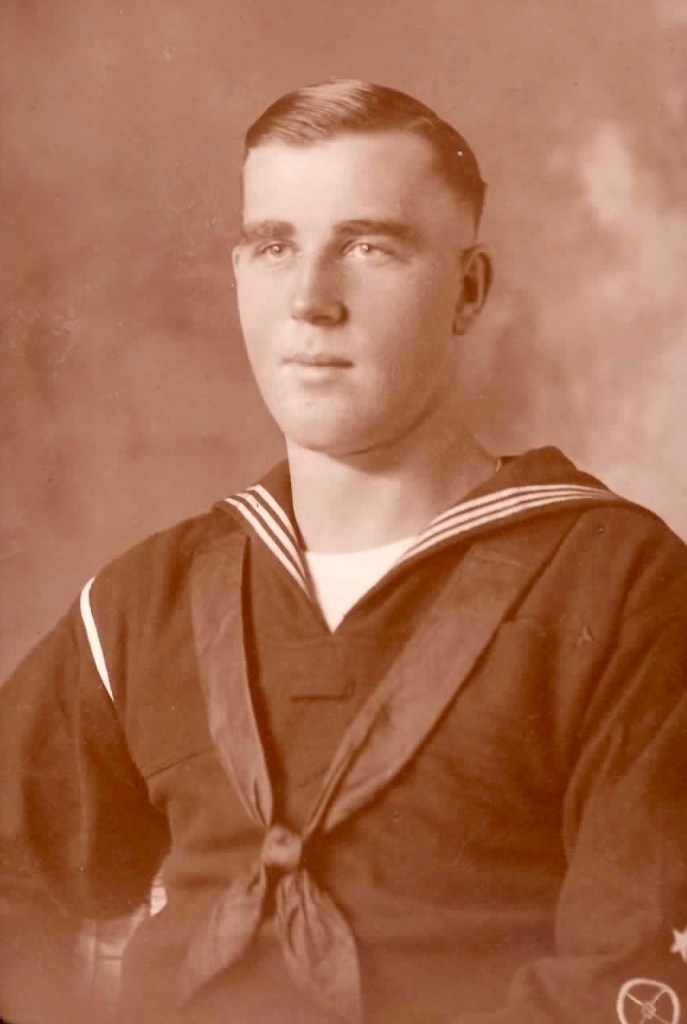
Oscar Veum in Navy uniform Two years after my Grandpa Bob was born, Oscar married Edna Wolf.

Edna and Oscar Veum I have yet to make contact with any of Oscar and Edna’s direct descendants.
I have sometimes wondered what Ole and Klara Rude thought about their son John marrying a woman with a five-year old son born out of wedlock. A little research into the Rude family has helped me realize that they were probably more understanding than most. It turns out that Klara had herself been an unwed mother. She gave birth to Anna in 1896, three years before she married Ole. In the church records from Ringsaker Parish, Anna is labeled “Uægte” and the father’s name is listed as Johan Andreasen (i.e., not Ole).
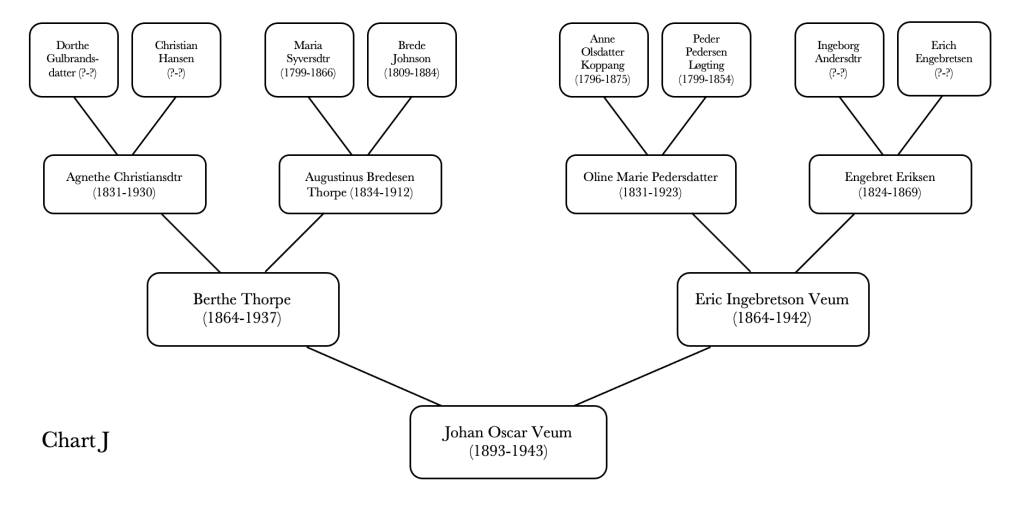
Coincidentally, the Veum family came from parishes that border Ringsaker and Veldre where the Rudes are from. Oscar’s father Erik Ingebretsen and his two brothers were born in Hamar in 1860s. The family moved to Nes Parish in the 1870s and Erik’s mother Oline Maria ran two farms there: Aarlien and Veum. She did so after the death of Erik’s father Engebret and with the help of a farmhand named Peder Hågensen, whom she married in 1881. During these years in Nes Parish, Erik must have met Berthe Thorpe, whose family lived on Helgøya, the large island in the middle of Lake Mjøsa. The couple married and left for Wisconsin in the mid-1880s.
I took a quick drive through Nes and found the Veum farm. I actually spoke to the current owner, and once I explained the connection she invited me into her home. Together we flipped through the local bygdebok (farm history) and found the relevant names. She also very kindly gave me directions to the other family farm, Aarlien.

Veum Farm in Nes, which was one of two farms owned and operated by Erik Veum’s mother, Oline Maria Pedersdatter, after the death of Erik’s father Engebret Eriksen. 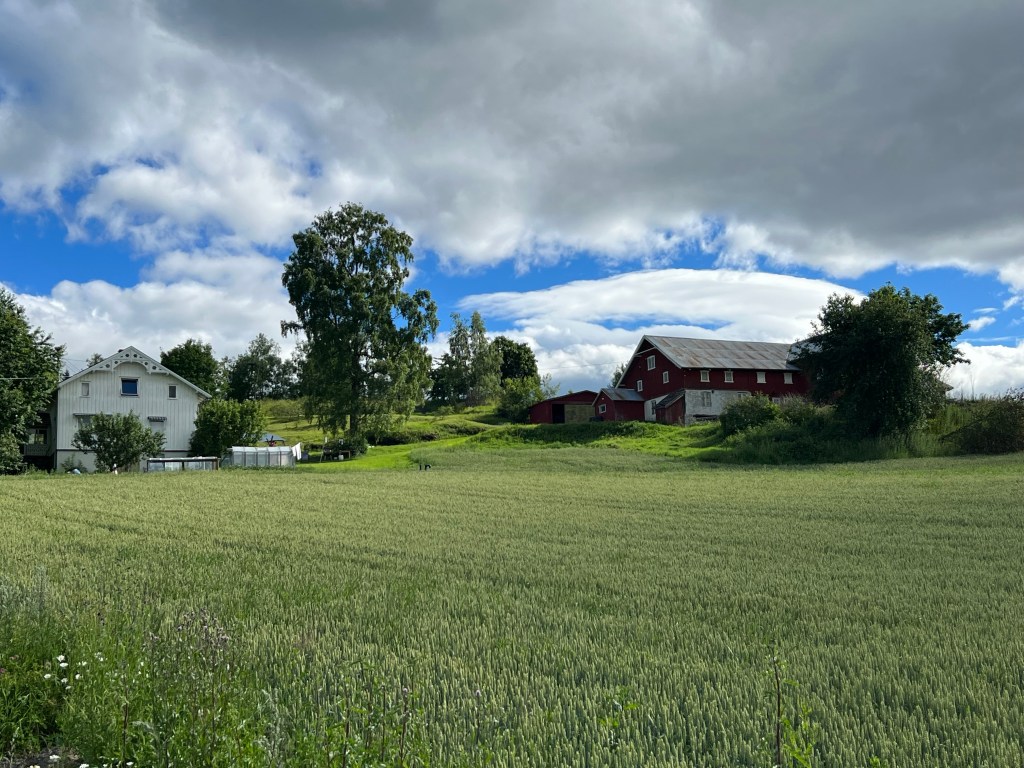
Aarlien — a second farm run by Oline Maria Pedersdatter, paternal grandmother of J. Oscar Veum Erik Veum’s wife Bertha Thorp was from a farm on Helgøya. I didn’t visit Helgøya, but I did drive down to the tip of Nes and take a look across the channel. It’s a beautiful, peaceful spot with barely any sounds but seagulls. Nes Church, consecrated in 1250, is located there in Tingnes, and that’s where
Erik and Bertha marriedmultiple family members married. [Correction made Apr 18, 2025]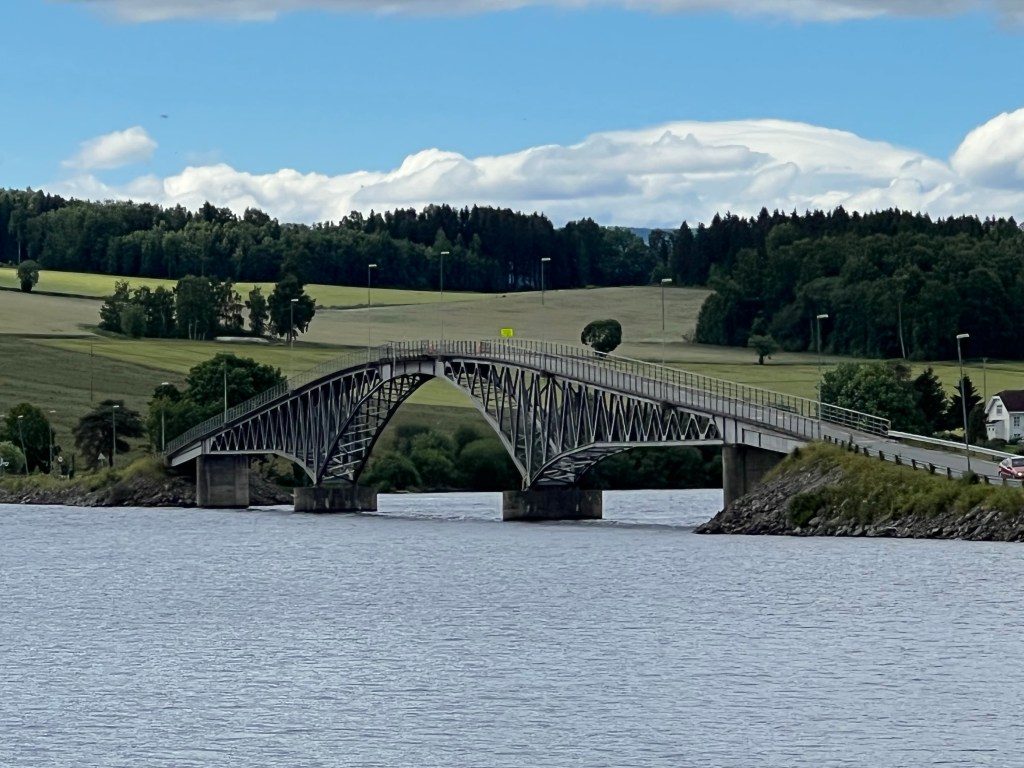
The bridge to Helgøya 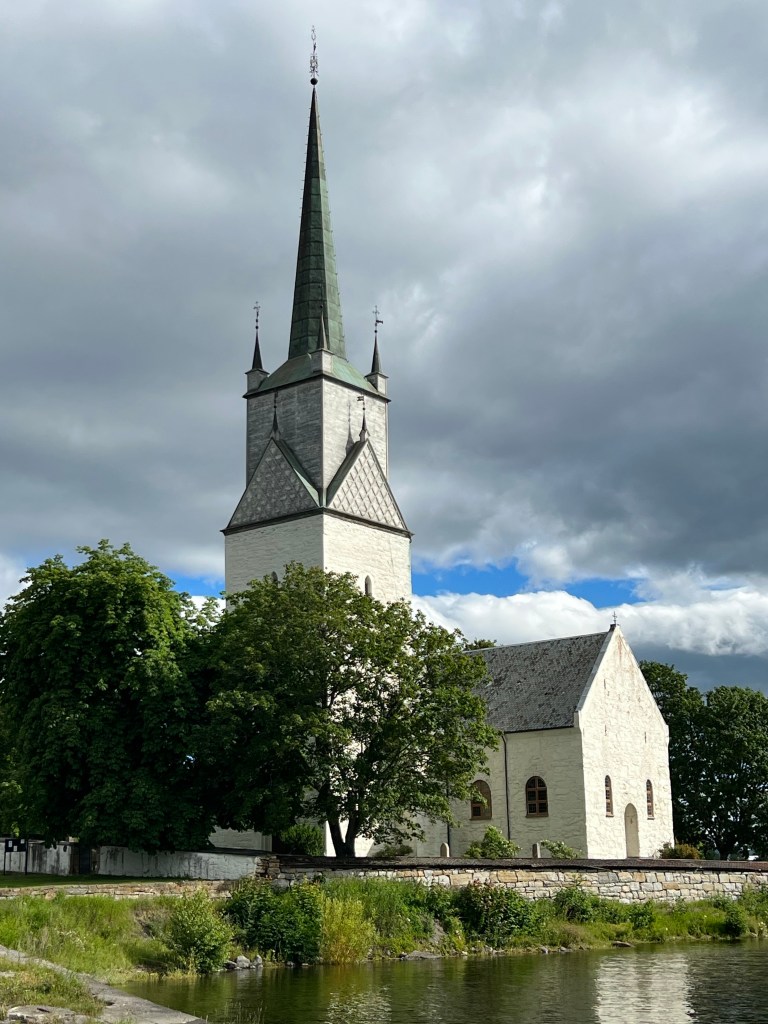
Nes Kirke I provide these details for any of the descendants of my Grandpa Bob who may be curious — as I was curious. But I want to be clear about my view on these matters: this may be “family history” but it isn’t my family history. Family isn’t biology; family is who you love and who loves you in return. Sometimes you hear people say “blood is thicker than water”. I disagree. For me, family is who I choose to have as part of my life, and DNA doesn’t have anything to do with that.
But I don’t shy away from discussing my grandpa’s paternity because (a) there’s nothing to be ashamed of, and (b) the generation that worked hard to keep this information locked away is now gone. A wise man once told me, “we’re only as sick as our secrets” and my life has shown me the truth of these words time and time again.
One of the most encouraging sights I saw during my time in Gjøvik was the symbol of one of my chosen families, the flag of the LGBT community, flying proudly in the plaza next to the town hall. It flew directly across from my hotel window and reminded me that we all belong to multiple families. The common denominator of all of our families is love.
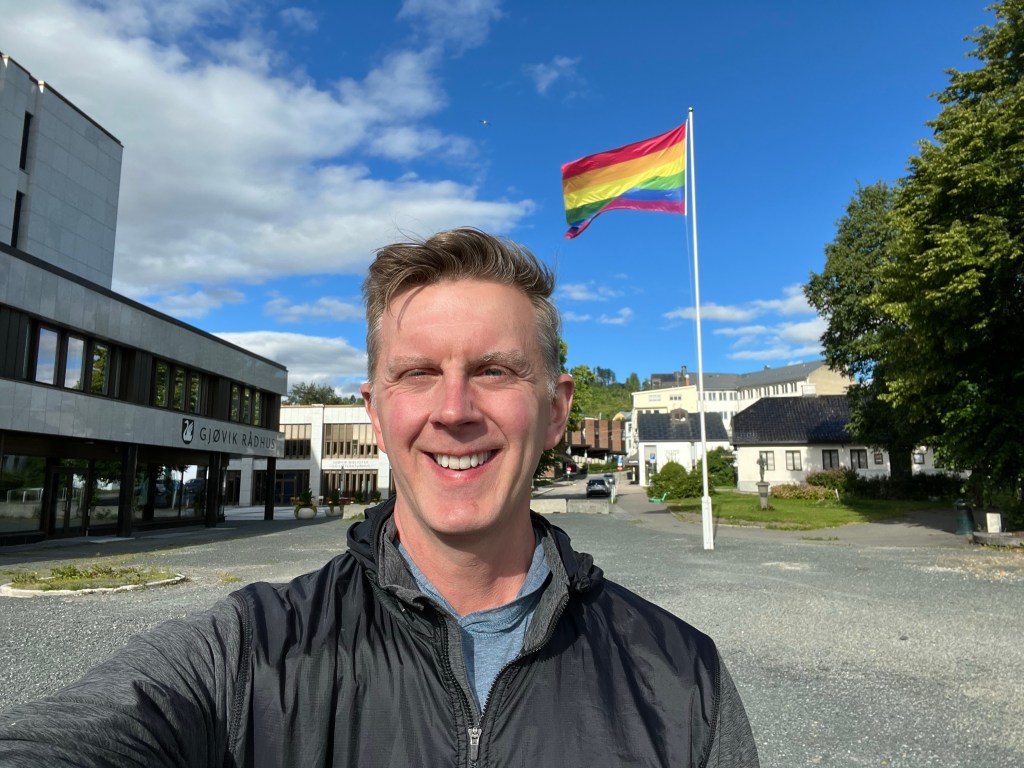
Gjøvik Rådhuset -
Meeting the Anderson-Lindalen family of Vardal
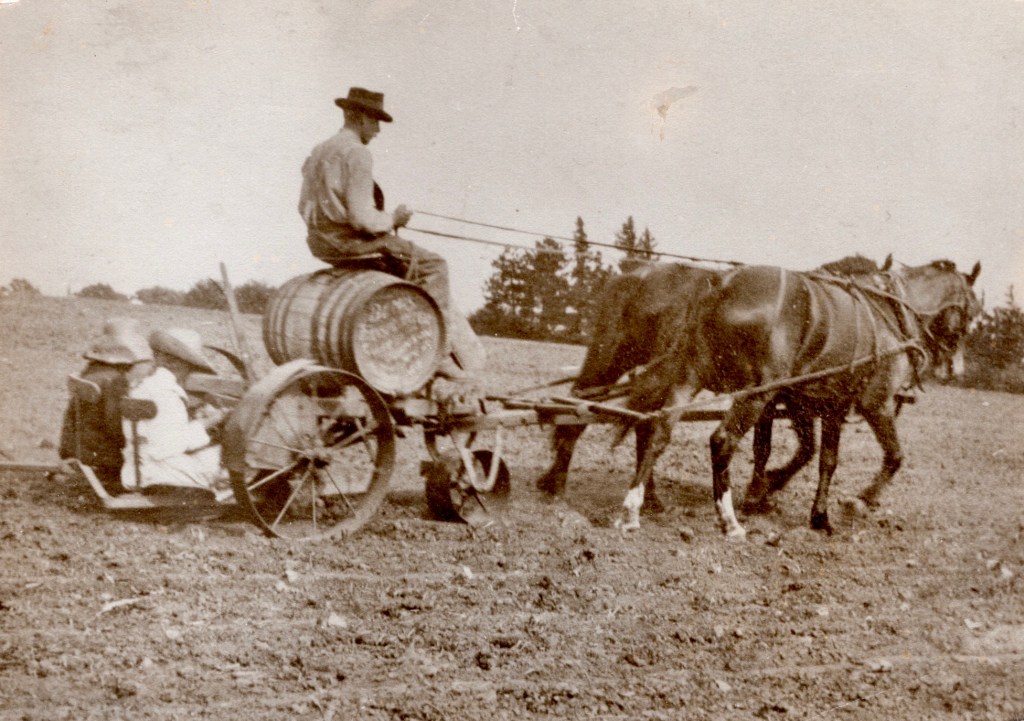
My great-grandma Elvina Anderson Smith’s father was born as Anton Andreasen Mustadeie on April 24, 1875 in Vardal, Norway to Elisa Christiansdatter (1838-1888) and Andreas Andersen (1834-1920).

Anton (Andreasen) Anderson – father of my great-grandma Elvina Anderson Smith I only have two photos of Grandpa Anton Anderson. The first is above – an enlargement of Anton from the photo I posted a few days ago (see this post). The second is below – Grandpa Anderson on his horse-drawn planter while his daughters Elvina and Nora plant tobacco. This photo was taken around 1908 when the Andersons were living on Rockdale Street in Cambridge, Wisconsin and working on local tobacco farms (here they were working on the Knud Henderson farm).
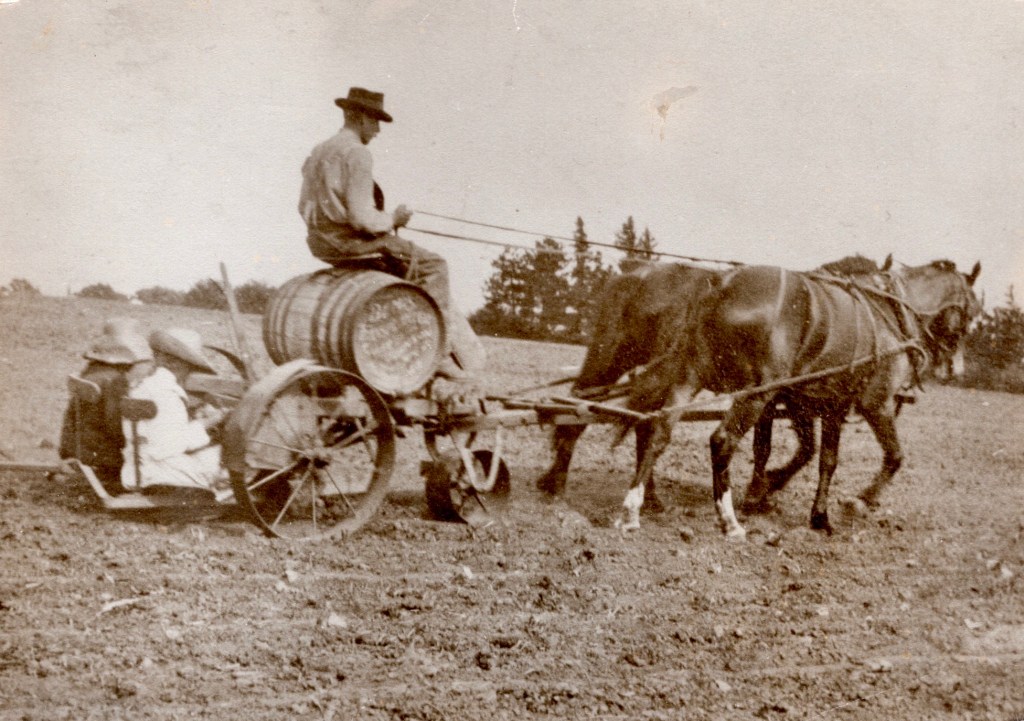
Anton Anderson with daughters Elvina and Nora; Knud Henderson farm near Cambridge, WI – about 1908 Anton and his wife Marie undoubtedly met through their siblings – Hans (Anton’s brother) and Berte (Marie’s sister) who had met and married in the US after immigrating. Anton and Marie probably met shortly after Anton immigrated in 1893. Marie and her father Alf had immigrated in 1892, just before Hans and Berte’s wedding. Hans and Berte ended up moving to Jackson County, Wisconsin. And that’s where Anton and Marie married on April 24, 1898 (Anton’s 23rd birthday). But the next year Anton and Marie decided to settle in Dane County, where Marie’s father Alf and her siblings Ingeborg, Berndt “Tobias” and Anders were living.

Vardal – where Grandpa Anton Anderson was born – is now incorporated within Gjøvik, the largest community in the area, which is located on the west side of Lake Mjøsa in Oppland. Anton’s mother, Elisa Christiansdatter, was born exactly 37 years before her son – on April 24, 1838 – to Siri Engebretsdatter (1805-1881) and Christian Johannesen Sevalseie (1810-1881). The Seval farm where Elisa grew up is just west of where she and Andreas raised their family. Elisa was one of at least four children born to Siri and Christian. Anton’s father Andreas Andersen was born on May 5, 1834, the seventh of nine children of Marte Olsdatter (b. 1791) and Anders Hansen (b. 1787). Andreas’s family worked on the lower portion of the Hage farm (“under Hage”), also located in Vardal.
Unfortunately, little is known about either of Anton’s parents, but his father Andreas Andersen lived to a ripe old age and was a well regarded small farm operator in the area. If my reading of the local bygdebok is correct, Andreas delivered the mail in Vardal for a few years and, due to conditions there at the time (1840s-50s), he felt it necessary to carry a loaded pistol when he made his rounds. In his later years, Andreas recounted a time when he was attacked on the road, but he managed to get away safely.[1]
Prior to Anton’s birth, Elisa and Andreas leased a homestead on the northern portion of the Snuggerud farm. Then for several years the family managed a section of the Mustad farm (where Anton was born) before finally moving to the Lindalen farm.* These multiple moves may indicate that Andreas and Elisa struggled to provide for their growing family. Indeed, Anton was the seventh of 10 children in total: Christian (1859), Anna Marie (1862), Syverina (1865), Hans (1867), Johanne (1870), Ole (1872), Anton (1875), Lina (1877), Mattias (1879) and Kristine (1884). The family church in those days was Vardal Kirke, built in 1801.
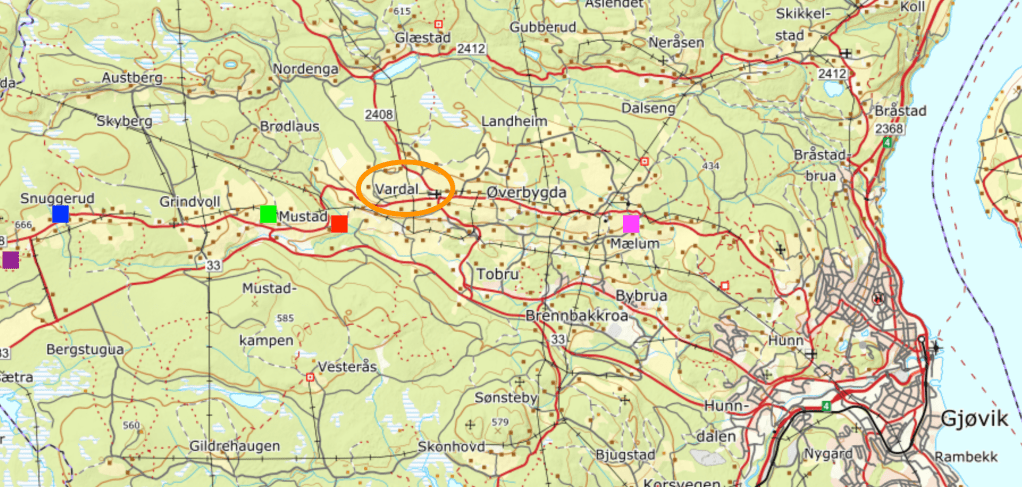
Family farms from west to east: Seval (purple), Snuggerud (blue), Mustad (green), Lindalen (red), and under Hage (pink); Vardal Church is circled 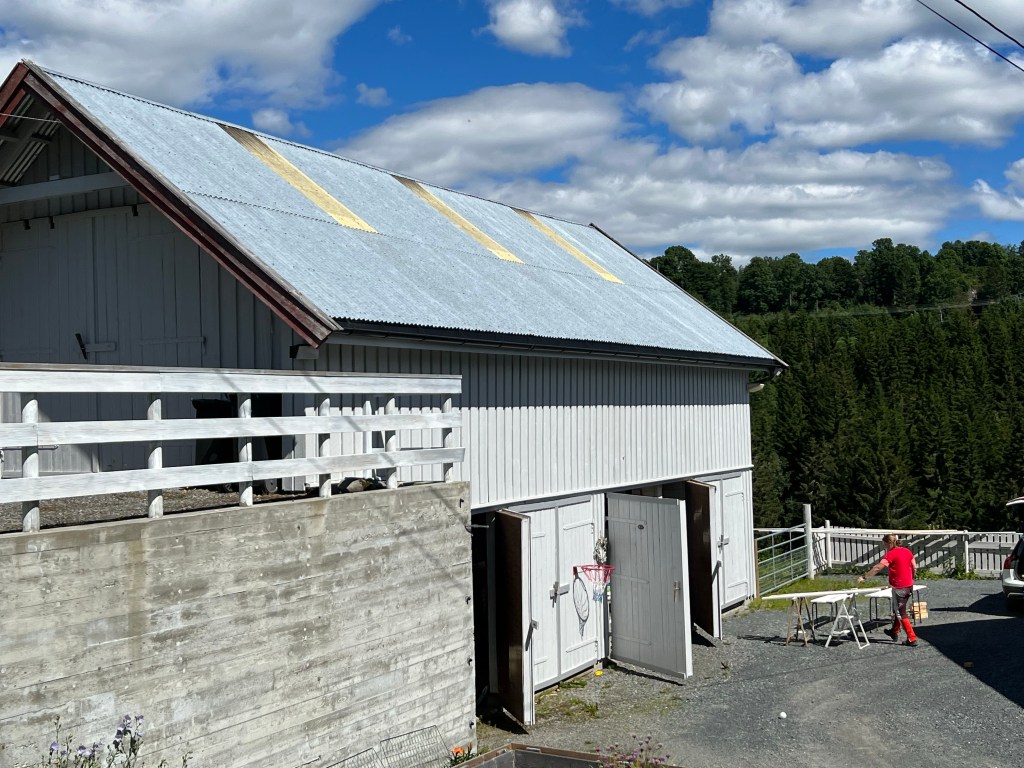
This is the Lindalen farm today. Interestingly, the current residents spoke about a skirmish with the Nazis that occurred here during Norway’s occupation. A large group of locals fled up the hill behind Lindalen and were shot at by the Germans. All but two survived. 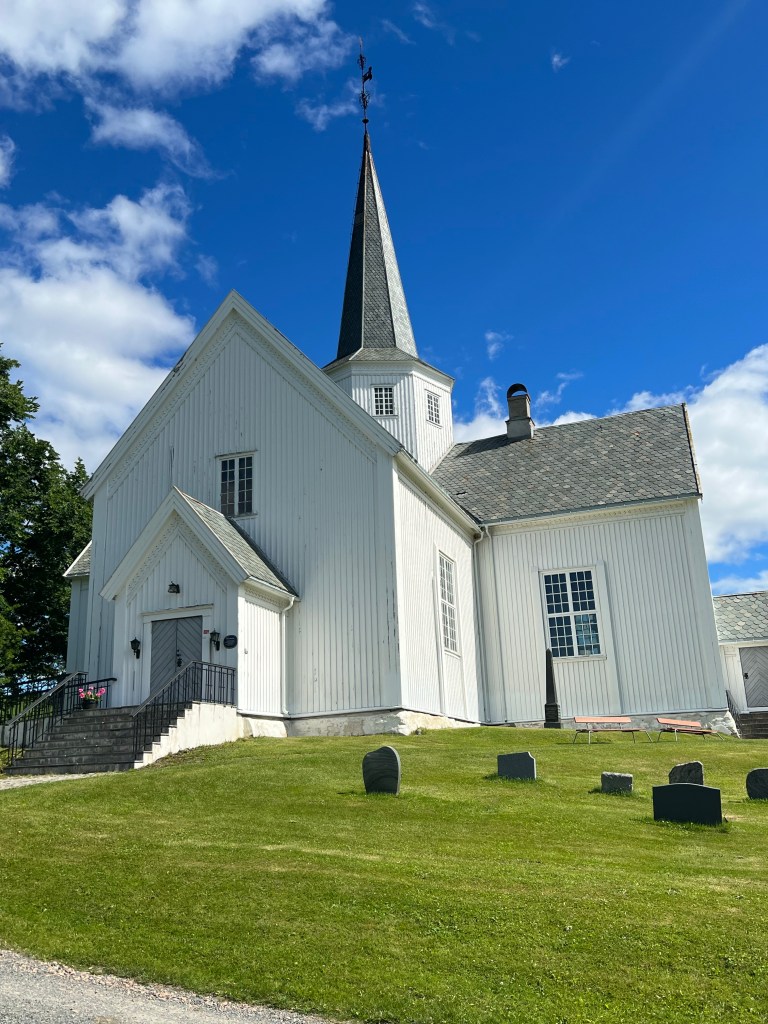
Vardal Kirke was used as a polling place in Norway’s first national election in 1814 — the one that elected the assembly that drafted the constitution at Eidsvoll (see the bottom of this post). As with his wife Marie’s family (see this post), Anton’s family experienced major changes in the 1880s. In the middle of that decade, at least two of Anton’s siblings – his brother Hans and his sister Syverina – emigrated to Wisconsin. And in 1888 Anton’s mother Elisa died. Anton was 13 at the time. After his mother’s death, Anton’s father Andreas married Gunhild Larsdatter Lybæk, whom Anton later recalled fondly as a good stepmother to him and his younger siblings.
Anton himself left for Wisconsin when he was just shy of his 18th birthday in March of 1893. Anton’s father, stepmother and other siblings stayed behind in Norway. Traveling on his own, Anton arrived by steamship into Halifax, Nova Scotia (by way of England), which was a common entry point for Norwegian immigrants at this time. From Halifax he journeyed by rail to Wisconsin, getting to Cambridge on the first of April. In his later years, he remembered being impressed by the endless wheat fields he saw from the train window.
In Wisconsin, Anton was reunited with his brother Hans, who was living in Cambridge at the time. Anton was first employed at the Torger Thompson Farm in Utica, which became part of the University of Wisconsin Farms. It is probable that around this time Hans and Anton decided to take the last name Anderson.**
Later, another of Anton’s sisters, Lina, joined her siblings Syverina and Hans in northern Wisconsin and started a family there. As far as I know, the rest of the siblings either died young or remained in Norway.
Among those who stayed was the youngest child, Kristine, who married Olaus Olsen Presterudgjerdet. Olaus took Kristine’s last name Lindalen and they raised seven children on their farm.

Back row: Olga, Gudrun, Reidar, Klara and Thora
Front row: Ottar, Kristine, Olaus and AlfOne of those seven children was Ottar (bottom left in the photo above), who was the father of Willy Lindalen and the paternal grandfather of Gry Lindalen.
Gry is famous in our family. She first came to the US in the summer of 1992 and visited the family in Wisconsin, and then she came back in 1994-95 to work as an au pair in Milwaukee. She bonded with our branch of the family and became especially close with my great-aunt Shirley and Shirley’s children. She has since been back to the States several times. Somehow, however, Gry and I had always missed one another. We’d never met. Until now!

Meeting Gry for the first time in Gjøvik on Friday Gry and I met for lunch on Friday as soon as I arrived into town, and it was like we had known each other for years. We hit it off immediately. She took me out to lunch and then we walked down the street and she treated me to Gjøvik’s finest chocolates. What a welcome! Before I went back to my hotel, Gry and I made a plan to meet up on Sunday at 11 am. Little did I know then what kind of a day lay ahead of me.
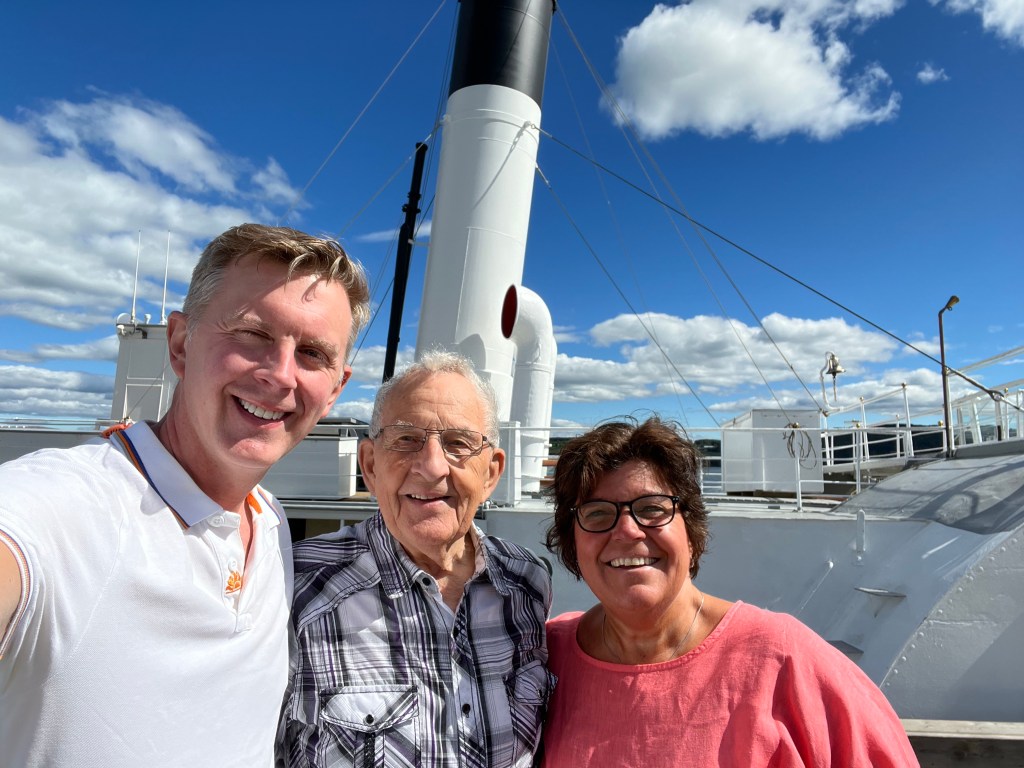
At the Skibladner, Norway’s only paddle steamer When Gry and her father Willy picked me up on Sunday, our first stop was the “white swan of Mjøsa”, the Skibladner. This paddle steamer first set sail in 1856, and it has been going more or less continuously ever since. At the moment it’s undergoing repairs, but it typically cruises around Lake Mjøsa in the summer. These days it’s used for tourism and not serious transportation, but we can imagine that our ancestors might have actually used this ship if they ever needed to cross from Gjøvik to Hamar in the east.
Our next stop was the Gjøvik Cemetery, where we visited the graves of Willy’s parents, Selma and Ottar Lindalen.

After this we headed west — into the Vardal farmlands where our ancestors have lived for hundreds of years.
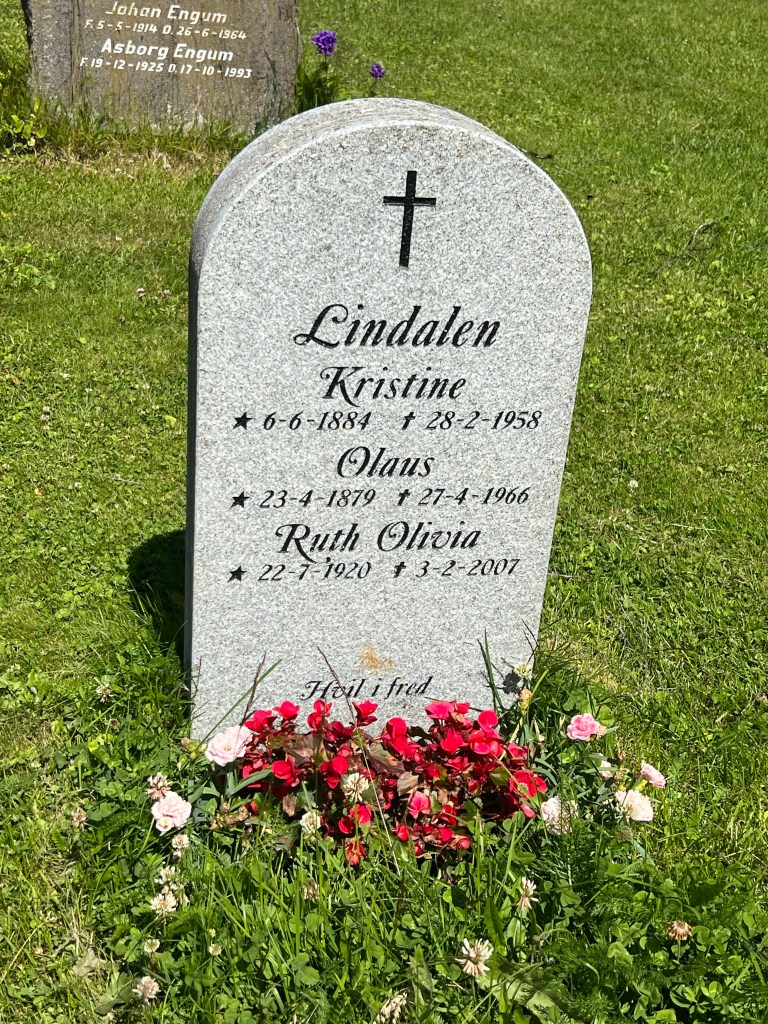
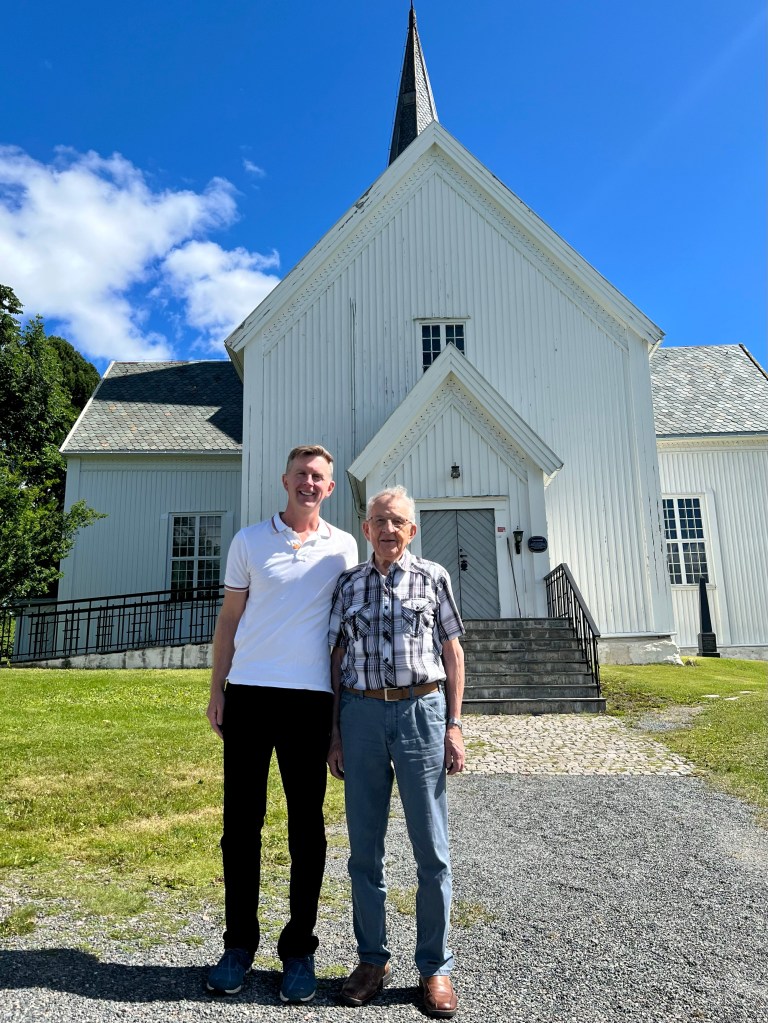
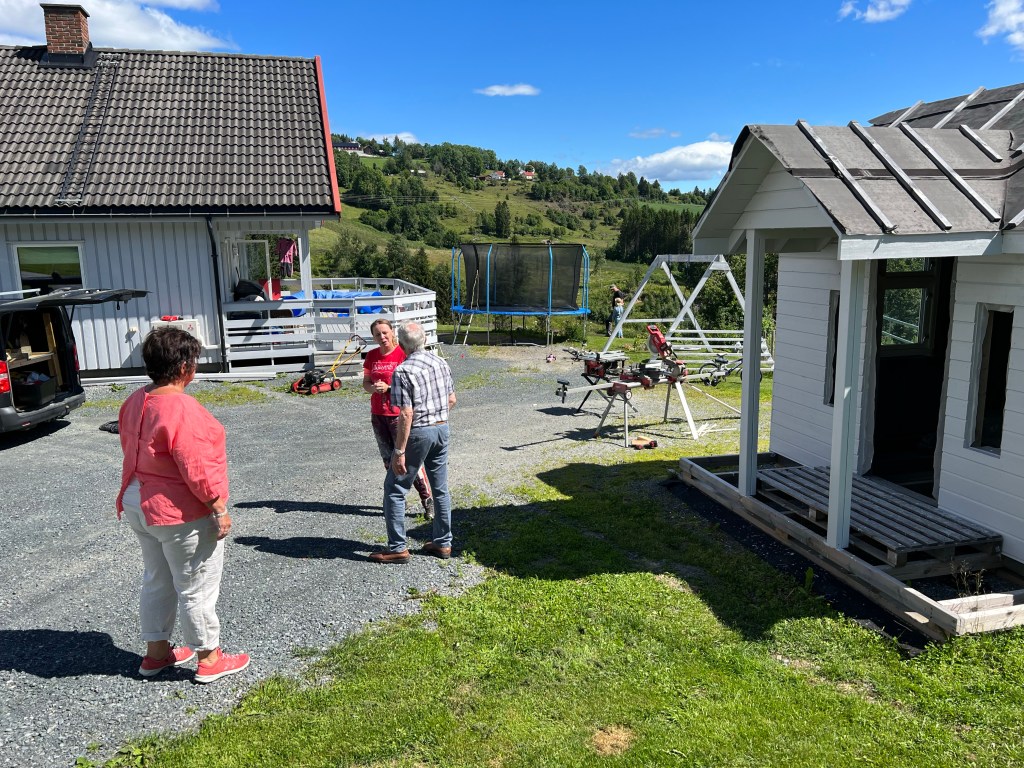
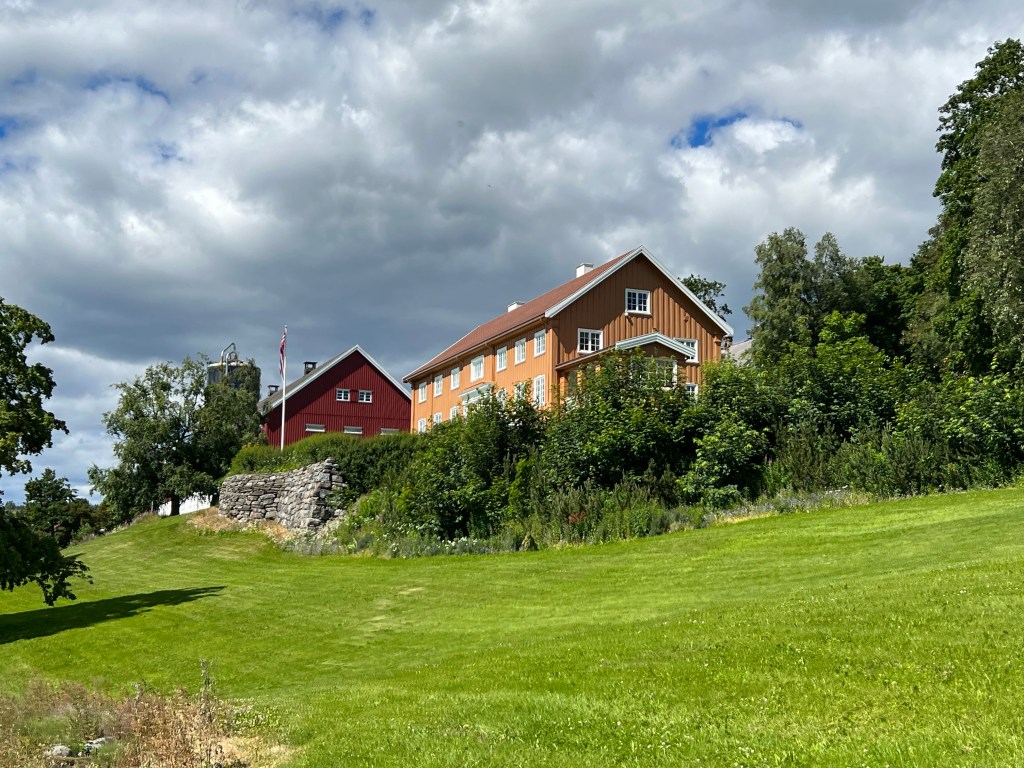
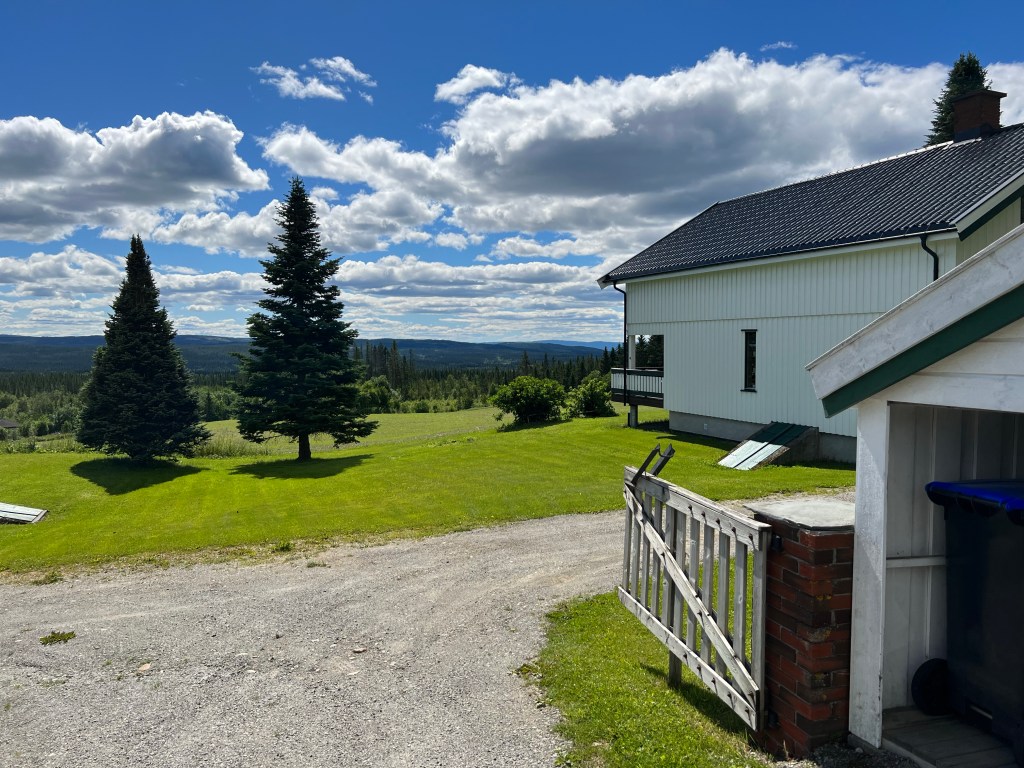
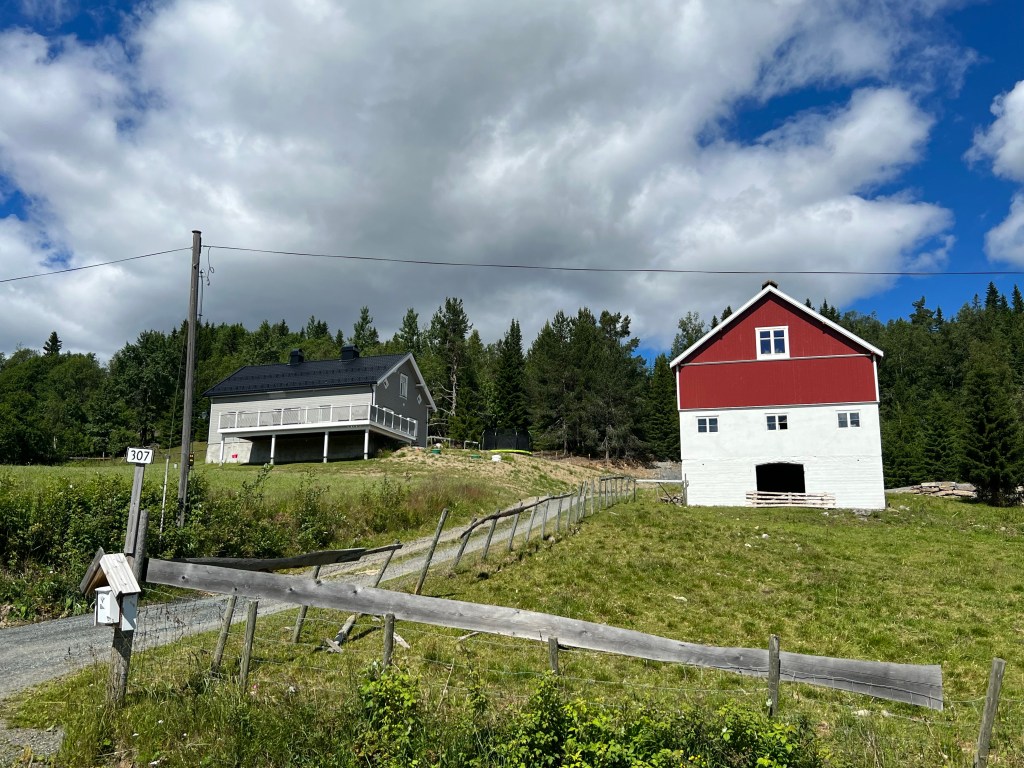
Our visit to Vardal Kirke, the Lindalen Farm, and views of other family farms: Mustad, Barlund / Seval, and Skyberg Our final stop was Willy and Helene’s lovely home in the hilly countryside northwest of Gjøvik. There a large number of Lindalen family members had gathered to meet me and have dinner together. It was overwhelming (in a good way!) to meet so many members of the family. They all spoke so highly of my great-aunt Shirley, and how good it was that she had kept in touch over the years. They’ve cherished her cards and letters. (If any of Aunt Shirley’s immediate family are reading this, will you please let her know that dozens of family members over here still think of her often?)
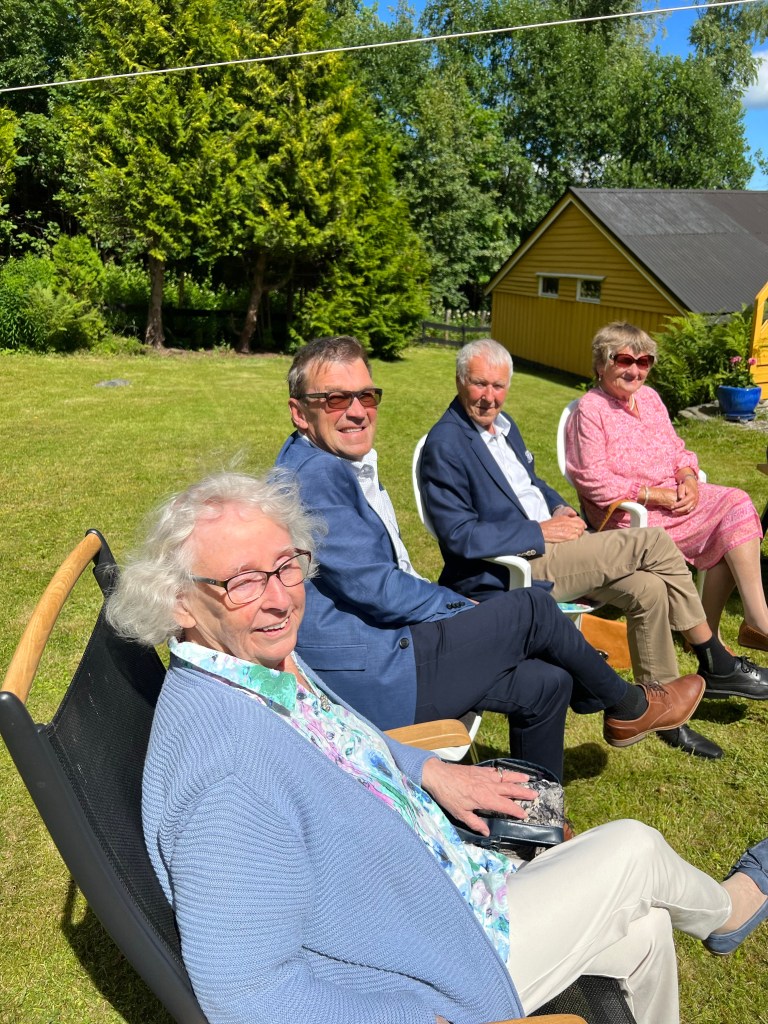

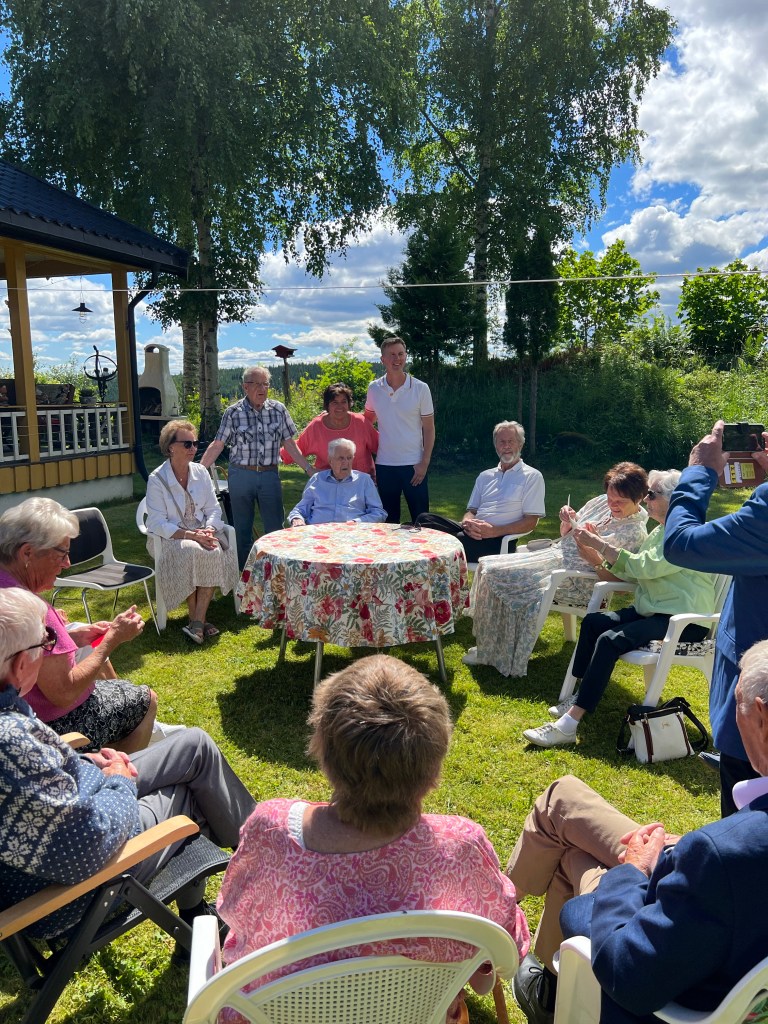
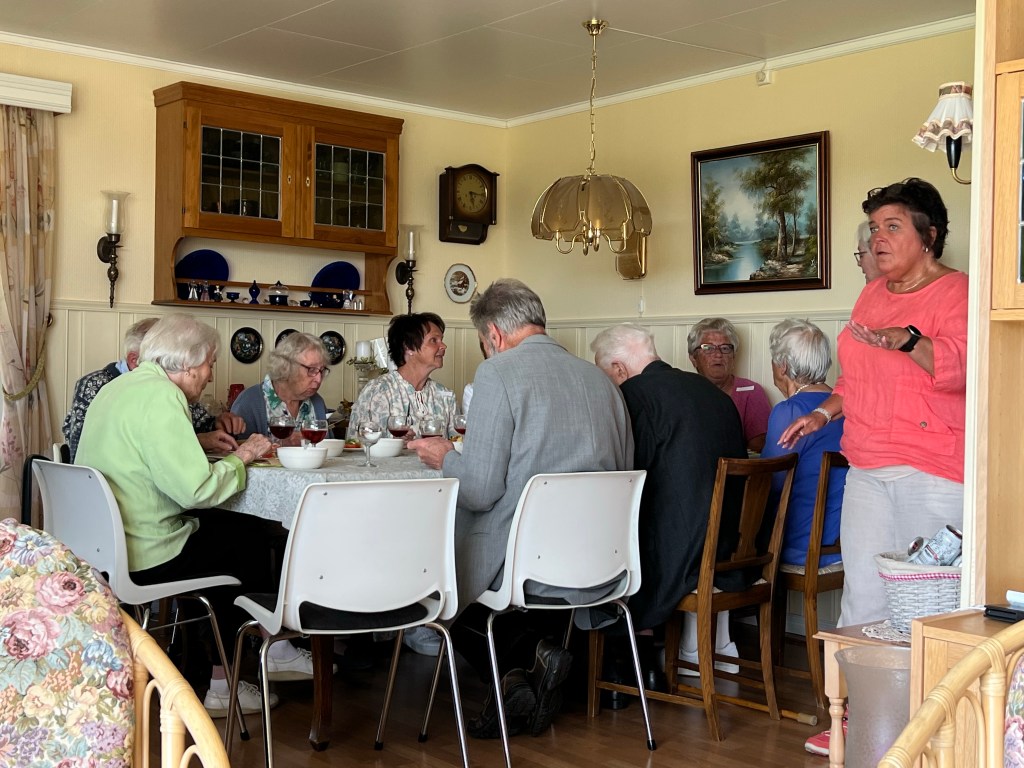


A large gathering of Lindalens! (Descendants of Kristine and Olaus Lindalen) Helene served a multi-course dinner that included rømmegrøt (sour cream porridge), mashed potatoes, eggs, spekkemat (cured meats), salads, fruits, flatbreads and cheeses. It was… heavenly.
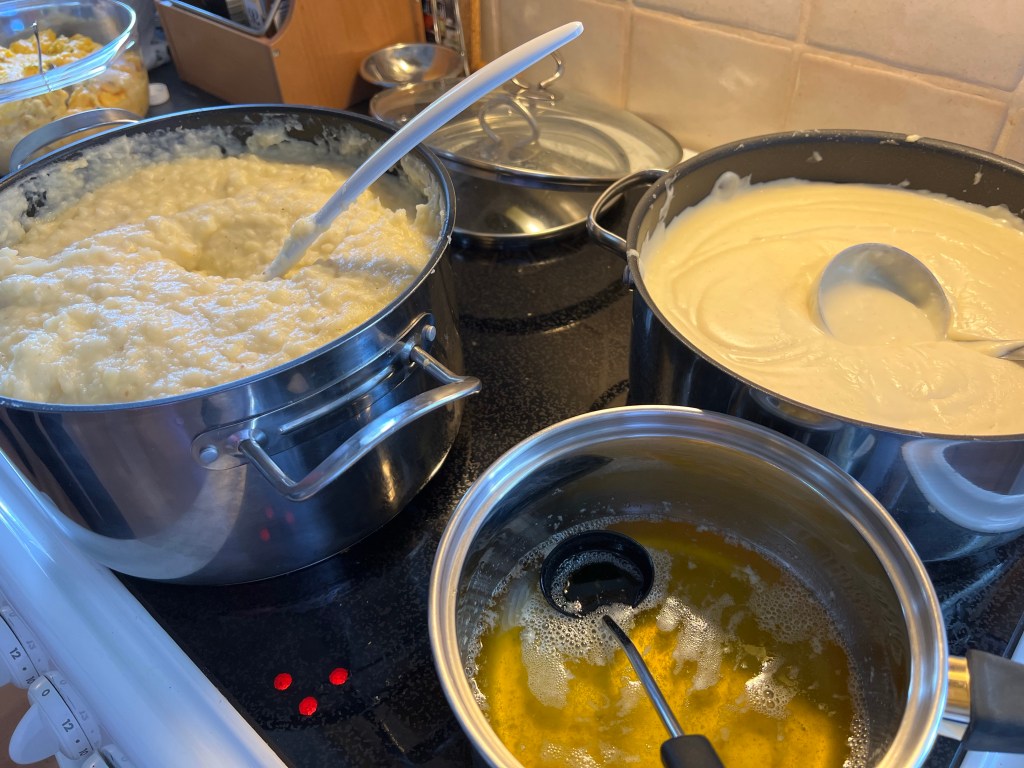
The creamy mixture on the right is rømmegrøt, which is a decadent porridge of sour cream, whole milk, wheat flour, butter, salt, sour cream, butter and sour cream. And butter. And more sour cream. And then you add your own melted butter and top it off with sugar and cinnamon, of course! Afterwards you wash it down with juice (and insulin!). I actually tried my first rømmegrøt when I visited Hovden (in the mountains of northern Agder) but Helene’s homemade rømmegrøt was much better. I had to go back for a big second helping. 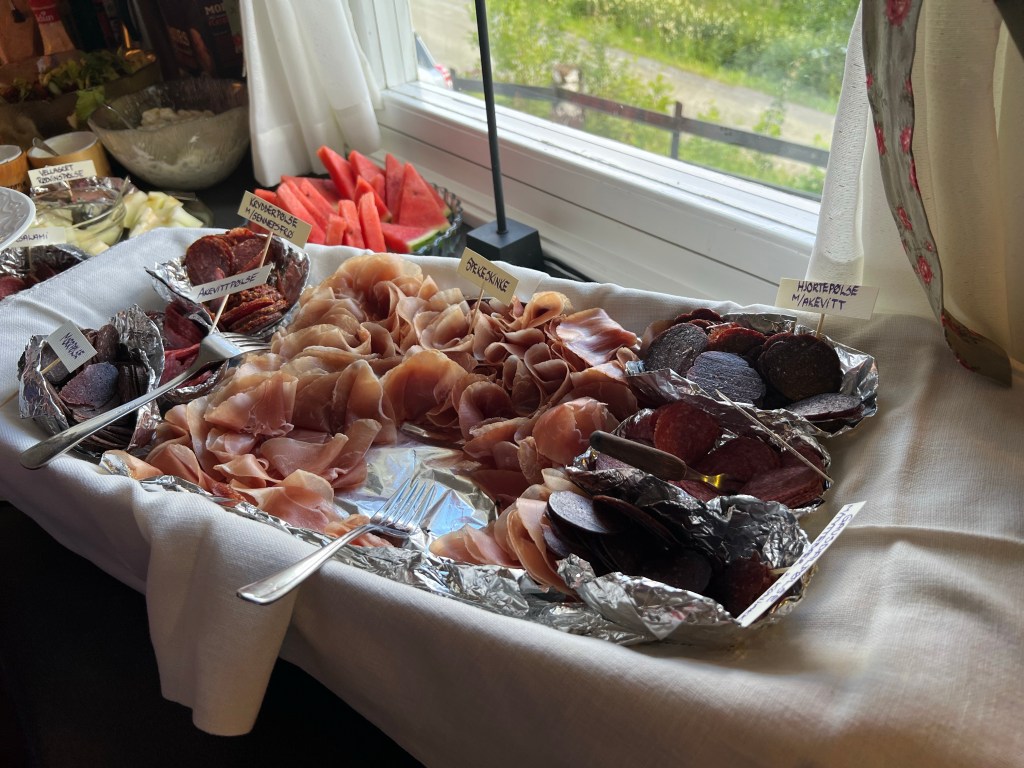
Multiple forms of spekkemat — Norwegian charcuterie. It was all excellent, but I especially liked the venison sausage. 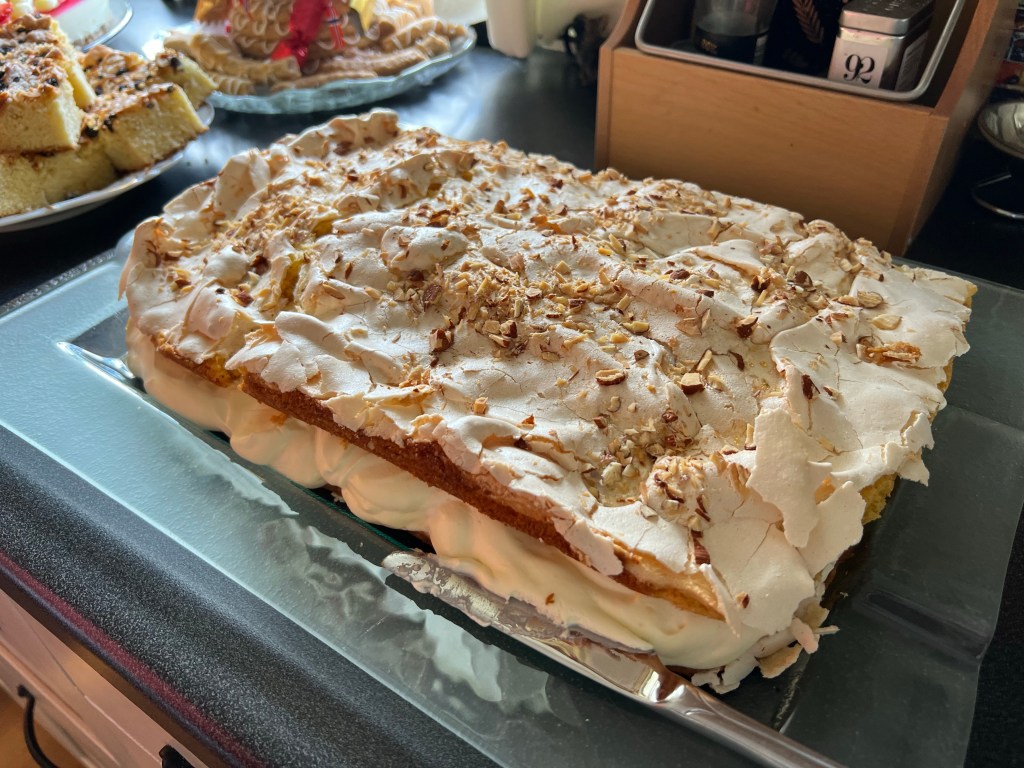
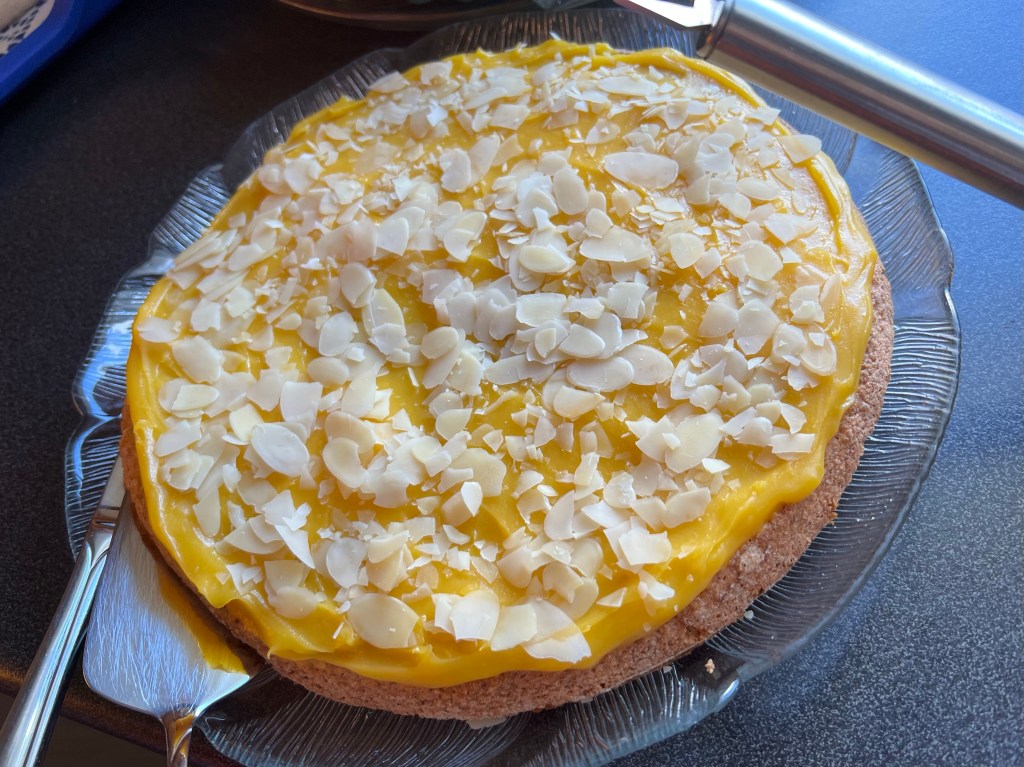
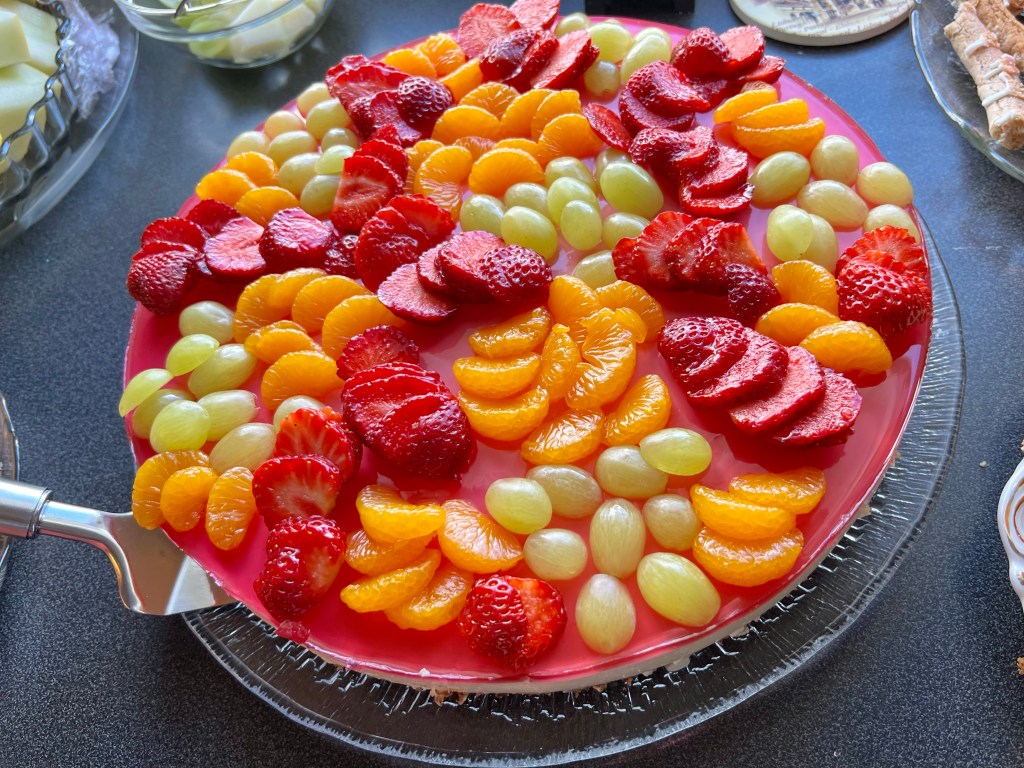
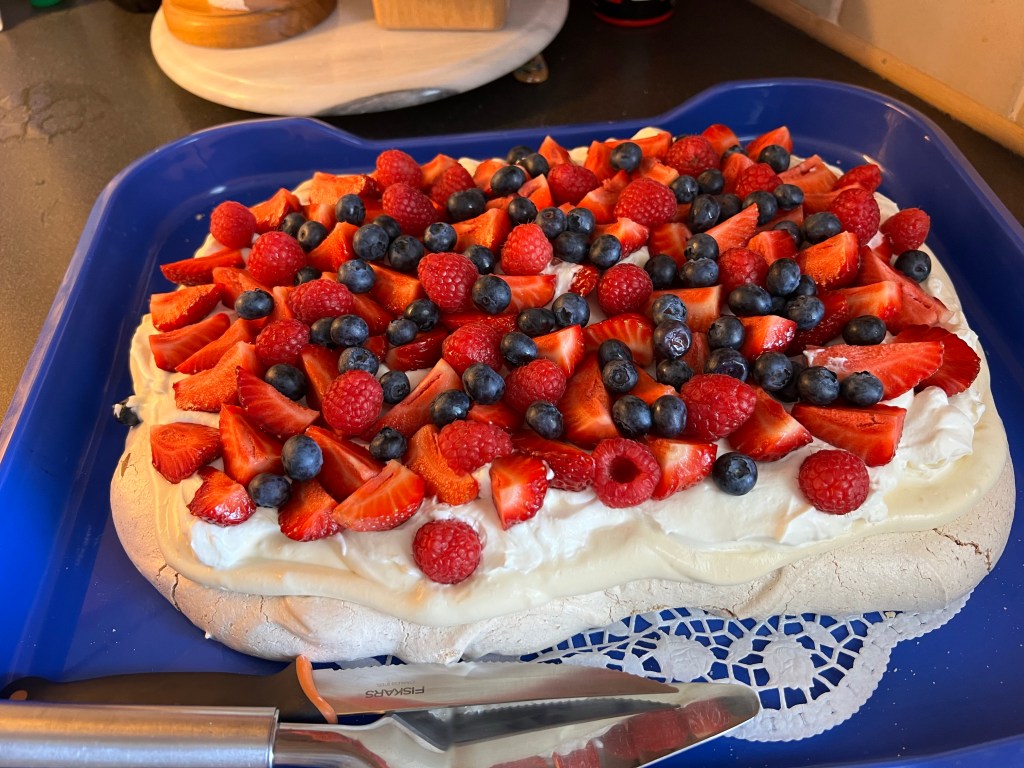
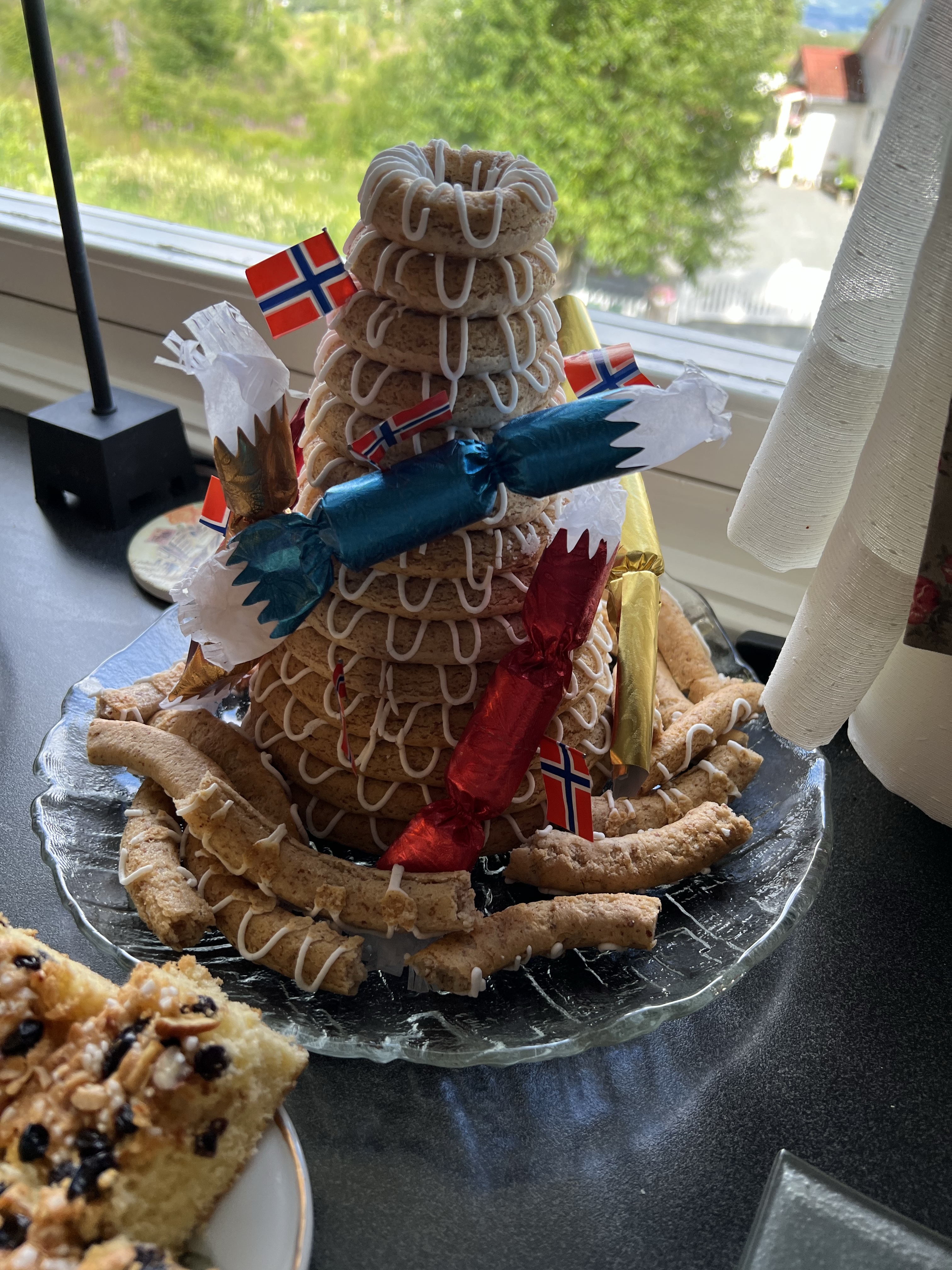

Somehow I saved room for dessert. Many of the attendees of Sunday’s gathering contributed traditional Norwegian desserts. But my Australian husband would have been impressed by the pavlova (which has its origins Down Under)! One of the best parts of this amazing day was having the opportunity to chat with my great-grandma Elvina’s first cousin, Reidar Lindalen, who is 97. Reidar is the youngest child of Olaus and Kristine (Anton’s youngest sister). He spoke about the old days, and how his mother didn’t know her older siblings who had moved to America because at least two of them (Syverine and Hans) had moved there before she was born. Reidar also had several funny stories about his years as a bus driver. My favorite was the one about the bus load of American visitors who he drove to a local hotel. In anticipation of their arrival, the hotel manager had organized a big dance party for these Americans, only to be informed by Reidar that they weren’t big partiers — it was a bus full of ministers!
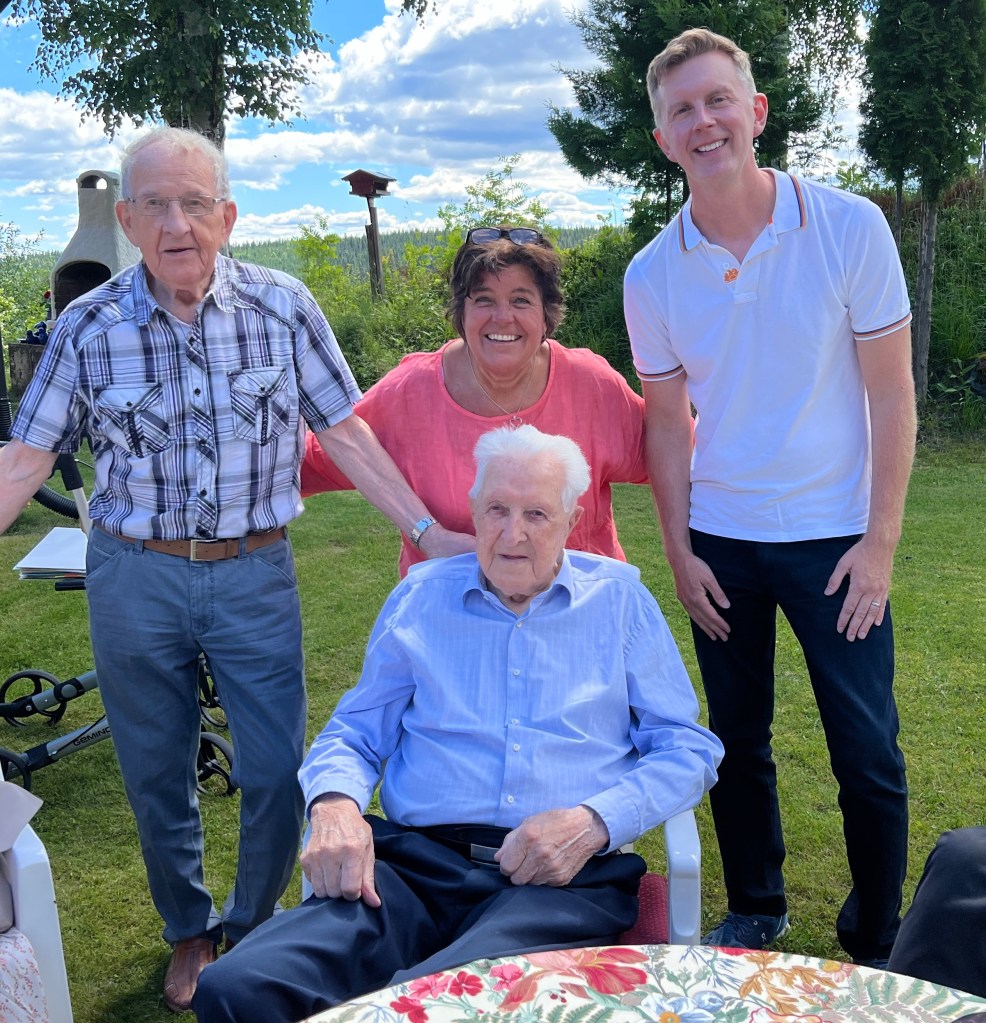
Willy, Gry, and me. And Reidar. 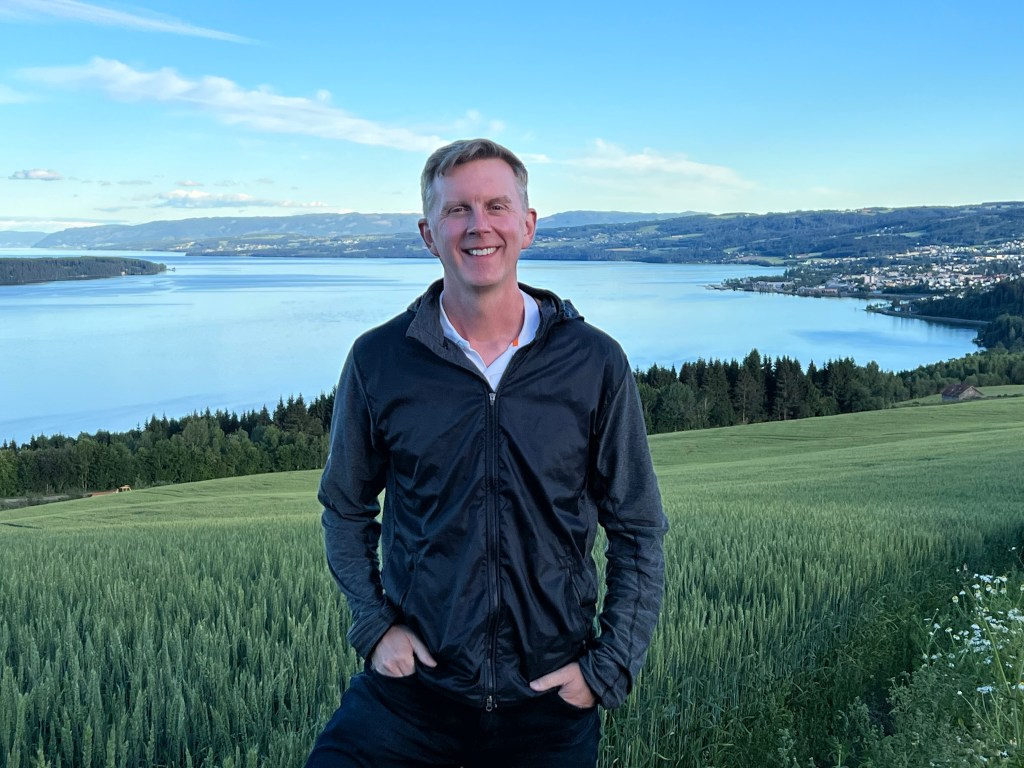
As Gry drove me back to the hotel on Sunday, she stopped for one of her favorite views of Mjøsa. Last night when I got back to town, Gry stopped by and we went out for a drink. As a parting gift, she gave me the one thing she knew I didn’t want to leave Norway without — a cheese knife (ostehøvel). And it’s not just any cheese knife but the prince of cheese knives. Thank you, Gry!
As I was leaving Gjøvik this morning (Tuesday), Gry came to the hotel to see me off. We both got a little teary-eyed. I told her this and I mean it sincerely: this isn’t “goodbye”, it’s “see you later”.

Vi sees senere! I’m currently writing these words on board a ship sailing between Denmark and Sweden, on my way to Kiel, Germany. And as I’ve been watching Norway retreat into the distance this evening, I keep thinking the same thing — “see you later!”
* I may have this wrong — it may be the case that the farm referred to as “Mustadeie” in the records (meaning owned by the Mustad farm) is one and the same as Lindalen. Still working on this one!
** Hans and Anton may have chosen “Anderson” because Andersen was their father’s patronym. Both men also became sons-in-law to Alf Andersen Greibesland, who arrived with daughter Marie in 1892, and that may have had an influence. On top of this, their sister Syverina (who had immigrated to Jackson County, WI) had married a man named Anderson. Other siblings of Anton and Hans – particularly those who stayed in Norway – kept the Andreasen patronym and used the farm name Lindalen as their last name after Norway passed a law in 1923 requiring a set surname.
[1] This is based on information I found in books 2 and 3 of the Vardal bygdebok (1930). I believe the writers of that book were referring to the Andreas Andersen Lindalen who was our ancestor, but I will attempt to get confirmation on this.
-
The Hansons and Helgestads of Østre Toten

My dad’s paternal grandparents were Borghild Helgestad Rude (1904-1975) and John Rude (1900-1997). The photo below was taken in May of 1975 shortly after I was born and shortly before my great-grandma Borghild died. Grandma Borghild was so weakened by illness at the time this photo was taken that she asked Grandpa John to hold me.

May 1975; at the home of John and Borghild Rude south of Rockdale, Wisconsin 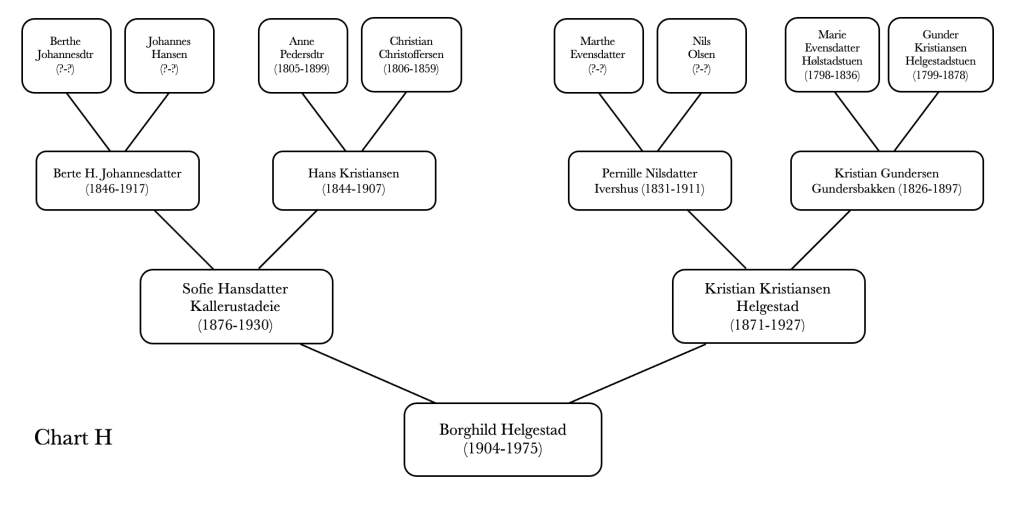
Direct ancestors of Borghild Helgestad – my paternal grandpa’s mother Grandma Borghild is the only one of my great-grandparents to have been born outside the U.S. Like her parents and her three older siblings, Borghild was born in the community of Østre Toten. She was baptised at Balke Church in July of 1904 at the time that her mother Sofie Hansdatter Kallerustad (1876-1930) was briefly living at a farm called Aurenhagen nedre (red square on the map below).
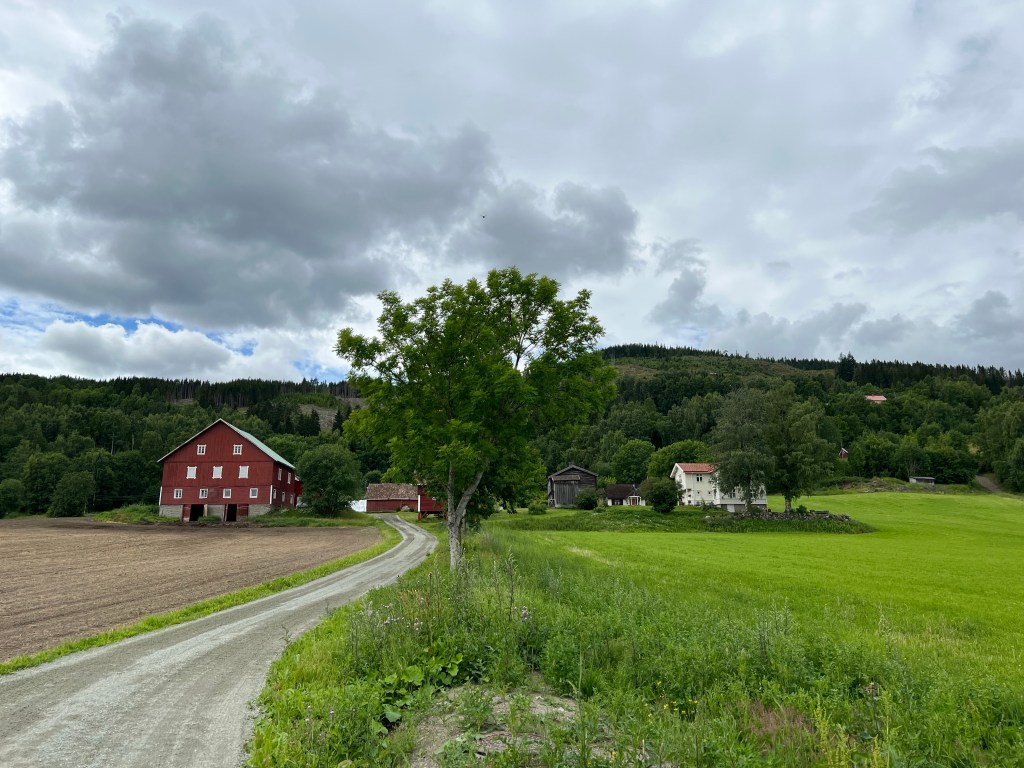
The Auren Farm, where Borghild Helgestad was born At the time of her baptism, Borghild’s father Kristian Kristiansen Helgestad (1871-1927) was working in Wisconsin and preparing for his family’s arrival in August of that year.

Østre Toten – location of family farms and churches During the late 1890s and early 1900s, the family had resided at several farms: Skramstad (1897), Øversveen (1900), Paulsrud (1901), and then Aurenhagen nedre (1904). Øvresveen and Paulsrud were part of a collection of farms called Vang (green square on the map above).
Before I left the area today, I stopped and spoke to the current owner of Vang. He showed me how to find Paulsrud, which is a tiny farm up on the hill overlooking the Vang Farm. I had to drive up a little dirt road and then walk a quarter mile through the woods. The house is now deserted.

The goats of Paulsrud!
I wouldn’t be a bit surprised if my ancestors Sophie and Kristian lived in this very house at the turn of the 20th century.The family of Borghild’s father Kristian lived and worked on one of the Helgestad farms called Gundersbakken (orange square on the map).
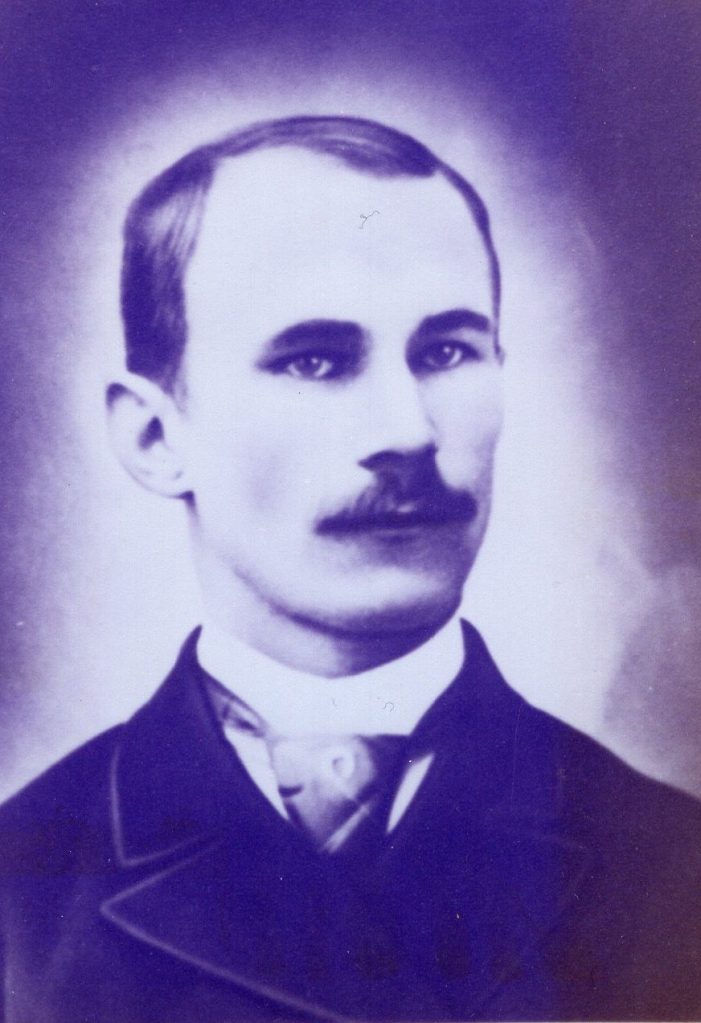
Charcoal drawing of Kristian Kristiansen Helgestad – father of my great-grandma Borghild Helgestad Rude 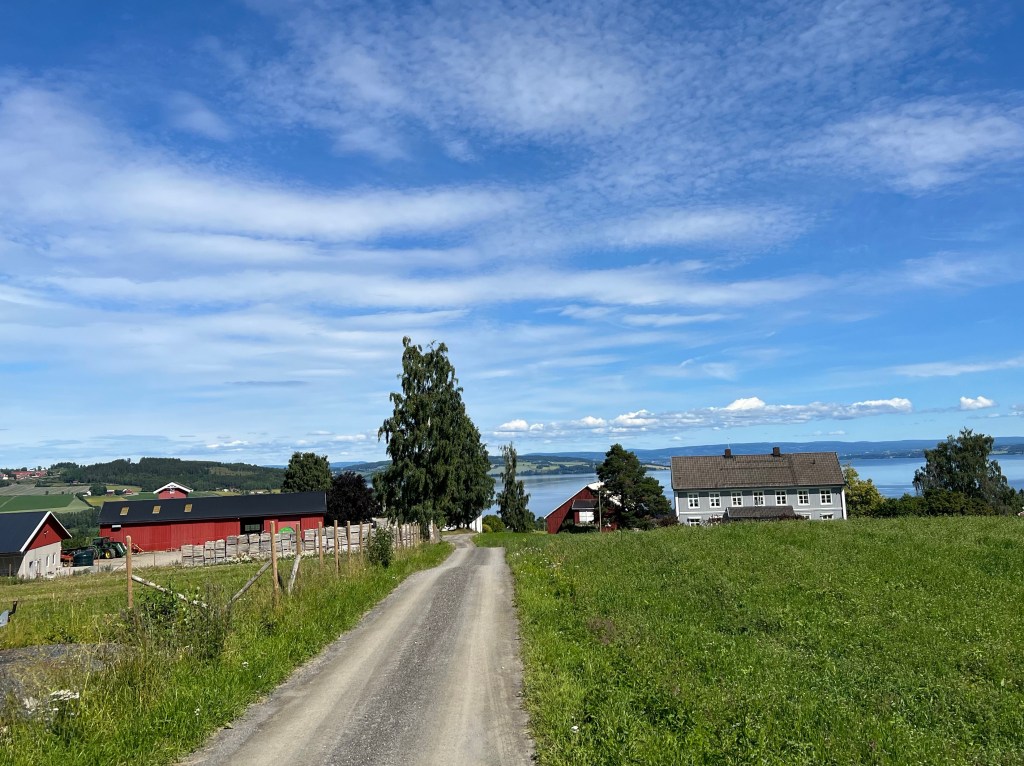
Helgestad Farm in Østre Toten 
Helgestad Lane Grandpa Kristian (1871-1927) was the youngest of six children born to Pernille Nilsdatter Ivershus (1831-1911) and Kristian Gundersen Gundersbakken (1826-1897). Their home, Helgestad, is a collection of farms to the east of the town of Skreia in Østre Toten.
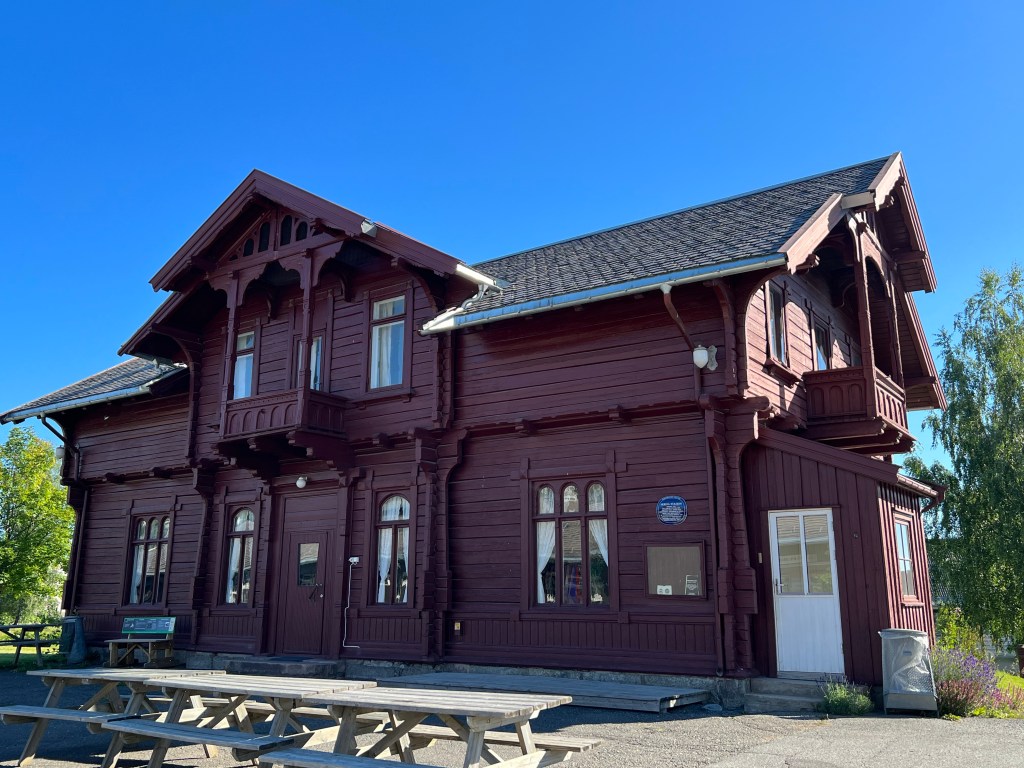
The old Skreia train station, built in 1902, is probably where Sofie and her four children began their journey to the US to join Kristian. There are actually three Helgestad Farms: Store Helgestad vestre (Big Helgestad west), Store Helgestad østre (Big Helgestad east) and Lille Helgestad (Small Helgestad). Gundersbakken was a sub-farm (bruk) of Store Helgestad vestre and lay opposite the bruk called Pederrudbakken. Grandpa Kristian’s father – Kristian Gundersen – also grew up on Gundersbakken. The farm was discontinued prior to 1930.[1]
Like his first four children, my great-great grandpa Kristian Kristiansen Helgestad was baptised at Balke Church (orange circle on the map). Balke Church was built in the Middle Ages – around 1170 – but had significant changes made in the early 18th century.
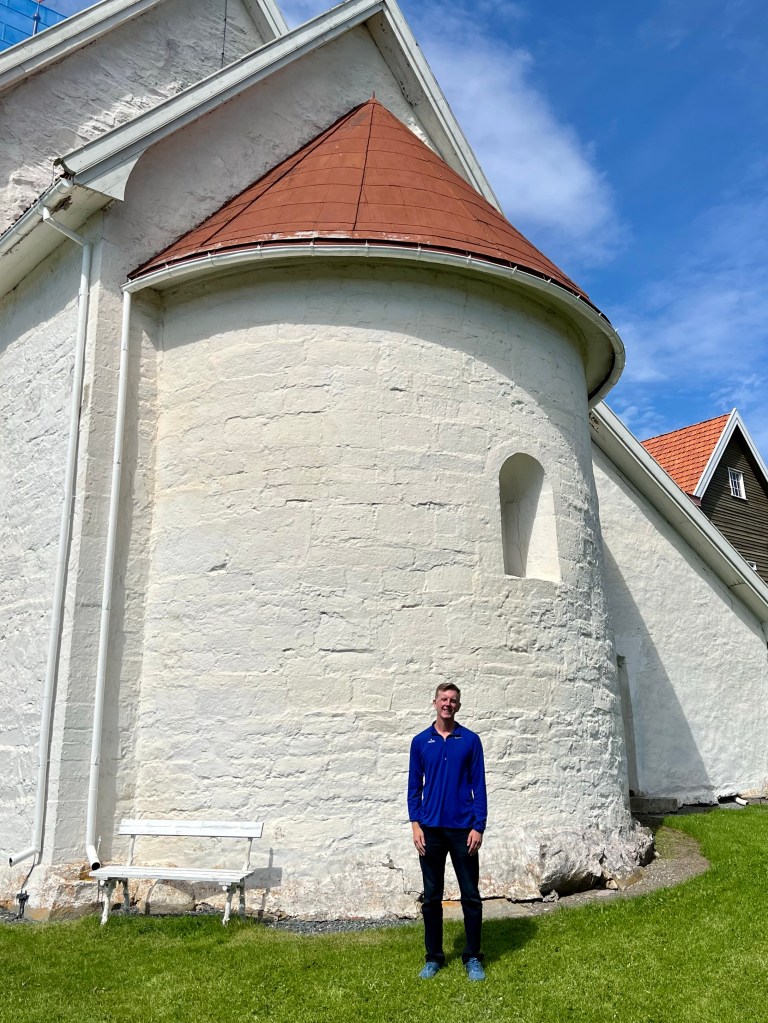
Balke Kirke My great-grandma Borghild’s mother Sofie was baptised at Hoff Church (blue circle on the map at the top of this post) when her parents were working the Kallerustad Farm (blue square).
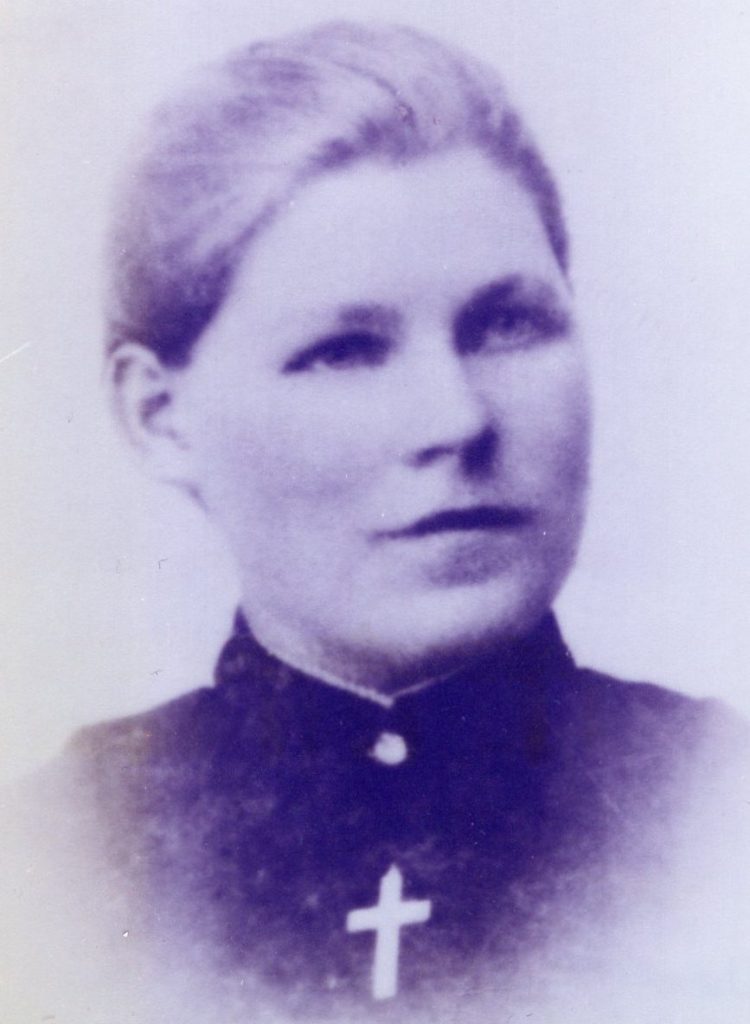
Photo of Sofie Hansdatter Kallerustad – mother of my great-grandma Borghild Helgestad Rude 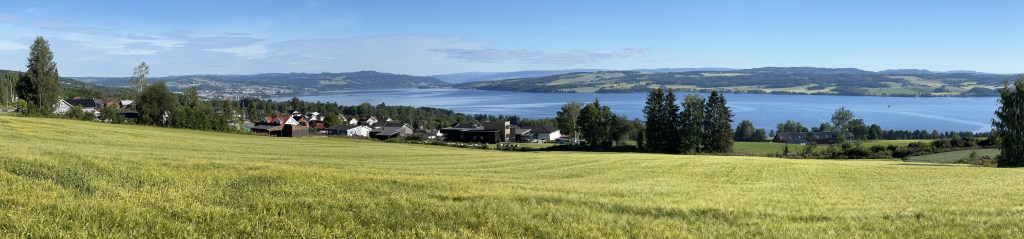
The view of Mjøsa from Kallerustad 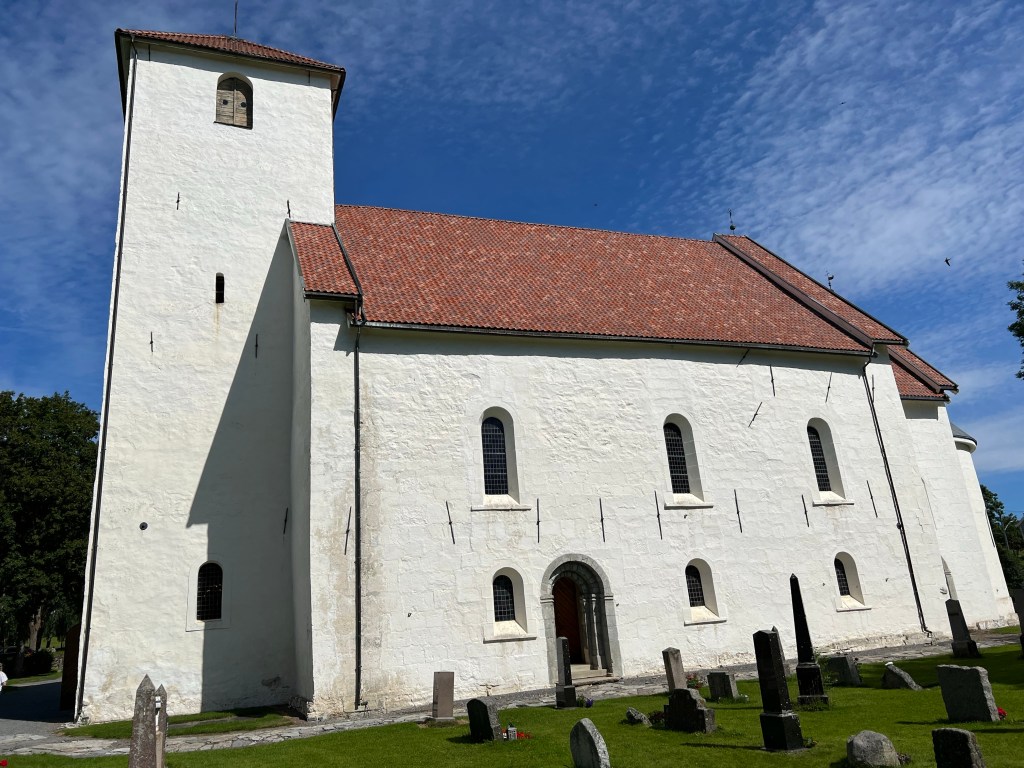


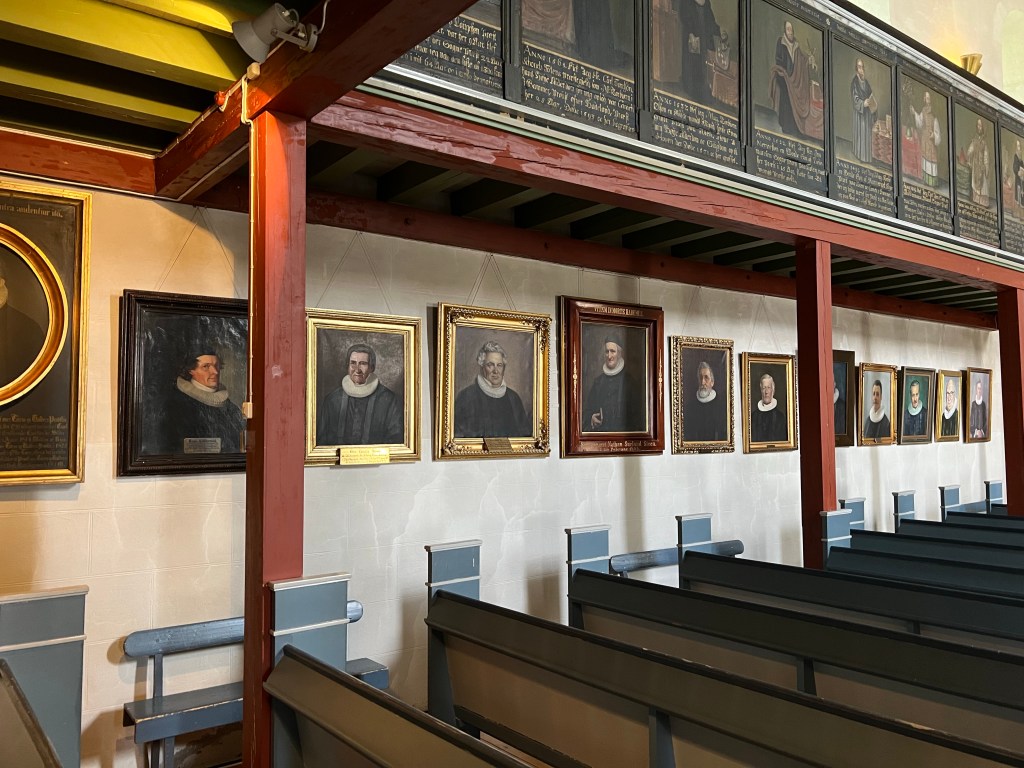
Images of the beautiful Hoff Kirke — consecrated circa 1150 Grandma Sofie was the fifth of nine children born to Berte Helene Johannesdatter (1846-1917) and Hans Kristiansen (1844-1907). By the time she left for Wisconsin, many of her aunts, uncles and cousins had already established themselves there. Her youngest sibling (and only brother) Hans Christian immigrated as well. Hans fought for the US in the First World War and lived in Milwaukee. He died in 1927 and is buried near his sister Sofie at East Koshkonong Cemetery south of Cambridge.*
To my knowledge, however, most of Sofie’s siblings stayed in Norway. One of the siblings who stayed was the eldest, Johanne Augusta (1867-1945), who married Martin Syversen (1855-1932). Johanne and Martin had eight children, including Helene Syversen Iversbakken (1901-1986).
My grandpa Bob Rude’s cousin, Judi Horn Winch, made contact with this branch of the family a few years ago and introduced me to Helene’s granddaughter (the daughter of Helene’s son Johan) — Hilde Iversbakken. Yesterday, Hilde and her family of four graciously welcomed me, my Aunt Cathe, and my cousin Bethany and her family to their home in Kapp. They served us a delicious lunch and gave us a wonderful family history tour of the area, with visits to Hoff Church, Totenvika Church, Balke Church, and several family farms. We also had the opportunity to meet Hilde’s charming mother Svanhild Iversbakken and Hilde’s brother and sister-in-law, Alf Helge and Ida Pauline Iversbakken, and their four delightful children.
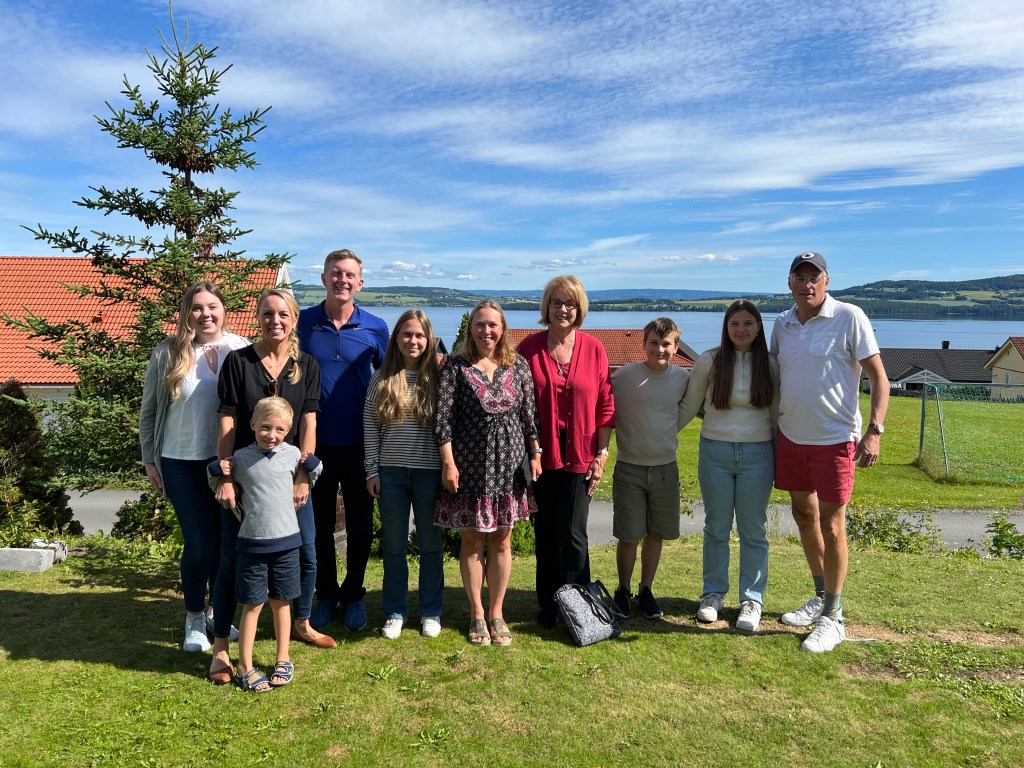
From left to right: Alexa Sparks (Bethany’s daughter), Bethany Lo Presti (my 1st cousin / Cathe’s daughter) and her son Xavier Lo Presti, me, Kathinka Hansen (Hilde’s daughter), Hilde Iversbakken, Cathe Engler (my aunt), Kristian Hansen (Hilde’s son), Josefine Hansen (Hilde’s daughter), and Jack Lo Presti (Bethany’s husband).
(Not pictured are Hilde’s daughter Mathilde who was in Italy and Mathilde’s boyfriend Raymond, who took this photo).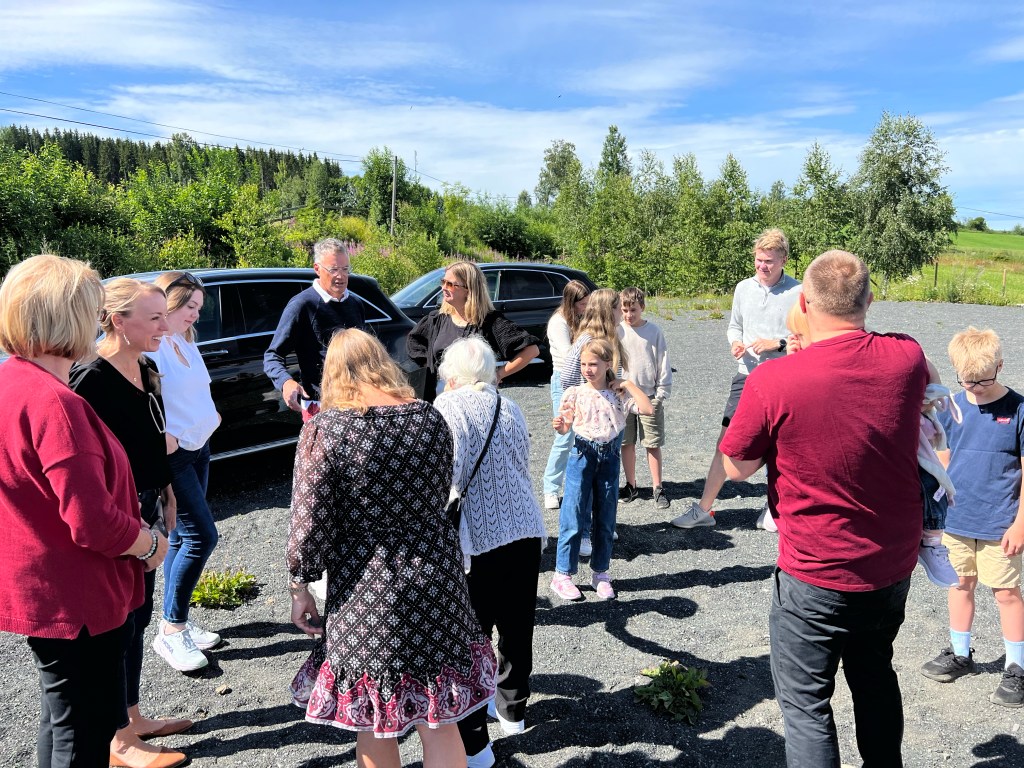
Meeting of Hilde’s family, her brother’s family, and our family at the Helgestad Farm 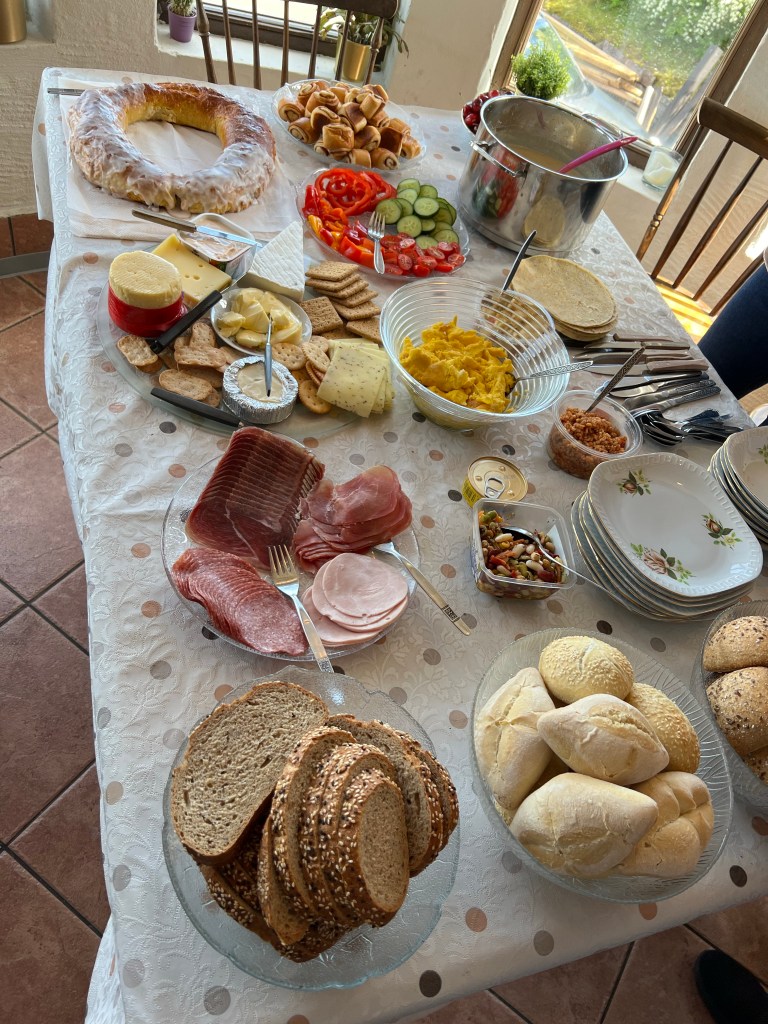
What a spread! It was so much fun to finally meet Hilde and her family after several months of messages back and forth. Now I’m looking forward to returning the favor and hosting our Norwegian family in the U.S. one day.
And I have to add that watching Bethany’s son Xavier playing with Hilde and Alf Helge’s children gave me hope that there will be another generation that will keep these family connections alive.
The next generation! From left: Ellinor Iversbakken, Josefine Hansen, Kathinka Hansen, Ebba Iversbakken, Kristian Hansen, Dagny Iversbakken, Xavier Lo Presti, and Johan Iversbakken 
Svanhild and Hilde Iversbakken at Svanhild’s beautifully furnished home in Sletta
* Because Hans took the last name Hanson in the US, I often refer to Sofie’s branch of the family as “the Hansons”. But surnames for the 9 siblings were all over the map. If you’d like to understand Norwegian naming conventions better, I highly recommend checking out this post by my friend (and professional genealogist) David Hovick Lohman: https://hovicklohmanhistory.wordpress.com/2021/03/07/norwegian-cultural-background/
[1] Information on Kristian and Sofie’s family farms comes from Ødegaard, Svein-Erik. 1984. Totenvika, p. 350 and 471.
-
The Rudes – an origin story
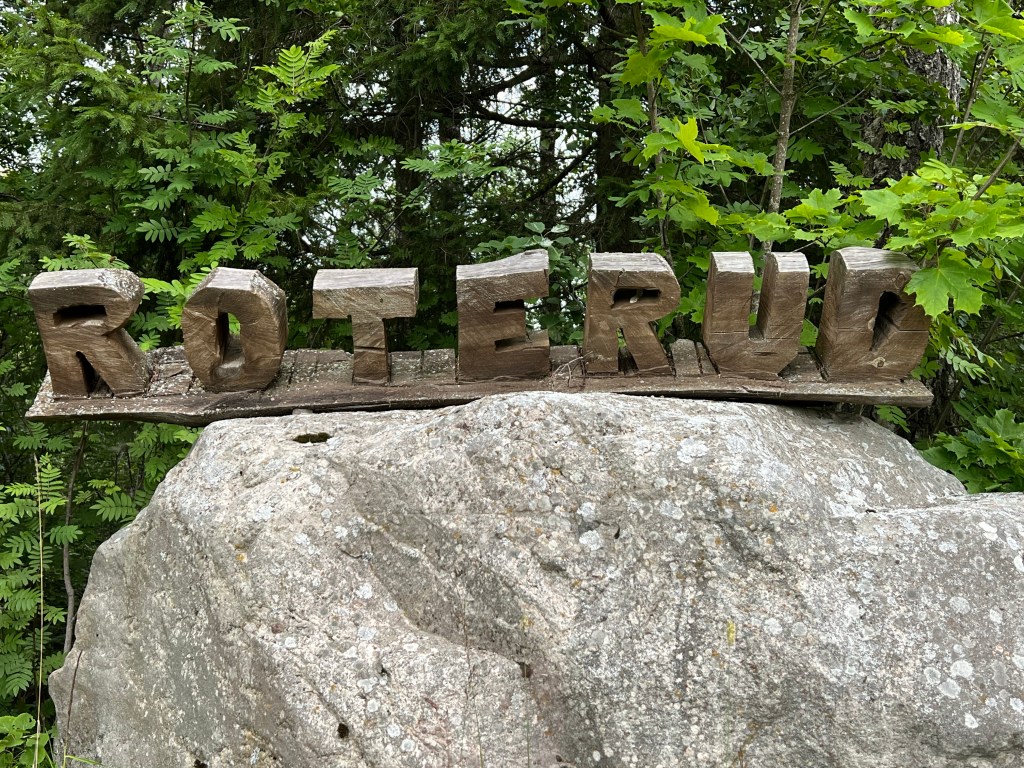
My dad’s paternal grandfather, John Rude (1900-1997), was born in the U.S. – but only barely. He was actually conceived in Norway and born in Wisconsin five months after his parents and older sister Anna arrived in Wisconsin from Olso by way of Liverpool, England and New York City.
Grandpa John’s parents were Ole Johannesen Rude (1874-1939) and Klara Hansdatter Bokrudstad (1876-1952), and they were both from the Ringsaker area on the north side of Lake Mjøsa in Hedmark. Ole had been working in the tobacco harvests in Wisconsin since 1896 and came back to Norway in 1899 to marry Klara and arrange for her and Anna to join him in Wisconsin.
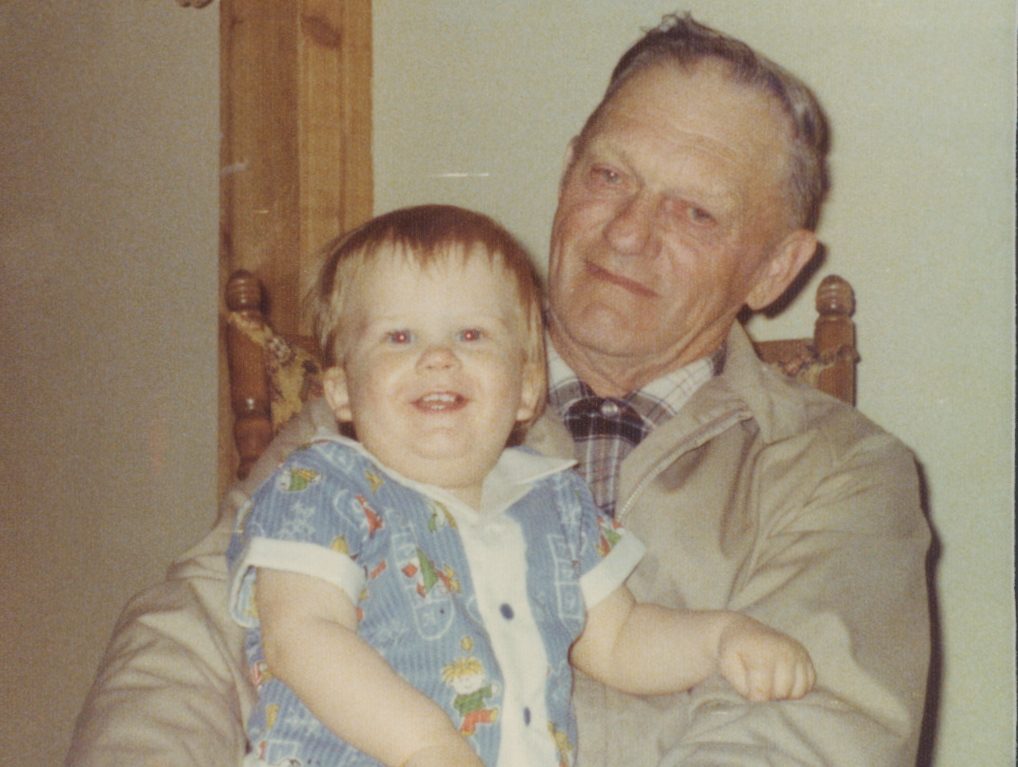
My great-grandpa John Rude and me, circa 1976, in Edgerton, Wisconsin The photo below was taken shortly before their departure from Oslo (then called Kristiania). Ole is standing at the left, with Klara and Anna seated. I’m not sure who the man with the bandaged arm is (at right). Perhaps Klara’s younger brother Nils? Or Ole’s younger brother Jørgen (who took over the Roterud farm)?
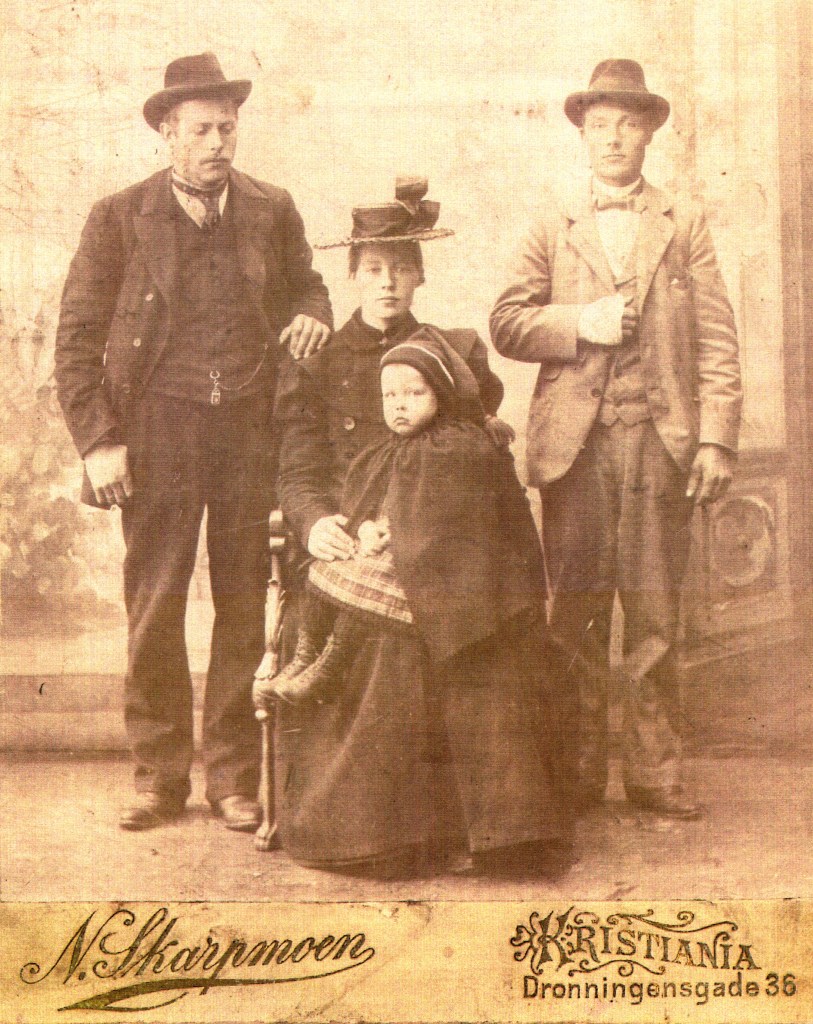
Ole, Klara, daughter Anna and unknown man in Oslo, 1900 When Ole was born, his family worked on the Sigstad Farm. In 1882, Ole’s father Johannes Christiansen (1843-1927) purchased Roterud, a farm located on the edge of the town of Byflaten. The family attended Veldre Church, which is only a couple of miles from the farm.
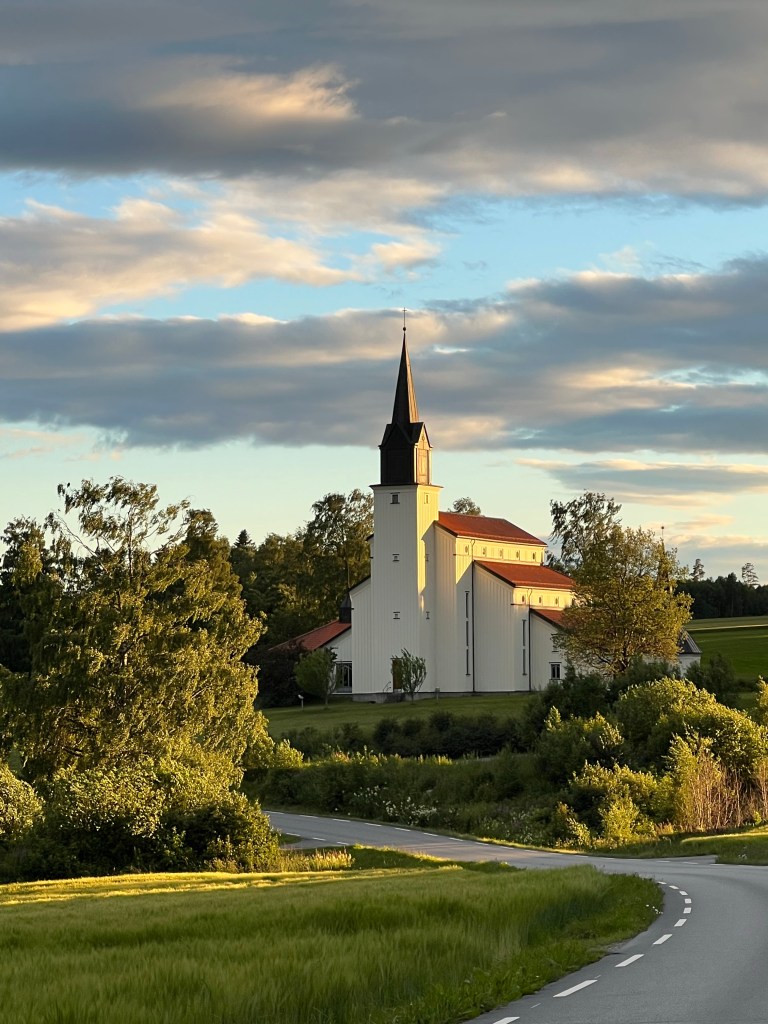
Veldre Kirke in Byflaten 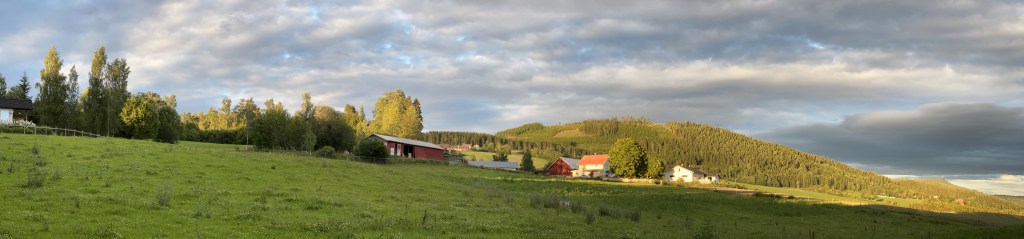
The Roterud Farm, near Byflaten. I spoke to one of the current residents, and it is very much still a working farm. 
The view of Lake Mjøsa from Roterud Ole’s father Johannes was originally from the Ellefsæterbakken farm. Ole’s mother Anne Olsdatter (1841-1933) was originally from the Kristensveen Farm, which is also in the Veldre area. Anne’s father Ole Andersen (1812-1894) was born on Grinieie Farm, and her mother Johanne Tollefsdatter (1810-1896) was from Altona Farm near Lismarka.[1]
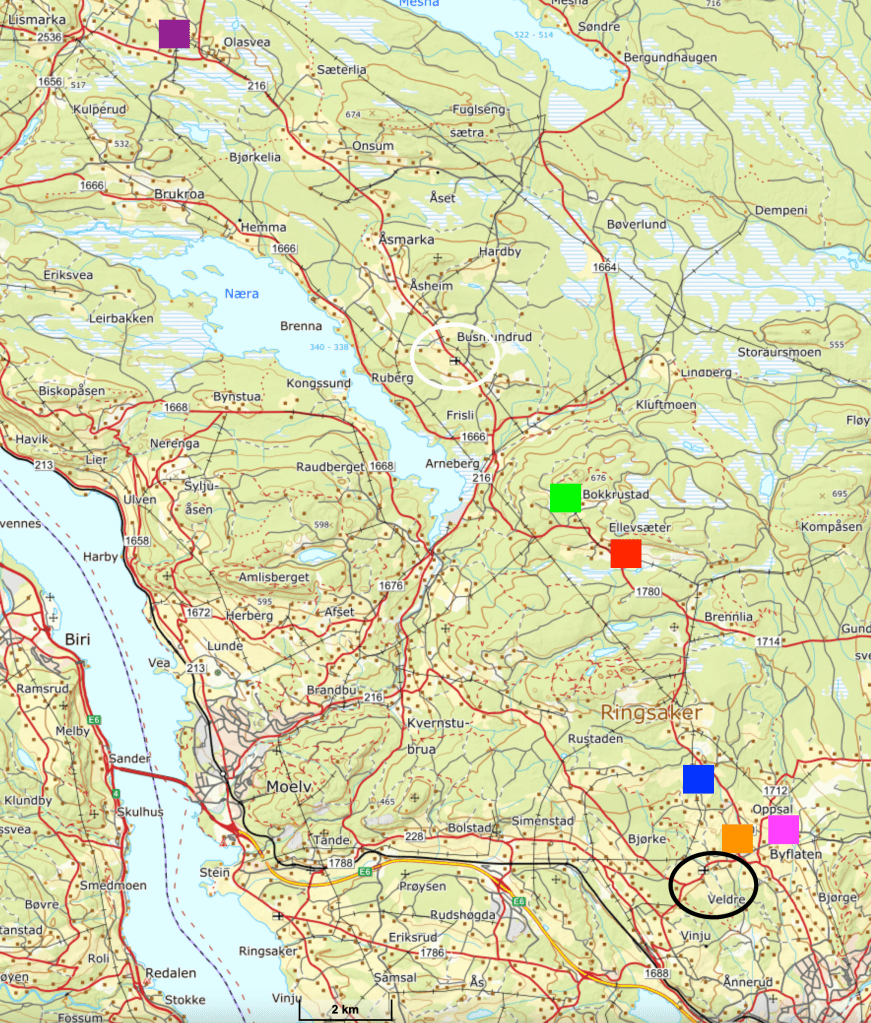
Family farms and churches in Ringsaker/Veldre parishes: Åsmarka Church circled in white, Veldre Church circled in black; Altona = purple square, Bokrudstad = green square, Ellevsæterbakken = red square, Kristensveen = blue square, Grinieie = orange square, Roterud = pink square 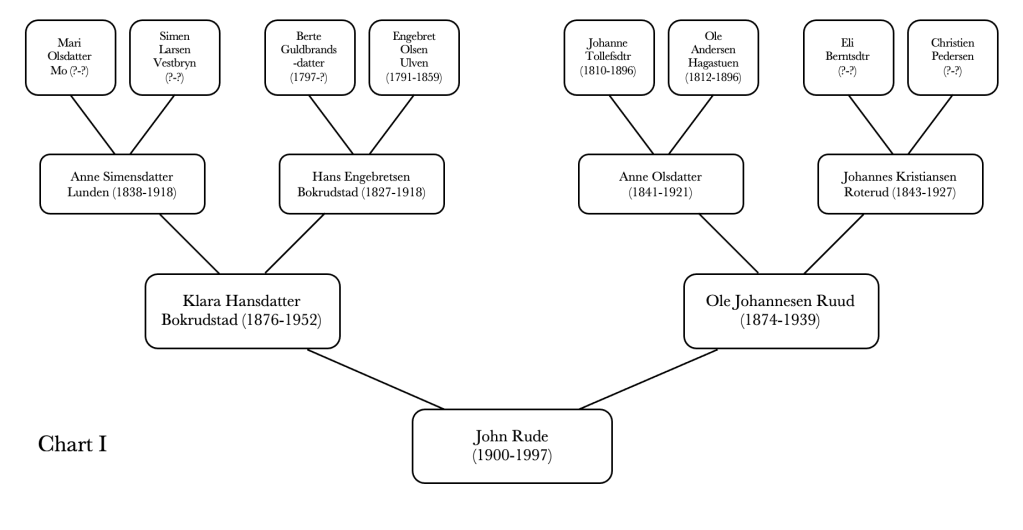
Direct ancestors of my great-grandpa John Rude On September 15, 1899, Ole and Klara married at Åsmarka Church, which was fairly close to where Klara’s family was living at the Bokrudstad farm.

Åsmarka Kirke — a beautiful octagonal chapel which I was able to see today 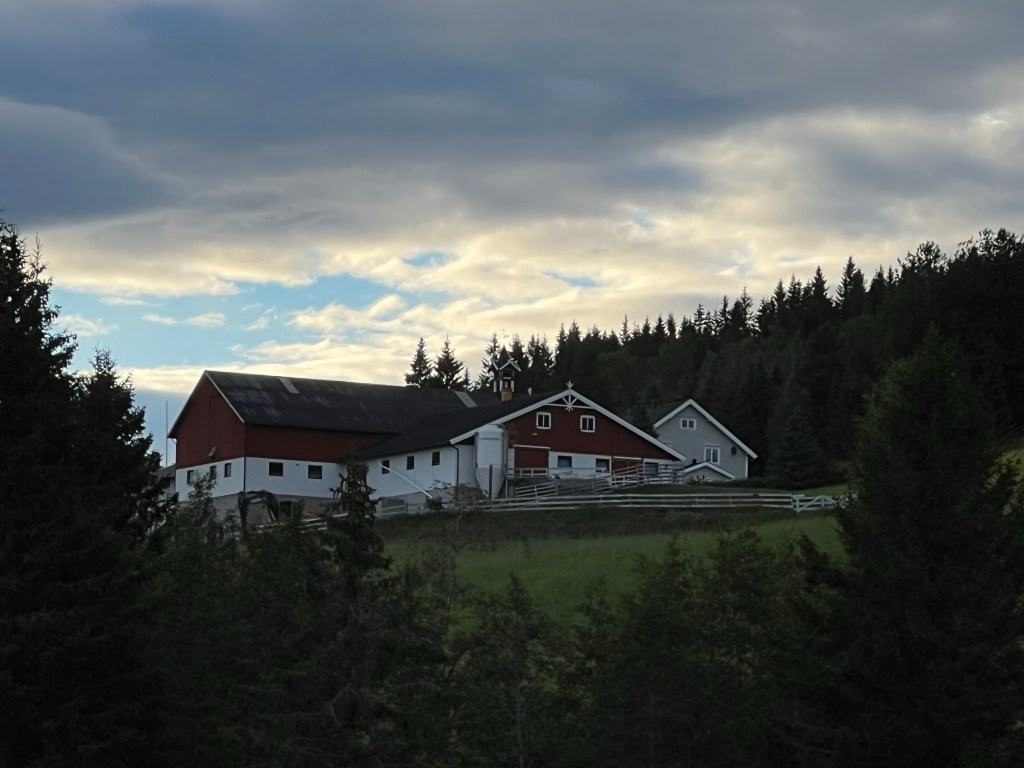
Bokrudstad Farm, just to the southeast of Næroset The next month they left for Wisconsin where Ole had been working. To my knowledge, Ole and Klara were the only children in their families to emigrate – a surprising fact given how common emigration was at the time and given how many siblings they had collectively (Ole was one of four, Klara was one of 13).

Ole Johannesen Ruud / Rude 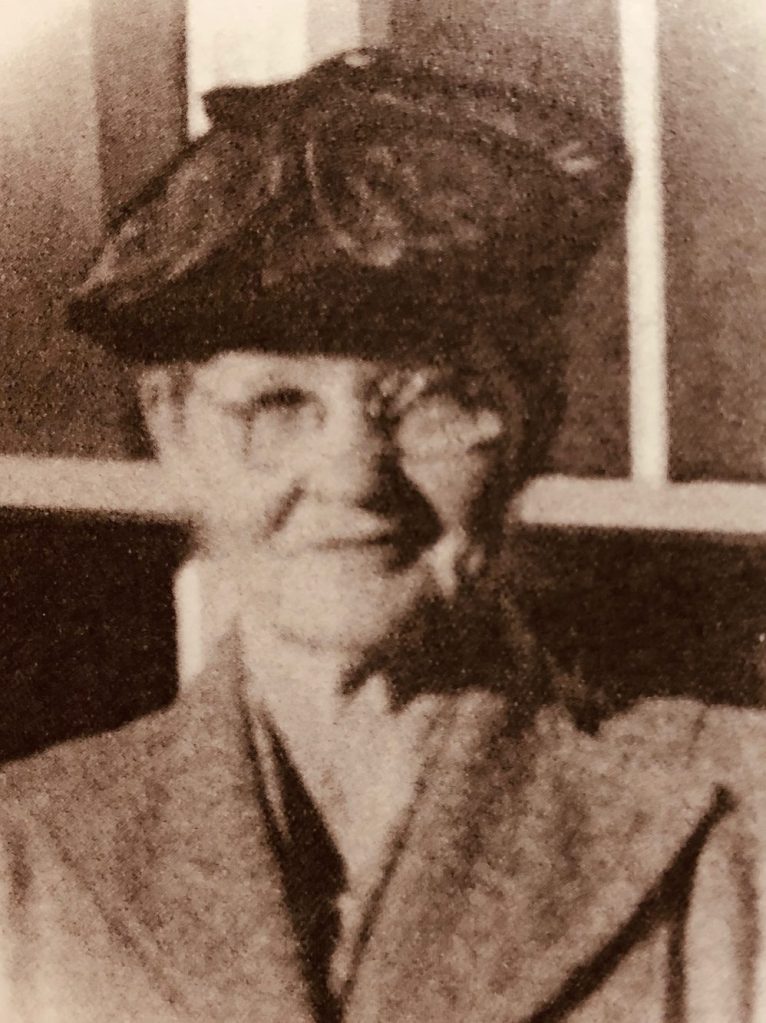
Klara Hansdatter Bokrudstad Rude On coming to the U.S., Ole simplified his farm name Roterud as “Rud” or sometimes “Ruud”. But the story goes that the family was getting their mail mixed up with another Ole Ruud family, so they changed it to Rude. Oh, what a fateful decision for those of us born with this name!
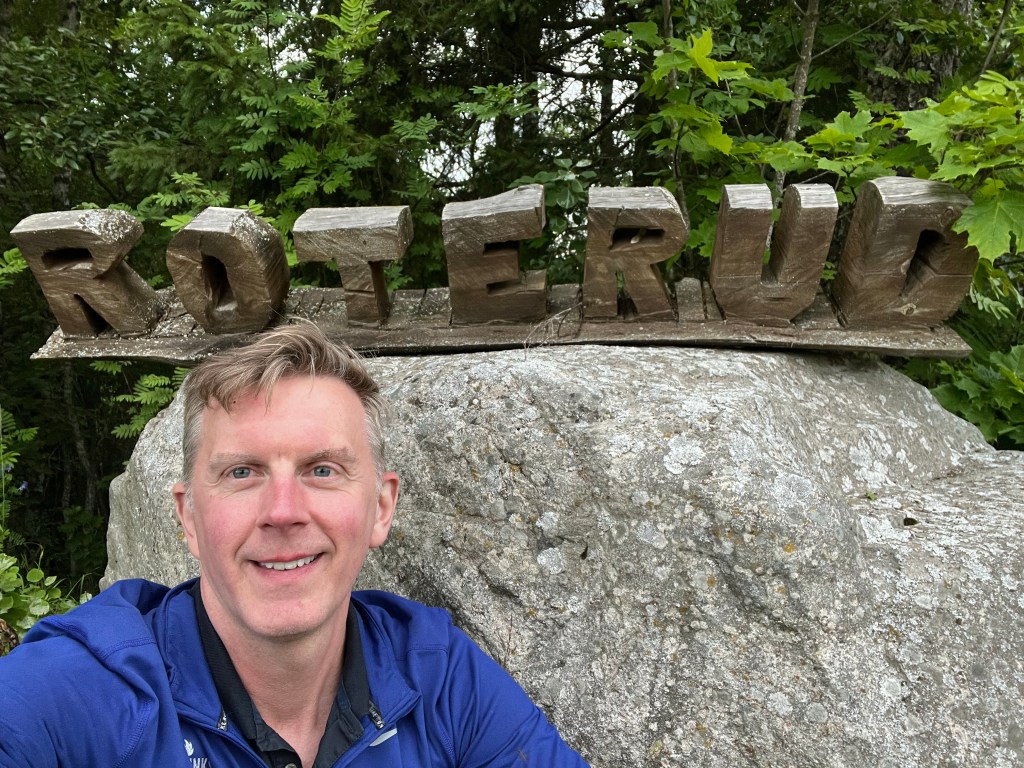
The eldest son of the eldest son of the eldest son of the eldest son of Ole Roterud Some of the descendants of Klara’s brother Simen Bokrudstad invited me to join them for a backyard barbecue in Næroset this afternoon. Anne Marie Skaugen is Simen’s great-granddaughter*, and she and her husband Aksel Harby run the grocery and bakery in Næroset that has been in the Harby family for 102 years. It was delightful to meet them, and the food they served us was incredible.
Not coincidentally — because we’d planned this for months — I met up with five of my family members from Wisconsin at this gathering: my dad’s sister Cathe, her daughter Bethany, Bethany’s husband Jack, their son Xavi and Bethany’s daughter Lexi. It was a special evening, and one I’ll never forget.
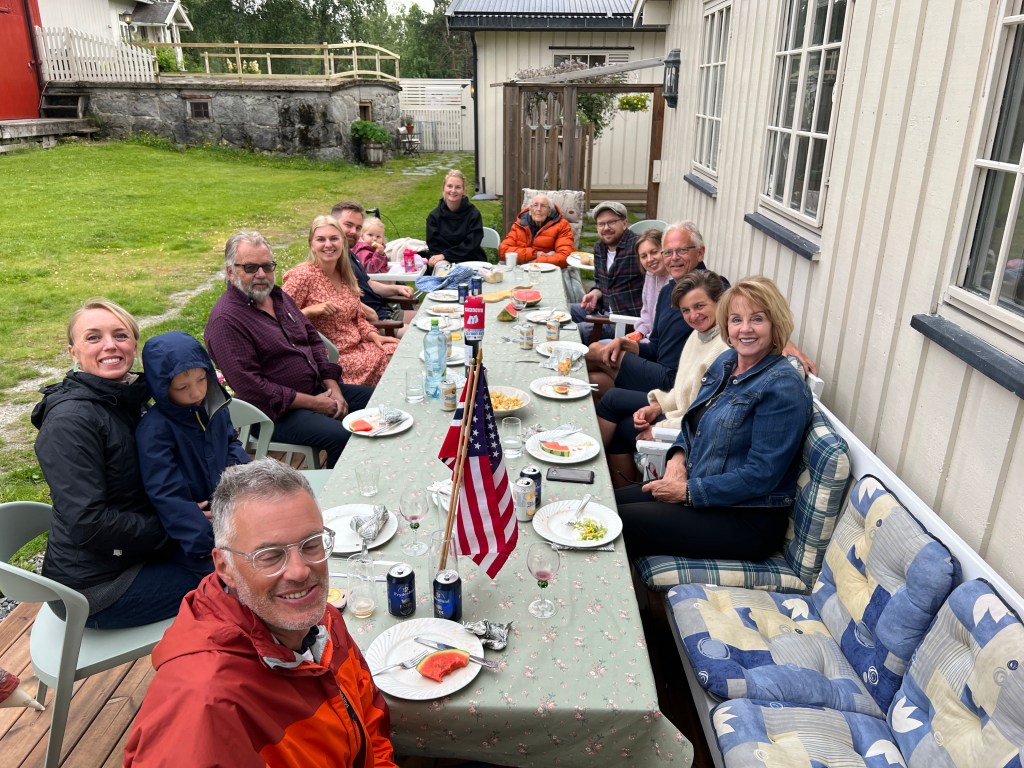
A gathering of Bokrudstad family members in Næroset — including six of us from Wisconsin! 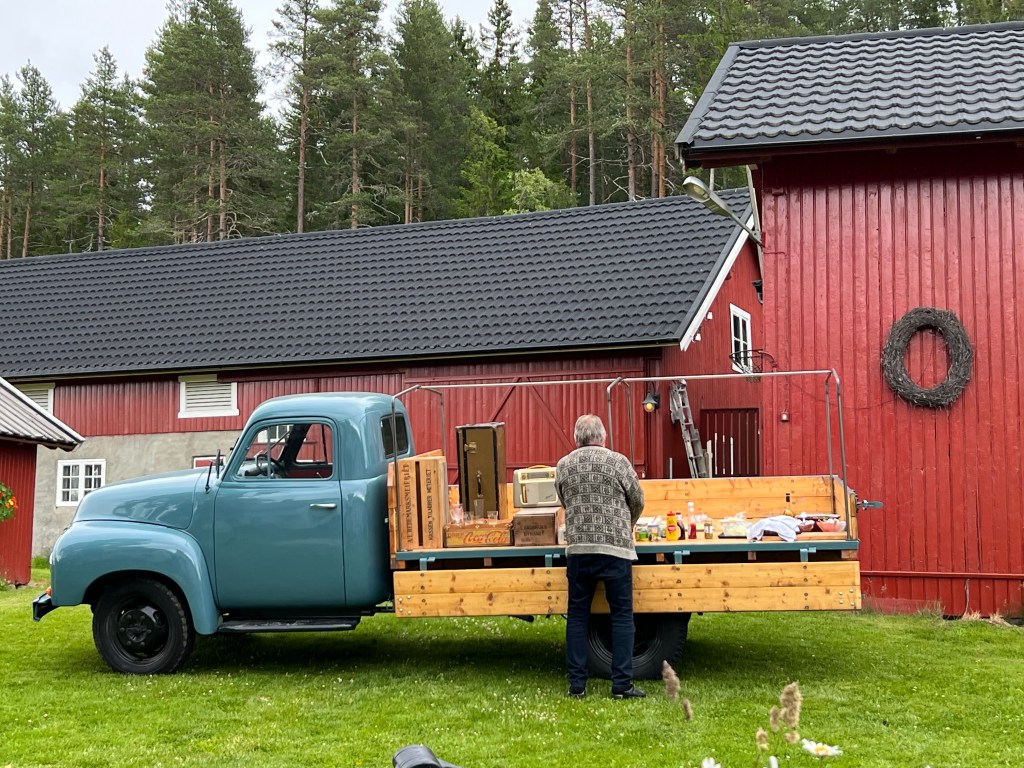
Aksel Harby sets out the food on the back of his 1950s pickup 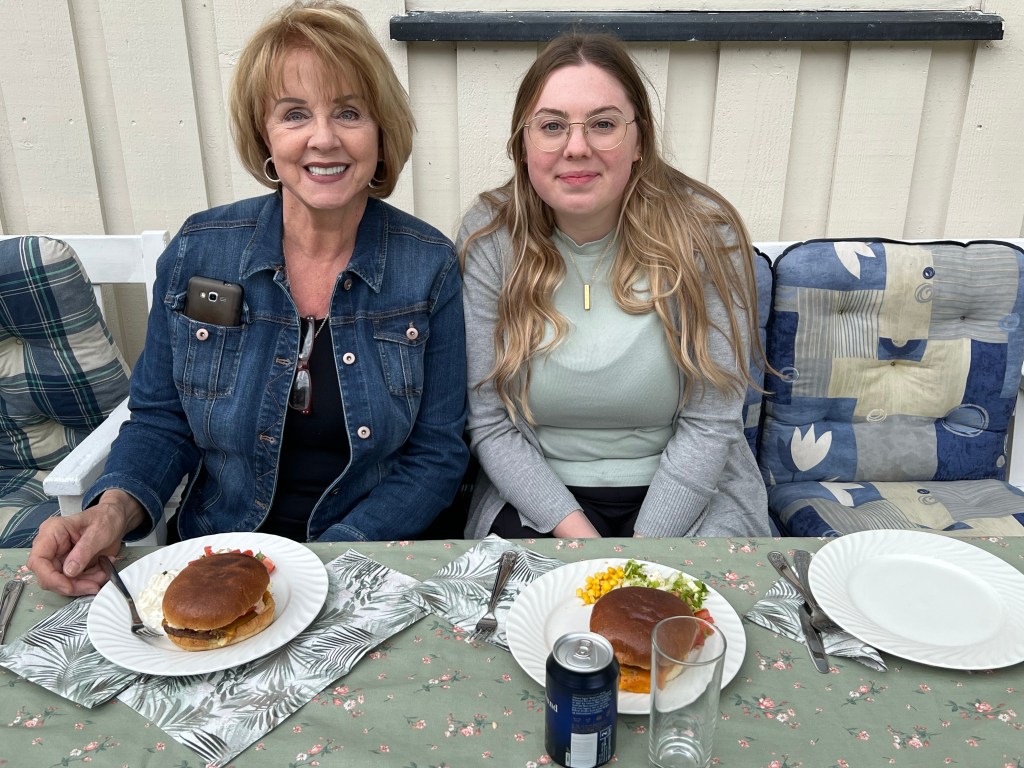
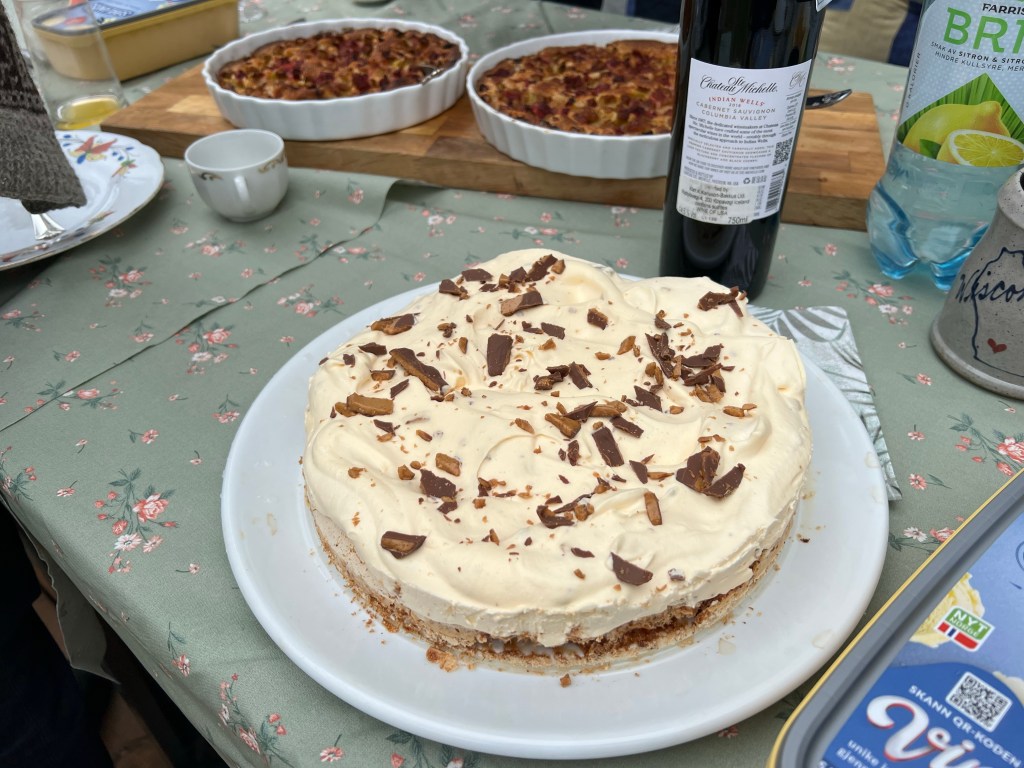
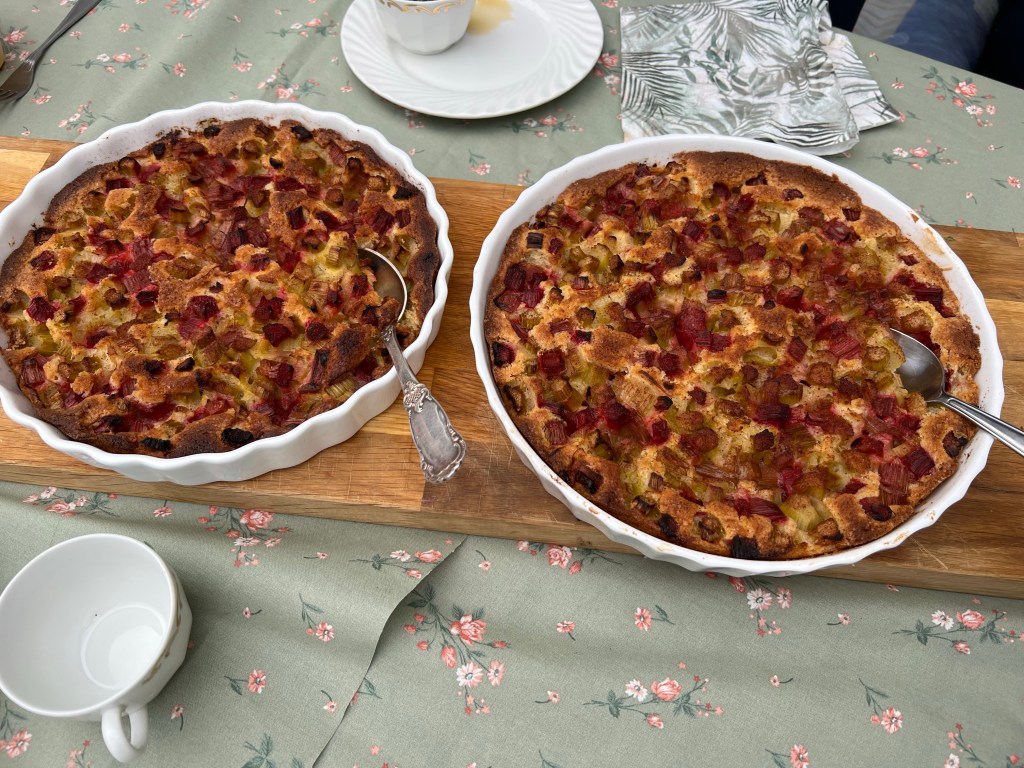
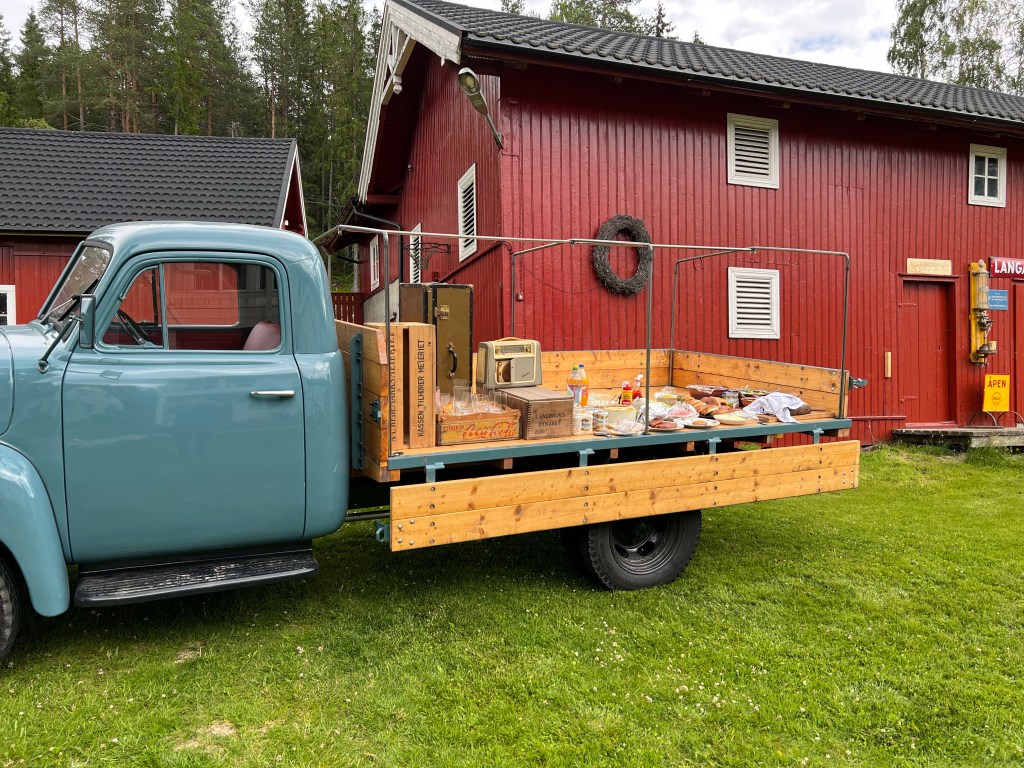
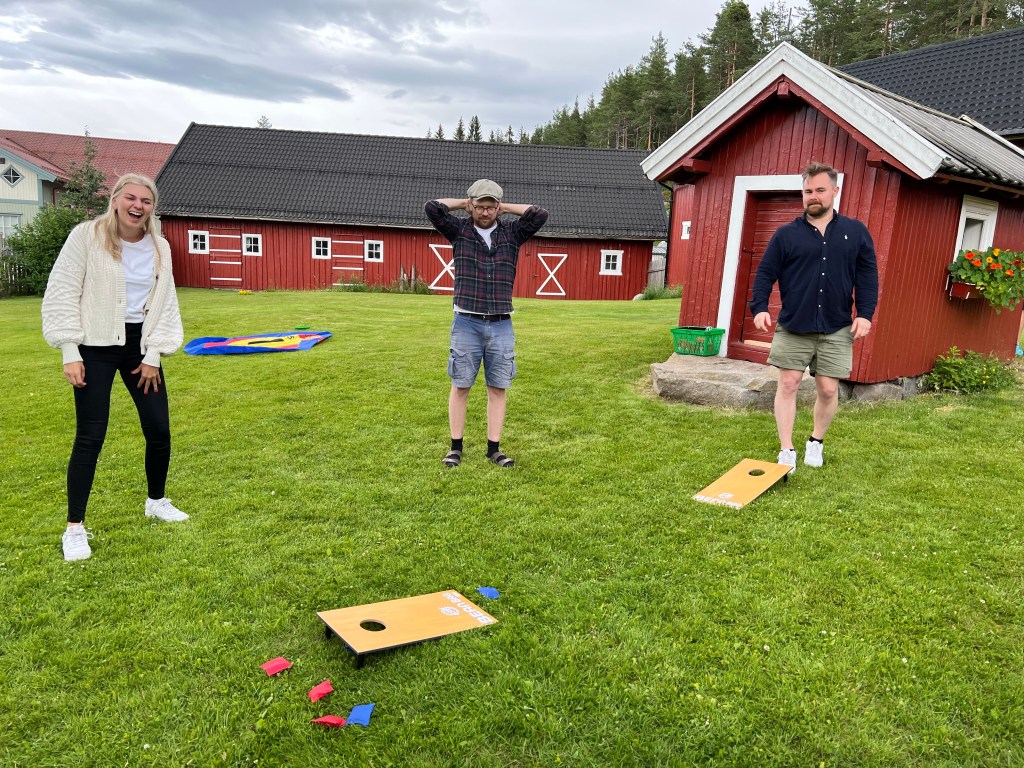
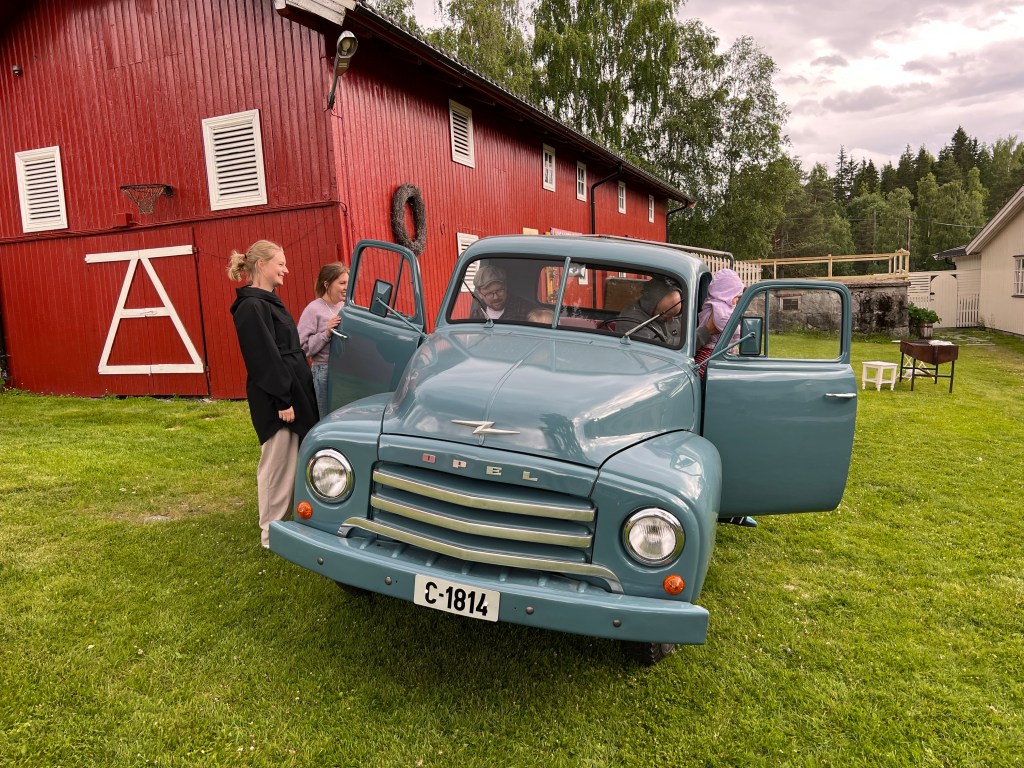
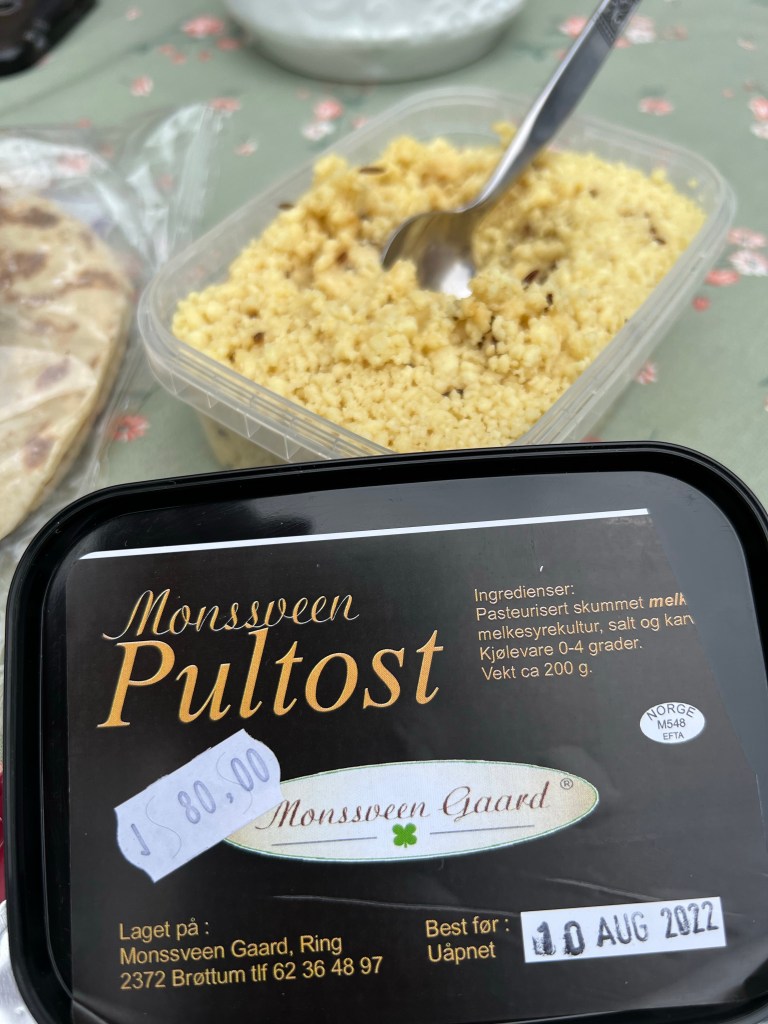
One of the treats of the event was when Kristian — Aksel and Anne Marie’s son, who runs the bakery — brought us out some pultost to try. Pultost is a fermented cheese with caraway seeds and has a… “distinctive” flavor.
[1] This information comes from the Veldre bygdebok, 1974.
* This makes Anne Marie a third cousin to my dad.
Anne Marie and Aksel also took us to see the family plot at Åsmarka Church.
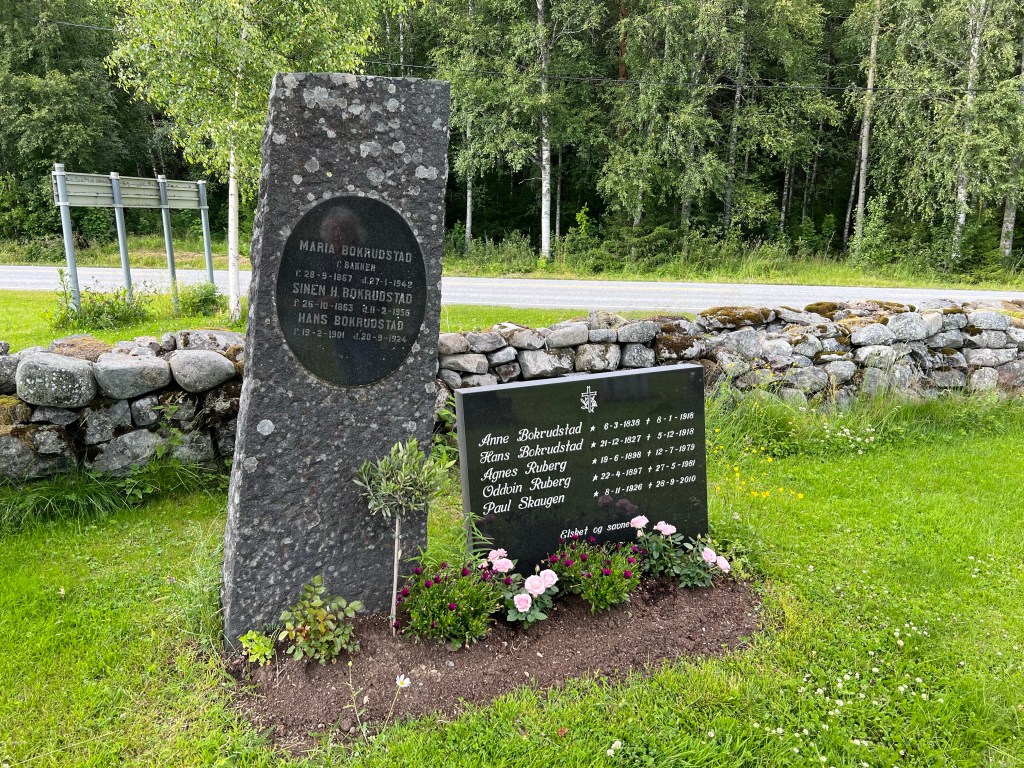
-
Mjøsa

Ancestors on both my mother and father’s sides have lived around Mjøsa – Norway’s largest lake – for hundreds (if not thousands) of years.
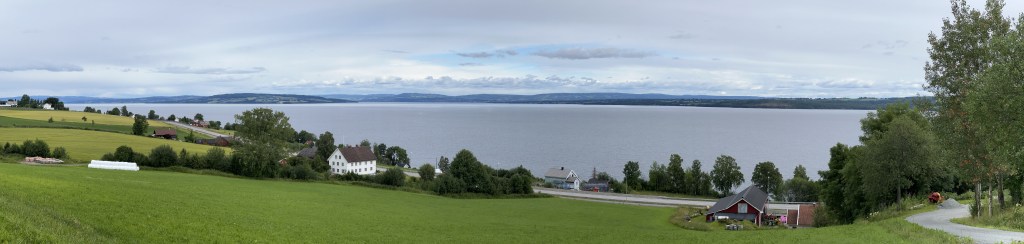
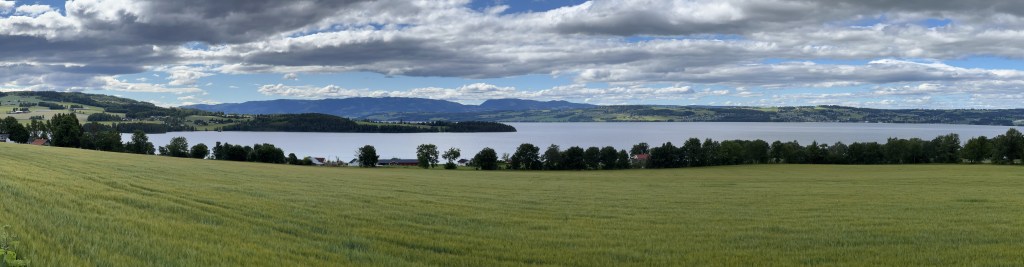
View of Lake Mjøsa from Auren Farm, where my great-grandma Borghild Helgestad Rude was born Mjøsa is massive – from end to end 73 miles (117 km). And at its deepest point, it’s nearly 1,500 feet (450 m). The lake is the dividing line between two traditional regions in Norway: Oppland on the west and Hedmark on the east. As of 2020, the two have been merged into the newly minted county of Innlandet. Technically, Innlandet is Norway’s only landlocked county, but in the years before railways, Mjøsa and its connecting rivers served as the region’s link to Oslo and the sea.
Over the next couple days I’ll be visiting the towns around Mjøsa where my ancestors lived, but before I do that, I thought a quick orientation to the area might be helpful.
For any of you related to me through my mother’s side – specifically my mother’s father’s side – the relevant location is the countryside west of Gjøvik. Using a yellow circle on the map below I’ve marked the approximate location of our family’s origins in Vardal Parish. Vardal is where my great-grandma Elvina Anderson Smith’s father Anton (Andreasen) Anderson came from.
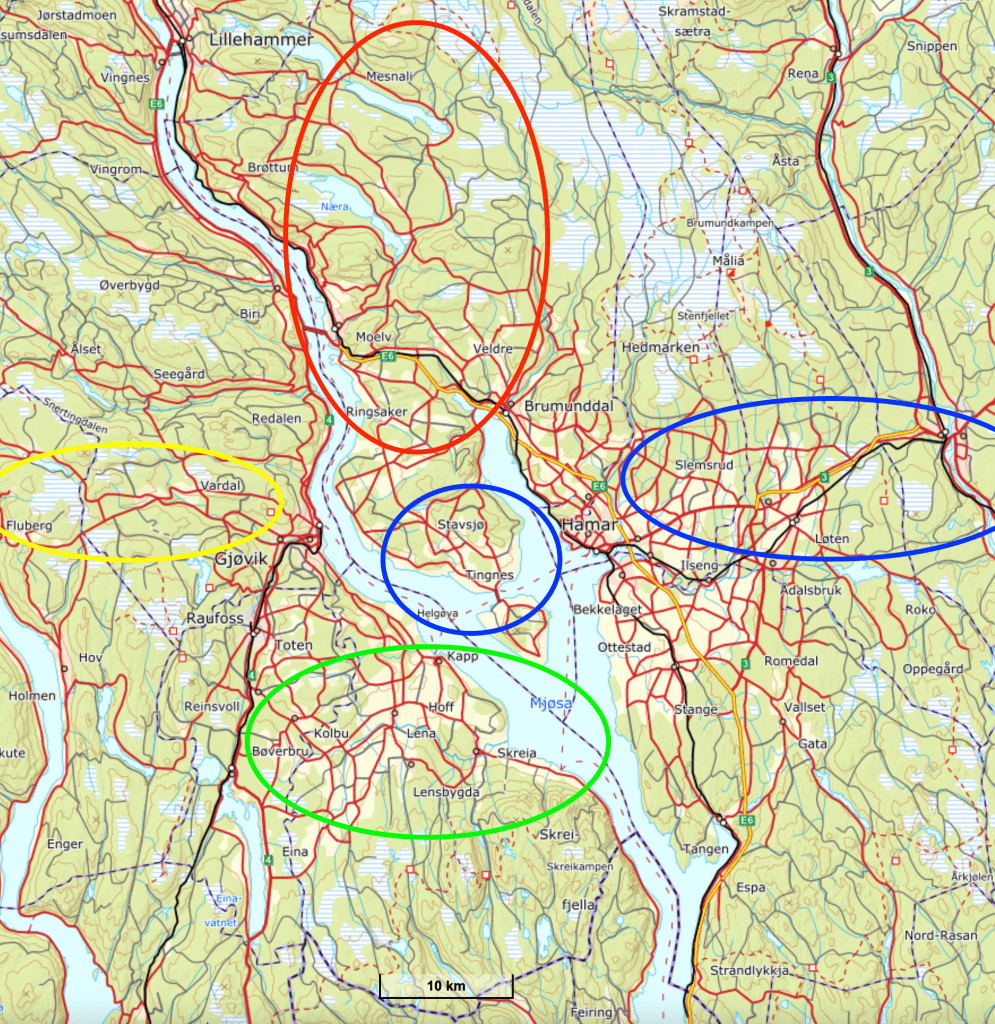
For any of you related to me through my father’s father’s side, there are multiple relevant locations. The red circle at the top of the map indicates the general area in Ringsaker Parish where my paternal grandfather’s paternal grandparents, Ole Johannesen (Roterud) Rude and Klara Hansdatter Bokrudstad, came from: Veldre and Ringsaker. The green circle at the bottom of the map marks the place where my paternal grandfather’s mother’s family originated — Østre Toten. And the blue circles indicate roughly where my paternal grandfather’s biological father’s family came from in Nes, Hamar, Løten and Elverum.
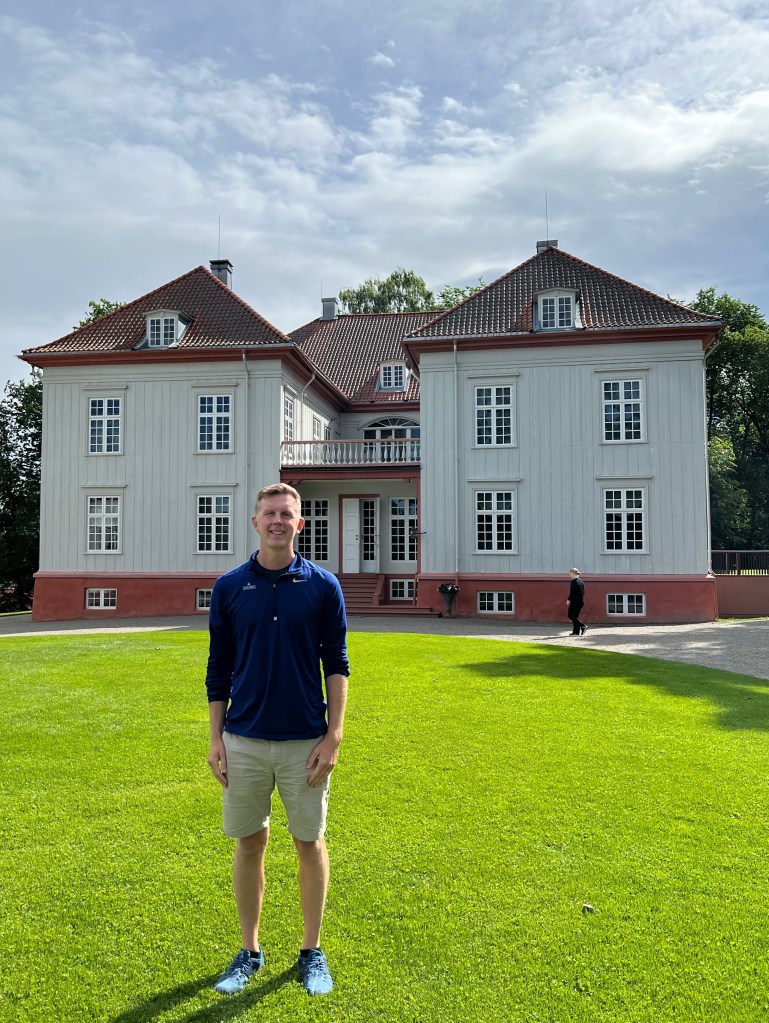
Eidsvollsbygningen — near the southern end of Lake Mjøsa — is where Norwegians ratified their constitution on May 17, 1814. -
Live from Oslo – a photo update
I am taking a little detour (again) from family history to share a few sights with you. Greetings from Oslo!
This first photo is from the suburb of Sandvika, just south of Oslo. Behind me is Løkke Bridge, which was the subject of an 1895 painting of Monet’s that I like. If you go to the homepage of my blog, you’ll see the painting. The original hangs in one of my favorite places — the Art Institute of Chicago.

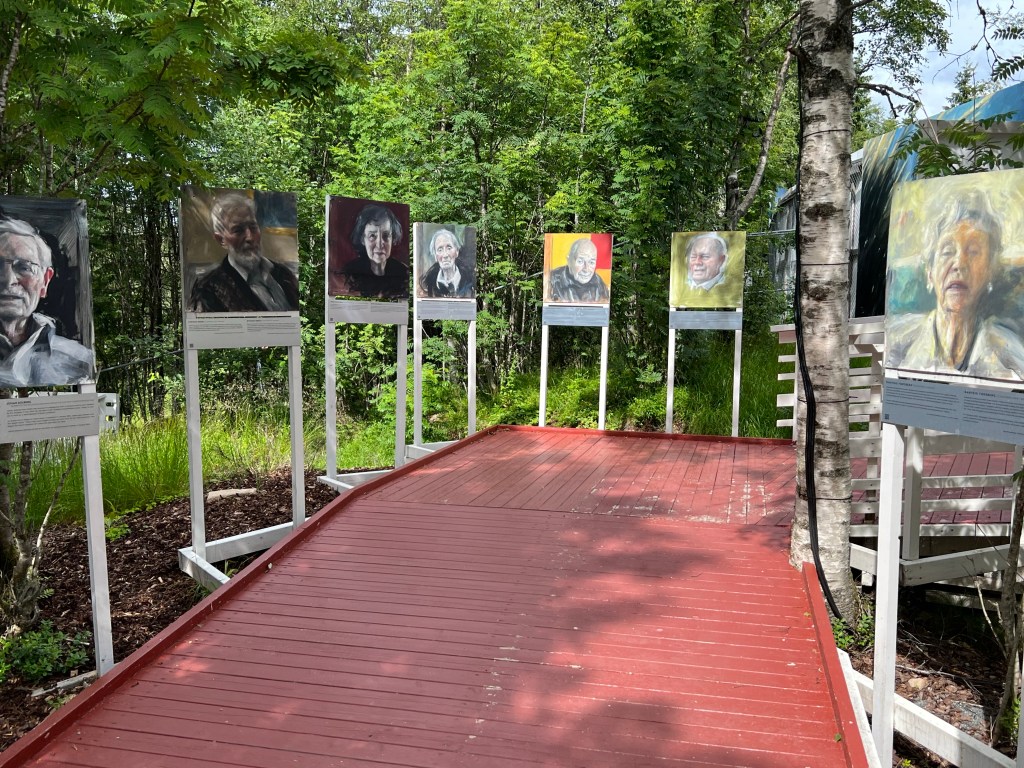
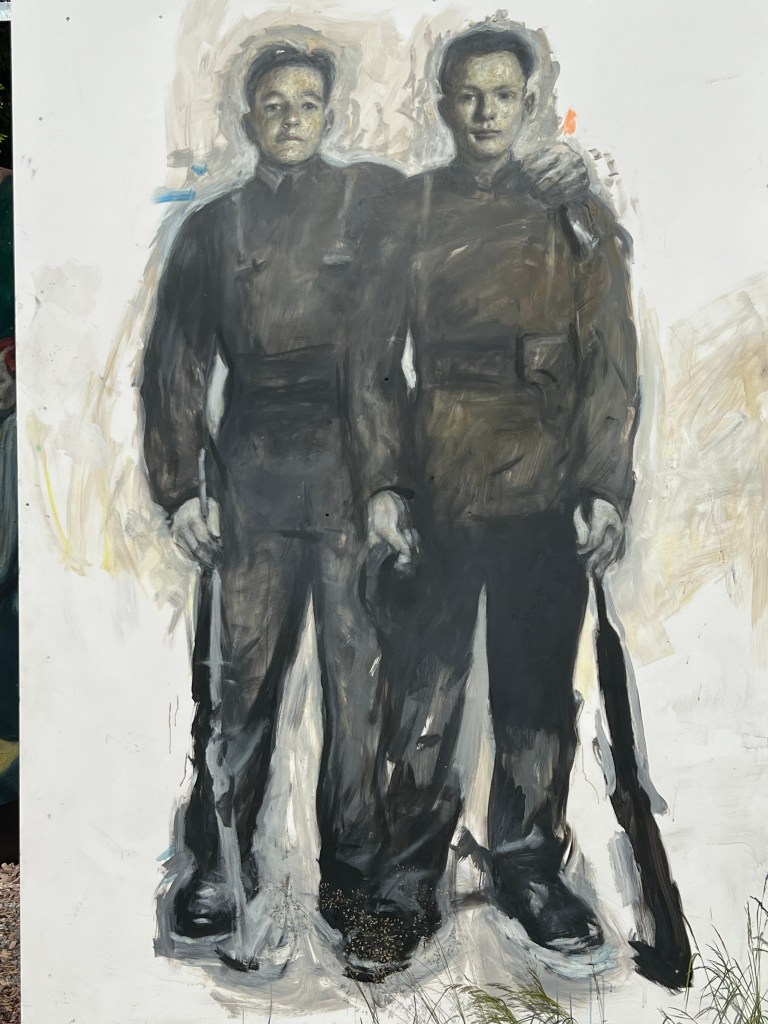
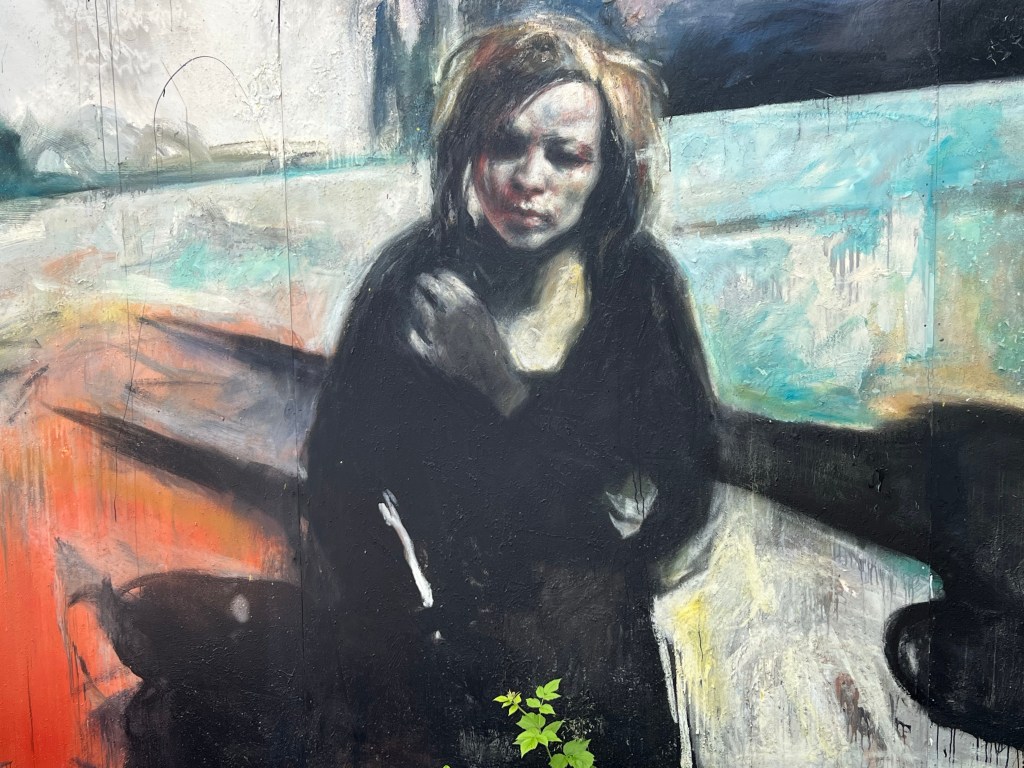
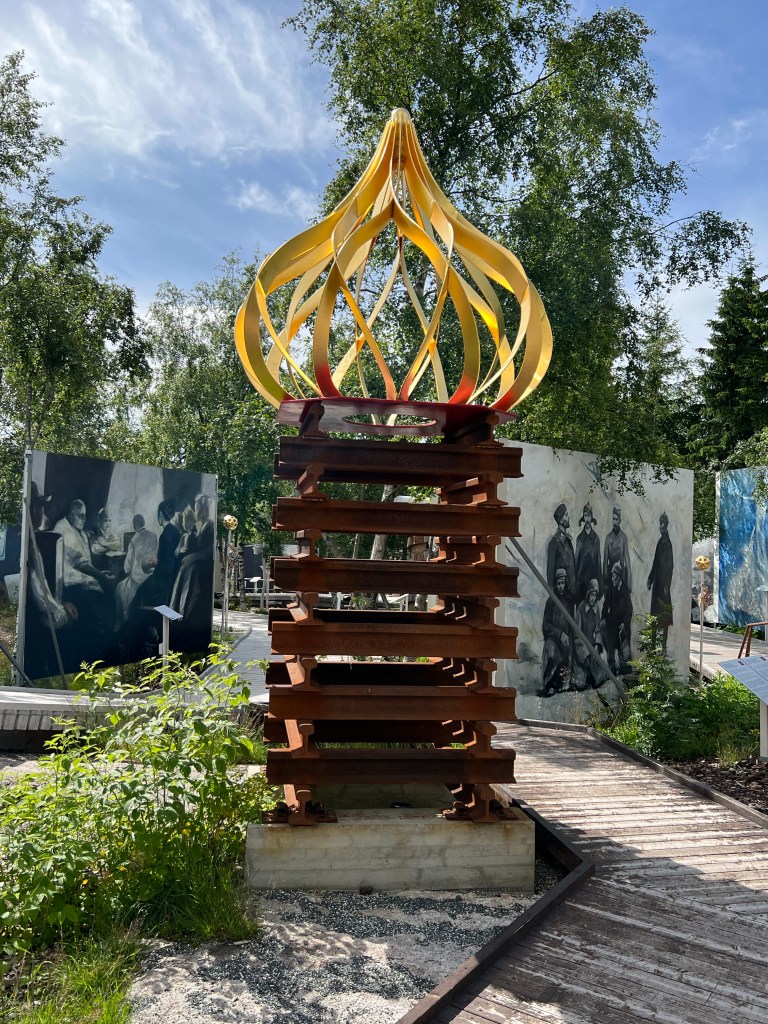
The next few photos are from a special art and history exhibit at Roseslottet (Rose Castle) at Frognerseteren in Oslo. Big thanks to Morten and Linda Kittelsen (the family I visited in Øvrebø) for recommending this!
The exhibit is a deeply moving outdoor installation of paintings and sculpture that documents the resistance to the Nazis in Norway, the expulsion of Norway’s Jews, and the conditions for soldiers and ordinary people during the War. If you like to learn more, visit this site: https://roseslottet.no/en/visjonen/



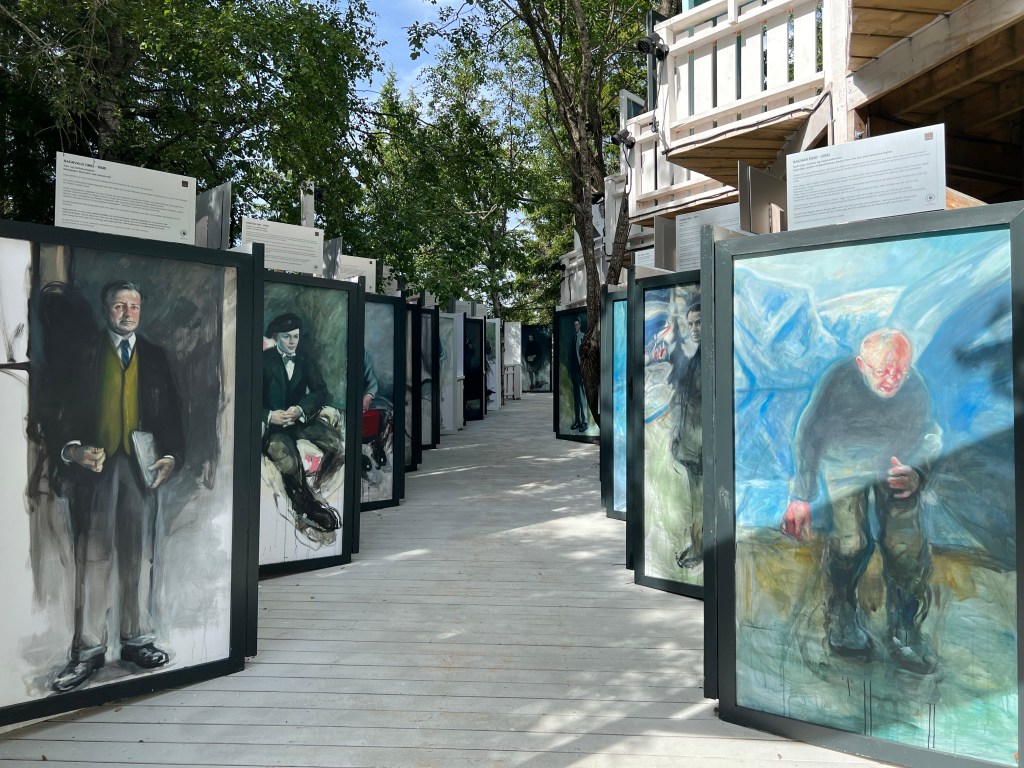
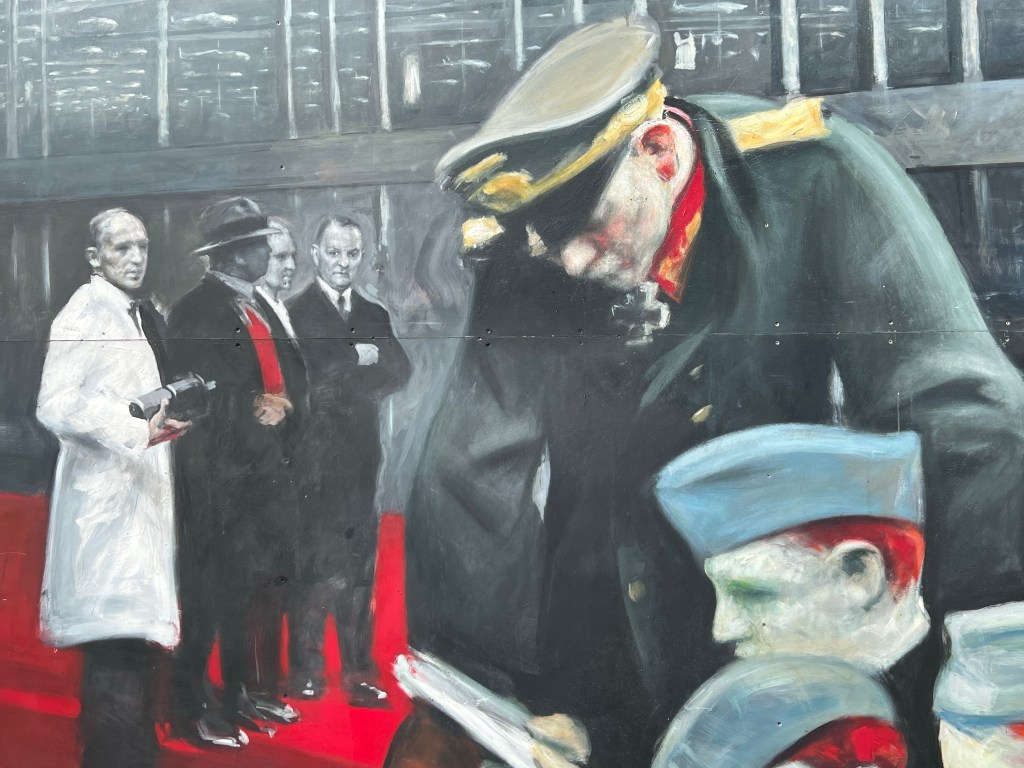
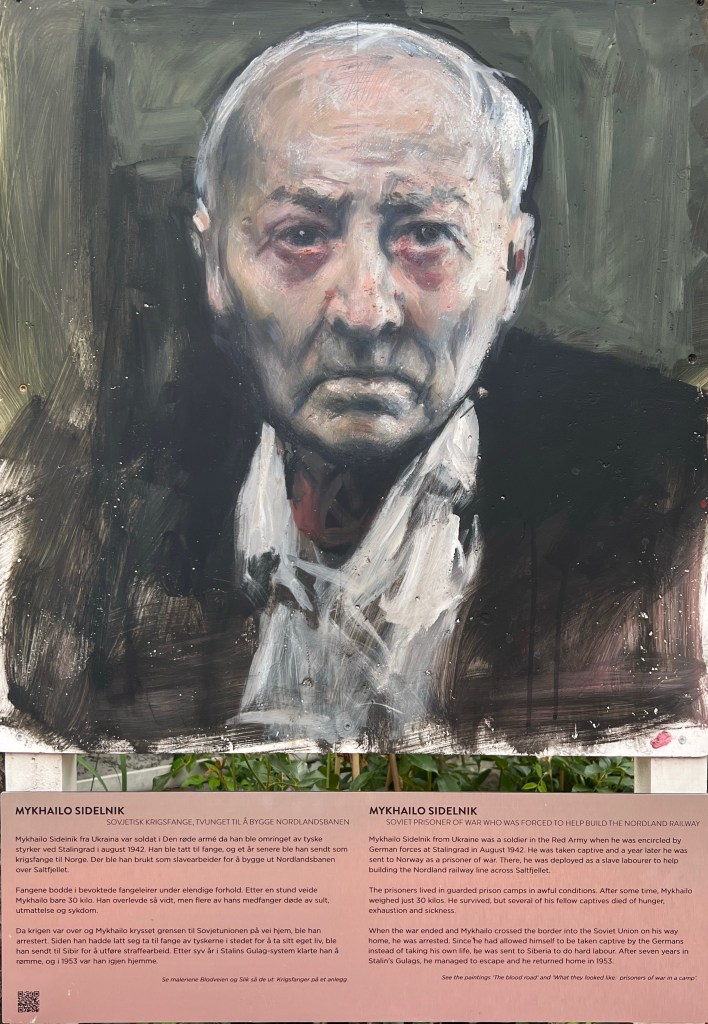
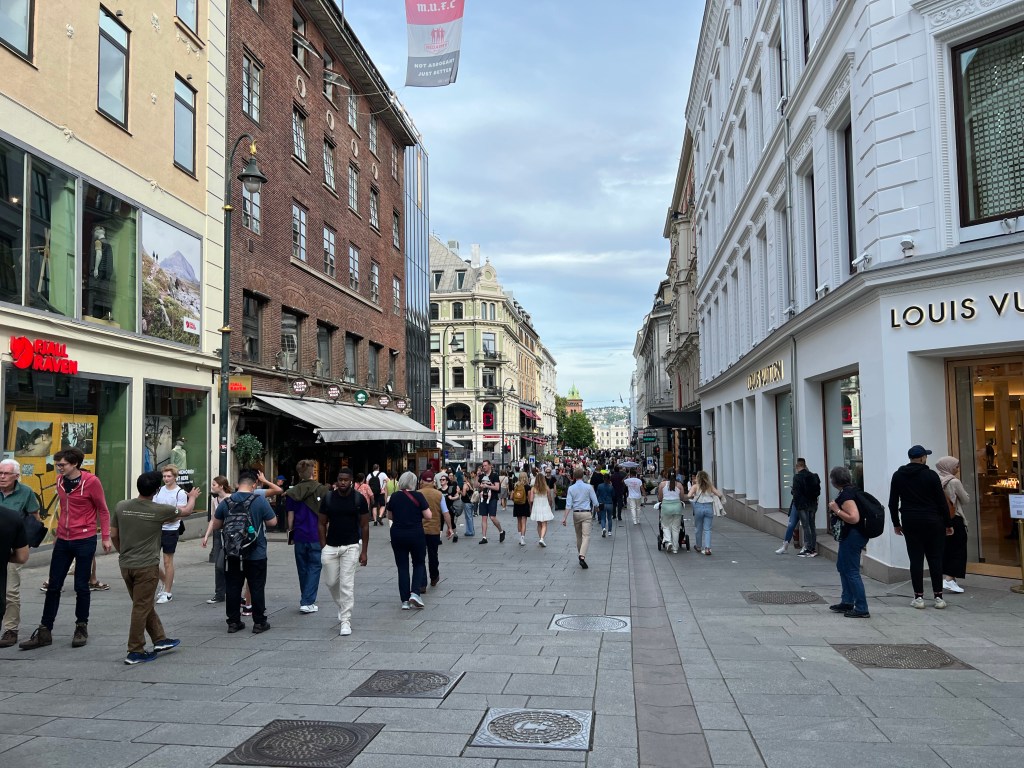
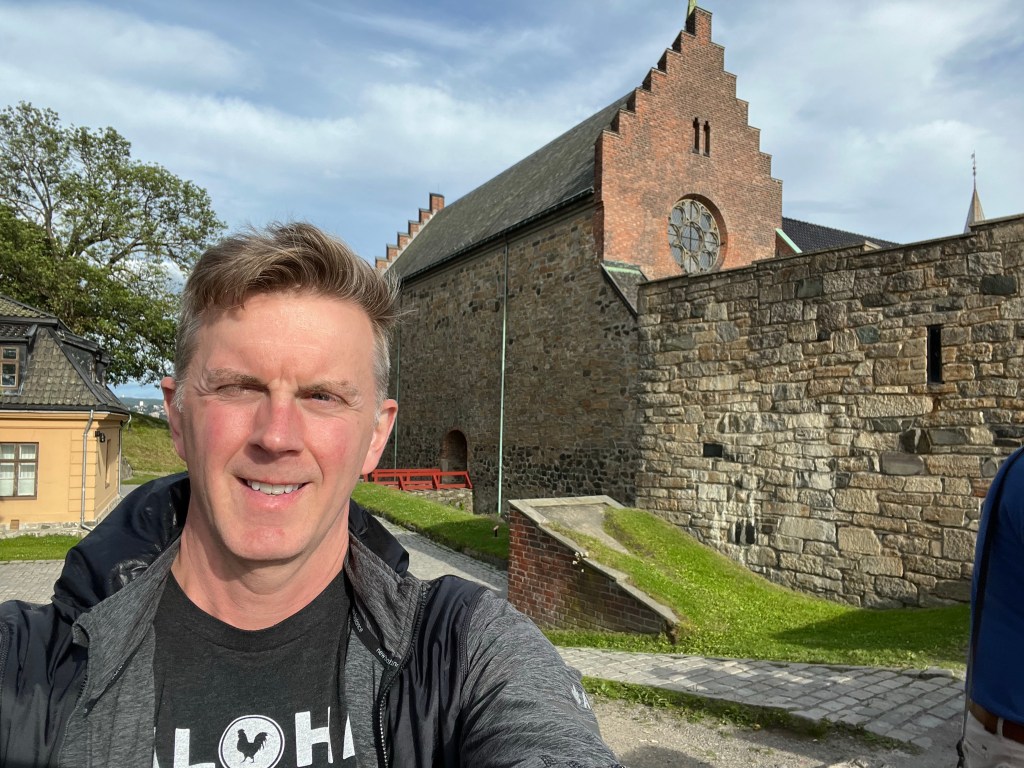
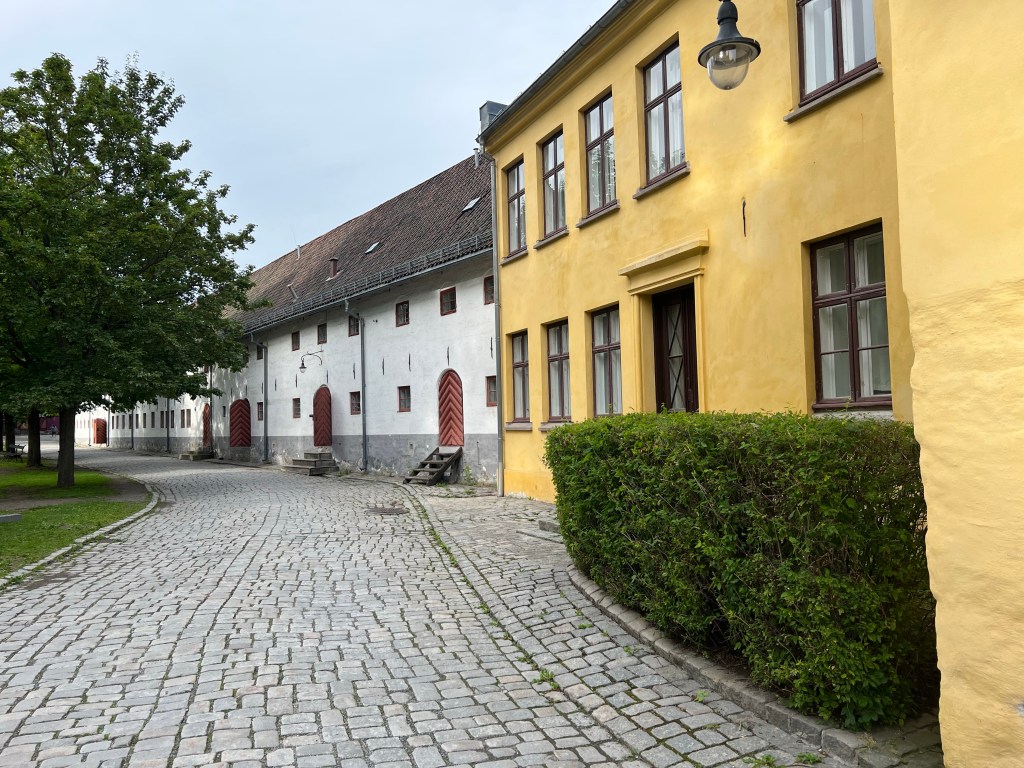
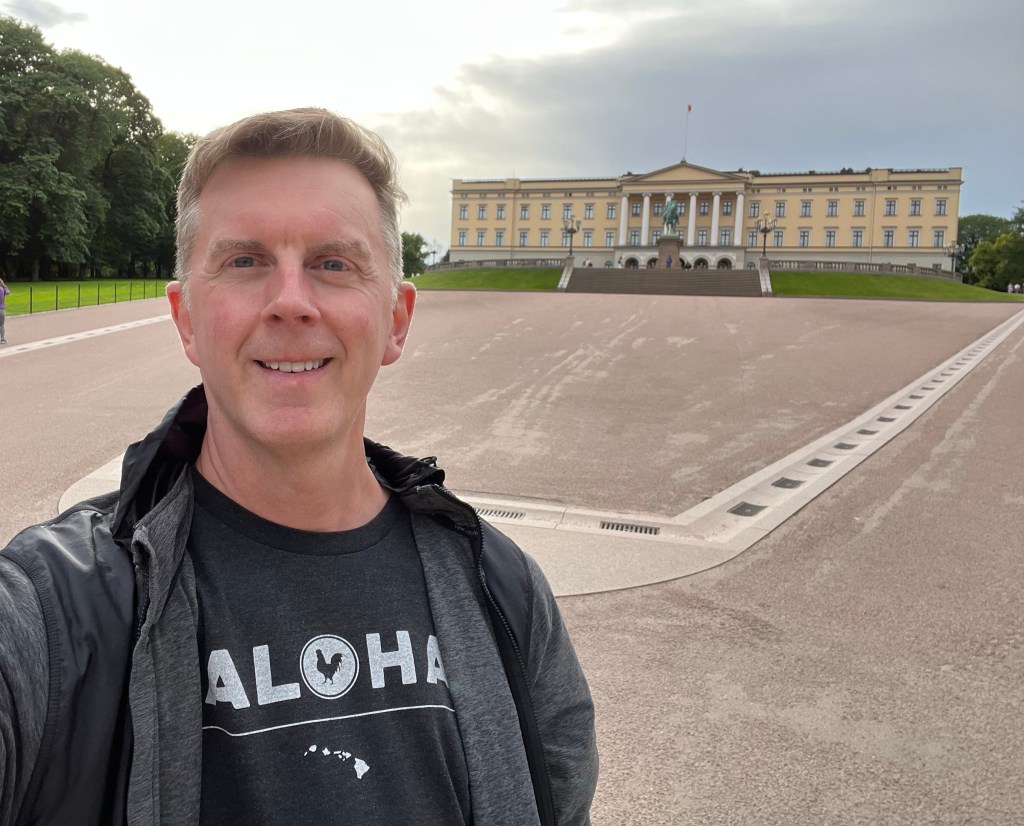
Finally, I’m sharing a few scenes from around the Oslo city center — including a photo of me having a nonalcoholic beer at the London Pub. I visited this bar 10 years ago when we came to Norway the first time. Sadly, a shooting occurred here two weeks ago, which killed two and injured 21 people. The attack is being investigated as a hate crime by the police. The London Pub is a fixture in the gay community in Oslo, and the shooting sent a shockwave around the world. It also led to the canceling of gay pride festivities in Oslo this year.


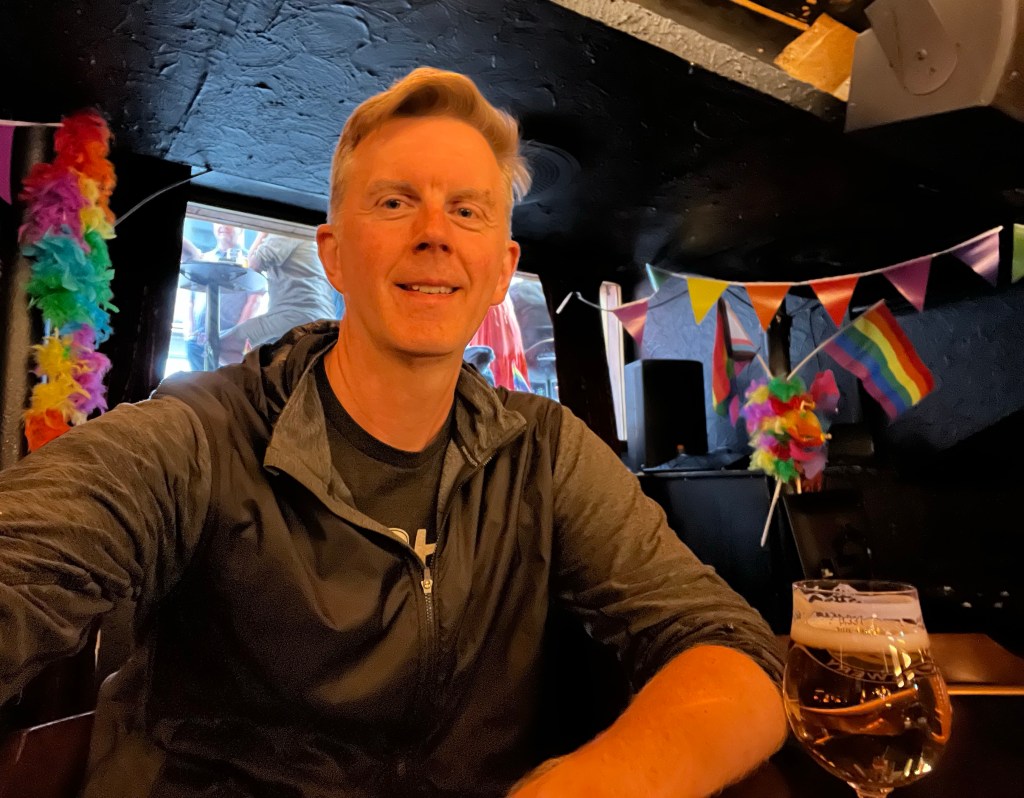
London Pub – still going strong
Deep Roots
Reflections on family history, identity and geography
Home
Welcome! I’ve created this site to share family history and collective memories.

